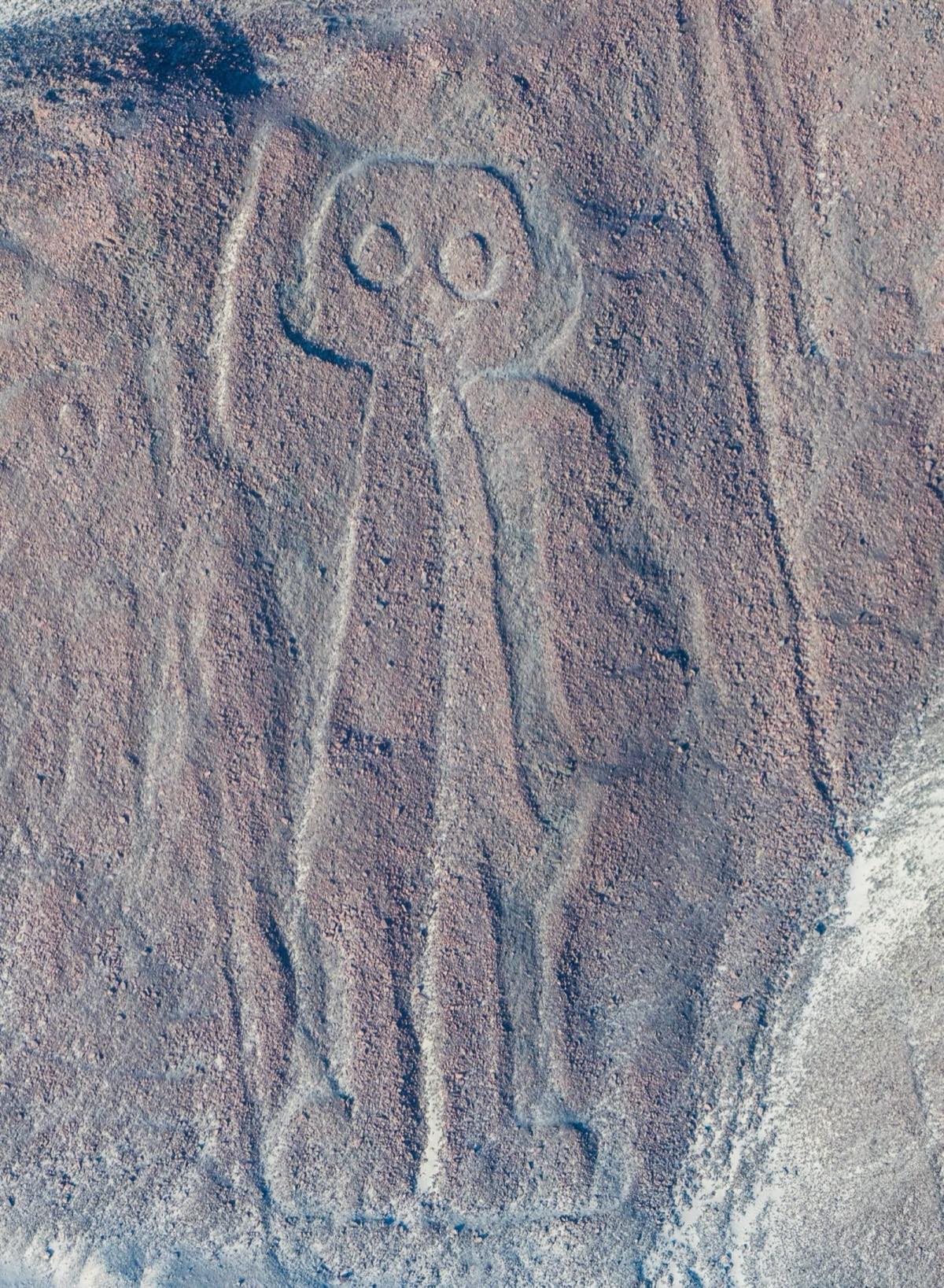
On the arid, wind-still plateau between the towns of Nazca and Palpa in southern Peru lies one of the most extraordinary bodies of ancient art on Earth: hundreds of vast figures and lines etched into the desert floor, so large that many are only fully legible from the air. There are straight lines running ruler-true for kilometres across the pampa; there are trapezoids, triangles, and spirals; and there are some seventy or more great biomorphic figures — a hummingbird, a monkey with a curling tail, a spider, a condor, a heron, a dog, a pair of hands, a flowering tree, and a humanoid figure on a hillside so often nicknamed 'the Astronaut.' They were made by the Nazca people, and by their Paracas predecessors, across roughly a thousand years around the start of the common era, by the simple and ingenious method of clearing away the dark, iron-stained stones of the desert surface to expose the paler ground beneath. Because it almost never rains here, and the wind barely stirs, the drawings have survived for two millennia. How they were made is, in fact, no mystery at all; the techniques are well within the reach of the people who made them, and required no view from the sky and certainly no help from beyond it. The genuine and unsolved question is why — what these enormous figures and lines were for. This is the story of the giant drawings in the desert.
Ancient & Historical Mysteries
-400