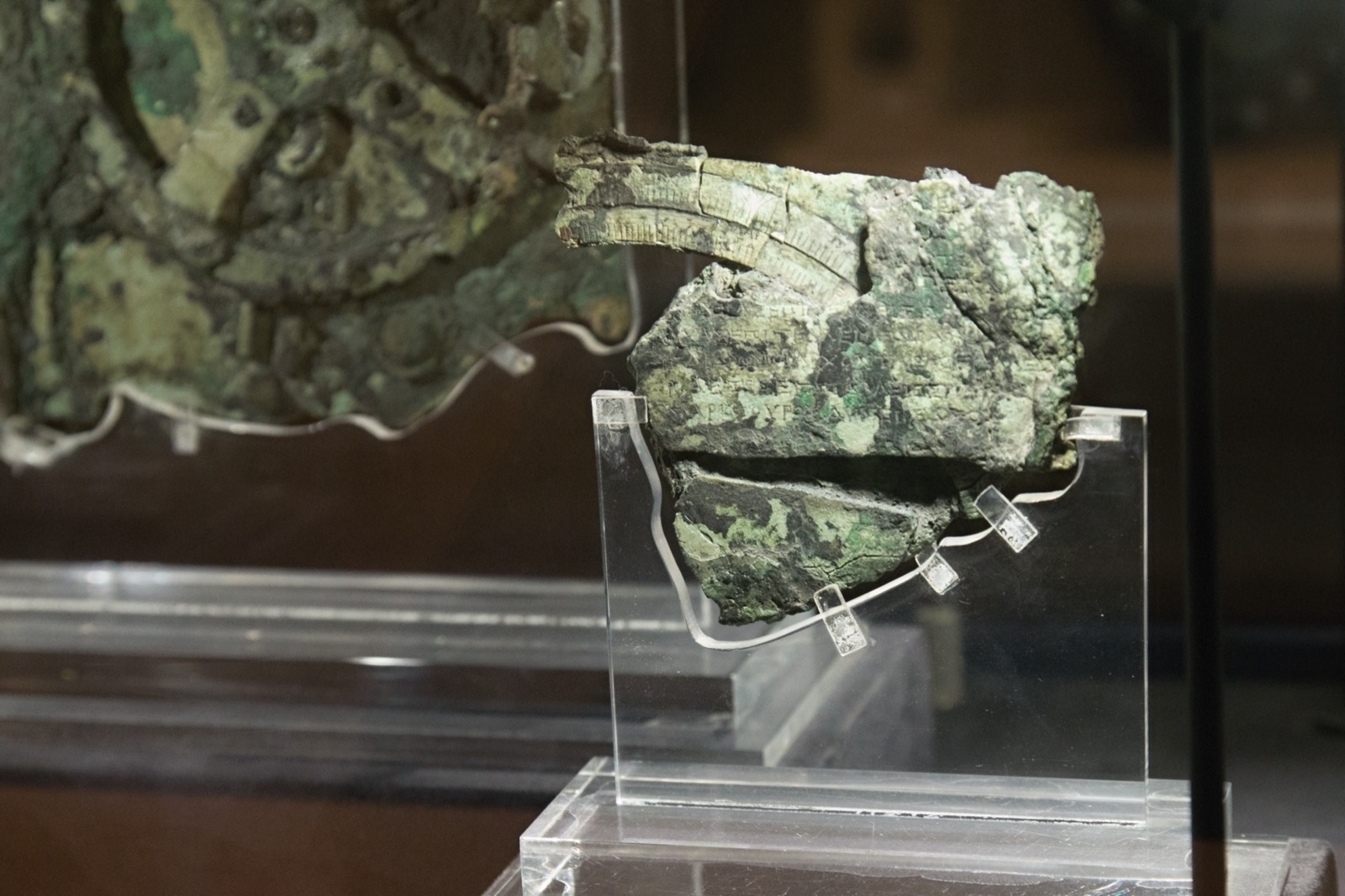
In 1901, Greek sponge divers sheltering from a storm off the tiny island of Antikythera, between Crete and the Peloponnese, stumbled on the wreck of an ancient ship laden with bronze and marble statues, glassware, and coins — a Roman-era cargo of Greek treasures that had gone down around the first century BCE. Among the finds hauled to the surface and shipped to Athens was an unpromising, shoebox-sized lump of corroded bronze and rotted wood, easily overlooked beside the museum's new statues. Months later, an archaeologist noticed something impossible protruding from it: a precisely cut gear wheel. Over the following century, X-rays and then advanced computed tomography would reveal that this lump was the wreckage of a hand-cranked mechanical device containing dozens of finely toothed bronze gears — an astronomical calculator that modeled the movements of the Sun, the Moon, and the planets, predicted eclipses, and tracked the cycles of the Greek calendar and the Olympic Games. Nothing of remotely comparable complexity is known to have existed for well over a thousand years afterward. The Antikythera Mechanism is not a hoax, not a fantasy, and — despite the claims of some — not evidence of anything from beyond the Earth. It is something stranger and more moving: a genuine artifact of ancient Greek genius, and a window onto a world of knowledge that was very nearly lost forever. This is its story.
Ancient & Historical Mysteries
-100