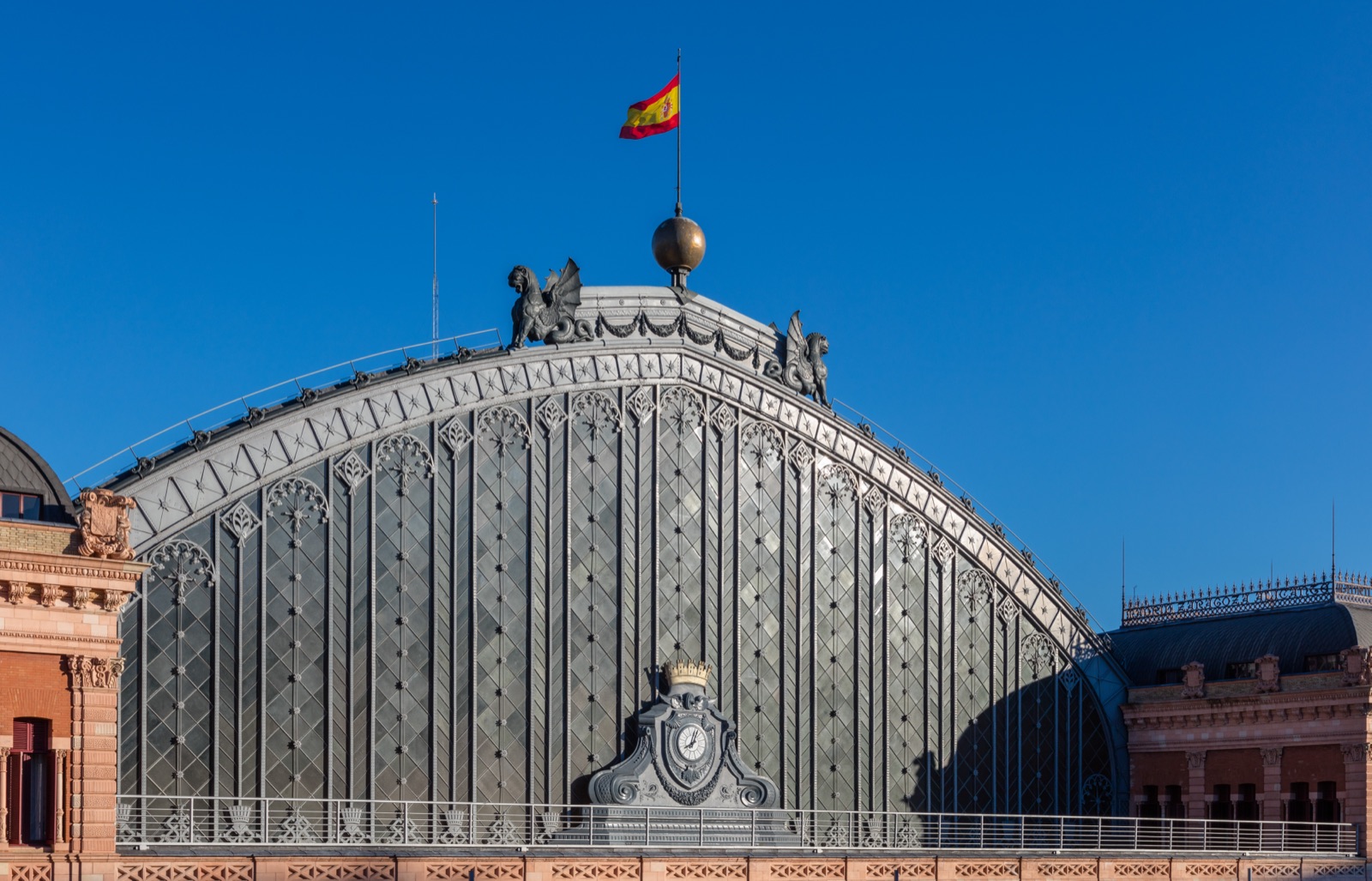
Atocha station in Madrid, the hub toward which the four bombed commuter trains were travelling on the morning of March 11, 2004. Three of the trains were at or near Atocha when the bombs detonated between 07:36 and 07:40; the fourth was at El Pozo del Tío Raimundo. One hundred and ninety-three people were killed. Wikimedia Commons / Diego Delso, CC BY-SA 4.0.
The Madrid Train Bombings and the Battle Over Who Did It
Spain, 2004 — 193 people were killed on four commuter trains three days before a general election. The courts established who did it; half the country never accepted the verdict
- Category
- Media & Propaganda
- Published
- Length
- 4,550 words · 19 min read
- Author
- The editors
The Madrid Train Bombings and the Battle Over Who Did It
Spain, 2004 — 193 people were killed on four commuter trains three days before a general election. The courts established who did it; half the country never accepted the verdict.
07:37, 11 March 2004
It was an ordinary Thursday morning, the trains carrying students, workers, and commuters from the dormitory towns and southeastern districts of Madrid toward the centre. On the Cercanías commuter line that runs into Atocha, the city's great southern terminus, four trains were strung out along the route within a few kilometres of one another. In the rush-hour crush, no one paid attention to a number of unremarkable sports bags and rucksacks that had been left on board.
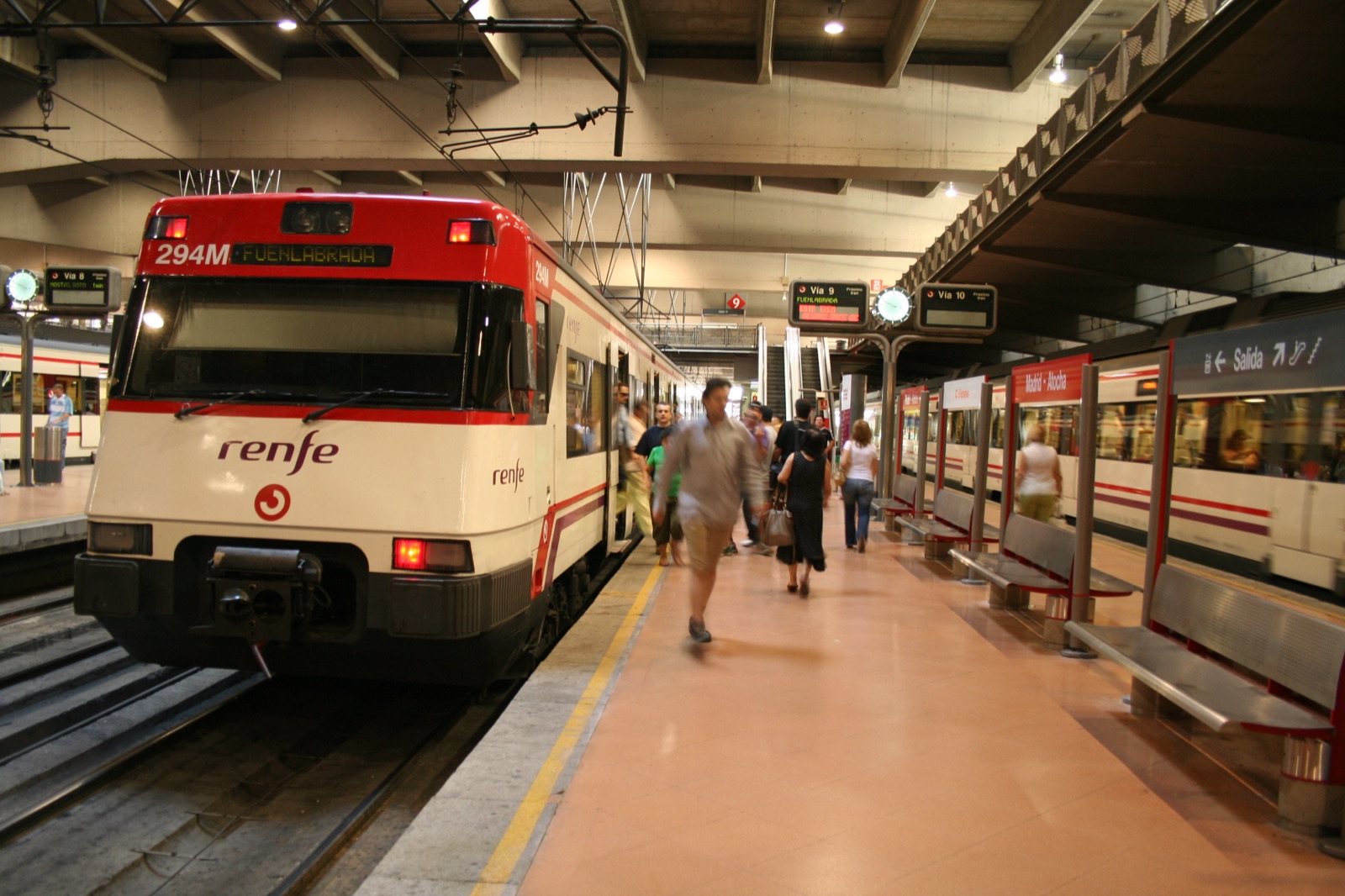
Between about 07:36 and 07:40, ten of them detonated. The bombs — there were thirteen in all, but three failed to explode — were made of Goma-2 ECO, a mining explosive, each charge packed with nails and screws to maximise the carnage and wired to the alarm of a cheap mobile phone set to ring at the appointed minute. Three of the trains were at or just outside Atocha; a fourth was at the station of El Pozo del Tío Raimundo, in a working-class district to the southeast, where two bombs on the same train produced the single greatest concentration of deaths. The explosions tore the carriages open, and the platforms and trackside became scenes of mass casualty that the emergency services, and ordinary passers-by and residents, struggled to answer. One hundred and ninety-one people died that day; the toll reached 193 with later deaths. Around two thousand were injured, many of them grievously.
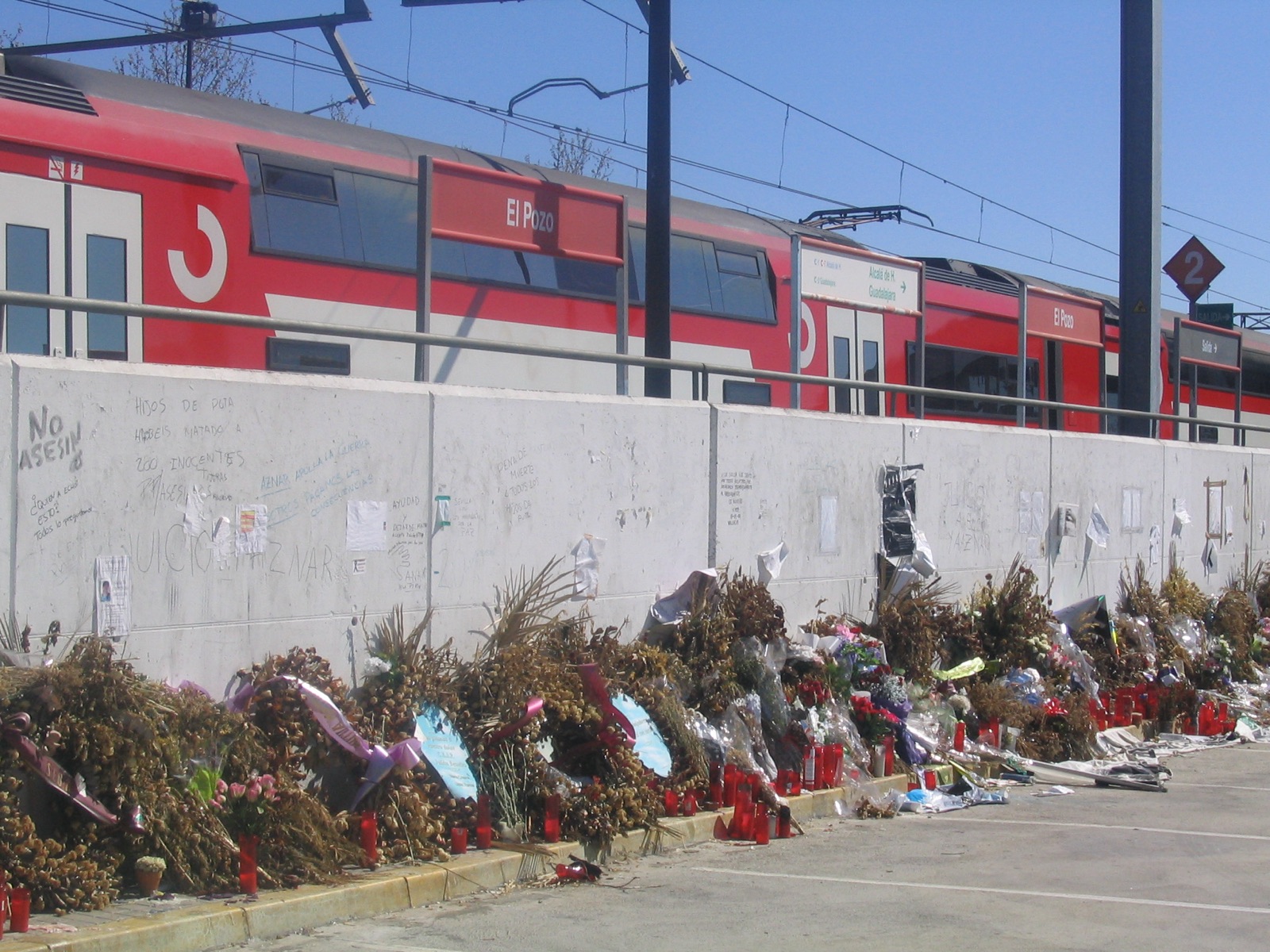
The four trains had all begun their runs at Alcalá de Henares, the historic town east of Madrid where Cervantes was born, and were strung along the same line as they ran toward the capital. The bombs caught them at four points: in the trench just outside Atocha, at the Téllez street overpass close by, at El Pozo del Tío Raimundo, and at Santa Eugenia. In the space of a few minutes the southeastern approach to the city had become four simultaneous disaster scenes, and the first response fell to whoever was nearest — railway staff, residents of the surrounding neighbourhoods, off-duty workers — who pulled at the wreckage with their hands before the emergency services could reach every site. Hospitals across Madrid declared mass-casualty alerts; an improvised morgue was opened at a convention centre near Atocha; queues formed at the city's blood-donation points. By nightfall the scale was beyond dispute: nothing like it had happened in Spain before.
Three days before an election
The timing was not incidental to anything that followed, because Spain was in the last days of a general election campaign, and the country was already raw over a related question: the war in Iraq.
The government of José María Aznar and the Partido Popular had been among the firmest European supporters of the United States–led invasion of Iraq in 2003, sending Spanish troops in the face of overwhelming public opposition — opinion polls had put Spaniards against the war at around ninety per cent. Aznar was stepping down, having handpicked Mariano Rajoy as his successor, and the PP went into the vote of March 14 expecting to win. Hanging over the campaign was the government's long confrontation with ETA, the Basque separatist organisation whose decades of killing the PP had made central to its identity as the party of firmness against terrorism. When the bombs went off on March 11, both of those threads — Iraq and ETA — were live, and the question of who had planted the bombs was, instantly and unavoidably, also a question about the election.
"Fue ETA"
The government's answer was immediate and unwavering: it was ETA.
Within hours, the Interior Minister, Ángel Acebes, told the country that ETA was responsible, and for the next three days the government held to that line in public statements, in briefings to journalists, and in diplomacy — Spain pressed the United Nations Security Council to pass a resolution that named ETA as the author of the attack, which it did on March 11. There was a political logic to the insistence that critics would later find damning: an attack by ETA would, if anything, have rallied voters to the party of anti-ETA resolve, whereas an Islamist attack would raise the politically lethal suggestion that the carnage was blowback for an unpopular war the government had joined against the public's wishes.
The trouble was that the evidence began, almost at once, to point the other way.
None of this turned the government's public message. As the investigators followed the phone and the van toward an Islamist cell, ministers continued through Friday and into Saturday to stress ETA's responsibility — or, at most, to allow that no line of inquiry was closed while still leading with the Basque group. To the government's defenders this was the natural caution of officials who did not want to outrun an unfinished investigation, in a country where ETA was the reflexive author of political violence. To its critics it was something nearer denial: a government that could see which way the evidence was running and could not bring itself to say so before the polls opened, because the answer was politically ruinous. Both readings would be argued for years. What is not in dispute is that the official line and the leaking evidence pulled visibly apart in the forty-eight hours before the vote.
The weekend that turned
The gap between what the government was saying and what was leaking out of the investigation became, over the following forty-eight hours, the decisive fact of the election.
By Saturday, March 13 — the official 'day of reflection' on which campaigning is banned in Spain — that gap had become a public crisis of trust. Spontaneous demonstrations, organised in part by mass text message at a time when that was a novel thing, gathered outside the Madrid headquarters of the Partido Popular on Calle Génova, with crowds demanding to be told the truth before they voted: "¿Quién ha sido?" — "Who was it?" The sense that the government was managing the attribution for electoral advantage, whether or not that was a fair reading of a chaotic three days, took hold among a large part of the electorate.
On Sunday, March 14, Spain voted, and the result was an upset. The Socialists, the PSOE, led by José Luis Rodríguez Zapatero, won 43.3 per cent to the PP's 37.7, on a surge in turnout, and formed a government; Zapatero had promised to withdraw Spanish troops from Iraq, and did. To this day the precise weight of the bombings in the outcome is debated — the PP's lead had been narrowing before the attack, and turnout effects are hard to disentangle — but few dispute that the massacre, and above all the public's reaction to how the government handled the question of who was responsible, shaped the result. A terrorist attack had been followed, within seventy-two hours, by a change of government. It was a sequence with few precedents in a democracy, and it would poison the argument over 11-M for years, because for the defeated right it carried an unbearable implication: that the attack had, in effect, chosen the government.
Leganés
The investigation, meanwhile, was closing on the cell.
On April 3, 2004, three weeks after the bombings, police traced a group of the suspects to an apartment in Leganés, a town just south of Madrid. As the special forces of the GEO prepared to storm the flat, the men inside detonated their own explosives, blowing themselves up rather than be taken. Seven of the cell died in the blast, among them figures identified as central to the plot — including Jamal Ahmidan, known as 'el Chino,' who had run the procurement of the explosives, and Sarhane Ben Abdelmajid Fakhet, 'the Tunisian,' regarded as a leader of the group. A GEO officer, Francisco Javier Torronteras, was killed in the explosion. The Leganés deaths removed several of the principal perpetrators from any future courtroom — a fact that would later feed the conspiracy theories, since the men who could have explained the most were now beyond questioning — but the physical and forensic evidence the investigation had already assembled was extensive, and the case did not depend on their testimony.
The investigation and the verdict
Spain did not rush. The judicial investigation, led by the examining magistrate Juan del Olmo, took years, and the trial that followed — at the Audiencia Nacional, the country's high court for terrorism cases, presided over by Judge Javier Gómez Bermúdez — was the longest and most thoroughly documented in modern Spanish history.
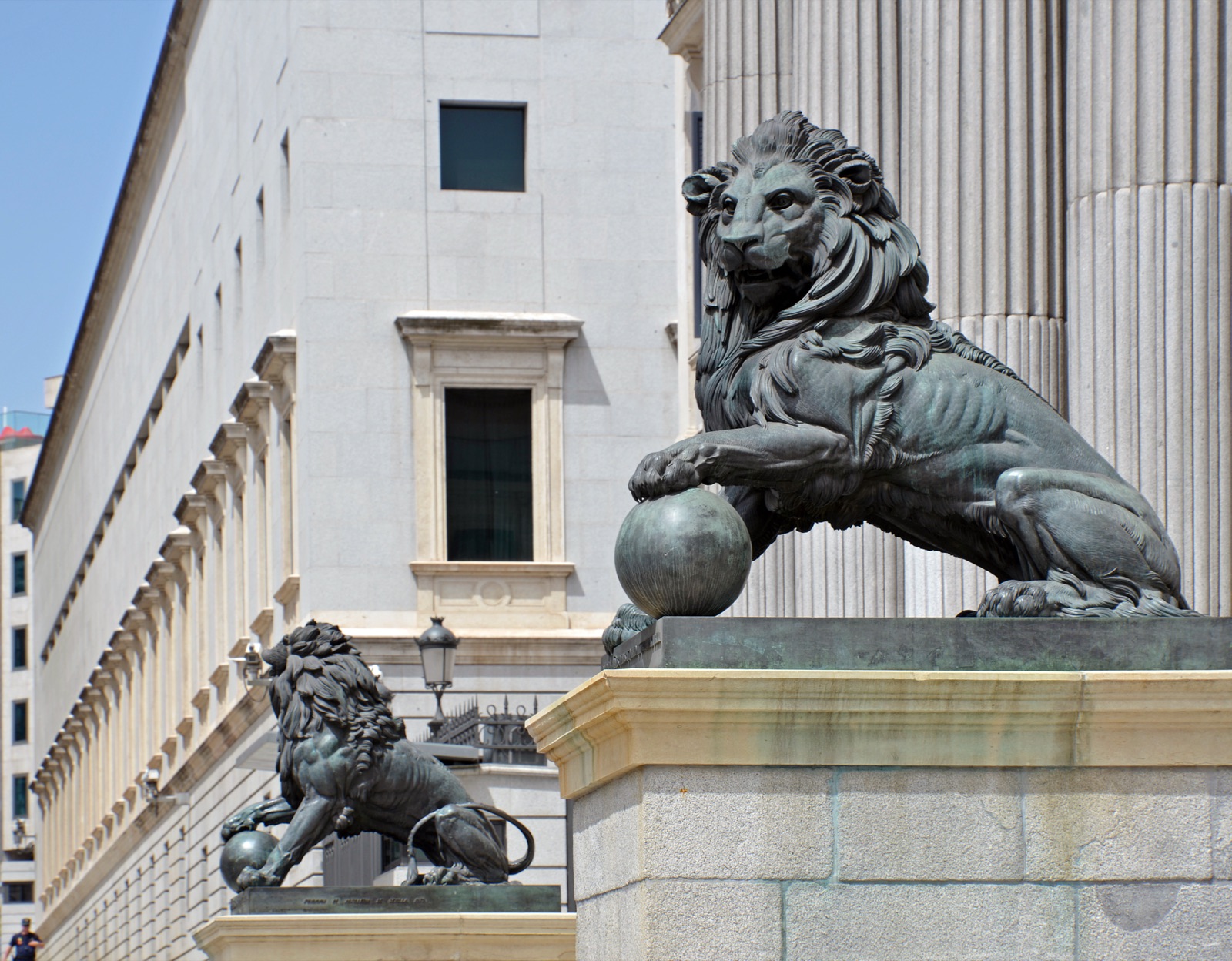
The verdict came on October 31, 2007. The court convicted twenty-one of the twenty-eight defendants, handing the heaviest sentences to those most directly implicated — among them Jamal Zougam, who had helped place bombs and whose phone shop had supplied handsets and SIM cards; Otman El Gnaoui; and José Emilio Suárez Trashorras, the supplier of the explosives. Crucially, the court set out in detail what 11-M had been: the work of a local jihadist cell, inspired by and ideologically aligned with al-Qaeda though not directed by it as a formal operation, and motivated by Spain's participation in the wars in Iraq and Afghanistan. And it stated, in terms that left no room for ambiguity, that there was no evidence whatever of ETA's involvement. The following year the Supreme Court reviewed the judgment, upholding its core while adjusting some individual verdicts — reducing certain sentences and acquitting a defendant, Rabei Osman, of the bombing itself. The central finding stood and stands: an Islamist cell, not ETA, murdered 193 people at Atocha.
The trial itself had been a vast undertaking. It ran from February to July 2007 in a purpose-secured courtroom, heard hundreds of witnesses and experts, and sifted an investigation that filled tens of thousands of pages — telephone records that reconstructed the cell's communications, forensic analysis of the explosive and the detonators, the accounts of survivors. The twenty-eight defendants included those who had supplied and moved the explosives, those who had helped assemble or place the bombs, and others accused of belonging to the wider support network; the seven who had died at Leganés, and some who had fled abroad, were beyond its reach. For all the later insistence that the truth had been concealed, 11-M was in fact among the most exhaustively adjudicated terrorist atrocities in European history — its evidence tested in open court over five months and then reviewed by the country's highest tribunal.
The explosives trail
If the verdict settled the headline question, it did not dissolve every shadow — and the deepest of the genuine shadows lay in where the bombs had come from.
The Goma-2 ECO used in the attack was a Spanish mining explosive, and the investigation traced it to mines in Asturias, in the north, and to a supply chain that ran not through any foreign terrorist network but through Spanish petty criminals and ex-miners with access to the stuff. At the centre of that chain was Suárez Trashorras — and the troubling detail, the one that did the real work in keeping the case alive, was that he had been an informant for the Spanish security forces. How a man connected to the police came to supply the explosives for the worst terrorist attack in the country's history is a question that the courts addressed and that critics never felt was fully answered. It is a legitimate question, and it belongs to a recognisable category — the murky zone, familiar from other cases, where informants and the underworld they inhabit blur the line between watching a crime and enabling one. It is not, however, evidence of a grand conspiracy. What it shows is that the explosives reached the cell through a sordid domestic criminal network that the state had partially penetrated and failed to control — a serious failure, and a different thing from a plot.
The conspiracy that wouldn't die
Onto that real ambiguity, and onto the rawer wound of a government brought down in the shadow of a massacre, was built one of the most sustained conspiracy campaigns in modern European media.
In the years after the attack, and continuing long after the 2007 verdict, a section of the Spanish right — led by the newspaper El Mundo and its editor Pedro J. Ramírez, and amplified by outlets such as the radio station COPE and the website Libertad Digital, with sympathetic figures inside the Partido Popular — advanced what came to be called simply la teoría de la conspiración. Its claims shifted over time, but their thrust was constant: that the official account was a fabrication, that ETA had been involved after all, that elements of the security services or the incoming Socialist government had had a hand in the attack or its cover-up, and that the true authors of 11-M had been protected. The campaign seized on every genuine loose end — the informant explosives, the destroyed evidence at Leganés, disputes over forensic details — and spun them into the architecture of a plot.
It did not hold up. A parliamentary commission of inquiry in 2004-05 examined the attack and its handling and found no support for the alternative thesis. The 2007 trial, with its mountain of forensic, telephone, and documentary evidence, established the jihadist authorship beyond reasonable doubt and ruled ETA out by name. No court, no inquiry, and no body of evidence has ever substantiated the conspiracy claims. What sustained them was not proof but politics and grief: the impossibility, for those who governed and lost, of accepting that their handling of three terrible days had helped cost them power; the human difficulty of accepting that a few dozen radicals with mining explosives could swing a nation's history; and a media ecosystem with every incentive to keep the wound open. Surveys in the years that followed found that a substantial minority of Spaniards continued to doubt the official account — a measure not of the evidence, which is overwhelming, but of how completely 11-M had been absorbed into the country's political divisions.
The victims and the long afterlife
The 11-M dead were not, for the most part, the powerful. The trains that morning carried commuters from the working-class and immigrant districts of Madrid's southeast — cleaners, students, construction workers, people from across Spain and from Romania, Ecuador, Morocco, Poland, and a dozen other countries. The attack that became a national political earthquake had fallen, in the first instance, on the ordinary travelling public, and the associations of survivors and bereaved families that formed afterward became, themselves, a contested presence in Spanish life.
That, too, belongs to the story's unhappiness. As the conspiracy campaign gathered force, the victims were not spared it. Some victims' organisations aligned themselves with the search for hidden authors and the suspicion of the official account; others rejected that framing entirely and asked only to be allowed to grieve outside the political war. When Pilar Manjón, who led one of the principal victims' associations and whose son had died on one of the trains, testified before the parliamentary commission, her insistence that the dead not be turned into ammunition was itself attacked from the partisan trenches. The sight of bereaved families being drawn into, and pulled apart by, an argument over whether the established facts of their own loss could be believed was among the bleaker features of the years that followed.
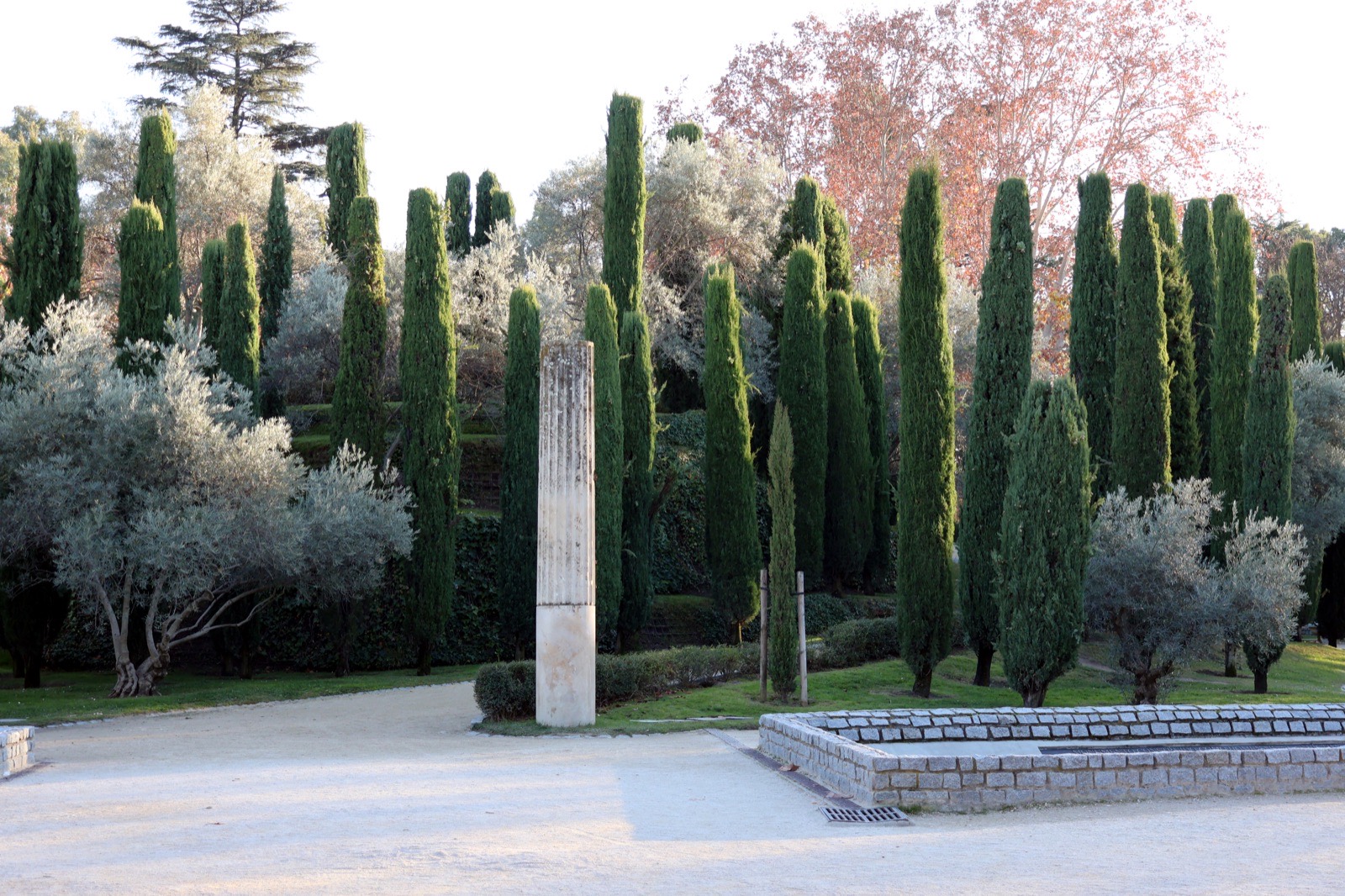
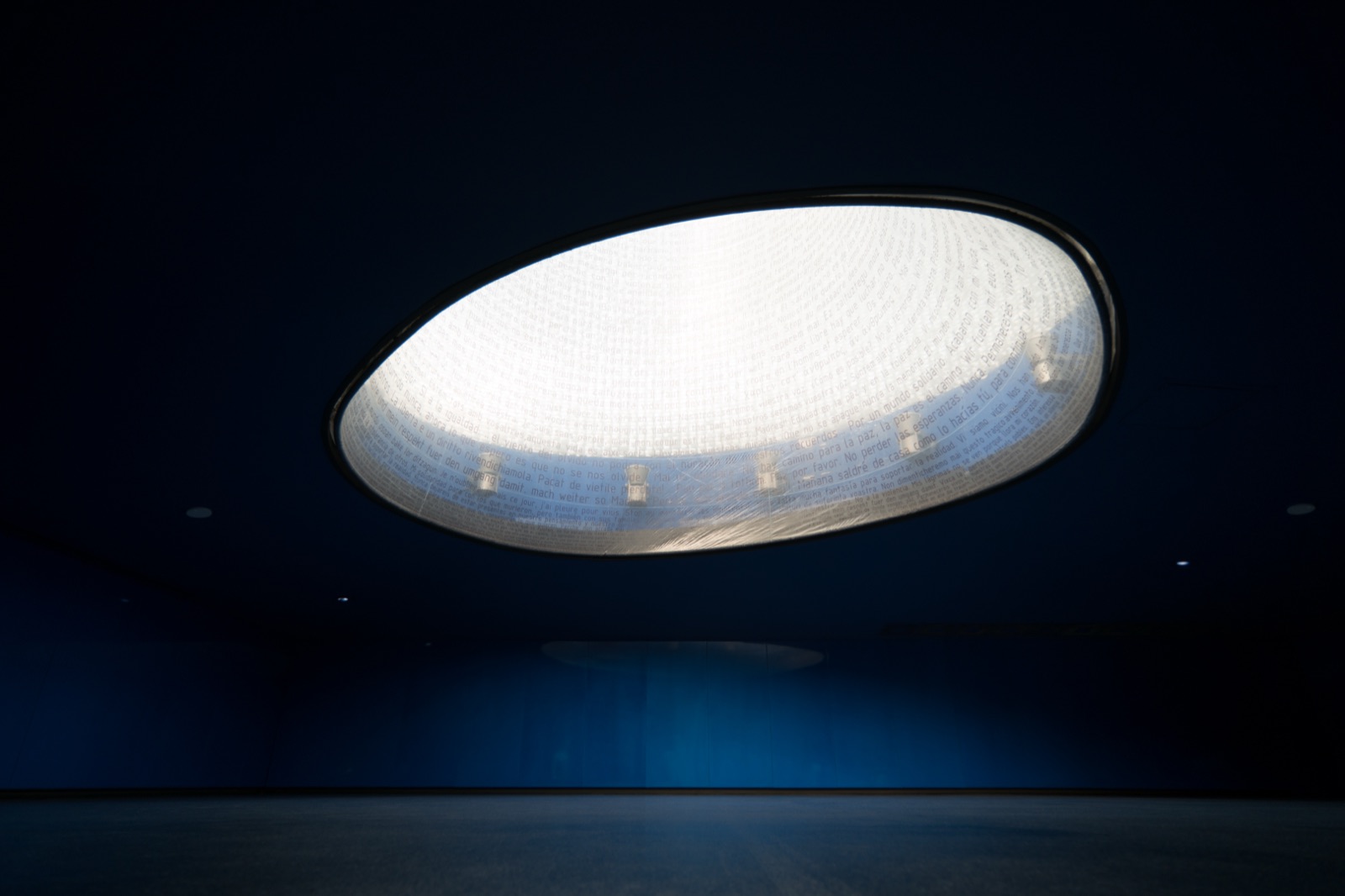
The state, for its part, built places to hold the grief apart from the politics — the grove of trees in the Retiro, the glowing memorial above the Atocha concourse, the plaques at the bombed stations — each an attempt to fix the meaning of 11-M to the 193 people who died rather than to the question of who governed Spain. Whether they have succeeded is, like much about the case, a matter on which the country has never entirely agreed.
What the question still is
The Madrid bombings occupy an unusual place among contested events, because almost everything about them is, in fact, known. The perpetrators were identified, the survivors among them tried and convicted, the explosive traced, the motive established, the false attribution to ETA judicially demolished. By any ordinary standard, 11-M is a solved crime.
What remains unsettled is therefore not really a factual question but a civic one. The genuine loose ends — above all the role of a police informant in supplying the explosives — are real, and they deserve the scrutiny they have received; they point to a failure of the state to control its own underworld sources, which is serious enough without being a conspiracy. But the larger thing that 'remains unresolved' about 11-M is the refusal of part of a society to accept a verdict it finds politically intolerable. That is the lingering mystery the case is usually said to hold, and it is not a mystery about who planted the bombs. It is a mystery about what a country does when the truth about a catastrophe is also a defeat for one side of its politics — when accepting the facts means accepting an outcome, and a humiliation, that a powerful faction would rather litigate forever than concede.
The 193 people who died at Atocha and El Pozo were killed by a cell of jihadist militants who believed they were striking at a country complicit in a war against Muslims. The courts proved it; the evidence is not in serious doubt. That this plain and terrible fact has had to coexist, for two decades, with an organised insistence that it cannot be true is the real and lasting strangeness of the Madrid train bombings — and a warning about how, in a polarised age, even a fully solved crime can be argued into a permanent fog.
Sources
Primary
- Audiencia Nacional, judgment in the 11-M case, October 31, 2007 (Sentencia del 11-M), and the Tribunal Supremo's review, July 2008.
- The judicial investigation (sumario) of the examining magistrate Juan del Olmo.
- Report of the Spanish parliamentary commission of inquiry into the March 11 attacks (Comisión de Investigación, 2004-05).
- United Nations Security Council Resolution 1530 (March 11, 2004), naming ETA — adopted on the basis of the Spanish government's early attribution.
- Contemporary statements of the Ministry of the Interior and the government during March 11-14, 2004.
Secondary
- Contemporaneous and retrospective reporting in El País, El Mundo, the BBC, The Guardian, The New York Times, and Reuters on the attack, the election, the Leganés raid, the trial, and the conspiracy controversy.
- Coverage of the spontaneous protests of March 13, 2004, and the role of text messaging in organising them.
- Analyses of the role of the Iraq war and of the attribution dispute in the outcome of the March 14, 2004 election.
- Accounts of the right-wing media campaign (El Mundo, COPE, Libertad Digital) advancing the alternative thesis.
Academic / reference
- Scholarship on the 2004 Madrid bombings, jihadist terrorism in Europe, and the electoral effects of terrorist attacks.
- Studies of conspiracy theories and political polarisation in the Spanish public sphere after 11-M.
Inspired this / based on it
Netflix
Documentary series for the 20th anniversary, reconstructing the attack, the investigation and the political fallout from multiple perspectives.
Movistar+ / Mariano Barroso
Drama series set in late-Franco and transition-era Barcelona; widely cited alongside Spain's reckoning with political violence and the security state.
Manuel Marlasca and others
Investigative reckoning with the persistent 11-M conspiracy theories and what the evidence actually showed.
various / Spanish TV
Retrospective coverage marking the attack and the long judicial process at the Audiencia Nacional.
Filed under
- #madrid-2004
- #11-m
- #atocha
- #eta
- #al-qaeda
- #jihadist-cell
- #aznar
- #zapatero
- #iraq-war
- #leganes
- #audiencia-nacional
- #conspiracy-theory
- #spain
- #2000s
- #mystery
Click any tag for every article carrying it.
Continue reading
Lockerbie / Pan Am 103
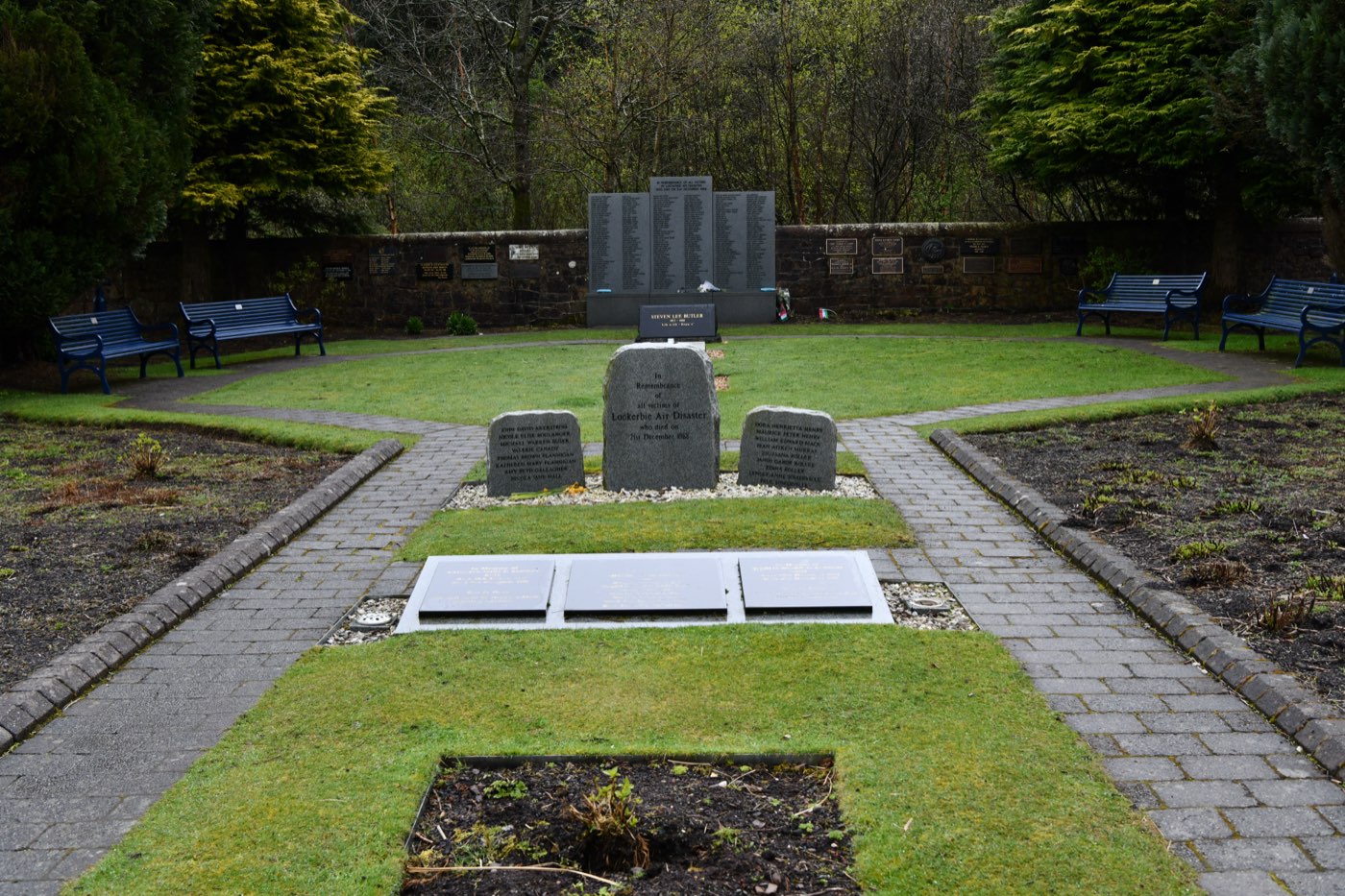
At 19:02:50 Greenwich Mean Time on Wednesday, December 21, 1988, Pan American World Airways Flight 103 — a Boeing 747-121 named *Clipper Maid of the Seas*, registration N739PA, on the daily transatlantic service from London Heathrow to New York's John F. Kennedy International Airport — was at flight level 310 (31,000 feet) and approximately 38 minutes into its scheduled 7-hour 50-minute flight when a 312-gram improvised explosive device detonated inside the forward cargo hold. The bomb had been concealed within a Toshiba RT-SF 16 BomBeat radio-cassette recorder packed inside a brown Samsonite hardshell suitcase. The aircraft broke up immediately. The forward fuselage section — including the cockpit — separated from the airframe and fell intact for approximately 90 seconds before impacting at Tundergarth, three miles east of the small Dumfriesshire market town of Lockerbie. The remaining airframe broke into thousands of pieces across an area subsequently mapped at 845 square miles. Of 243 passengers and 16 crew aboard, all died. On the ground in Lockerbie, 11 residents of Sherwood Crescent were killed when the centre-wing fuel tanks impacted at the southwestern edge of the town. Total deaths: 270 — the highest single-incident terrorist casualty figure on British soil in the 20th century. The investigation that followed has had two principal evidential phases. The first phase (December 1988 – November 1990) focused on the Popular Front for the Liberation of Palestine – General Command (PFLP-GC), a Syrian-sponsored Palestinian faction. The second phase (from November 1990) re-directed the investigation toward Libya and produced the November 1991 U.S. and U.K. indictments of two Libyan Arab Airlines employees: Abdelbaset al-Megrahi and Lamin Khalifa Fhimah. The temporal coincidence between the investigative shift and the Gulf War coalition-building of late 1990 (which brought Syria into alignment with the United States) has been the subject of subsequent academic and journalistic debate. The Camp Zeist trial of 2000-2001 — held under Scottish law in a Dutch facility designated as Scottish soil for the trial — convicted Megrahi (January 31, 2001) and acquitted Fhimah. Megrahi was released by the Scottish Government on compassionate grounds (terminal prostate cancer) on August 20, 2009, after serving 8 years 6 months of his life sentence; he died in Tripoli on May 20, 2012. A second Libyan defendant — Abu Agila Mohammad Mas'ud Kheir Al-Marimi, identified as the bombmaker — was extradited to the United States from Libya in December 2022 and is currently awaiting trial in the District of Columbia. The case is formally closed in legal terms; substantive aspects of the evidence — including the identification of the timer fragment that linked Megrahi to the bomb — remain disputed in independent forensic reviews.
Operation Gladio
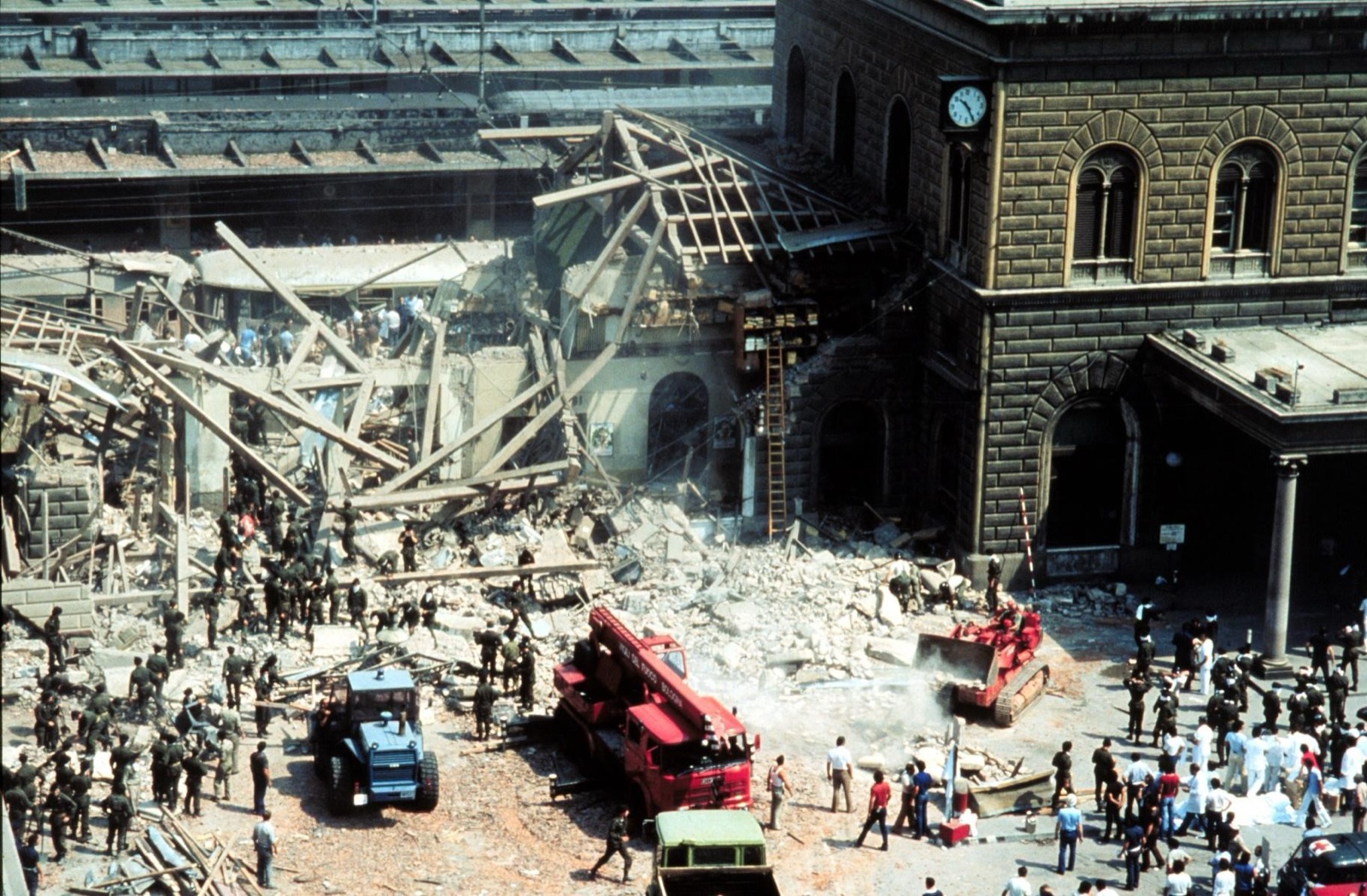
From 1956 onward, NATO and the CIA helped build clandestine paramilitary networks across Western Europe — Italy, Belgium, West Germany, France, the Netherlands, Greece, Turkey, Spain, Portugal — designed to wage guerrilla war if the Red Army crossed the Iron Curtain. The Red Army never crossed. The networks did not disband. In Italy, where the operation was codenamed Gladio, the same structures became entangled with right-wing terror that killed hundreds of civilians between 1969 and 1984. The network's existence was confirmed by the Italian Prime Minister, in Parliament, on October 24, 1990.
Cambridge Analytica
In 2014, a 27-year-old Canadian data scientist named Christopher Wylie helped design what he would later describe as a 'psychological warfare tool.' His employer, Cambridge Analytica, had paid an academic researcher to build a personality quiz that, through a quirk of Facebook's developer policy, harvested data not only on the people who took it but on every Facebook friend of every taker — eventually some 87 million profiles. The data was used to target voters in the 2016 Brexit referendum and the 2016 Trump presidential campaign. Wylie went to The Guardian in March 2018. Within ten weeks, Cambridge Analytica had shut its doors.