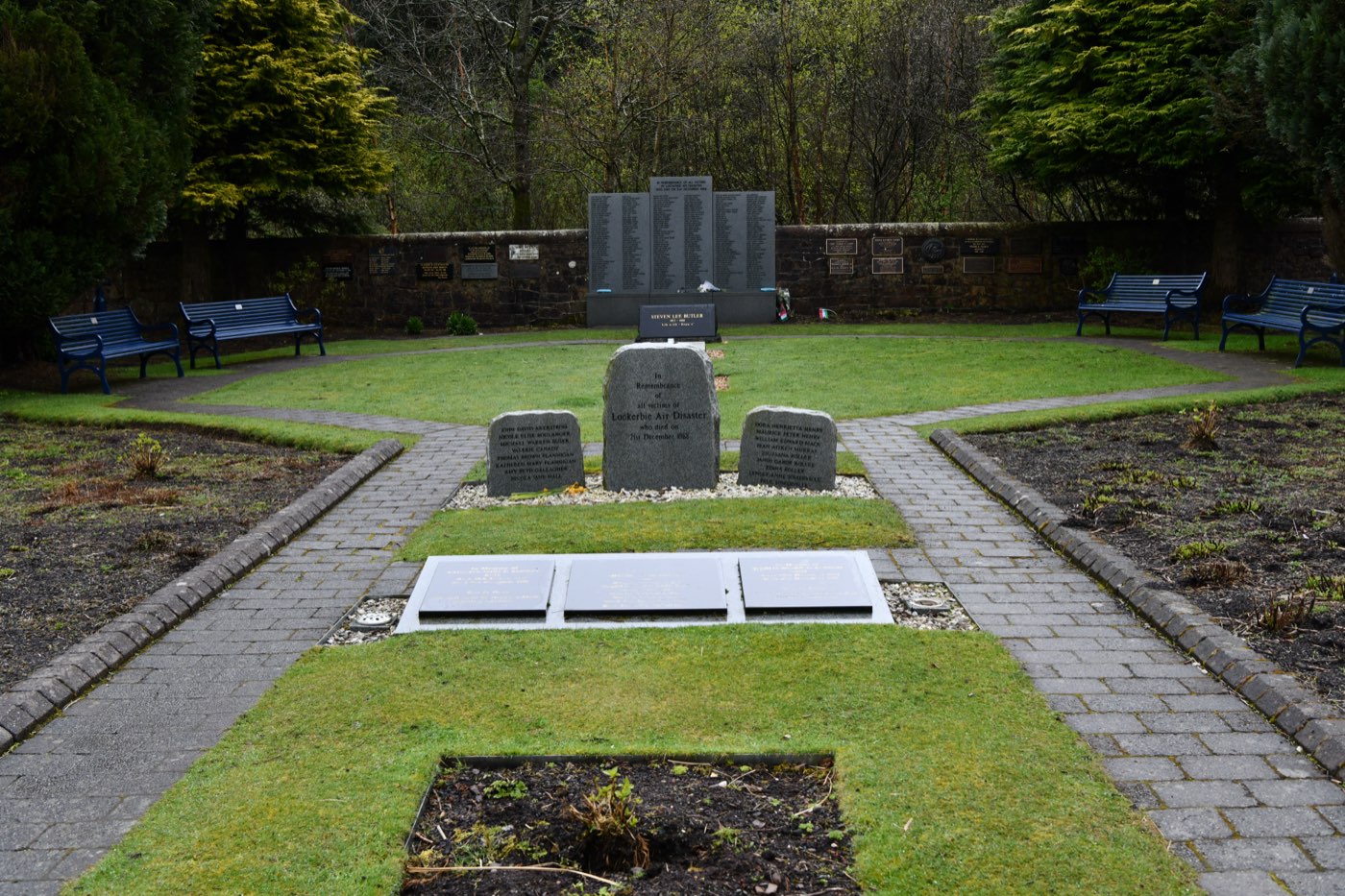
The Lockerbie Air Disaster Memorial Garden at Tundergarth Mains, three miles east of Lockerbie, Dumfries and Galloway, Scotland. The site sits at approximately the location where the forward fuselage section of Pan Am Flight 103 impacted on December 21, 1988. The memorial was established by the Lockerbie community and is maintained by Dumfries and Galloway Council. The list of all 270 victims is engraved on the central wall. Wikimedia Commons, CC BY-SA 2.0.
Lockerbie / Pan Am 103
December 21, 1988 — and the investigation that shifted from Iran-Syria to Libya in 1990-91
- Category
- State & Intelligence Operations
- Published
- Length
- 3,700 words · 17 min read
- Author
- The editors
Lockerbie / Pan Am 103
December 21, 1988 — and the investigation that shifted from Iran-Syria to Libya in 1990-91.
December 21, 1988
Pan American World Airways Flight 103 was Pan Am's regularly scheduled service from London Heathrow Terminal 3 to New York's John F. Kennedy International Airport, departing Heathrow daily at approximately 18:00 GMT. The aircraft operating on December 21, 1988 was Pan Am's Clipper Maid of the Seas — a Boeing 747-121, registration N739PA, in service since February 1970 and with approximately 73,000 flight hours.
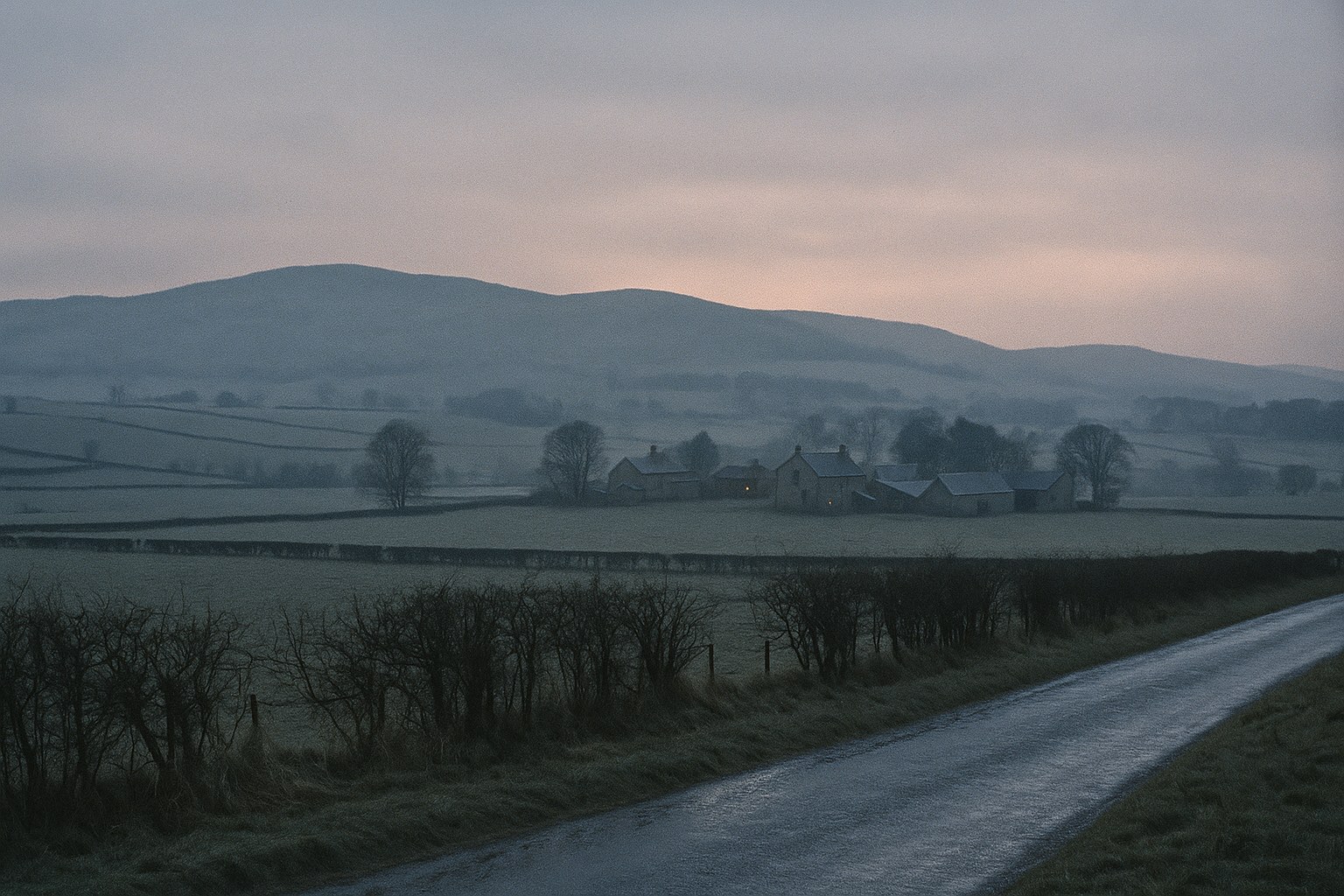
The flight's passenger manifest included 189 American citizens, 43 British, 12 Indian, and personnel of approximately 21 other nationalities. Among the passengers: 35 students of Syracuse University returning from a semester in London; United Nations Commissioner for Namibia Bernt Carlsson (en route to the December 22 signing of the Tripartite Accord that would end South African control of Namibia); the U.S. Department of Justice prosecutor Matthew Gannon; and four U.S. State Department personnel.
The flight took off from Heathrow runway 27R at 18:25 GMT. It climbed on a westerly heading toward the Scottish coast for the transatlantic crossing. At 18:58 the aircraft was handed off from London Air Traffic Control to Shanwick Oceanic Control. At 19:02:46.9 GMT the explosion occurred. The aircraft's flight data and cockpit voice recorders both stopped recording within 0.1 seconds. The aircraft's flight path at that moment placed it directly over the town of Lockerbie at 31,000 feet.
What fell on Lockerbie
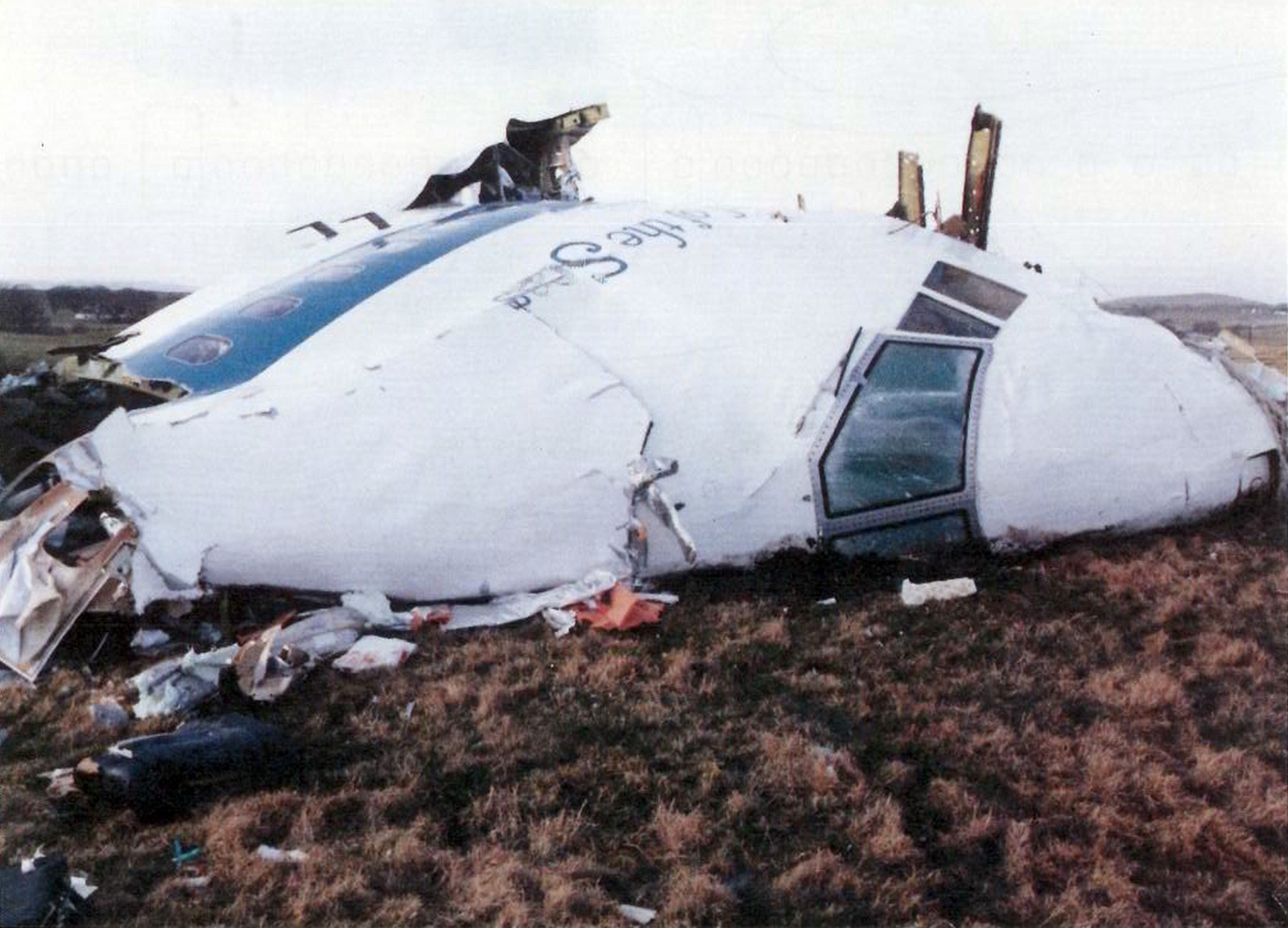
The forward fuselage section — comprising approximately the first 80 feet of the aircraft including the cockpit — separated from the airframe within the first second of the explosion. It fell as an intact section for approximately 90 seconds before impacting in a field at Tundergarth Mains, three miles east of Lockerbie town. The cockpit-section impact was the principal physical artefact recovered intact.
The centre-wing fuel tanks impacted at 19:03:31 GMT (45 seconds after the initial detonation) at Sherwood Crescent on the southwestern edge of Lockerbie town. The impact created a crater approximately 47 metres long and 196 cubic metres in volume. The houses at 13, 14, 15, 15A, and 16 Sherwood Crescent were destroyed; 11 residents were killed. The fuel-tank impact caused the principal ground fire and was the source of most of the visible smoke in subsequent press photographs.
The remaining airframe — fuselage skin, control surfaces, engines, landing gear, cargo, and human remains — was distributed across approximately 845 square miles of southwest Scotland and the Cumbrian coast. Police and military recovery teams operated for approximately 18 months to map and recover material; approximately 4 million individual fragments were ultimately catalogued.
The Toshiba bomb
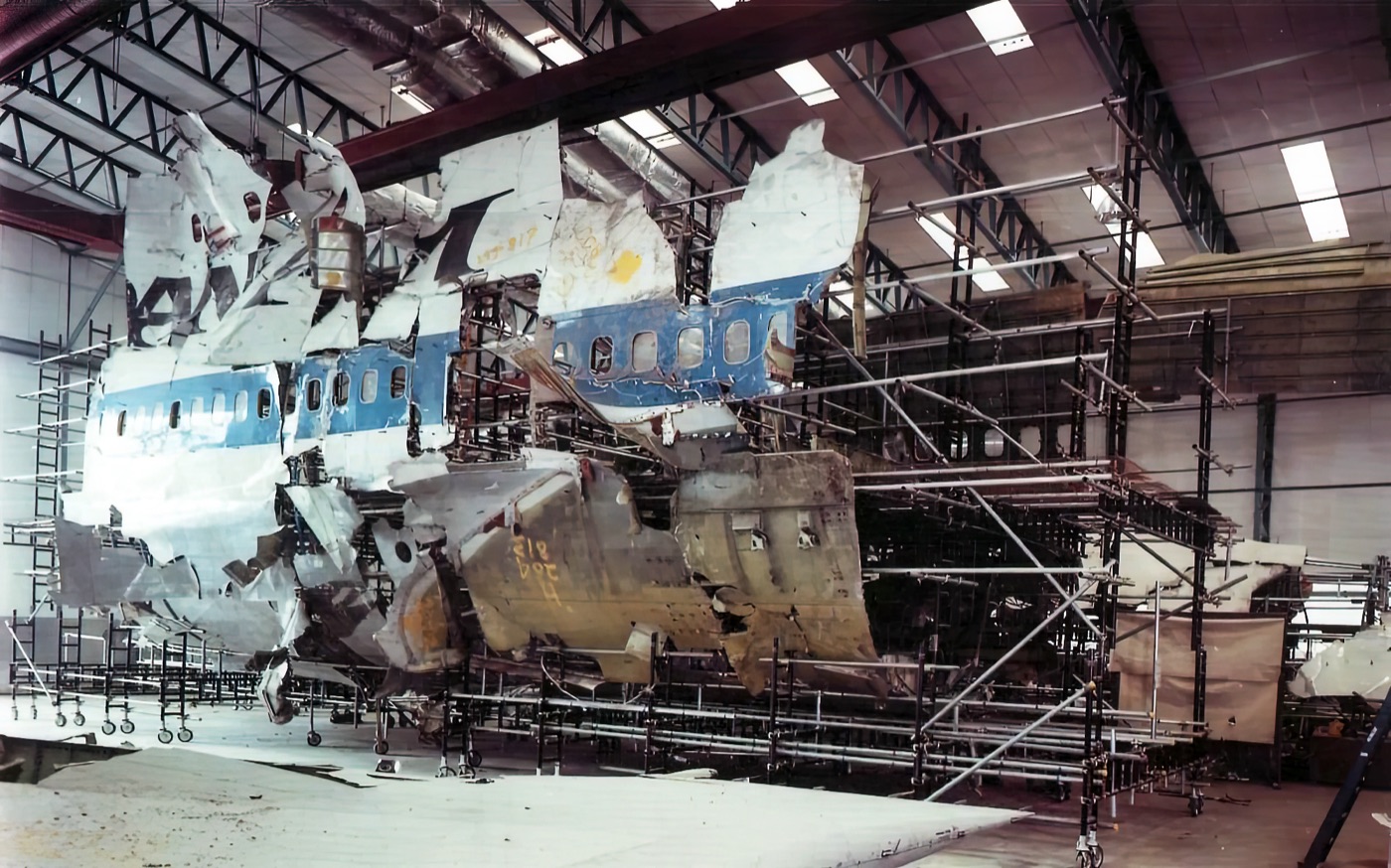
The Air Accidents Investigation Branch (AAIB) — under the leadership of Inspector Michael Charles — conducted the initial forensic reconstruction at Farnborough, England. The reconstruction confirmed within four weeks that the destruction had been caused by a high-explosive detonation in the forward cargo hold, at approximately container position AVE 4041 PA, on the left side of the aircraft.
The explosive material was identified as Semtex — a Czechoslovak-manufactured plastic explosive widely used by Eastern Bloc and Middle East-affiliated paramilitary organisations through the 1980s. The detonator package was identified as a Toshiba RT-SF 16 BomBeat radio-cassette recorder. Fragments of the device recovered in the wreckage included pieces of the Toshiba's electronics, fragments of the suitcase exterior (a brown Samsonite hardshell), and — critically — a small fragment of green-coloured fibreglass circuit board.
The first investigation, 1988-90
The principal early-investigation hypothesis was that the bombing had been conducted by the Popular Front for the Liberation of Palestine – General Command (PFLP-GC), a Syrian-government-supported Palestinian organisation led by Ahmed Jibril and based in Damascus. The PFLP-GC was a credible suspect for four operational reasons:
- Motive. Two Iranian sources had reportedly contracted with the PFLP-GC to conduct a retaliatory operation against U.S. civil aviation in response to the U.S. Navy's accidental July 3, 1988 shoot-down of Iran Air Flight 655 over the Strait of Hormuz (290 civilians killed). The PFLP-GC contract reportedly funded at approximately $10 million.
- Capability. The PFLP-GC had a documented technical bombmaking program led by Marwan Kreesat.
- Recent operational activity. A West German police raid (Operation Autumn Leaves) on a PFLP-GC cell in Neuss, near Frankfurt, on October 26, 1988 — eight weeks before Lockerbie — had recovered four IEDs concealed in Toshiba radio-cassette recorders. The Toshiba RT-SF 16 BomBeat was one of the models used in the recovered devices.
- Recovery patterns. The 14 PFLP-GC personnel arrested in the Autumn Leaves operation were released by West German authorities within weeks; not all subsequent movements have been documented.
The PFLP-GC hypothesis was the dominant investigative working theory from December 1988 through approximately November 1990. The U.S. and British media coverage of December 1988 – November 1990 reflected this focus; the Sunday Times, the New York Times, and the BBC all reported the PFLP-GC connection as the principal investigative lead.
The shift to Libya, 1990-91
In late 1990, the investigation's evidential focus shifted from PFLP-GC to Libya. The principal documented reason was the May 1989 forensic identification of the PT/35(b) timer fragment as an MEBO MST-13 model. The MEBO sale records pointed exclusively to Libya. The investigators' identification of the Samsonite suitcase as having transferred from Air Malta KM180 (Malta-Frankfurt) — and Tony Gauci's identification of a customer at his Mary's House clothing shop in Sliema, Malta as resembling Abdelbaset al-Megrahi — connected the bag's loading to a specific Libyan individual.
The temporal correlation with the Gulf War coalition-building of late 1990 has been the subject of subsequent journalistic and academic attention. Between August 1990 (the Iraqi invasion of Kuwait) and January 1991 (Operation Desert Storm), Syria joined the U.S.-led coalition. Syria's coalition participation was strategically important for U.S. policy. PFLP-GC was a Syrian-sponsored organisation; the U.S. position toward Syrian-sponsored operations softened substantially in the late 1990 period. Whether the investigative shift was driven by the timer-fragment forensics independently of the political context — or whether the forensics provided cover for a shift that was operationally desirable — is a question that has been argued on both sides of in subsequent academic literature without definitive resolution.
The Crown Office of Scotland and the U.S. Department of Justice issued parallel indictments on November 13-14, 1991. The indictments named:
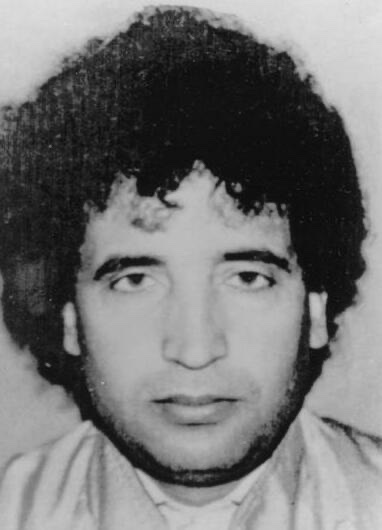
- Abdelbaset Ali Mohmed al-Megrahi (b. April 1, 1952) — Libyan citizen; Libyan Arab Airlines security officer at Malta's Luqa International Airport in 1988; also identified in indictment documents as a member of the Libyan External Security Organisation.
- Lamin Khalifa Fhimah (b. April 4, 1956) — Libyan citizen; station manager for Libyan Arab Airlines at Malta's Luqa International Airport.
The indictments alleged that Megrahi and Fhimah had placed the bag containing the bomb onto Air Malta KM180 in Malta on the morning of December 21, 1988, transferring it to Pan Am 103A (Frankfurt-Heathrow) and then to Pan Am 103 itself.
The Camp Zeist trial
The Libyan government rejected extradition for 11 years (1991-1999). Following sanctions imposed by U.N. Security Council Resolutions 748 (March 1992) and 883 (November 1993), and intensive diplomatic mediation primarily by South Africa's Nelson Mandela, the United Kingdom and Libya reached agreement in February 1999 for trial under Scottish law at a neutral venue. The agreed location: Camp Zeist, a former U.S. Air Force facility near Utrecht in the Netherlands, which was designated as Scottish sovereign territory for the trial period.
The trial proceedings ran from May 3, 2000 to January 31, 2001 under presiding judge Lord Sutherland and panel judges Lords Coulsfield and MacLean (later joined by Lord Maclean). Prosecuting: Crown Office of Scotland. Defending: William Taylor QC for Megrahi, Richard Keen QC for Fhimah.
The principal evidentiary elements:
- The Tony Gauci identification. Gauci, the proprietor of Mary's House clothing shop in Sliema, Malta, testified that on December 7, 1988 he had sold a brown Samsonite-style suitcase, a Babygro romper suit, and other items to a Libyan-appearing customer subsequently identified by him as Megrahi. The clothing fragments matched fibres recovered from the bomb suitcase. Gauci's identification of Megrahi was central to the prosecution case.
- PT/35(b) timer fragment. The MEBO MST-13 identification, with MEBO's records establishing exclusive Libyan-government sales.
- Megrahi's December 20-21 Malta travel. Megrahi had used the cover name "Abdusamad" and had travelled to Malta with a Libyan passport in that name; he had returned to Tripoli on the morning of December 21.
The verdicts, delivered January 31, 2001: Megrahi guilty of 270 counts of murder; sentenced to life imprisonment with a minimum term of 27 years (later reduced to 20). Fhimah acquitted on all charges; released and returned to Libya immediately.
The 2009 release
Megrahi's first appeal was rejected by a Scottish appeals court on March 14, 2002. A second appeal, prepared after the Scottish Criminal Cases Review Commission's June 2007 referral, was scheduled for hearing in 2009. The SCCRC had identified six grounds on which Megrahi's conviction "may have been a miscarriage of justice" — including the credibility of the Tony Gauci identification (Gauci had been paid approximately $2 million by U.S. authorities subsequent to the trial), the timer-fragment chain of custody, and the failure to disclose specific exculpatory material to the defence.
The 2009 appeal was never heard. On August 20, 2009, with the appeal pending, Megrahi was diagnosed with terminal prostate cancer with an estimated 3-month life expectancy. The Scottish Cabinet Secretary for Justice, Kenny MacAskill, ordered Megrahi's release on compassionate grounds. The release required Megrahi to withdraw his pending appeal — a condition that has been the subject of subsequent legal scholarship and that prevented further evidentiary review of the conviction.
Megrahi returned to Tripoli on August 20, 2009, where his arrival was celebrated by Libyan crowds organised by the Gaddafi government. He survived approximately 33 months — substantially beyond the medical estimate. He died on May 20, 2012.
Libya, 2003 — and Gaddafi
In August 2003, Libya formally accepted "responsibility for the actions of its officials" in the Lockerbie bombing in a letter to the U.N. Security Council. The acknowledgment was conditioned on the lifting of U.N. and U.S. sanctions, which had progressively damaged Libya's economy through the 1990s. The acknowledgment was followed by a compensation agreement: Libya paid approximately $2.7 billion to be distributed among the victim families ($10 million per victim, with disbursement contingent on sanctions removal in stages).
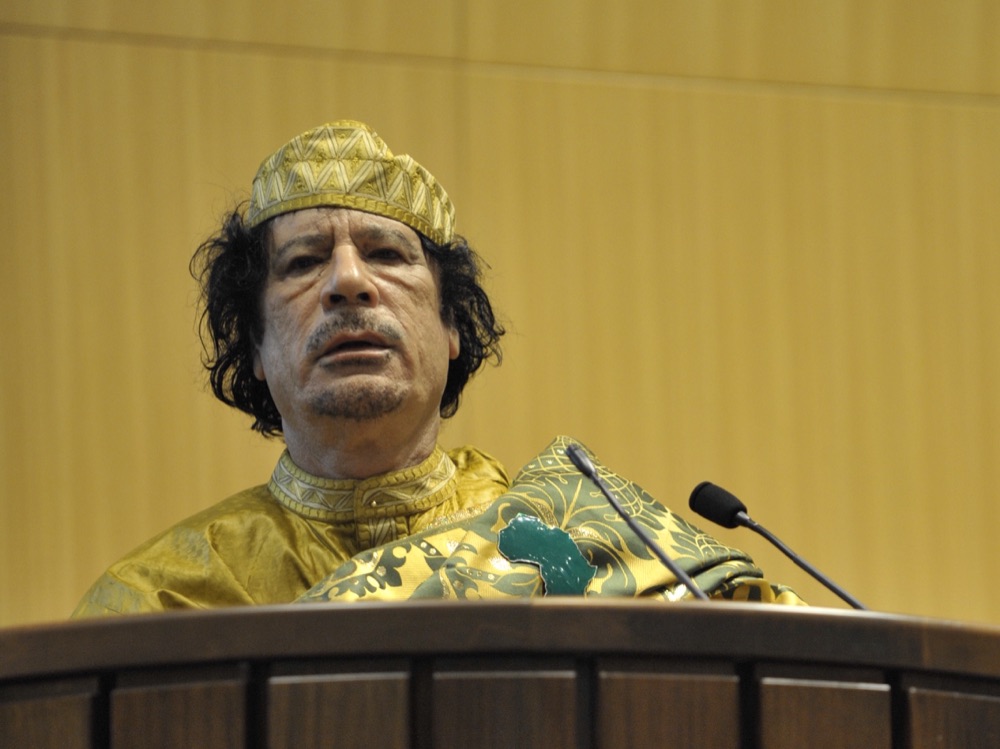
The 2003 acknowledgment was carefully worded. Libya accepted "responsibility for the actions of its officials" — a formulation that did not specify state authorisation chains, did not name additional operational personnel, and did not concede the substantive details of the December 1988 operation. Libyan officials maintained, in subsequent statements through 2008, that the formal acknowledgment had been a sanctions-removal mechanism rather than an evidentiary statement.
The 2011 Libyan Civil War and the subsequent end of the Gaddafi regime opened the possibility of further documentary recovery from Libyan state files. Post-2011 disclosures have included Libyan intelligence service (Mukhabarat al-Jamahiriya) records partially confirming the operational involvement of External Security Organisation personnel in the Lockerbie file. The records have not, as of 2026, been fully released to U.S. or U.K. authorities.
Mas'ud — 2022 onwards
The U.S. Department of Justice unsealed an indictment against Abu Agila Mohammad Mas'ud Kheir Al-Marimi on December 21, 2020 — the 32nd anniversary of the bombing. The indictment, returned by a grand jury in the District of Columbia, identified Mas'ud as a Libyan External Security Organisation technician responsible for the construction of the device used in the Lockerbie operation.
Mas'ud had been in custody in Libya from 2011 (in connection with separate domestic charges relating to the Gaddafi regime). On December 11, 2022, following an extended extradition negotiation, Mas'ud was transferred from Libyan custody to U.S. federal custody and brought to the United States. He appeared in U.S. District Court for the District of Columbia on December 12, 2022. He pleaded not guilty.
Mas'ud's trial in the District of Columbia is ongoing as of mid-2026. The case has been complicated by procedural questions including the admissibility of his 2012 confession (made during interrogation by Libyan post-revolutionary authorities) and by the chain-of-evidence issues that have followed the Lockerbie file for thirty years. A verdict is not expected before late 2026.
The cast
Sources
Primary documents:
- Aircraft Accident Report 2/90 — Report on the Accident to Boeing 747-121, N739PA at Lockerbie, Dumfriesshire, Scotland on 21 December 1988, Air Accidents Investigation Branch, August 1990.
- Her Majesty's Advocate v. Abdelbaset Ali Mohmed Al Megrahi and Al Amin Khalifa Fhimah, High Court of Justiciary at Camp Zeist, May 3, 2000 – January 31, 2001. Verdict and opinion of the Court available via the Scottish Court Service.
- Megrahi v. HMA, Court of Criminal Appeal, March 14, 2002 (first appeal).
- Scottish Criminal Cases Review Commission, Megrahi Statement of Reasons, June 28, 2007 (partial public release).
- U.S. Department of Justice indictment of Abu Agila Mohammad Mas'ud Kheir Al-Marimi, U.S. District Court for the District of Columbia, December 21, 2020.
- U.N. Security Council Resolutions 731 (January 1992), 748 (March 1992), 883 (November 1993).
- Libyan letter to U.N. Security Council, August 15, 2003 (acknowledgment of responsibility).
- FBI Lockerbie Investigation case file, declassified portions through 2025.
Secondary investigative reporting: 9. John Ashton, Megrahi: You Are My Jury (Birlinn, 2012). The principal book-length defence-perspective account. 10. John Ashton and Ian Ferguson, Cover-Up of Convenience: The Hidden Scandal of Lockerbie (Mainstream, 2001). 11. David Leppard, On the Trail of Terror: The Inside Story of the Lockerbie Investigation (Jonathan Cape, 1991). 12. Paul Foot, Lockerbie: Flight from Justice (Private Eye Special Report, 2001). 13. PBS Frontline, "The Lockerbie Trial" (2001) and "Pan Am 103: A Story of Justice" (2002). 14. BBC Panorama, multi-decade Lockerbie coverage 1989-2024. 15. The New York Times and The Sunday Times, multi-decade Lockerbie coverage 1988-2024. 16. Lockerbie: The Long Road to Justice (Sky/Peacock, 2025 dramatic miniseries). 17. Lockerbie (BBC/Netflix, 2025 dramatic miniseries based on Jim Swire's account).
Academic / specialist scholarship: 18. Hans Köchler, Justice — Not Vengeance: Reflections on the Lockerbie Verdict, U.N. Observer at the Camp Zeist trial (Penal Reform International, 2002). 19. Robert Black, Lockerbie: A Satellite View of the Trial (in Edinburgh Law Review 2002 and subsequent essays). 20. Charles Norrie, The Wider Lockerbie Case (online dissertation, 2010). 21. International Bar Association Newsletter, "The Lockerbie Trial: A Critical Review" (multi-author symposium, 2002).
Corrections & updates
2026-06-03: First publication.
Inspired this / based on it
John Ashton
Birlinn. The book-length defence-perspective account drawing on Megrahi's extended interviews.
BBC / Netflix
Miniseries based on Dr. Jim Swire's decades-long investigation. Colin Firth as Swire.
Sky / Peacock
Alternate 2025 dramatic miniseries with focus on the Scottish investigators and Camp Zeist trial.
PBS Frontline
Contemporary documentary of the Camp Zeist proceedings.
John Ashton and Ian Ferguson
Mainstream Publishing. Investigative critique of the official narrative.
David Leppard
Jonathan Cape. The contemporary investigative account by the Sunday Times reporter.
Filed under
- #lockerbie
- #pan-am-103
- #abdelbaset-al-megrahi
- #lamin-fhimah
- #muammar-gaddafi
- #libya
- #scotland
- #camp-zeist
- #pflp-gc
- #toshiba-bombeat
- #mebo-mst-13
- #fbi
- #scottish-police
- #1988
- #europe
- #middle-east
- #declassified
Click any tag for every article carrying it.
Continue reading

Iran 1953 — Operation Ajax
In the summer of 1953, the CIA was six years old. It had never overthrown a government. By August 19 of that year, working with British MI6, it had — and the country it had overthrown was Iran, the prime minister was Mohammad Mosaddegh, and the cause was, almost entirely, oil. The operation was codenamed Ajax. It was authorized by President Eisenhower against the recommendation of his Secretary of State, executed on the ground by a 36-year-old grandson of Theodore Roosevelt, and very nearly failed. The CIA officially acknowledged its role only in August 2013.
The Umbrella Murder: The Poisoning of Georgi Markov
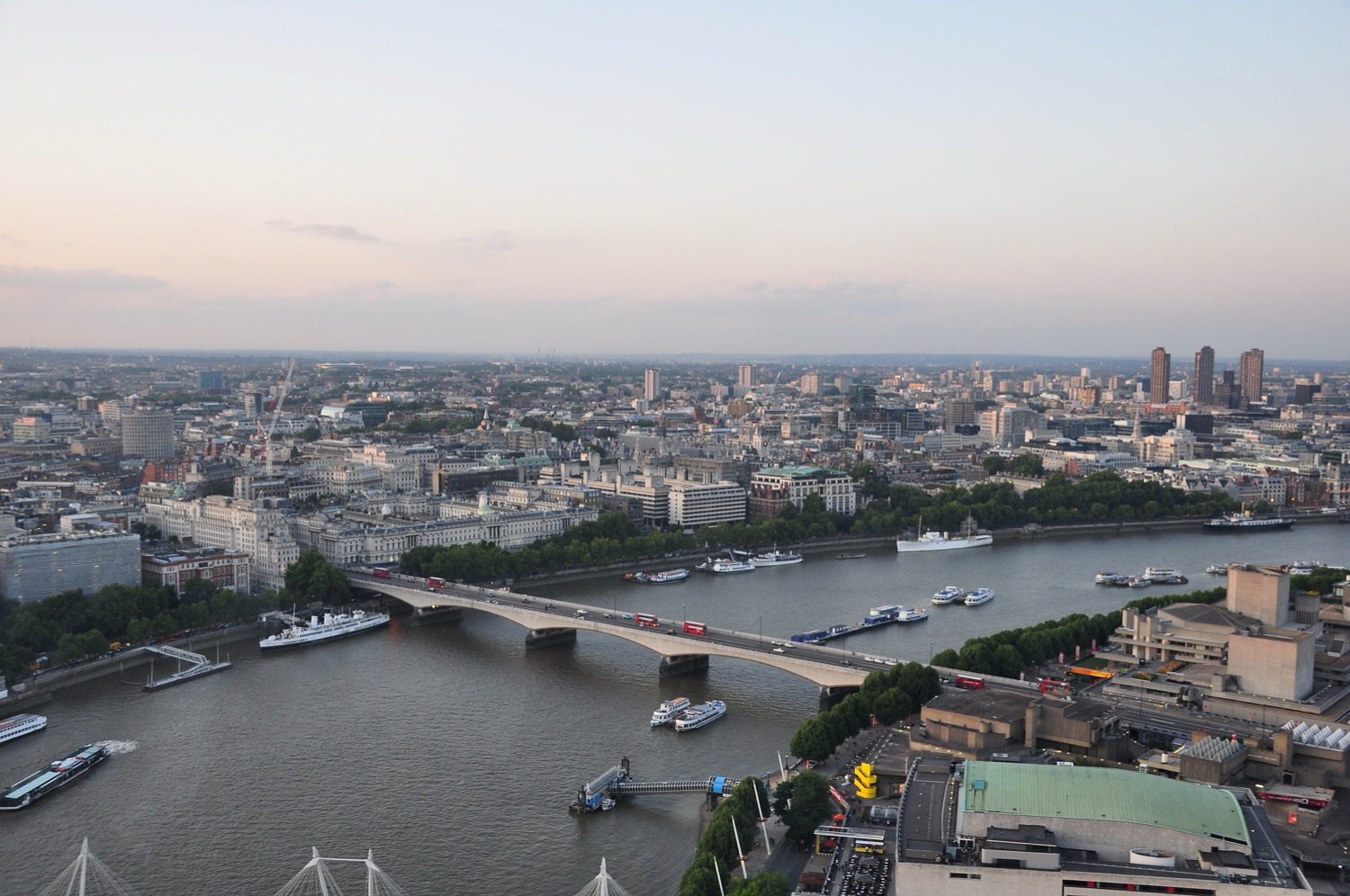
On the afternoon of 7 September 1978, Georgi Markov, a Bulgarian émigré writer, was waiting at a bus stop on Waterloo Bridge in London, on his way to his job at the BBC World Service, when he felt a sudden sharp sting in the back of his right thigh. Turning, he saw a man behind him bending to pick up a dropped umbrella; the man apologised in a foreign accent, hurried across the road, and got into a taxi. Markov thought little of it at first, but by that evening he had developed a high fever, and over the next three days his condition collapsed catastrophically. He died on 11 September, aged forty-nine. A post-mortem examination found, embedded in his thigh, a tiny metal pellet no larger than a pinhead, drilled with minuscule cavities that had held a dose of ricin — one of the deadliest toxins known, and one for which there is no antidote. Markov had been assassinated in broad daylight on a London street, murdered for the crime of broadcasting the truth about the communist regime in his homeland. The method — a poison pellet delivered, it is believed, by a specially engineered umbrella — became one of the most infamous images of Cold War espionage, and the killing itself one of its clearest examples of a state reaching across borders to silence a dissident. This is the story of the umbrella murder.
The Poisoning of Alexander Litvinenko: Polonium in a London Teapot
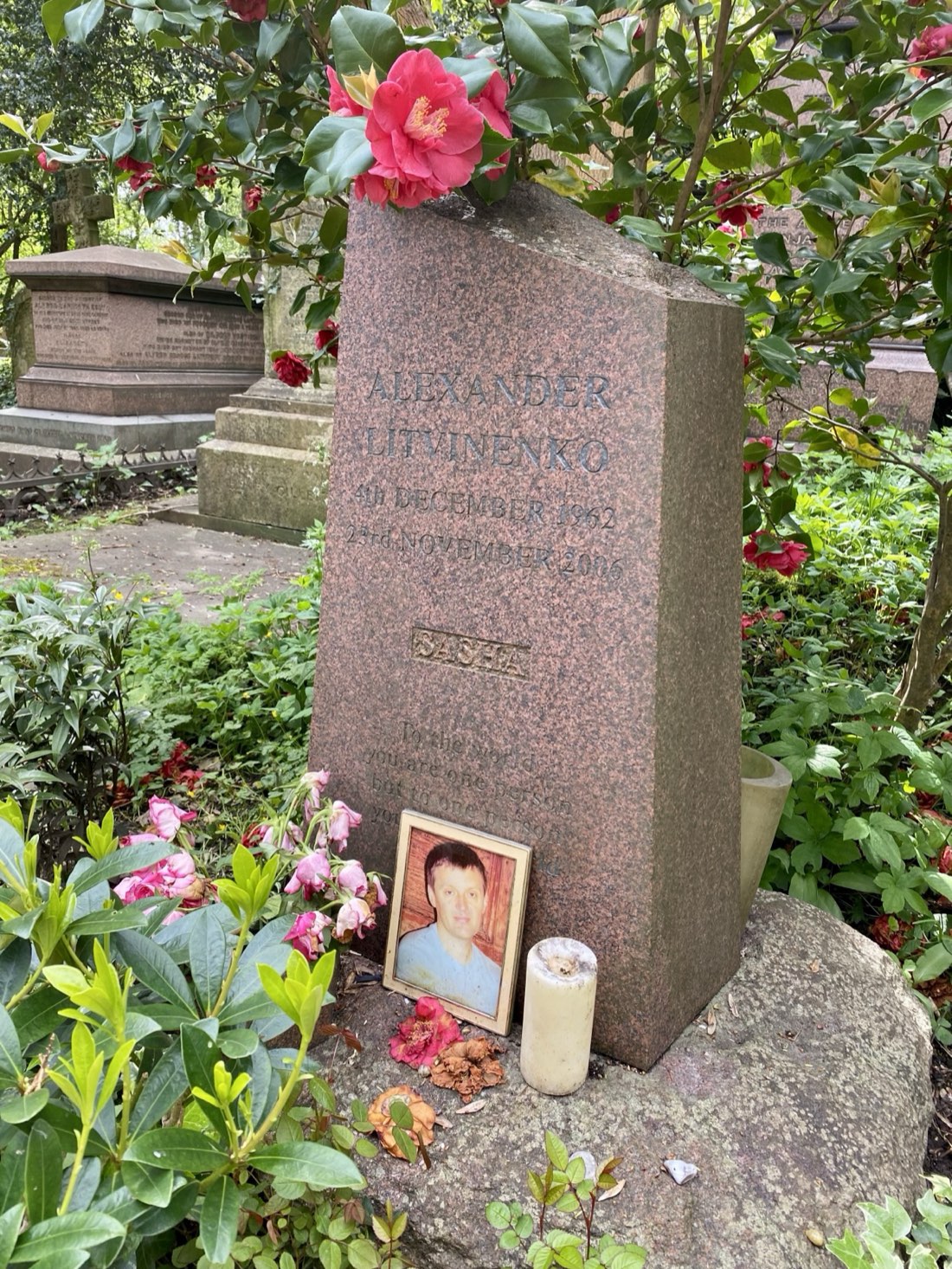
On 1 November 2006, Alexander Litvinenko, a former officer of Russia's FSB security service who had defected to Britain and become one of the Kremlin's most outspoken critics, met two Russian contacts for tea at the Pine Bar of the Millennium Hotel in London's Mayfair. Within hours he was violently ill; over the following three weeks he wasted away in a hospital bed, his hair falling out, his organs failing, as doctors struggled to identify what was killing him. Only as he lay dying did they discover the cause: polonium-210, a rare and extraordinarily radioactive isotope, which had been slipped into his teapot. He died on 23 November 2006, aged forty-four, but not before dictating a statement accusing President Vladimir Putin directly of ordering his murder. The polonium had left a faint radioactive trail across London — through the hotel, restaurants, offices, and aircraft — which investigators followed to two Russian men, and, they concluded, back to the Russian state itself. A decade later, a British public inquiry found that Litvinenko had been killed in an operation carried out by the FSB and 'probably approved' by Putin himself. It was an assassination by radiation on the streets of a Western capital, and one of the most brazen acts of state murder of the twenty-first century. This is the story of the polonium poisoning of Alexander Litvinenko.