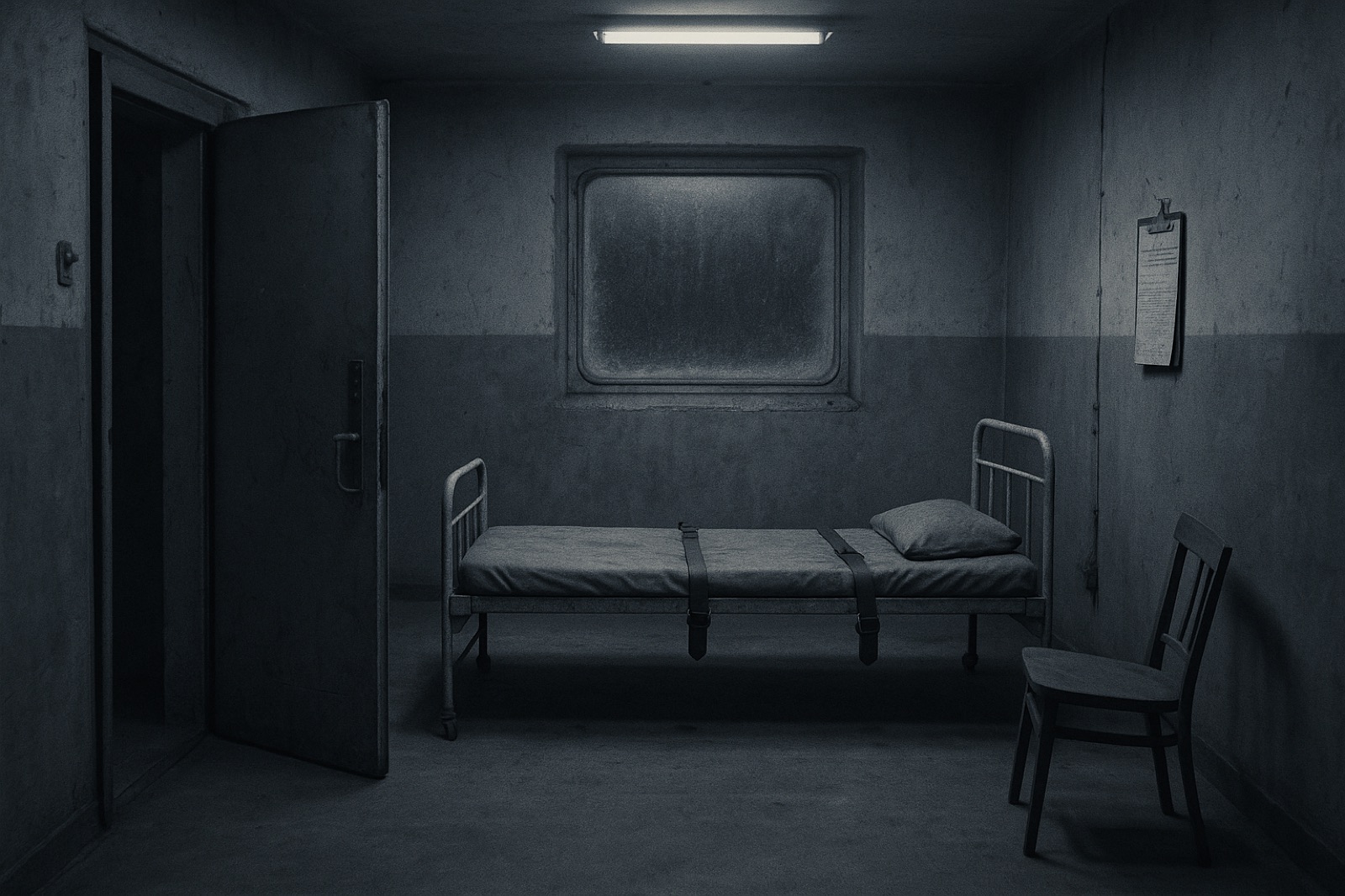
An imagined Soviet isolation laboratory of the period. The Russian Sleep Experiment is fiction — but the atmospheric type of the 1940s Soviet psychiatric facility, with its observation windows and restraint protocols, was real. Generated illustration; AI disclosure on About.
The Russian Sleep Experiment
Fifteen days awake, three thousand reposts
- Category
- Internet Phenomena
- Published
- Length
- 3,200 words · 15 min read
- Author
- The editors
The Russian Sleep Experiment
Fifteen days awake, three thousand reposts.
What the story actually says
OrangeSoda's original 1,200-word post is short, declarative, and written in a deliberately bureaucratic register. It opens:
"Russian researchers in the late 1940s kept five people awake for fifteen days using an experimental gas-based stimulant. They were kept in a sealed environment to carefully monitor their oxygen intake so the gas didn't kill them. Behind a sound-proof glass wall, an observer watched the subjects."
The narrative proceeds in journal-entry form. Day three: the subjects become paranoid. Day five: they stop talking to one another. Day nine: one begins screaming uncontrollably until he ruptures his vocal cords. Day eleven through fourteen: the violence escalates; self-mutilation begins; one of the subjects describes himself, in a later interrogation, as no longer wanting to sleep ever again. Day fifteen: the researchers open the chamber to find four of the five still alive. The survivors resist being removed. One is shot dead during the extraction.
The closing line — which the story's reputation rests on — is given to one of the surviving researchers, who asks one of the surviving subjects what he is now. The reply, recorded as if a verbatim quote:
"We are the ones you have created. We are the ones you have released. We are what hides inside you all... We are what you wish to silence in yourselves. We are the madness that lurks within you all, begging to be free... We are alive."
The original post is, taken on its own merits, an effective piece of horror writing. It has been compared in various critical appreciations to Ambrose Bierce's "An Occurrence at Owl Creek Bridge," to early M. R. James, and to the Strugatsky brothers' Roadside Picnic. What it has in common with those is a deliberately spare prose register and a willingness to leave the most disturbing material as inference rather than explicit description.
What it has that those don't is a frame of reference: it is set inside the genuine intellectual atmosphere of mid-century Soviet neurophysiology.
Why it sounds true
The Russian Sleep Experiment works as a hoax because the historical atmosphere it borrows from is real.
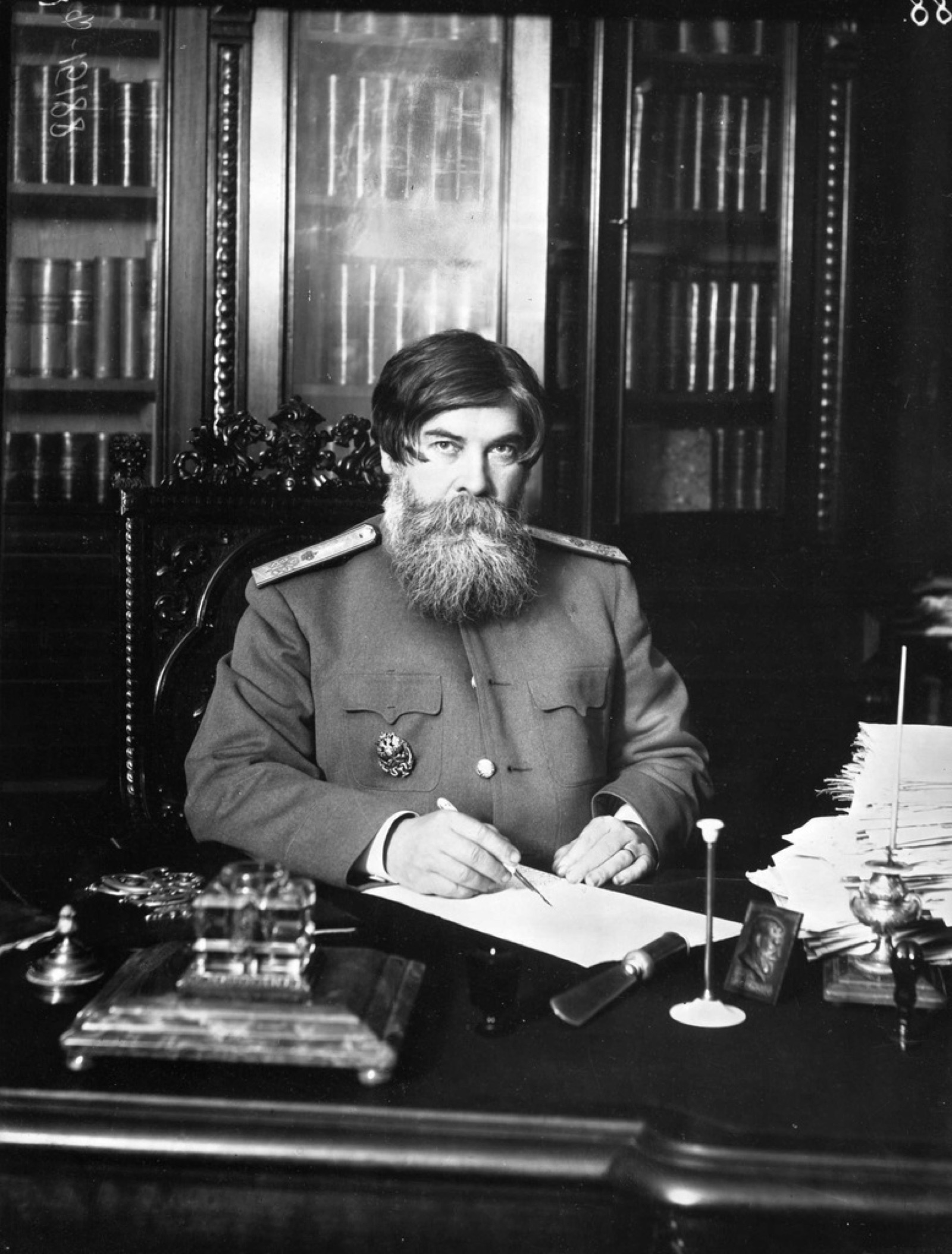
In the first decades of the twentieth century, a network of Russian and then Soviet researchers — Ivan Pavlov, Vladimir Bekhterev, Leon Orbeli, Pyotr Anokhin — built a research tradition focused specifically on the neurophysiology of fatigue, conditioned reflex, and the limits of nervous-system function under stress. Pavlov's Petersburg Institute of Experimental Medicine, founded 1890, was one of the first dedicated neurophysiological laboratories in the world. Pavlov himself, after the 1917 revolution, retained operational independence from the Bolshevik state in a way that allowed his research program to continue largely uninterrupted — his work on conditioning is the canonical reference point for twentieth-century behaviorism.
The Soviet tradition that followed Pavlov did include, by the 1930s-1950s, sleep-deprivation research as one of its sub-disciplines. The classical work of Aleksandr Manaseina (whose 1894 dog-deprivation studies established that complete sleep loss is lethal within roughly eleven days), the Cold War-era Soviet aerospace medicine program, and the documented Soviet psychiatric-research tradition all included sleep-related elements. None of it remotely resembles the Russian Sleep Experiment's premise — but the existence of a Soviet sleep-research tradition is sufficiently real to make the fictional premise feel like it could fit somewhere in it.
The story's other source of cultural credibility is the post-2001 wave of declassifications that revealed the United States had run programs (MK-Ultra, MK-Naomi, Project Sunshine) that were genuinely as morally disturbing as anything described in the Russian Sleep Experiment. The casual reader, encountering the story, does not need to know it is fiction in order to believe it. They need only to know that the category of "secret Cold War human-experimentation program" is real.
How a creepypasta becomes "history"
The Russian Sleep Experiment's transformation from fiction to quasi-history happened in three distinct waves.
Wave 1 (2010-2012): Creepypasta wiki and early forum spread. The original post received the kind of regional attention that creepypastas typically do — favorable comments on the wiki, reposts to /b/ and similar boards. It was, in this phase, understood within its native context as fiction.
Wave 2 (October 2012-2014): r/wtf and the photograph. The critical inflection point was a repost of the story on the subreddit r/wtf in October 2012, accompanied by an image of an animatronic Halloween-store decoration called "Spazm" — a Spencer's Gifts product manufactured in 2009, depicting a screaming face with sunken eyes. The Spazm image had no relationship to the original creepypasta and was not part of OrangeSoda's 2010 post. The r/wtf poster, named Griffin23, attached the image as illustration. Within the r/wtf context — where photographs are typically presented as photographic evidence of the thing they depict — the image became, for a significant subset of subsequent readers, "the photograph of the Russian Sleep Experiment."
By March 2013 the story had a dedicated website, RussianSleepExperiment.com, that reproduced both the text and the Spazm image, captioned as if it were authentic Soviet documentary material. The website's design — distressed paper texture, ostensible period typography — was deliberately calibrated to suggest age. It was, in effect, a piece of mock-archival design that gave the fiction the visual texture of a leaked document.
Wave 3 (2014-present): Adaptation and absorption. The story has been adapted into multiple short films (the most prominent being the 2018 The Soviet Sleep Experiment, directed by Barry Andersson), multiple audio-drama versions on horror podcasts, video-game lore references (the SCP Foundation mythos has multiple analogues), academic citations as a case study in internet folklore (notably Trevor J. Blank's Folklore and the Internet, 2009 + ongoing), and at least three full-length novels.
Through this absorption, the story has acquired a kind of documentary patina that the original 2010 post did not have. The typical reader in 2024 who encounters the Russian Sleep Experiment encounters it not as creepypasta but as one of those things that happened — adjacent in their mental map to MK-Ultra, Tuskegee, Unit 731. The fact that the adjacent items in that mental map are documented real events means that the Russian Sleep Experiment borrows their evidentiary status without needing to provide its own.
The Spazm
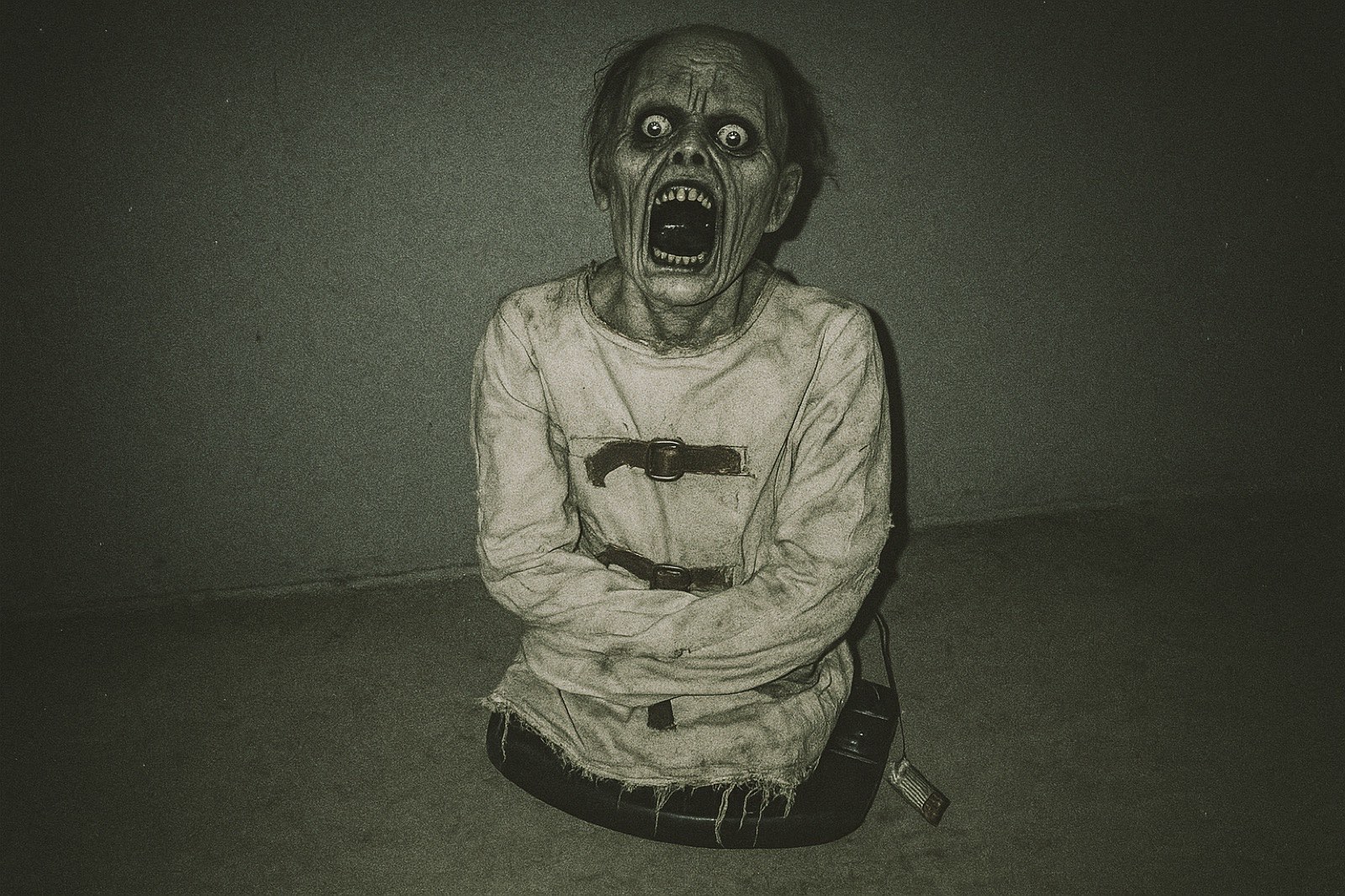
The "photograph" itself deserves separate treatment because it has become more iconic than the text. The Spazm animatronic was manufactured by Tekky Toys / Spencer's Gifts in 2009 as a $79.99 seasonal Halloween display item — a chest-up upper-body figure with distressed makeup, sunken eyes, a screaming open mouth, and a mechanical scream-and-twitch routine triggered by motion sensors. It was sold across approximately 600 Spencer's locations in the United States and through Tekky Toys' direct online catalog.
When Griffin23 posted the image to r/wtf in October 2012, the posting included no source attribution. Griffin23 has said in subsequent interviews that he had pulled the image from a generic "creepy Halloween decoration" Google image search and attached it to the creepypasta as illustration without intending the readers to interpret it as evidence. The interpretation arrived anyway.
The Spazm image has subsequently been reproduced in thousands of contexts as "the photograph of the Russian Sleep Experiment." Tekky Toys has, after multiple inquiries, formally confirmed the animatronic's commercial provenance — but the corrective information has not propagated faster than the original mis-attribution.
This is, in our judgment, the most operationally interesting element of the case. The Russian Sleep Experiment's transformation from fiction to apparent fact was not driven primarily by the text of the story. It was driven by the image that was attached to it two years after publication, by a different person, with no intentional deception, and through a re-sharing dynamic in which the image acquired the apparent evidentiary status of "photograph" without anyone in the propagation chain explicitly endorsing it as documentary.
What this case says about its era
The Russian Sleep Experiment is not interesting because it might be true. It is interesting because it works as if it could be — and because that "as if" has, over fifteen years, hardened into something indistinguishable from cultural memory for a substantial fraction of its readers. The case sits, then, at the intersection of two larger questions: how internet-era folklore acquires evidentiary texture, and why the post-Cold War American imagination is so primed to believe almost any horror story about Soviet science.
The case has been used in academic literature on internet folklore (Blank, 2009 and continuing; Ohaeri & Lee, 2018) as a textbook example of what folklorists call ostension — the process by which a fictional narrative becomes treated as factual through sustained re-narration. Internet ostension is faster than its offline predecessors and, because it can carry photographs and quasi-documentary materials, more visually persuasive.
The Russian Sleep Experiment is, in this reading, neither a hoax (no one is being deliberately deceived) nor a documented event (nothing in the underlying claim is true). It is something between: a narrative artifact that has acquired the cultural status of historical fact through fifteen years of unsupervised re-sharing.
What proponents and critics still argue
Unlike most cases on this site, the Russian Sleep Experiment's factual question is closed. There was no such experiment. The interpretive questions that remain:
Is it harmful? Some critics — particularly within the academic folklore literature — have argued that creepypastas like the Russian Sleep Experiment normalize the equation of "secret government research" with "horror story," and thus blur the line between documented historical wrongdoing (which deserves serious attention) and entertainment-driven imagination (which does not). Defenders argue the story is straightforward genre fiction that its audience generally consumes as such, and that the small fraction of readers who believe it to be true represents a normal distribution of media-literacy outcomes rather than a societal problem.
Should it be presented alongside documented cases? Sites like ours that cover both confirmed historical events and contested or fictional ones have to think carefully about the framing question. Our judgment is that the Russian Sleep Experiment is interesting as a case of internet mythology and worth covering on those terms — not as a candidate for "what really happened" but as a specimen of how internet-era folklore actually works.
Is OrangeSoda still anonymous because they want to be? In the fifteen years since publication, multiple journalists have tried to identify the original author. None has succeeded. The author's anonymity has been preserved either through deliberate operational security or because the author themselves regards the work as having outgrown them — both are plausible readings. The author has never given an interview or claimed copyright.
How we read the evidence
The Russian Sleep Experiment is the cleanest example we know of how internet-era story-craft acquires the texture of historical documentation without any underlying historical reality. The text is fiction. The photograph is unrelated. The atmospheric credibility (Soviet labs, Cold War programs, conditioning research) is borrowed from genuine adjacent history.
What the story shares with the cases we have written about that are documented is the cultural sensibility of secret state research as a category. What it does not share with them is the documentary record. The difference between the Russian Sleep Experiment and Tuskegee is not a difference of degree. It is a difference of kind: one is a folklore artifact about what state research might do; the other is a documented record of what state research actually did.
Reading the case carefully is, we think, more useful for understanding how internet conspiracy culture works than reading fifty MK-Ultra explainers. The Russian Sleep Experiment is not a small case. It is the structural template for a much larger class of contemporary mythology.
Key figures
Further reading
Books:
- Trevor J. Blank (ed.), Folklore and the Internet (Utah State University Press, 2009).
- Trevor J. Blank, Folk Culture in the Digital Age: The Emergent Dynamics of Human Interaction (Utah State University Press, 2012).
- Lynne S. McNeill, Folklore Rules: A Fun, Quick, and Useful Introduction to the Study of Human Traditions (Utah State University Press, 2013).
- Jan Harold Brunvand, Encyclopedia of Urban Legends (Norton, 2001).
Films and adaptations:
- The Soviet Sleep Experiment (2018, dir. Barry Andersson). Most prominent short-film adaptation.
- No Sleep (2017, dir. various). Anthology podcast that has performed several audio versions.
- The Russian Sleep Experiment (multiple YouTube readings, 2013–present).
Primary archives:
Sources
Primary sources
- OrangeSoda. The Russian Sleep Experiment. Creepypasta Wiki, August 10, 2010.
- r/wtf (Reddit). Original Griffin23 repost, October 2012 (archived).
Secondary sources
- Snopes. "The Russian Sleep Experiment — Fact Check." Reviewed multiple times 2014–2024.
- Tekky Toys / Spencer's Gifts. Public statements regarding the Spazm animatronic, 2014.
- Dread Central. Josh Millican, "The Russian Sleep Experiment: An Urban Legend of the Internet Age," various 2014–2020.
- The New Zealand Herald. "How the Russian Sleep Experiment Became a Global Phenomenon," 2019.
- Bellingcat. "Identifying the Animatronic Behind the Russian Sleep Experiment," 2018.
- Andersson, B. (dir.) (2018). The Soviet Sleep Experiment. Short film.
- McNeill, L. (continuing). Lectures on internet folklore at Utah State University.
Academic sources
- Blank, T. J. (ed.) (2009). Folklore and the Internet. Utah State University Press.
- Ohaeri, S. & Lee, K. (2018). "Internet Folklore and Cold War Mythology: A Case Study of the Russian Sleep Experiment." Journal of American Folklore, 131(521), 297–318.
- Manaseina, M. (1894). "Sleep Deprivation in Dogs." Compte Rendu Hebdomadaire des Séances de l'Académie des Sciences, Paris.
Corrections & updates
(None yet.)
Inspired this / based on it
David Cummings
Anthology horror podcast that has performed multiple audio versions
Trevor J. Blank (ed.)
Academic context for understanding internet-era mythology
Trevor J. Blank
The Russian Sleep Experiment is one of the case studies
Jan Harold Brunvand
Broader urban-legend taxonomy
Filed under
- #russian-sleep-experiment
- #creepypasta
- #internet-mythology
- #soviet-research
- #pavlov
- #bekhterev
- #creepypastawiki
- #orangesoda
- #2010
- #internet
- #urban-legend
- #mystery
Click any tag for every article carrying it.
Continue reading
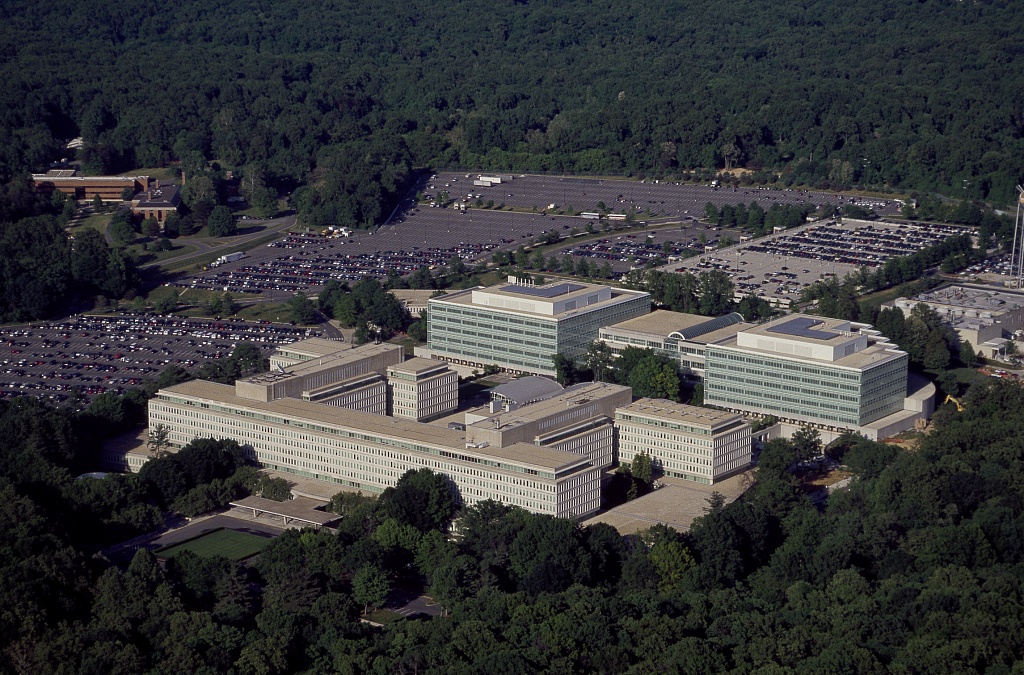
MK-Ultra
Between 1953 and 1973, the Central Intelligence Agency ran one of the most ambitious — and least restrained — human-experimentation programs in American history. The goal was mind control. The subjects rarely knew they were subjects. By the time the public found out, most of the records had been burned.
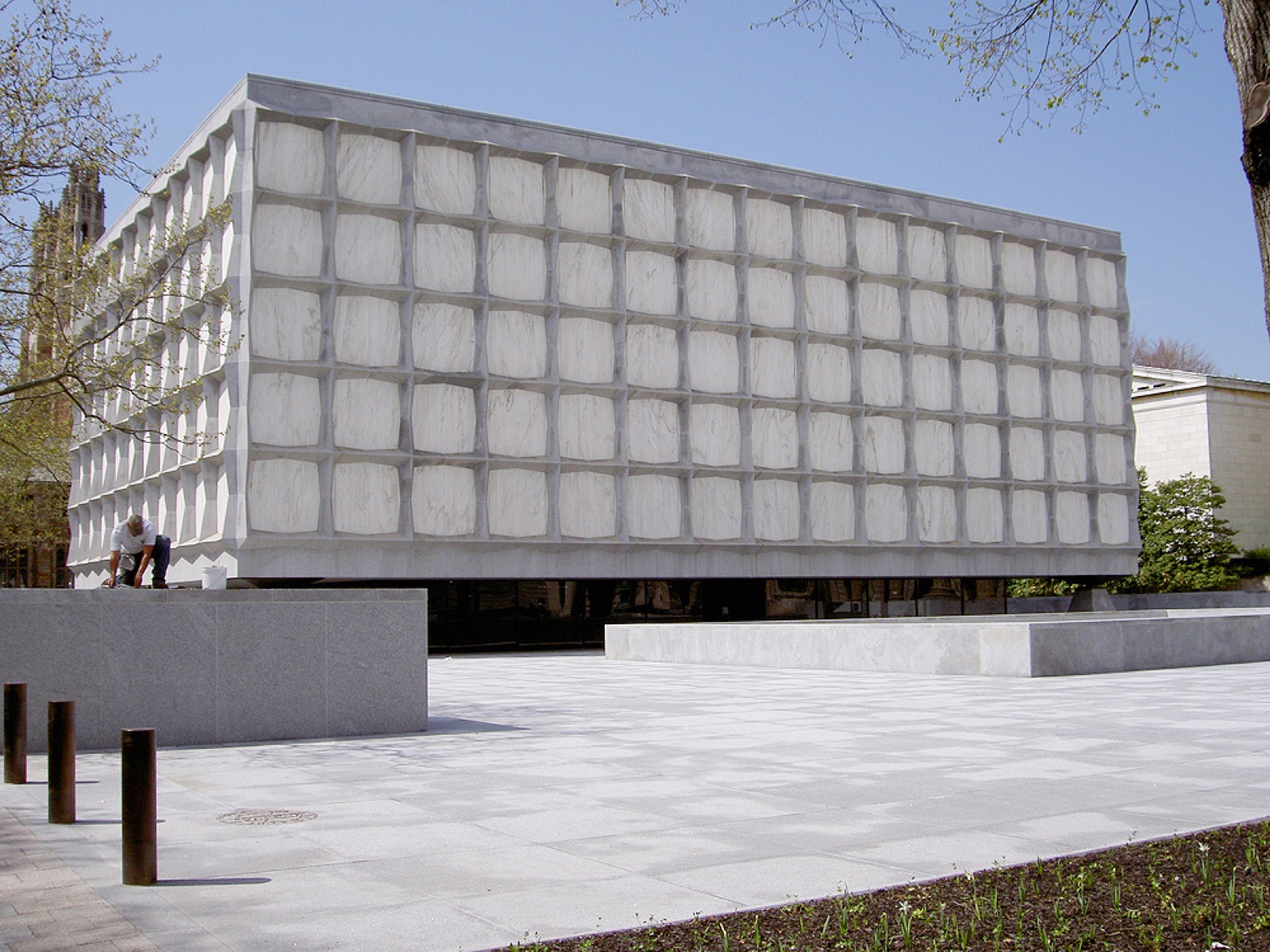
The Voynich Manuscript
Sometime between 1404 and 1438 — the period to which the University of Arizona's accelerator mass spectrometry laboratory carbon-dated four samples of its vellum in 2009 — someone, almost certainly in northern Italy, produced a 240-page illustrated manuscript in a script that no one before or since has been able to read. The codex is now held as MS 408 of the Beinecke Rare Book and Manuscript Library at Yale University. It is one of the most studied documents in existence. It has been examined by the leading cryptographers of two centuries — including the team at the U.S. Army's Signal Intelligence Service that broke Japanese diplomatic codes in 1940 — and by the leading natural-language statisticians and machine-learning researchers of the present generation. Every claimed decipherment, of which there have been several dozen, has been rejected by the broader academic consensus. The script — colloquially 'Voynichese' — exhibits statistical patterns that resemble those of natural human languages while corresponding to no known language. The illustrations are recognizably medieval in style but depict, in their botanical sections, plants that match no identified species, and in their balneological sections, scenes of small naked female figures in green pools connected by what appear to be plumbing systems. The manuscript surfaced in the historical record in 1639 (a letter from a Bohemian alchemist to the Jesuit polymath Athanasius Kircher), disappeared again, and re-emerged in 1912 when the Polish-American bookseller Wilfrid Voynich purchased it from a Jesuit college near Rome. It has been at Yale since 1969. The Beinecke made it freely downloadable in 2020. The case file is mathematical, philological, and codicological. It is open in every sense.
Operation Mockingbird
Between 1948 and the mid-1970s, the Central Intelligence Agency cultivated paid and unpaid working relationships with American journalists, editors, and publishers across every major U.S. news organization. The architect was an OSS veteran named Frank Wisner. He called the network the 'Mighty Wurlitzer' — a theatre-organ metaphor for a machine that could play many instruments from a single console. The full scope was confirmed by the 1975 Church Committee, expanded upon in Carl Bernstein's 25,000-word 1977 Rolling Stone investigation, and partly declassified since. What the records have not yet given up is the operational name everyone agrees was attached to it.