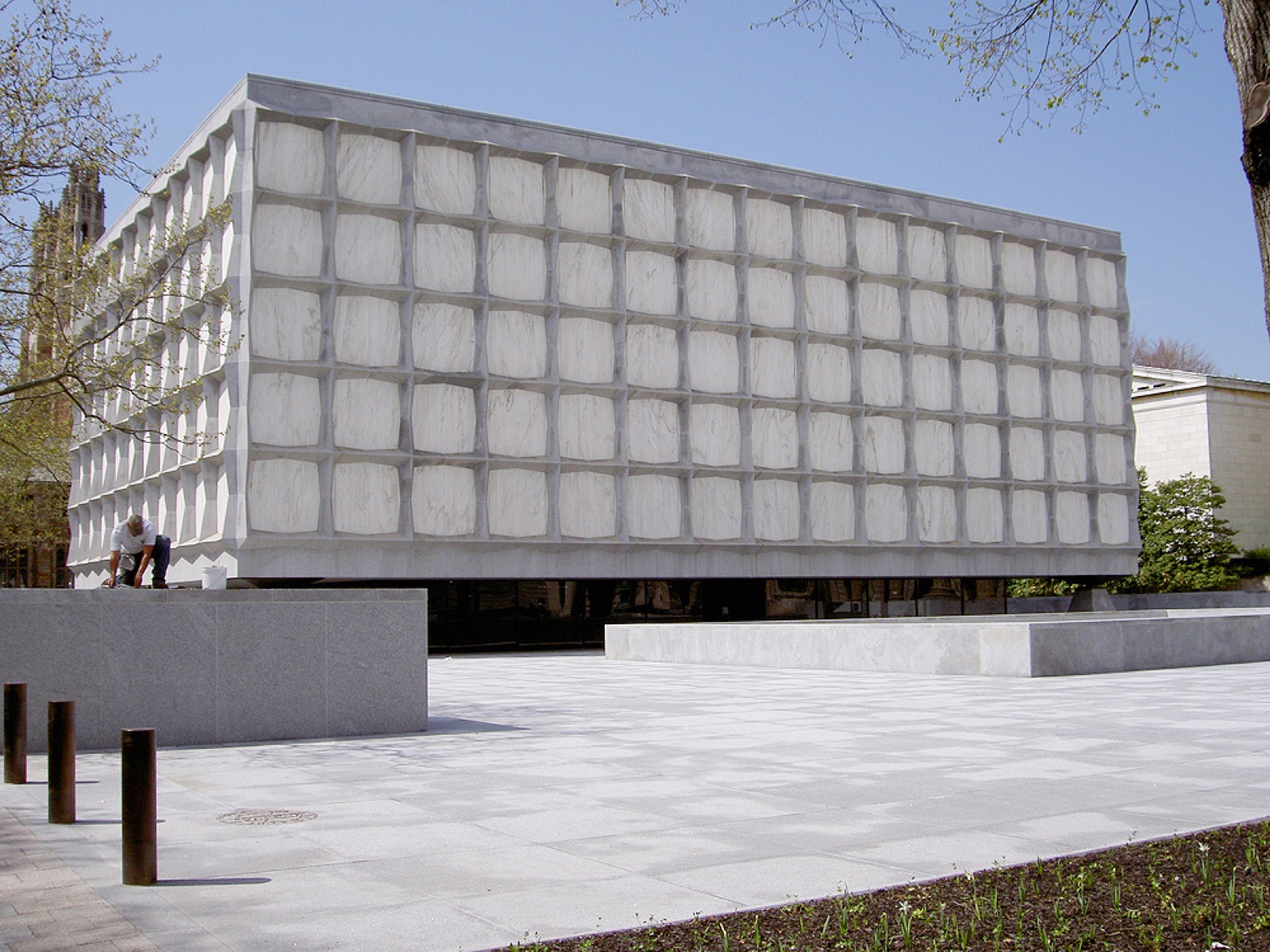
The Beinecke Rare Book and Manuscript Library, Yale University, New Haven, Connecticut. Designed by Skidmore, Owings & Merrill and opened October 14, 1963. The Voynich Manuscript has been held here as MS 408 since 1969. The library's exterior — translucent Vermont marble panels held in a Vierendeel truss of grey granite — admits diffused daylight without exposing the manuscripts to direct sunlight. Wikimedia Commons, public domain.
The Voynich Manuscript
Six hundred years, no one has read it
- Category
- Ancient & Historical Mysteries
- Published
- Length
- 3,700 words · 17 min read
- Author
- The editors
The Voynich Manuscript
Six hundred years, no one has read it.
The object
The Voynich Manuscript is physically modest. The codex is approximately 23.5 cm tall by 16.2 cm wide — slightly smaller than a modern paperback. The vellum is of moderate quality; the workmanship of the binding is competent but unspectacular. It contains 240 surviving folios bound in 18 quires. The paint is of period composition — iron-gall ink for the text, copper-based greens, ochre yellows, lead-white whites, and small applications of azurite blue and vermilion red for emphasis. Analysis by McCrone Associates in 2009 confirmed pigment compositions consistent with the carbon-dated period.
The text is written in a single direction (left to right), in word-groups separated by visible spaces. Five distinct scribal hands have been identified by Beinecke paleographers and confirmed by external scholars including Lisa Fagin Davis. There are no visible corrections, marginal annotations, or erasures — a notable feature, since copying errors and corrections appear in essentially all surviving medieval working manuscripts. The text appears to flow without hesitation.
The illustrations are integrated with the text — text wraps around plant drawings, text labels surround astronomical wheels, text appears within the balneological pool scenes. The integration tells us the manuscript was conceived as a complete object, not as a text supplemented later with illustration. Whatever it is, it was made all at once.
The six sections
The manuscript divides into six thematic sections, identified by image content. None of the section headings are themselves in any known language; the categorization is modern, based on what the images appear to depict.
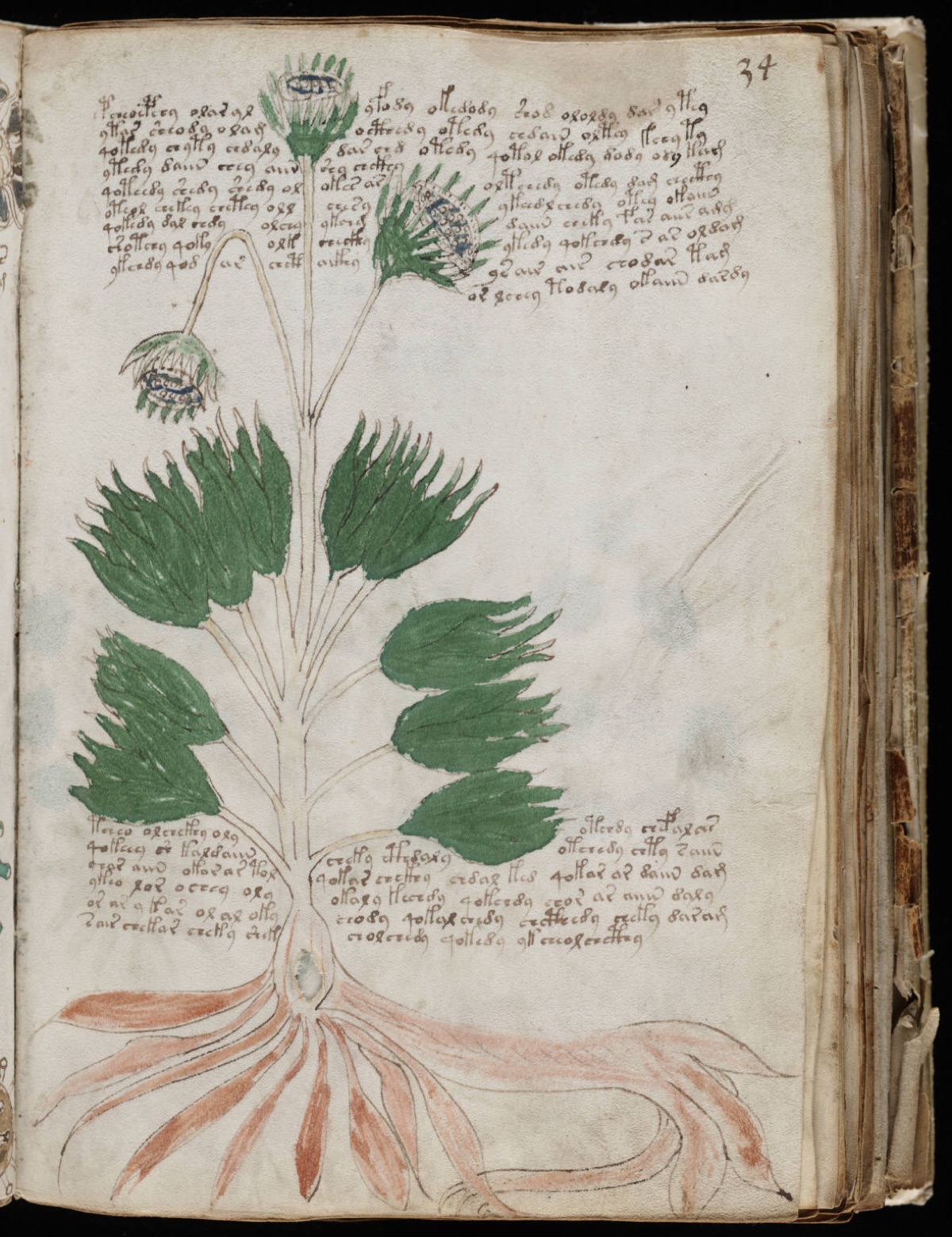
Botanical (folios 1r-66v). Approximately 113 illustrated plant specimens, each with a paragraph of accompanying text. The plants resemble medieval herbal manuscripts in format but depict no identified species. Edith Sherwood, an independent researcher, has argued for tentative identifications (sunflower, viola, etc.) for a subset of plants; the broader academic consensus is that the depicted plants are either unidentified species, composites of multiple species, or invented.
Astronomical/zodiac (folios 67r-73v). Twelve circular zodiac diagrams, each surrounded by 30 small female figures (one per degree of the zodiac sign), each figure labeled with a brief Voynichese word. The zodiac sequence as preserved runs from Pisces through Sagittarius — Capricorn and Aquarius are missing in the surviving folios. The figures are drawn with care; the labels appear to function as personal names or as some other denomination.
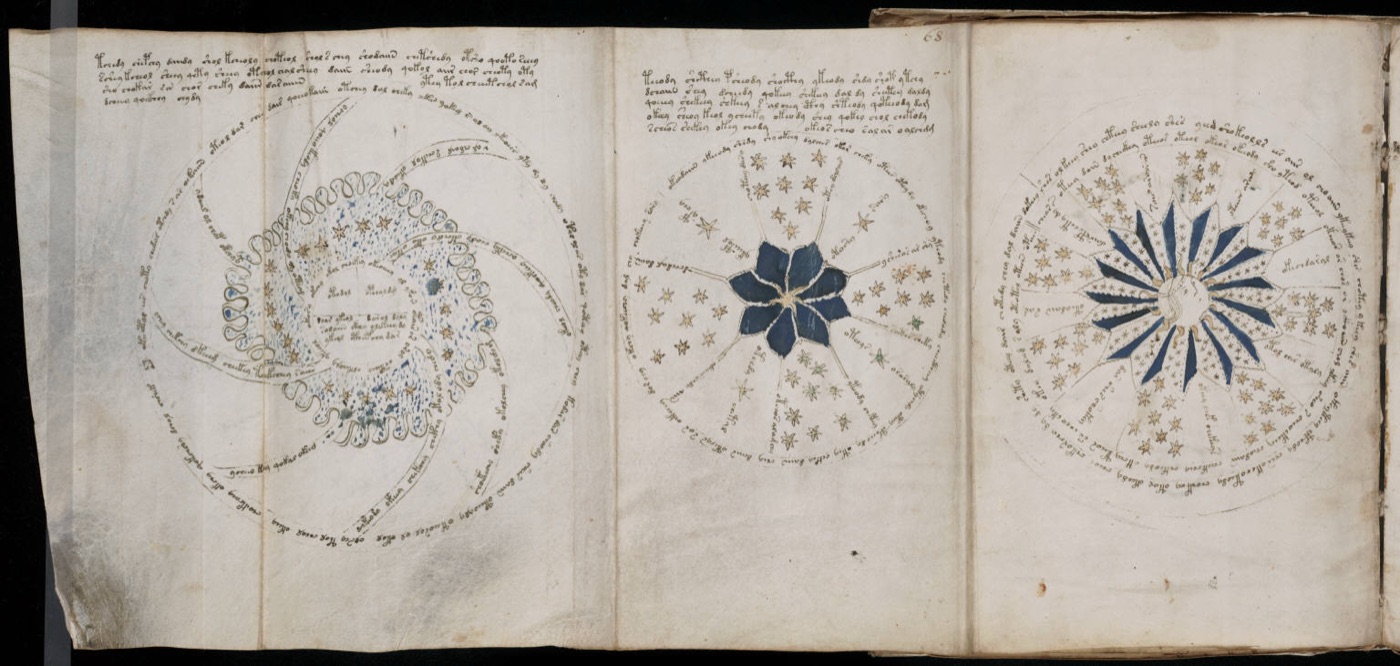
Cosmological (folios 67r-86v). A series of multi-page foldouts — the famous "Rosettes Folio" at f85v-86r unfolds to nearly four times the width of a standard page — depicting interconnected circular structures, possibly representing a cosmology or a map. The Rosettes Folio in particular has been the subject of speculative geographic identification (Diane O'Donovan has proposed a Mediterranean reading; the academic consensus has not endorsed any particular reading).
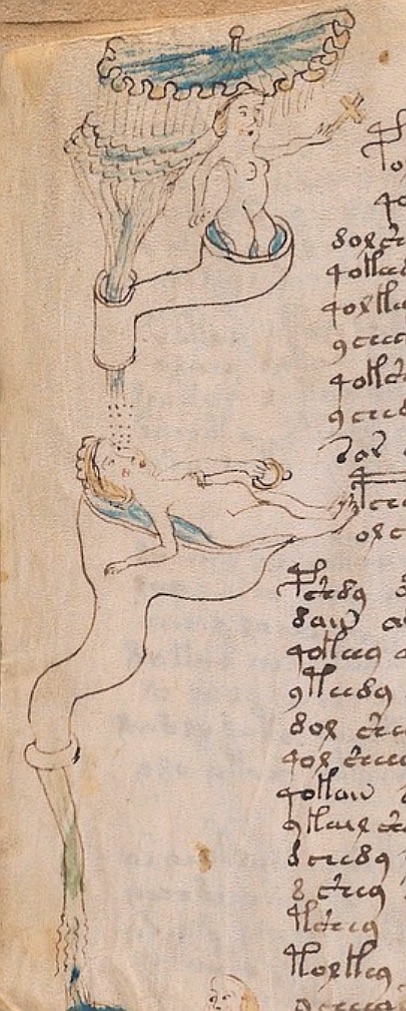
Biological/Balneological (folios 75r-84v). The most visually distinctive section: small naked female figures, depicted standing in green pools, connected by what appear to be tubes or pipes. The functional meaning has been variously proposed — anatomical theory, balneological therapy, theological allegory, alchemical iconography — without academic settlement.
Pharmaceutical (folios 87r-102v). Paragraphs of text accompanied by small drawings of plant-parts, vessels, and jars — the format of a medieval recipe or pharmacy section. No specific recipe has been identified.
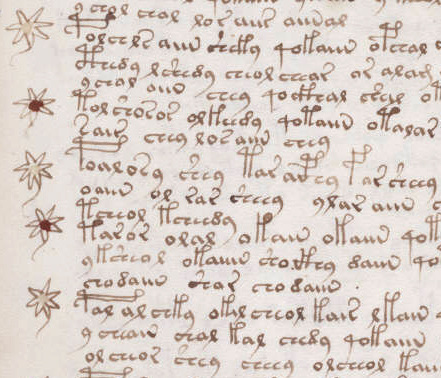
Recipes (folios 103r-116v). The final section. Approximately 324 short paragraphs, each labeled with a star or floral symbol. The recipe-section format suggests an index of brief, discrete instructions. None have been read.
The script
The script — referred to in academic shorthand as "Voynichese" — is the principal mystery of the manuscript. It has been the subject of approximately 110 years of analysis. The current consensus statistical profile (Bowern 2018; Reddy and Knight 2011; Stolfi 1997-2015) reports the following:
- Total tokens: approximately 35,000 word-instances.
- Total types: approximately 8,000 distinct word-forms.
- Type-token ratio: approximately 0.23 — within the natural-language range.
- Word-length distribution: binomial, peaked around 5-6 characters — within the natural-language range.
- Zipf-law distribution of word frequency: holds with parameters within natural-language range.
- Conditional entropy of character-given-prior-character: approximately 2.0 bits — toward the low end of natural languages but not beyond plausible range.
- Word-internal positional constraints: very strong. Certain characters appear almost exclusively at word-beginnings; others almost exclusively at word-ends. This is unusual for natural languages and is one of the features that distinguishes Voynichese as a candidate construction.
The script's statistical regularities are too tight for the hypothesis that it is random gibberish. The script's positional constraints are too strong for the hypothesis that it is a simple letter-substitution cipher of a natural language. The hypothesis that has gained ground in the academic literature since approximately 2015 is that it is a constructed or systematically transformed language — a deliberate engineered script with some functional relationship to either a natural or a constructed underlying language. No specific identification of the underlying language has been accepted.
The decipherment attempts
The Voynich Manuscript has been the subject of decipherment claims at approximately one per decade since 1921. The following are the principal claims:
William Newbold (1921). University of Pennsylvania classicist. Proposed that the script was a microscopic shorthand attributable to the 13th-century English Franciscan Roger Bacon. Newbold claimed to have read substantive Latin passages by examining individual character-strokes under magnification. The proposal was definitively refuted by Bacon-scholar Manly (Chicago, 1931) on the basis that the alleged microscopic strokes were paint-cracking artifacts.
William F. Friedman's team (1944-1978). Friedman, the principal U.S. Army cryptographer of the 20th century, became interested in the Voynich Manuscript in 1944 and led successive analysis groups through retirement. Friedman concluded — in his unpublished 1978 letter — that the manuscript was likely written in a constructed a priori language with a categorical or philosophical organizing principle, in the manner of the 17th-century constructed languages of John Wilkins and George Dalgarno. He did not produce a decipherment.
Robert Brumbaugh (1976). Yale philosophy professor. Proposed a multi-cipher reading in which different paragraphs used different substitution alphabets. He read individual plant names ("hellebore," "verbena") that did not survive subsequent scrutiny.
Stephen Bax (2014). University of Bedfordshire linguist. Identified ten plant labels with proposed phonetic readings tied to known Latin and Arabic plant names. The proposal was peer-reviewed but the readings were tentative and limited; the academic reception was cautiously interested but did not accept the readings as systematic decipherment.
Greg Kondrak and Bradley Hauer (2018). University of Alberta computer-science researchers. Applied statistical machine translation to the Voynich text using a corpus of medieval Hebrew. Reported a Hebrew anagram-cipher hypothesis with a candidate first-sentence reading. The proposal was rejected by Hebraists on philological grounds.
Claire Bowern (2018). Yale linguist; the principal academic Voynich researcher of the current generation. Bowern's analysis — published in Annual Review of Linguistics — established the statistical profile cited above and demonstrated that the manuscript is unlikely to be a simple monoalphabetic cipher and unlikely to be random gibberish. Bowern's contribution is methodological rather than translatory: she has identified what kind of object Voynichese is (a structured script with natural-language-adjacent properties) without claiming to read it.
Gerard Cheshire (2019). University of Bristol researcher. Proposed that the manuscript was written in "proto-Romance" — a putative 15th-century Mediterranean lingua franca. The claim was published in Romance Studies in May 2019 and was subsequently and widely rejected by the academic community, including by Romance philologists at peer institutions; the journal retracted the article and Bristol issued a clarification distancing the university from the publication.
Diego Cisneros (2023). Independent researcher. Proposed a Nahuatl-language reading rooted in an alleged Spanish colonial-era origin. The C14 dating (1404-1438) places the manuscript a century before any plausible Spanish-Nahuatl contact. The proposal has not been accepted.
The pattern across decipherment claims is consistent: each new claim attracts initial press attention; each is subsequently rejected by domain experts; the manuscript remains unread.
How it got to Yale
The provenance from production (ca 1420) to first historical record (1639) is incompletely traced. The most likely transmission line:
- Late 15th-16th century, northern Italy. Production and early ownership unknown.
- 1576-1612, Prague (Rudolf II). A 17th-century Bohemian source asserts that the manuscript was purchased by Holy Roman Emperor Rudolf II for 600 ducats. Rudolf II maintained a large alchemical/occult library at Prague Castle and is a plausible owner.
- Post-1612. The manuscript passed to Jakub Hořčický (a Rudolfine court physician), then to Georg Baresch (a Prague alchemist), then to Joannes Marcus Marci (rector of Charles University, Prague).
- August 19, 1665. Marci, in his last letter, sent the manuscript to Athanasius Kircher (the Jesuit polymath in Rome). Marci asked Kircher to attempt a decipherment. Kircher's reply, if any, has not been found.
- 1665-1870. The manuscript was deposited in the Roman College, the principal Jesuit library in Rome.
- 1870. The Italian state confiscated Jesuit properties after Italian unification. The Voynich Manuscript was apparently moved to the Villa Mondragone in Frascati, a Jesuit teaching establishment under different legal status.
- 1912. Wilfrid Voynich purchased the manuscript from the Villa Mondragone, ostensibly with five other items. The purchase price is variously reported. Voynich relocated to New York City.
- 1930. Voynich died in New York. The manuscript passed to his widow, Ethel Lilian Voynich (b. 1864, novelist, author of The Gadfly 1897).
- 1960. After Ethel Voynich's 1960 death, the manuscript was sold to bookseller Hans P. Kraus.
- 1969. Kraus, unable to find a buyer at his asking price, donated the manuscript to Yale University. It has been at the Beinecke Rare Book and Manuscript Library since.
What it might be
The substantive interpretive options are these:
A genuine cipher of a natural language. The script encodes a known European language (most likely Latin, Italian, or possibly Czech, given the Prague provenance). This is the historically dominant hypothesis, advocated by Newbold, Brumbaugh, and most early researchers. It is now considered unlikely on statistical grounds: the script's positional constraints and lack of expected natural-language patterns (no consistent grammatical-particle distribution, no expected punctuation structure) are difficult to reconcile with any simple cipher of a natural language.
A constructed a priori language. The script encodes a deliberately engineered language modeled on philosophical or categorical principles. This is the Friedman hypothesis (1978) and remains a serious candidate. The closest historical analogue is the 17th-century work of John Wilkins and George Dalgarno, but a 15th-century constructed language would be earlier than any known and would represent a substantial intellectual achievement.
An unknown natural language. The script encodes a language that has not survived in any other source. This is logically possible but evidentially poor: a language that was used to produce 240 pages of text without leaving any other surviving record is improbable.
Glossolalia or cryptophasia. The text is the product of an unconstrained linguistic generation (religious glossolalia, or the private language of a single individual). The text's statistical properties — too regular for true gibberish, too constrained for natural speech — are partially consistent with this hypothesis but do not require it.
An elaborate hoax. The manuscript was produced as an empty pseudo-text for sale to a wealthy collector. The early scholarship gravitated toward this view (particularly when Edward Kelley, the 16th-century English alchemist with a documented record of literary forgery, was a candidate author). The 2009 C14 dating definitively excludes any author later than approximately 1440 — well before Kelley's time. A 15th-century hoax remains conceivable but would require a level of statistical sophistication (deliberately engineered Zipfian distributions, deliberately calibrated word-length statistics) that exceeds what was demonstrably available to 15th-century forgers.
What the manuscript is not
The accumulated negative evidence is, in some ways, more useful than the positive evidence. The Voynich Manuscript is, by current academic consensus, not:
- A 16th-century forgery (excluded by 2009 C14 dating).
- A 17th-century forgery (excluded by 2009 C14 dating).
- A simple monoalphabetic substitution cipher of a known European language (excluded by statistical analysis since Friedman).
- A microscopic shorthand of a Roger Bacon text (excluded by Manly 1931).
- A Hebrew anagram cipher (excluded by Hebraist review of Hauer/Kondrak 2018).
- A "proto-Romance" Mediterranean lingua franca (excluded by academic rejection of Cheshire 2019).
- A Nahuatl text (excluded by C14 dating predating Spanish-Nahuatl contact).
What it is — a structured but unidentified script-language object produced in northern Italy in the early 15th century — is what the empirical evidence robustly supports.
The cast
Sources
Primary documents:
- Yale Beinecke Rare Book and Manuscript Library, Manuscript 408 (Voynich Manuscript), full open-access digital release at https://collections.library.yale.edu/catalog/2002046, January 2020.
- Letter, Joannes Marcus Marci to Athanasius Kircher, August 19, 1665. Now bound with the manuscript at Beinecke.
- Letter, Georg Baresch to Athanasius Kircher, 1639. The first documented mention of the manuscript.
- University of Arizona AMS Laboratory, vellum carbon-dating report, Greg Hodgins, 2009.
- McCrone Associates, pigment chemistry analysis, 2009.
Secondary investigative reporting and analysis: 6. Mary D'Imperio, The Voynich Manuscript: An Elegant Enigma (National Security Agency, 1978). The Friedman team's summary monograph. 7. Gerry Kennedy and Rob Churchill, The Voynich Manuscript: The Mysterious Code That Has Defied Interpretation for Centuries (Inner Traditions, 2006). 8. Stephen Skinner, The Voynich Manuscript (Watkins, 2017). 9. Nicholas Gibbs, "Voynich Manuscript: The Solution," Times Literary Supplement, September 5, 2017 (proposed reading; subsequently rejected). 10. Yale University Press, The Voynich Manuscript (Raymond Clemens, ed.; Yale, 2016). The Beinecke's authoritative facsimile and essay collection. 11. 60 Minutes Plus, "The Voynich Manuscript: A Long-Unread Mystery," October 2020. 12. Atlas Obscura, "What We Know About the Voynich Manuscript," long-form online treatment, multiple updates 2015-2024. 13. The New Yorker, "The Unsolved Mystery of the Voynich Manuscript" (Reed Johnson, July 9, 2013). 14. Nautilus, "The Voynich Manuscript Is Genuine Writing" (Sarah Zhang, April 26, 2018). 15. Lisa Fagin Davis, "How Many Glyphs and How Many Scribes? Digital Paleography and the Voynich Manuscript" (Manuscript Studies, 2020). 16. Stolfi, Jorge. "A prefix-midfix-suffix decomposition of Voynichese words" (online manuscript, 1997-2015). 17. Reddy and Knight, "What We Know About the Voynich Manuscript" (LATECH workshop, 2011).
Academic / specialist scholarship: 18. Claire Bowern and Luke Lindemann, "The Linguistics of the Voynich Manuscript," Annual Review of Linguistics, 2021. 19. Lisa Fagin Davis, La Trobe Journal (special issue on Voynich paleography), 2020. 20. Bradley Hauer and Greg Kondrak, "Decoding Anagrammed Texts Written in an Unknown Language and Script," Transactions of the Association for Computational Linguistics, 2016 (subsequently extended to Voynich in 2018; the extension was rejected by Hebraists). 21. René Zandbergen, voynich.nu (the comprehensive online reference, 1999-present). 22. Gabriel Landini, "Evidence of linguistic structure in the Voynich manuscript using spectral analysis," Cryptologia, 2001. 23. Andreas Schinner, "The Voynich Manuscript: Evidence of the Hoax Hypothesis," Cryptologia, 2007 (a now-superseded position). 24. Mary E. D'Imperio, Voynich Manuscript Bibliography (NSA Technical Journal, 1976). 25. Edith Sherwood, The Voynich Manuscript: Plant Identifications (online, 2007-present).
Corrections & updates
2026-05-31: First publication.
Inspired this / based on it
Yale University Press / Raymond Clemens (ed.)
The Beinecke's authoritative full-color facsimile with essays by Davis, Bowern, and Clemens.
Mary D'Imperio
The Friedman team's summary monograph; reissued by the National Security Agency 1980 and 2001.
National Geographic
Full-length documentary; the principal popular video treatment.
Gerry Kennedy and Rob Churchill
Inner Traditions; the most accessible popular survey.
CBS
October 2020 segment on the Beinecke open-access release.
BBC / Melvyn Bragg
June 2021 episode with Lisa Fagin Davis and Stephen Bax (posthumous segment).
Filed under
- #voynich
- #voynich-manuscript
- #ms-408
- #beinecke-library
- #yale
- #cryptography
- #cipher
- #medieval-manuscripts
- #athanasius-kircher
- #wilfrid-voynich
- #william-friedman
- #claire-bowern
- #northern-italy
- #1400s
- #15th-century
- #europe
Click any tag for every article carrying it.
Continue reading
The Antikythera Mechanism: The Ancient Greek Computer
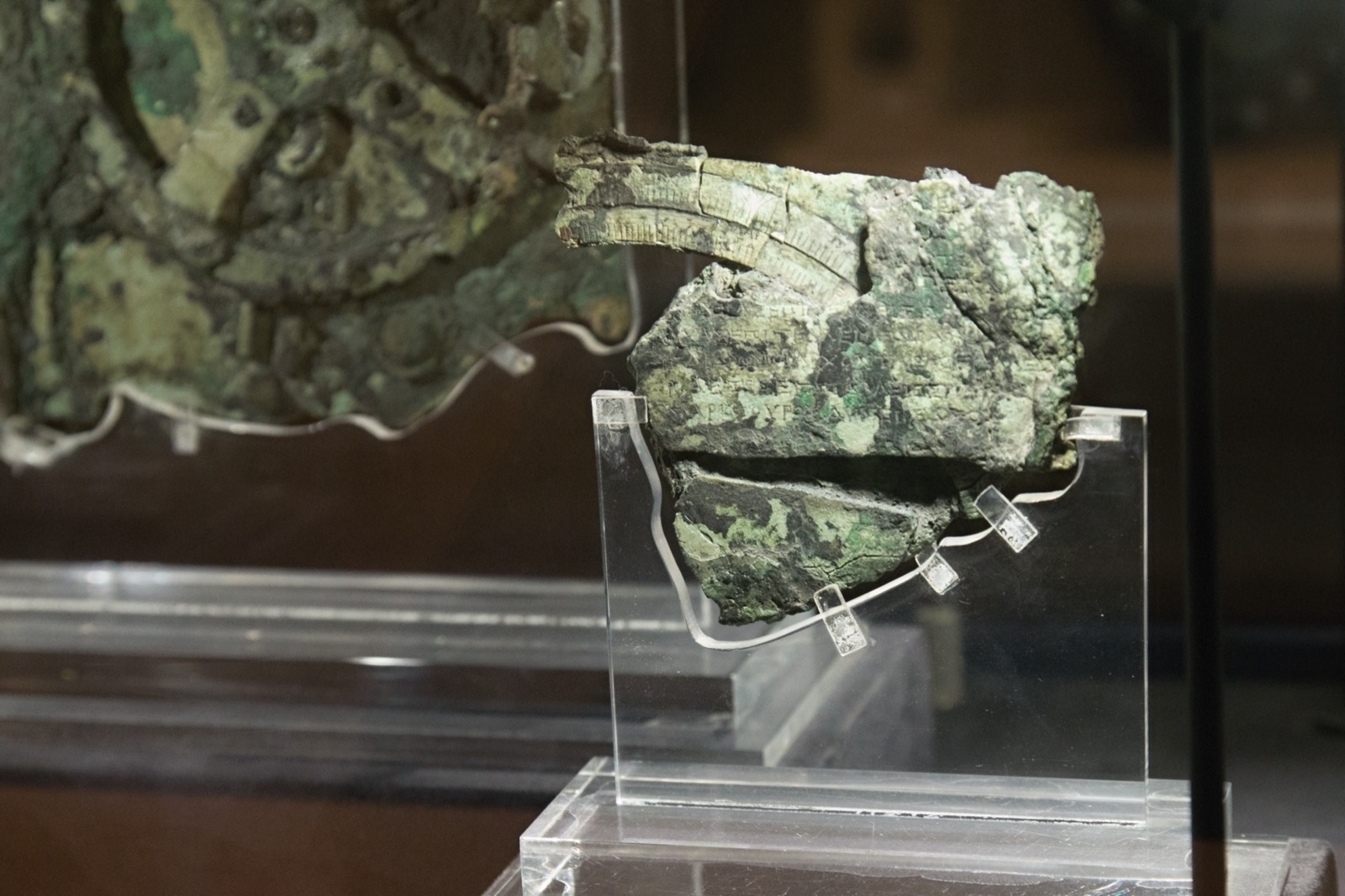
In 1901, Greek sponge divers sheltering from a storm off the tiny island of Antikythera, between Crete and the Peloponnese, stumbled on the wreck of an ancient ship laden with bronze and marble statues, glassware, and coins — a Roman-era cargo of Greek treasures that had gone down around the first century BCE. Among the finds hauled to the surface and shipped to Athens was an unpromising, shoebox-sized lump of corroded bronze and rotted wood, easily overlooked beside the museum's new statues. Months later, an archaeologist noticed something impossible protruding from it: a precisely cut gear wheel. Over the following century, X-rays and then advanced computed tomography would reveal that this lump was the wreckage of a hand-cranked mechanical device containing dozens of finely toothed bronze gears — an astronomical calculator that modeled the movements of the Sun, the Moon, and the planets, predicted eclipses, and tracked the cycles of the Greek calendar and the Olympic Games. Nothing of remotely comparable complexity is known to have existed for well over a thousand years afterward. The Antikythera Mechanism is not a hoax, not a fantasy, and — despite the claims of some — not evidence of anything from beyond the Earth. It is something stranger and more moving: a genuine artifact of ancient Greek genius, and a window onto a world of knowledge that was very nearly lost forever. This is its story.
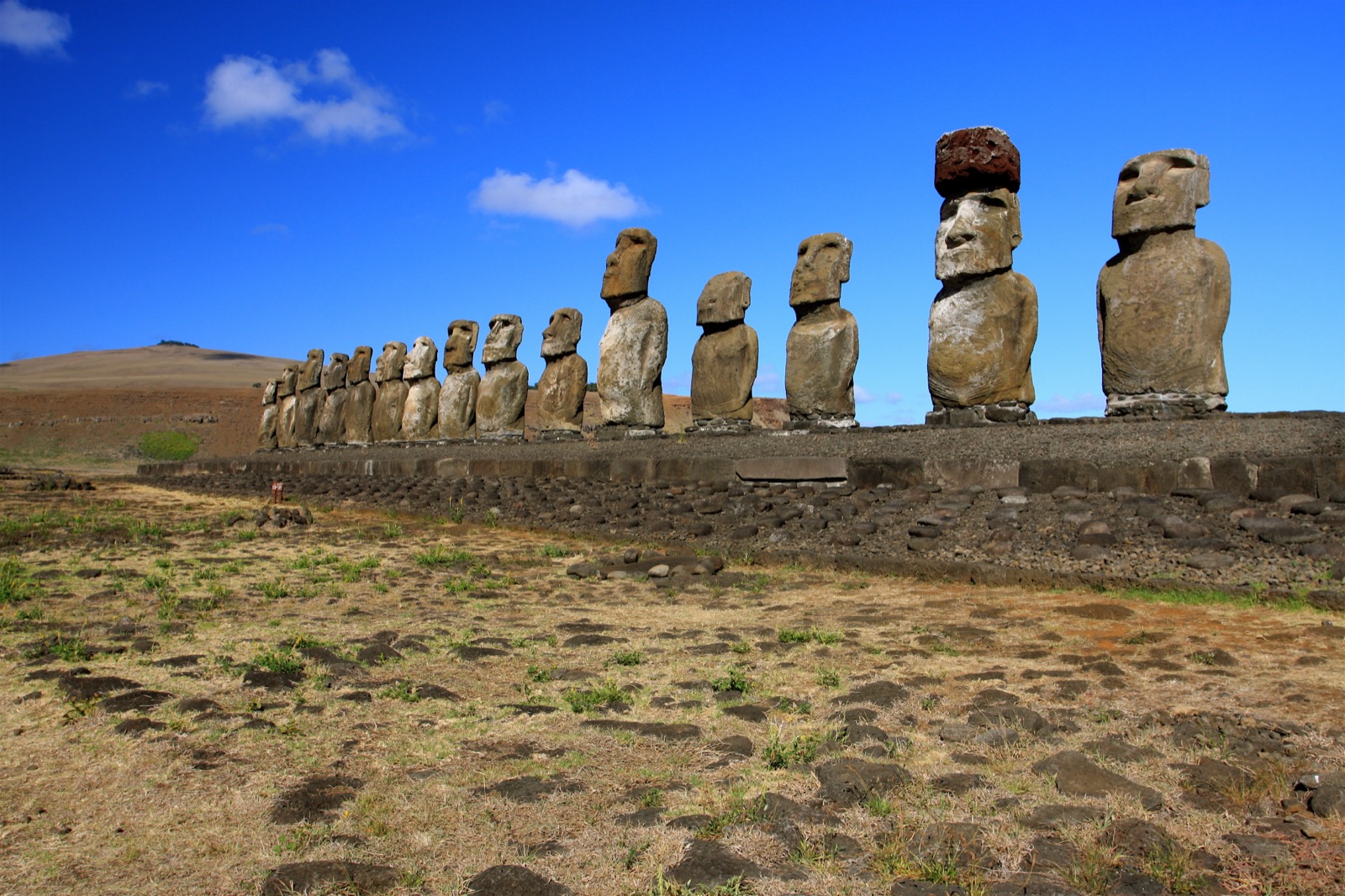
The Moai of Easter Island: The Statues That Walked
Rapa Nui — Easter Island — is one of the loneliest places inhabited by human beings, a small volcanic triangle in the southeastern Pacific more than three thousand kilometres from the coast of Chile and some two thousand from the nearest inhabited island. On this remote speck of land, a Polynesian society created one of the most recognisable bodies of monumental art in the world: the moai, nearly a thousand colossal stone figures, carved from volcanic rock and raised on stone platforms to gaze inland over the people they were made to protect. For centuries, outsiders looked at these statues on their treeless island and asked how so 'primitive' a people could have made and moved them — a question that led, at its worst, to fantasies of lost continents and ancient astronauts, and, more insidiously, to a powerful modern morality tale in which the islanders supposedly destroyed their own environment, felled their last tree to haul their idols, and collapsed into famine and war: a cautionary fable of self-inflicted ecological ruin. Both the wonder and the warning turn out to be built on misunderstanding. The moai are unmistakably the work of the Rapanui themselves; recent experiments suggest they were 'walked' upright to their platforms, exactly as island tradition always said; and the story of ecological suicide has been steadily dismantled, revealing instead a resilient people whose real catastrophe came not from within but from the arrival of outsiders. This is the story of the statues that walked.
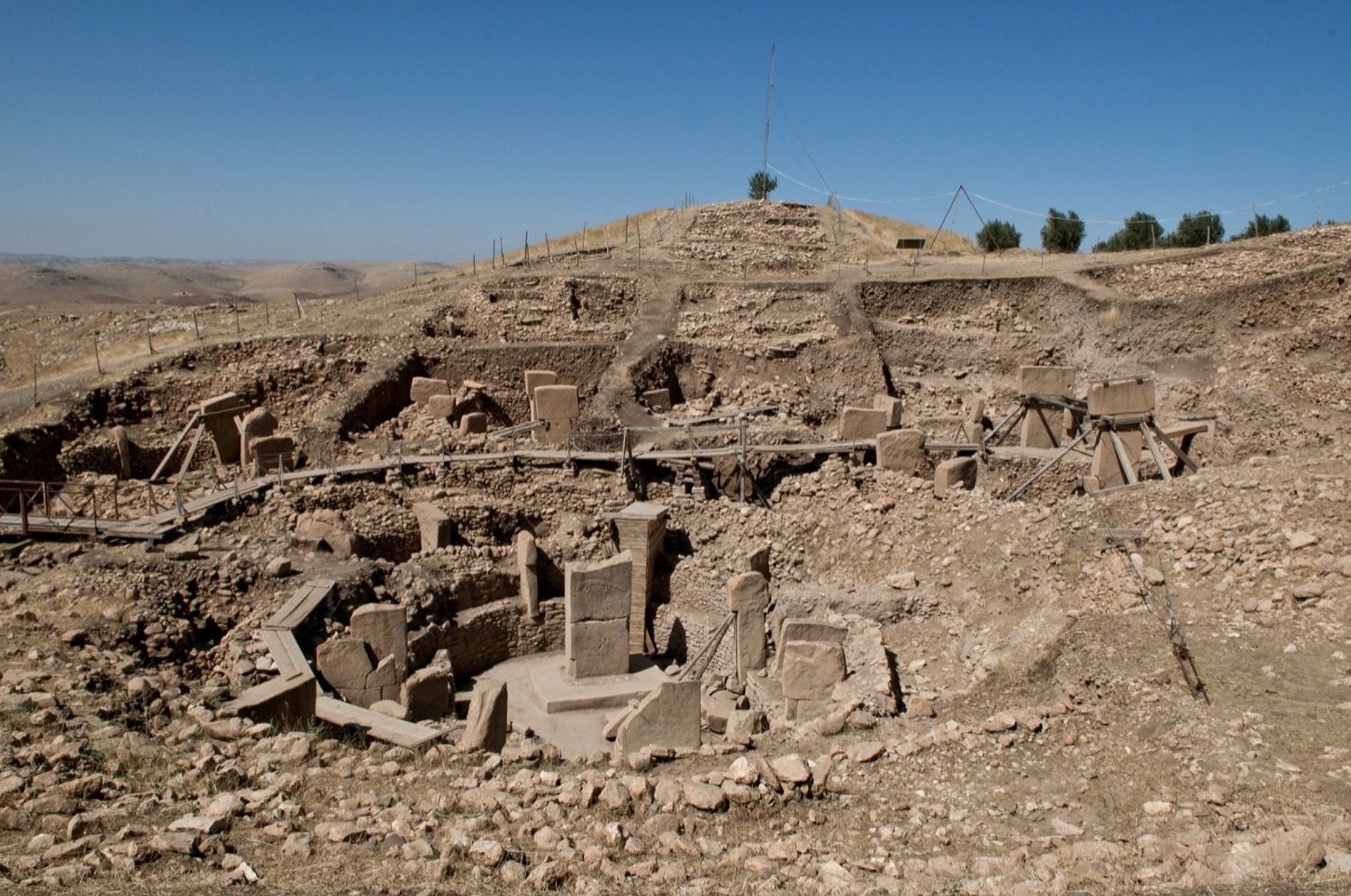
Göbekli Tepe: The Temple That Rewrote Prehistory
On a limestone ridge overlooking the plains of southeastern Turkey, near the ancient city of Urfa, stands a place that forced archaeologists to rewrite the earliest chapter of the human story. Göbekli Tepe — the name means 'Potbelly Hill' in Turkish — is a complex of great circular enclosures built from massive T-shaped stone pillars, some more than five metres tall and weighing many tons, many of them carved in relief with foxes, boars, snakes, scorpions, vultures, and other animals. It is staggeringly old. Radiocarbon dating places its construction to around 9500 BCE and earlier, making it roughly eleven and a half thousand years old — some six thousand years older than Stonehenge and seven thousand older than the Great Pyramid. What made the discovery revolutionary was not merely its age but who built it: not a settled society of farmers with cities and kings, but hunter-gatherers, people without pottery, without metal, without the wheel, and without — at least at first — agriculture itself. The prevailing wisdom had long held that monumental architecture was a product of civilisation, something only settled, food-producing societies could afford. Göbekli Tepe stood that assumption on its head, and suggested that the impulse to gather and build something great may have come first. It is a genuine mystery — but a mystery of human achievement, not of lost super-civilisations or visitors from the stars. This is the story of the temple that rewrote prehistory.