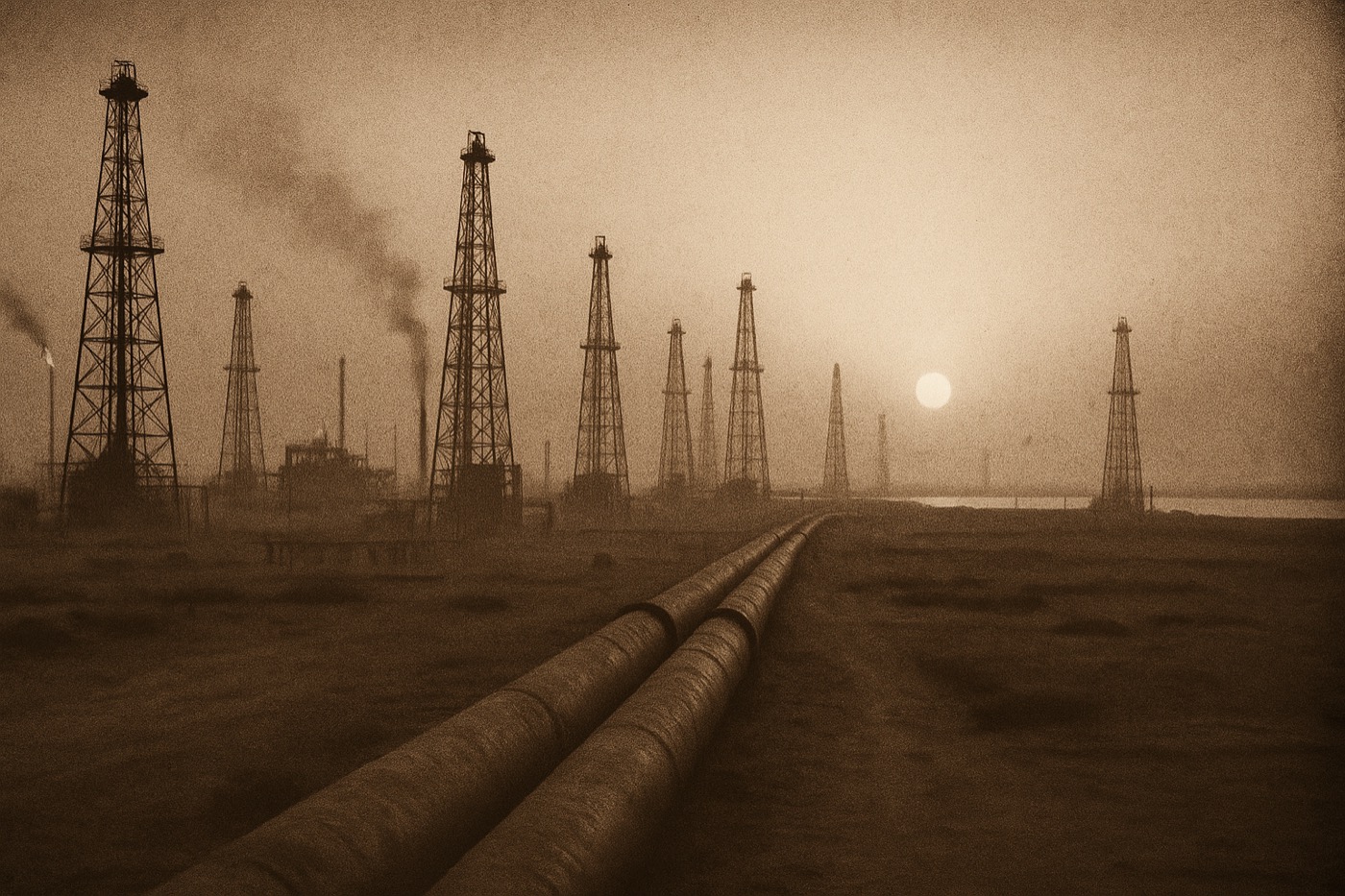
An imagined oil refinery of the Anglo-Iranian Oil Company era. The nationalization of the AIOC in 1951 was the trigger for the coup that followed. Generated illustration; AI disclosure on About.
Iran 1953 — Operation Ajax
Four days in August, sixty years of consequence
- Category
- State & Intelligence Operations
- Published
- Length
- 3,500 words · 17 min read
- Author
- The editors
Iran 1953 — Operation Ajax
Four days in August, sixty years of consequence.
A nationalization
The Anglo-Iranian Oil Company had been pumping Iranian oil since 1908. Its 1933 concession agreement, signed under the previous Pahlavi dynasty, gave the British company exclusive rights for 60 years across most of southern Iran. The company paid the Iranian state a royalty of 16 percent of net profits. The British exchequer, through corporate taxes on the same company, received approximately 30 percent. By the late 1940s, the AIOC was the single largest foreign exchange earner the United Kingdom had — Iranian oil was, operationally, an extension of British state finance.
By 1949, this arrangement had become politically untenable in Iran. The country had emerged from World War II occupied jointly by British, Soviet, and (briefly) American forces. Iranian nationalism had hardened. The Majles had been demanding renegotiation of the AIOC concession for two years. AIOC's response had been to delay, to offer cosmetic adjustments, and to publicly characterize Iranian demands as Communist-influenced.
In March 1951, after the assassination of Prime Minister Ali Razmara by Islamic Fadayan, the Majles voted to nationalize. The bill was signed by Mohammad Reza Pahlavi on May 1, 1951. The country had, through democratic legislative process, taken back the oil.
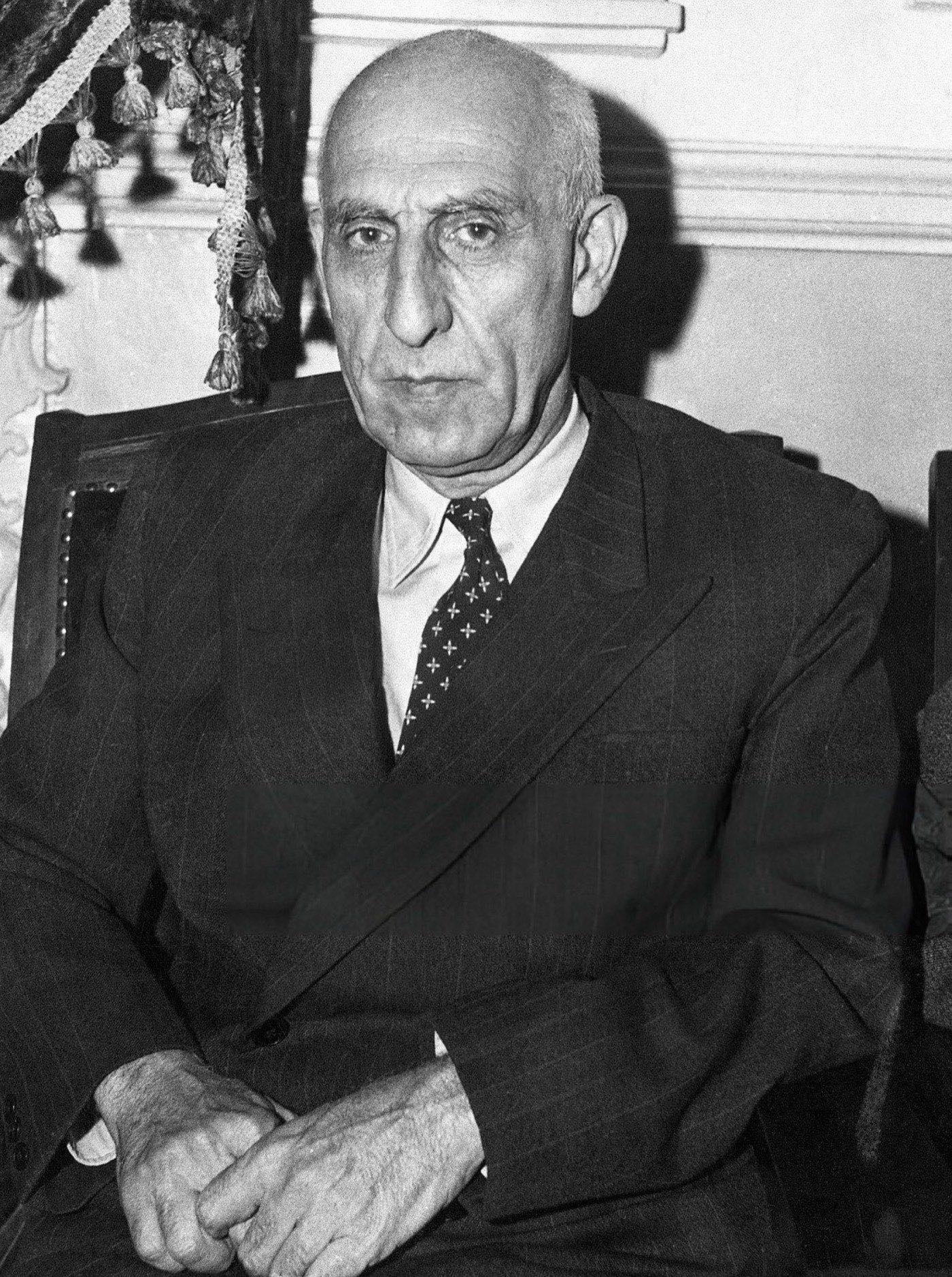
Mosaddegh became Prime Minister six weeks later. He was, by any measure of his career, the most legitimately elected head of government Iran had ever had. He had spent four decades as a constitutional reformer. He held a doctorate in law from the University of Lausanne. He spoke French, English, and Persian. He was sixty-nine years old and, in the manner of the Iranian political class of his generation, conducted most of his cabinet meetings from a hospital bed.
The British blockade
The British response was not negotiation. It was operational removal of Iran from the international oil market.
By September 1951, the Royal Navy had effectively blockaded the Abadan refinery (the world's largest at the time). British tankers left empty. Iranian oil could not legally be sold to any major international buyer — AIOC had global injunctions on its books against any company that purchased "stolen" Iranian crude. The British Treasury froze Iran's sterling reserves. The Bank of England refused to clear Iranian payments.
Iran's foreign exchange earnings, which had been roughly 60 percent oil-dependent, collapsed. By 1952, the Iranian state was running out of dollars to pay for imports of basic goods. Mosaddegh's domestic position weakened. The pressure was operationally exactly what the British government intended.
What the British also began doing, from the late summer of 1951 onward, was lobbying the Truman administration in Washington for support of a more decisive intervention. Truman declined repeatedly. His position was that the Iranian government had acted within its legal authority, that the AIOC's pre-1951 arrangement had been inequitable, and that a negotiated settlement remained the right American policy.
The 1952 American presidential election changed this.
The Dulles brothers
By the time Dwight Eisenhower took office on January 20, 1953, his Secretary of State and his Director of Central Intelligence were, respectively, John Foster Dulles and Allen Welsh Dulles — brothers, both Sullivan & Cromwell partners in their pre-government careers, both deeply invested in the post-war American conception of the Cold War as an existential ideological contest in which neutralism was effectively alignment with the Soviet bloc.
Mosaddegh, in this framework, was a problem.
The CIA's internal assessment of Mosaddegh's actual political orientation was nuanced. The agency's Iran station chief, Roger Goiran, considered Mosaddegh nationalist but not communist, and the Iranian Communist Party (the Tudeh) too weak to actually take power in any imminent timeframe. The State Department's Iran specialist, Loy Henderson, was more aligned with the British view — that Mosaddegh's persistence in power created the long-term conditions under which the Tudeh might rise.
Allen Dulles, after consultations with both his brother and with British Secret Intelligence Service representative Christopher "Monty" Woodhouse in Washington, made the decision in February 1953 to pursue covert removal.
President Eisenhower formally authorized the operation in July.
The man in the field
The on-the-ground commander of the operation was Kermit Roosevelt Jr. — known throughout his life as "Kim" — a 36-year-old CIA officer who was the grandson of President Theodore Roosevelt. Roosevelt was the CIA's Near East Division chief. He spoke Arabic and Farsi. He had run wartime OSS operations in Egypt. He arrived in Tehran on July 19, 1953, traveling under his own name but with documentation identifying him as a James Lockridge of the Carlyle Group (a fictitious affiliation).
His operational base was a small house in the Tajrish neighborhood of north Tehran. His direct subordinates were two CIA officers and approximately fifteen Iranian network operatives — most of them inherited from MI6's pre-1953 cultivation.
The operational plan, codenamed TPAJAX, was straightforward in concept and operationally complex in execution:
- Coordinate with the Shah to obtain a formal firman (royal decree) dismissing Mosaddegh and appointing General Fazlollah Zahedi as new Prime Minister.
- Deliver the firman to Mosaddegh under conditions that would prevent him from refusing.
- Generate street demonstrations — paid mobs, paid newspapers, paid mullahs — that would create the appearance of popular demand for the change.
- Activate sympathetic Iranian military units to support the change if Mosaddegh resisted.
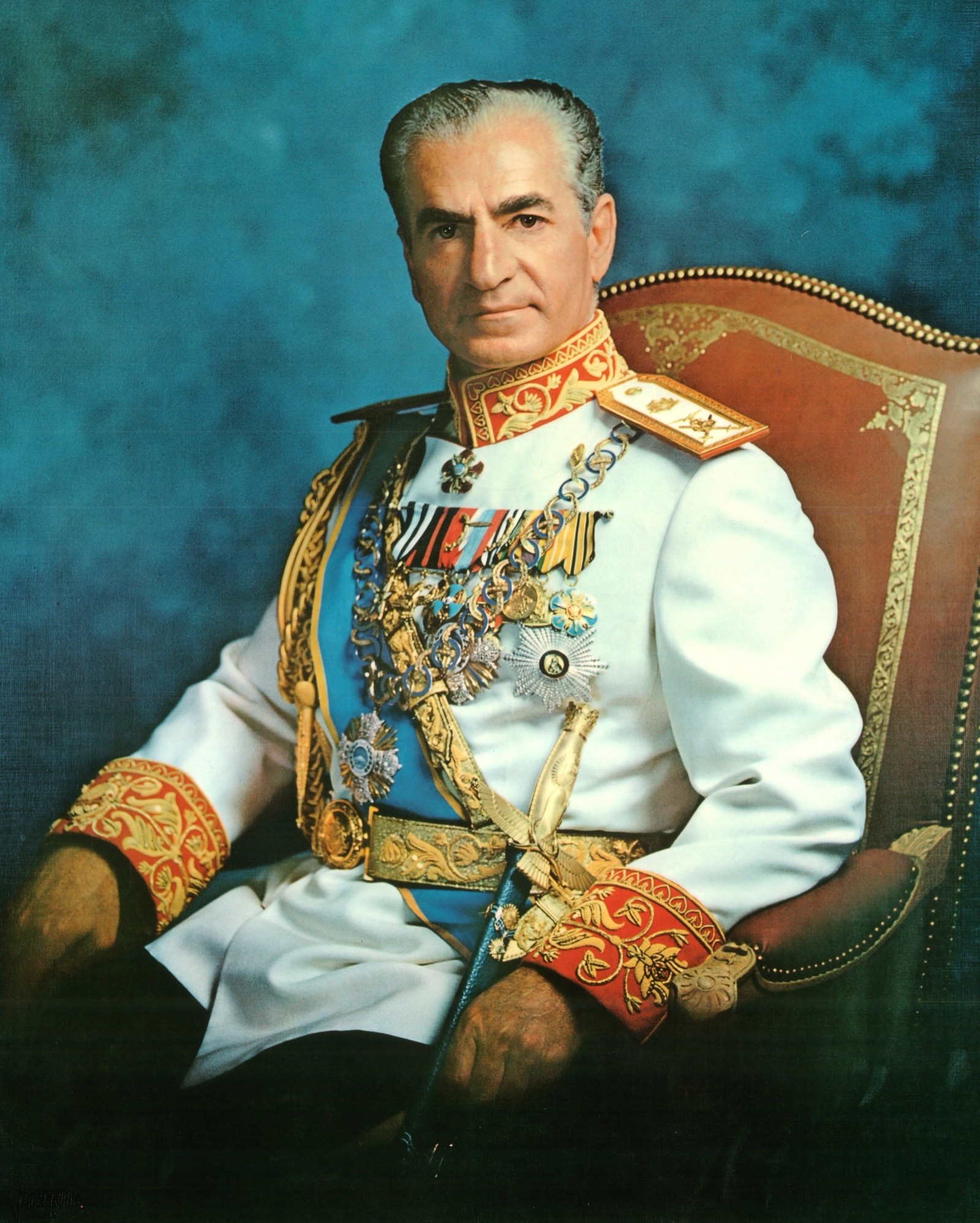
The Shah, by all accounts, was reluctant. He understood that involvement in any failed coup would end his reign. He requested multiple meetings with Roosevelt before agreeing to sign the firman — meetings Roosevelt later described in interviews as having required "very considerable persuasion."
August 15-19
The first attempt to deliver the firman to Mosaddegh occurred at midnight on August 15, 1953. The man chosen to physically deliver it was Colonel Nematollah Nassiri, commander of the Imperial Guard. Nassiri arrived at Mosaddegh's residence in central Tehran with the firman and a small detachment of soldiers. Mosaddegh had been tipped off in advance — the source of the tip has been variously attributed to the Tudeh's intelligence network, to Mosaddegh's own domestic intelligence service, and to an Iranian intelligence officer with mixed loyalties.
Mosaddegh refused to accept the firman. He had Nassiri arrested. He went on the national radio at 5 a.m. to announce that the Shah had attempted a coup against the legitimate government, that it had failed, and that loyalist forces were now consolidating control of Tehran.
The Shah, having been told of the operation's failure, fled with his wife to Baghdad. From Baghdad they continued to Rome. Operation Ajax, in operational terms, had collapsed.
What followed over the next three days has become the most-quoted operational episode in the early CIA's history.
Washington ordered Roosevelt to abandon the operation. The cable, dispatched on August 16, instructed him to evacuate Tehran and return to the United States. Roosevelt, in his own subsequent account, declined to comply with the cable. He spent August 17 and 18 operationally rebuilding what had collapsed:
- He instructed his Iranian network operatives to spread contradictory accounts of the Shah's whereabouts — including the story that the Shah had been the victim of a Mosaddegh-Tudeh plot.
- He authorized the distribution of approximately $50,000 to Tehran street operators to organize pro-Shah demonstrations on August 19.
- He had the network's contacts in the Iranian Army identify units that could be mobilized under the appearance of having spontaneously sided with the Shah.
On the morning of August 19, paid mobs filled Tehran's central boulevards chanting pro-Shah slogans. Other paid mobs — also working for Roosevelt's network — attacked symbols of the Shah while shouting Mosaddegh slogans, in a deliberate effort to discredit the pro-Mosaddegh faction. Army units sympathetic to Zahedi joined the demonstrations by mid-morning.
By 4 p.m., loyalist forces had been pushed out of central Tehran. By 6 p.m., Mosaddegh's residence was surrounded. By 8 p.m., Mosaddegh had escaped over a rear wall and gone into hiding. He turned himself in two days later.
The Shah returned from Rome on August 22.
The asymmetric outcome
Mosaddegh was tried by a military tribunal in November 1953 for treason. He was sentenced to three years' imprisonment, served the sentence, and was then placed under house arrest at his estate in Ahmad-Abad for the remainder of his life. He died on March 5, 1967, age 84.
The Shah ruled Iran for the next 26 years. His government became progressively more authoritarian, more dependent on U.S. military support, and more economically tied to American oil interests. The 1957 establishment of SAVAK (the Iranian security service, trained by the CIA and Mossad) consolidated the state's domestic intelligence apparatus. Political opposition was systematically suppressed.
The Iranian Revolution of 1979 — which removed the Shah from power and established the Islamic Republic under Ayatollah Khomeini — was, by the analysis of most subsequent historians, a delayed consequence of the 1953 coup. Khomeini himself cited the overthrow of Mosaddegh as one of the proximate justifications for the 1979 transformation. The hostage crisis of 1979-1981 (which ended Jimmy Carter's presidency) was, in the Iranian revolutionary narrative, retaliation for 1953.
The CIA officially acknowledged its role in the operation only on August 19, 2013 — sixty years after the fact, on the operation's anniversary, as part of a National Security Archive declassification request.1
What proponents and critics still argue
The factual record of Operation Ajax is closed. The CIA documents released in 2013 and 2017 confirmed every major operational claim that had appeared in Kermit Roosevelt's own 1979 memoir Countercoup (which the CIA had attempted to suppress) and in Kinzer's All the Shah's Men (2003). The interpretive questions that remain:
Was the operation actually necessary? Defenders argued at the time (and some still argue) that Mosaddegh's continued tenure would have led to a Tudeh-aligned Iran within the Soviet orbit. The empirical basis for this projection is contested. The CIA's own operational analysis in early 1953 considered the Tudeh too weak to take power in any near-term timeframe.
Did Roosevelt's insubordination save or doom the operation? The operation that succeeded on August 19 was not the operation Washington had authorized in July. It was a different operation, improvised by Roosevelt over 72 hours after the original had failed. Whether his decision to continue against orders represented heroic field initiative (the CIA's internal preferred reading) or catastrophic operational unaccountability is contested.
Could the 1979 Revolution have been prevented? Historians have argued both that the 1953 coup made 1979 inevitable, and that the Shah's specific policy failures in 1973-1978 (the White Revolution, SAVAK's escalating repression, the dramatic income inequality caused by the 1973 oil shock) would have produced similar outcomes regardless of 1953. The counterfactual is unresolvable.
How we read the evidence
Operation Ajax is the foundational case for thinking about U.S. covert regime change. It established the operational template that the CIA would subsequently apply in Guatemala (1954), Congo (1961), Brazil (1964), Chile (1973), and other operations. It demonstrated that an external intelligence service could remove a democratically elected head of government with limited financial resources and substantial pre-existing local political networks. It showed how quickly the operational benefit could be obtained, and how slowly the political consequence would arrive.
What the operation also showed, and what was less prominently recorded at the time, is the long-term asymmetry of covert action. The CIA acquired a successful operational case study in 1953. The United States, as a foreign-policy actor, acquired sixty years of intermittently catastrophic Iranian relations — including a revolution, a hostage crisis, the longest-running diplomatic breach in modern American foreign policy, and a regional adversary whose existence has shaped American Middle East strategy for half a century.
The asymmetry is operationally significant for any thinking about the strategic costs of covert action: the operations are visible to their planners and obscure to their targets at the moment of execution, but the consequences eventually become visible to everyone, and the asymmetry of memory works in favor of the target country and against the perpetrator.
Key figures
Further reading
Books:
- Stephen Kinzer, All the Shah's Men: An American Coup and the Roots of Middle East Terror (Wiley, 2003).
- Kermit Roosevelt, Countercoup: The Struggle for the Control of Iran (McGraw-Hill, 1979). The field commander's own memoir.
- Ervand Abrahamian, The Coup: 1953, the CIA, and the Roots of Modern U.S.-Iranian Relations (New Press, 2013).
- Mark Gasiorowski & Malcolm Byrne (eds.), Mohammad Mosaddeq and the 1953 Coup in Iran (Syracuse UP, 2004).
- Donald Wilber, Clandestine Service History: Overthrow of Premier Mosaddeq of Iran, November 1952-August 1953. The internal CIA history — first leaked to NYT in 2000, fully declassified 2013.
Films and documentaries:
- Coup 53 (2019, dir. Taghi Amirani). The definitive documentary, featuring Ralph Fiennes reading Monty Woodhouse's diary entries.
- Argo (2012, dir. Ben Affleck). Set during the 1979 hostage crisis but with prologue context on 1953.
- All the Shah's Men: An American Coup (2007, PBS documentary based on Kinzer).
Primary archives:
- National Security Archive — CIA Confirms Role (2013)
- CIA's own declassified internal history (Wilber, 1954)
- Iran 1953 declassified documents archive at George Washington University
Sources
Primary sources
- CIA Directorate of Plans. Wilber, D. Clandestine Service History: Overthrow of Premier Mosaddeq of Iran, November 1952-August 1953, March 1954. Internal CIA report; fully declassified 2013.
- National Security Archive. Iran 1953 document collection (2000, 2013, 2017 releases).
- U.S. Department of State. Foreign Relations of the United States, 1952-1954, Iran, 1951-1954 (Government Printing Office, 2017). Long-suppressed FRUS volume.
- Roosevelt, K. (1979). Countercoup: The Struggle for the Control of Iran. McGraw-Hill.
Secondary sources
- Kinzer, S. (2003). All the Shah's Men. Wiley.
- Abrahamian, E. (2013). The Coup. New Press.
- Gasiorowski, M. & Byrne, M. (eds.) (2004). Mohammad Mosaddeq and the 1953 Coup in Iran. Syracuse UP.
- Heiss, M. (1997). Empire and Nationhood: The United States, Great Britain, and Iranian Oil, 1950-1954. Columbia UP.
- The Washington Post — coverage of the 2013 and 2017 declassifications.
- The Guardian — UK coverage of MI6's Operation Boot role.
- Foreign Policy, 2017 — "64 Years Later, CIA Finally Releases Details of Iranian Coup."
- NPR Throughline, 2019 — "How The CIA Overthrew Iran's Democracy In 4 Days."
- Coup 53 (Amirani, 2019). Documentary.
Academic sources
- Gasiorowski, M. J. (1987). "The 1953 Coup d'Etat in Iran." International Journal of Middle East Studies, 19(3), 261-286.
- Abrahamian, E. (2001). "The 1953 Coup in Iran." Science & Society, 65(2), 182-215.
Corrections & updates
(None yet.)
Footnotes
-
National Security Archive. CIA Confirms Role in 1953 Iran Coup: Documents Provide New Details on Mosaddeq Overthrow and Its Aftermath. NSA Electronic Briefing Book No. 435. August 19, 2013. Available at nsarchive2.gwu.edu/NSAEBB/NSAEBB435/. A second tranche of documents was released in June 2017 under FOIA. ↩
Inspired this / based on it
Taghi Amirani · ★ 7.8
The definitive documentary. Ralph Fiennes reads Monty Woodhouse diary entries.
Stephen Kinzer
The most-read modern account
Ervand Abrahamian
Definitive academic account using 2013 declassifications
Kermit Roosevelt Jr.
The field commander's own memoir; CIA tried to suppress publication
Filed under
- #iran-1953
- #operation-ajax
- #tpajax
- #mosaddegh
- #shah
- #cia
- #mi6
- #kermit-roosevelt
- #aioc
- #anglo-iranian
- #oil
- #1953
- #iran
- #declassified
Click any tag for every article carrying it.
Continue reading
Operation Northwoods
In March 1962, the Joint Chiefs of Staff put a document on Robert McNamara's desk. It proposed a series of false-flag attacks against the United States — sunk ships, civilian terror campaigns in Miami and Washington, a faked civilian airliner shoot-down — to manufacture public support for invading Cuba. Every member of the Joint Chiefs signed it. Kennedy rejected it within days. The document stayed buried for thirty-five years.
Operation Paperclip
Between 1945 and 1959, the U.S. Army Ordnance Corps and the Joint Intelligence Objectives Agency secretly transported more than 1,600 German scientists, engineers, and technicians from defeated Nazi Germany to the United States — together with files that had been quietly stripped of references to Nazi Party membership, SS rank, and slave-labour exploitation. The clip on the folder was where the program got its name. The most prominent of the imported men was Wernher von Braun, designer of the V-2 ballistic missile, who twenty-four years later watched the Saturn V — a rocket built by his Huntsville team — lift Apollo 11 toward the Moon.
Iran-Contra
Between August 1985 and October 1986, the Reagan administration secretly sold anti-tank and anti-aircraft missiles to the Islamic Republic of Iran — an officially designated state sponsor of terrorism, in the middle of a war with Iraq. The cash went into Swiss bank accounts. From there a portion was diverted, in defiance of two congressional bans, to the Contra rebels fighting the Sandinista government in Nicaragua. The scheme was exposed by a Lebanese magazine, dismantled by a special commission, and partly prosecuted before President George H. W. Bush issued the pardons that ended the cases.