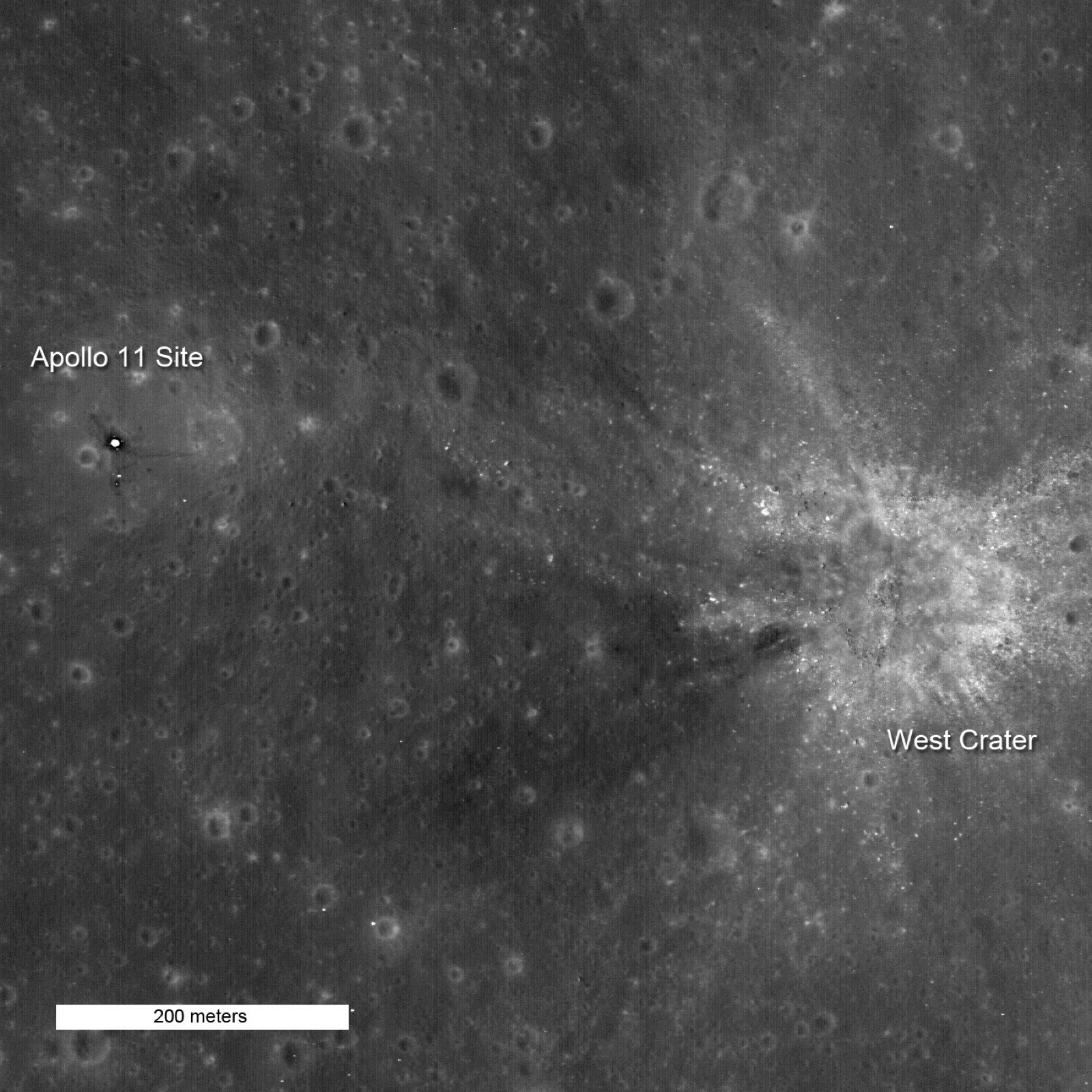
The Apollo 11 landing site at Tranquility Base, photographed by the NASA Lunar Reconnaissance Orbiter Camera (LROC) in 2011. The descent stage of the lunar module and the surface experiments left by Armstrong and Aldrin are clearly visible. The image is one of approximately 250,000 high-resolution LROC frames available in the public archive. NASA / Goddard Space Flight Center / Arizona State University, public domain.
The Moon Landing Hoax Theory
What the theory claims, what the evidence shows
- Category
- Space & UFOlogy
- Published
- Length
- 3,650 words · 17 min read
- Author
- The editors
The Moon Landing Hoax Theory
What the theory claims, what the evidence shows.
The case for the landings
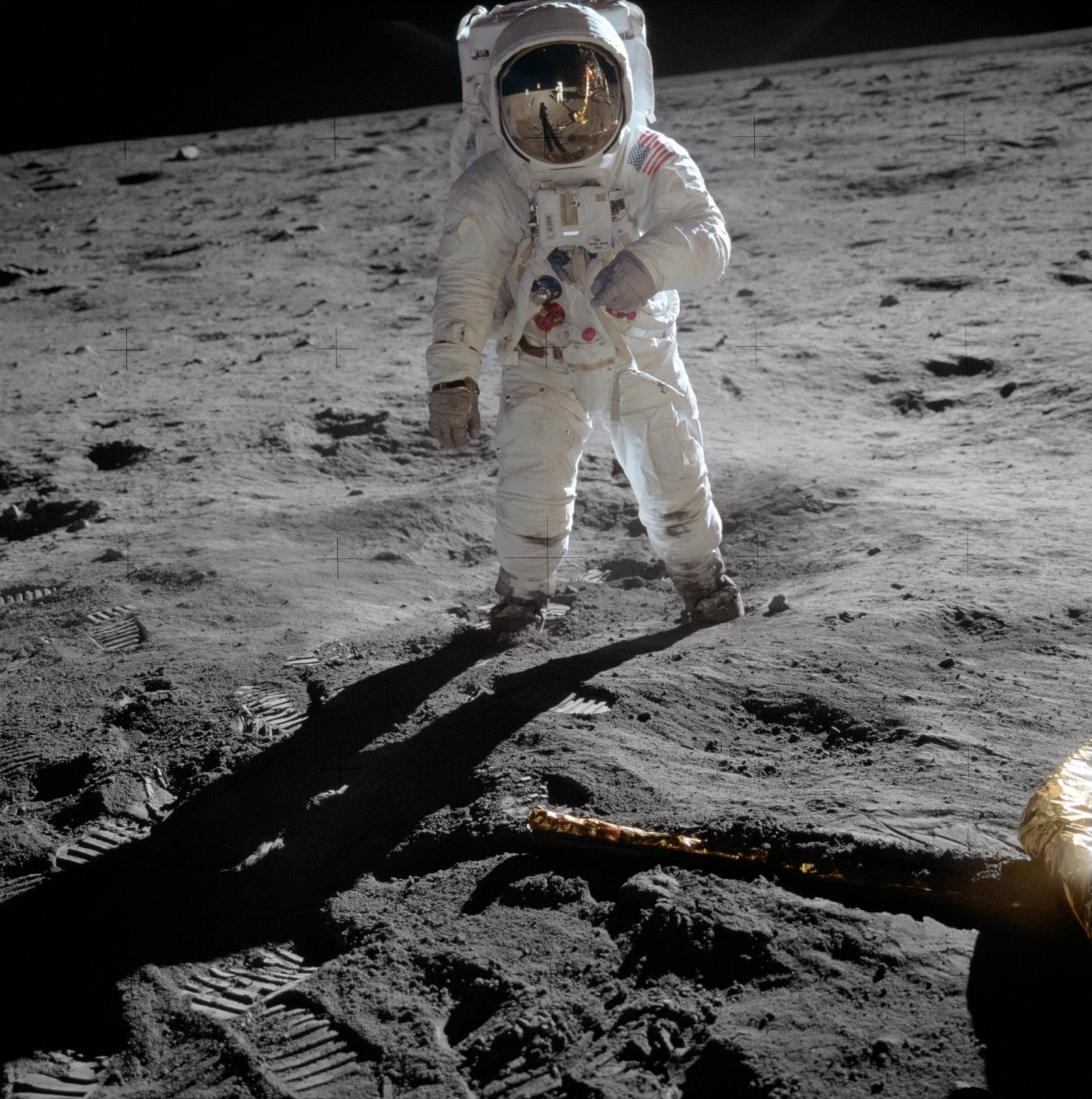
Before describing the hoax theory in detail, it is worth establishing the documented case. The Apollo lunar landings are supported by five independent categories of evidence, each verified by parties with varying interests in the outcome.
Lunar samples. The Apollo missions returned 382 kilograms of lunar rock and regolith. These samples have been studied at approximately 500 laboratories in over thirty countries since 1969. The samples exhibit isotopic ratios, mineralogy, and radiation exposure signatures consistent with lunar origin and inconsistent with any known terrestrial source. The Soviet Union's Luna 16, Luna 20, and Luna 24 robotic missions (1970, 1972, 1976) returned approximately 326 grams of independent lunar samples; the U.S. and USSR exchanged samples, and analysis confirmed they were geologically consistent with each other and with the broader lunar geology revealed by remote sensing. The Apollo samples remain in active use today; new analytical techniques periodically reveal new findings (most recently, evidence of indigenous water in lunar regolith, published 2008-2018).
Retroreflectors. Three Apollo missions (11, 14, 15) deployed laser retroreflector arrays on the lunar surface. These arrays — flat panels of corner-cube prisms — return light precisely back along the incoming beam path. Lunar-laser-ranging observatories at Apache Point Observatory (New Mexico), Côte d'Azur Observatory (France), Mount Stromlo Observatory (Australia), and others routinely target these arrays. The Earth-Moon distance is measured to approximately 1-centimeter precision through this technique. The two Lunokhod arrays, placed by Soviet robotic missions, are also operational. A single laser pulse returning from the Apollo 11 retroreflector array in 1969 is documented; the equipment has been continuously available to any astronomer with the required laser facility for 55 years.
Lunar Reconnaissance Orbiter imagery. Since 2009, the LRO has photographed all six Apollo landing sites and the three Soviet Lunokhod traverses at resolutions sufficient to identify the descent stages, surface equipment packages, footpaths, and rover tracks. The Apollo 17 landing site, photographed in 2011, shows the lunar rover's tracks, the descent stage, and the three traverses Eugene Cernan and Harrison Schmitt made over their three days on the surface. The imagery is publicly available through the LRO archive at Arizona State University.
Soviet contemporaneous tracking. The USSR's deep-space network at Yevpatoria (Crimea) and the Pulkovo Observatory tracked all six Apollo missions in real time on independent radio-frequency equipment. Soviet documents released after 1991 — including post-program debriefs by Mstislav Keldysh, the President of the USSR Academy of Sciences during the Apollo era — describe the missions as understood to be authentic. The Soviet space program had every motivation to expose a U.S. fraud and the technical means to detect one. It did not.
Hardware traces. Apollo descent stages remain on the Moon. The Apollo 11 descent stage (the lower half of the Lunar Module Eagle) is at 0.6741°N, 23.4730°E in Mare Tranquillitatis. The Apollo 12 descent stage is at 3.0124°S, 23.4216°W in the Ocean of Storms. And so on. These can be identified in LRO imagery at the specified coordinates.
The theory
The Moon landing hoax theory holds, in its strongest form, that NASA did not land humans on the Moon — that the Apollo missions either did not leave Earth orbit or did so but did not land, and that the photographs, film, audio, and rock samples were fabricated. The theory has competing variant forms; some hold only the photography was staged while the rockets did go to the Moon, others hold the entire program was a Cold War propaganda fabrication.
The theory has a specific genealogy. It did not exist as a coherent position in 1969 or in the immediate years after. The first sustained articulation was Bill Kaysing's 1976 self-published book We Never Went to the Moon: America's Thirty Billion Dollar Swindle. Kaysing had worked as a publications writer at the Rocketdyne propulsion company between 1956 and 1963 — six years before the Apollo 11 landing. He had no engineering credentials. His central claim was that the F-1 engines used on the Saturn V booster were technically incapable of lifting the required payload, and therefore that the program had been faked.
The 1978 film Capricorn One, directed by Peter Hyams, dramatized a NASA-staged Mars landing. The film was fiction. It was widely understood as fiction at release. But it contributed to the public imaginative frame within which the hoax theory could be entertained.
The theory's modern popular form crystallized around the February 2001 Fox television documentary Conspiracy Theory: Did We Land on the Moon?, narrated by Mitch Pileggi. The documentary advanced a series of specific evidentiary claims — about flag motion, shadows, the Van Allen belts, and others — that had been thoroughly addressed in the scientific and engineering literature but were presented as unanswered.
The Fox documentary was widely circulated on the early internet. It remains, for many present-day proponents, the foundational text. The specific claims it advanced are the ones most often cited.
What the theory claims, and what the evidence shows
The theory's central evidentiary claims can be examined one at a time. Each has a documented physical or photographic resolution.
Claim 1: The flag is waving in vacuum
The American flags planted at each Apollo landing site appear, in photographs and film, to flutter or wave. Vacuum contains no atmosphere; therefore, the theory holds, the flag's motion proves the photographs were taken in atmosphere.
Resolution: The Apollo flags were designed with a horizontal rod inserted through a sleeve at the top of the flag, perpendicular to the vertical pole. This made the flag stand out from the pole in vacuum, where it would otherwise have hung limp. The flags appear to "wave" only at the moments when astronauts are manually setting them up — twisting the pole into the regolith. Inertia of the fabric around the supporting rod produces a brief flutter that persists for a few seconds while the rod's torsion damps out. In the long-duration film of the Apollo 11 EVA, the flag is stationary for almost the entire time except during the planting sequence. The NASA EVA videos document this directly.
Claim 2: There are no stars in the photographs
The lunar sky should be densely starred — there's no atmosphere to scatter light. The Apollo photographs show black skies with no stars. Therefore, the theory holds, the photographs were taken in a soundstage with a black backdrop.
Resolution: Camera exposure. The astronauts were standing on a lunar surface in direct sunlight, surrounded by extremely bright regolith. The exposure settings on the Hasselblad cameras were set for the bright surface and bright spacesuits — typical settings around f/8 to f/11, 1/250 second. At those settings, stars are not visible to the film. The same effect occurs in daytime photographs taken on Earth — daytime photos do not show stars even though stars are physically present. To see stars from the Moon during EVA, the astronauts would have had to underexpose their foreground subject by approximately ten f-stops, which would have produced a useless photograph for the documentation purpose.
Claim 3: Shadows are non-parallel
In some Apollo photographs, shadows of different objects appear to fall at slightly different angles. With only one light source (the Sun), all shadows should be parallel. Therefore, the theory holds, multiple soundstage lights were used.
Resolution: Perspective. Two objects standing on the surface at slightly different distances from the camera will cast shadows of slightly different lengths and apparent directions due to two- dimensional projection of three-dimensional space onto the camera sensor. The same effect occurs in any wide-angle outdoor photograph on Earth. The Sun-shadow geometry has been independently verified by multiple photographers and physicists, including Italian astronaut Paolo Nespoli, who specifically reconstructed the photographic geometry. Additionally, the lunar regolith is not perfectly flat — small undulations produce additional apparent shadow variation.
Claim 4: The Van Allen belts are lethal
The Earth is surrounded by two belts of trapped charged particles (the Van Allen belts) extending from approximately 1,000 km to 60,000 km altitude. Transit through these belts, the theory holds, would expose astronauts to lethal radiation. Therefore, no humans could have made the trip.
Resolution: The Apollo missions traversed the Van Allen belts on trajectories that minimized exposure time. The Saturn V's trans-lunar injection put the spacecraft on a high-velocity hyperbolic trajectory. Transit time through the densest part of the inner belt was approximately 30 minutes; total transit through both belts was approximately 4 hours. The astronauts received an estimated 16 millisieverts of radiation per mission — comparable to a head CT scan. The biological threshold for acute radiation sickness begins at approximately 1,000 millisieverts. Lethal acute doses begin at approximately 5,000 millisieverts. The Apollo crews were nowhere near these thresholds. The James Van Allen for whom the belts are named publicly stated in 1969 that the Apollo radiation exposure was "trivial."
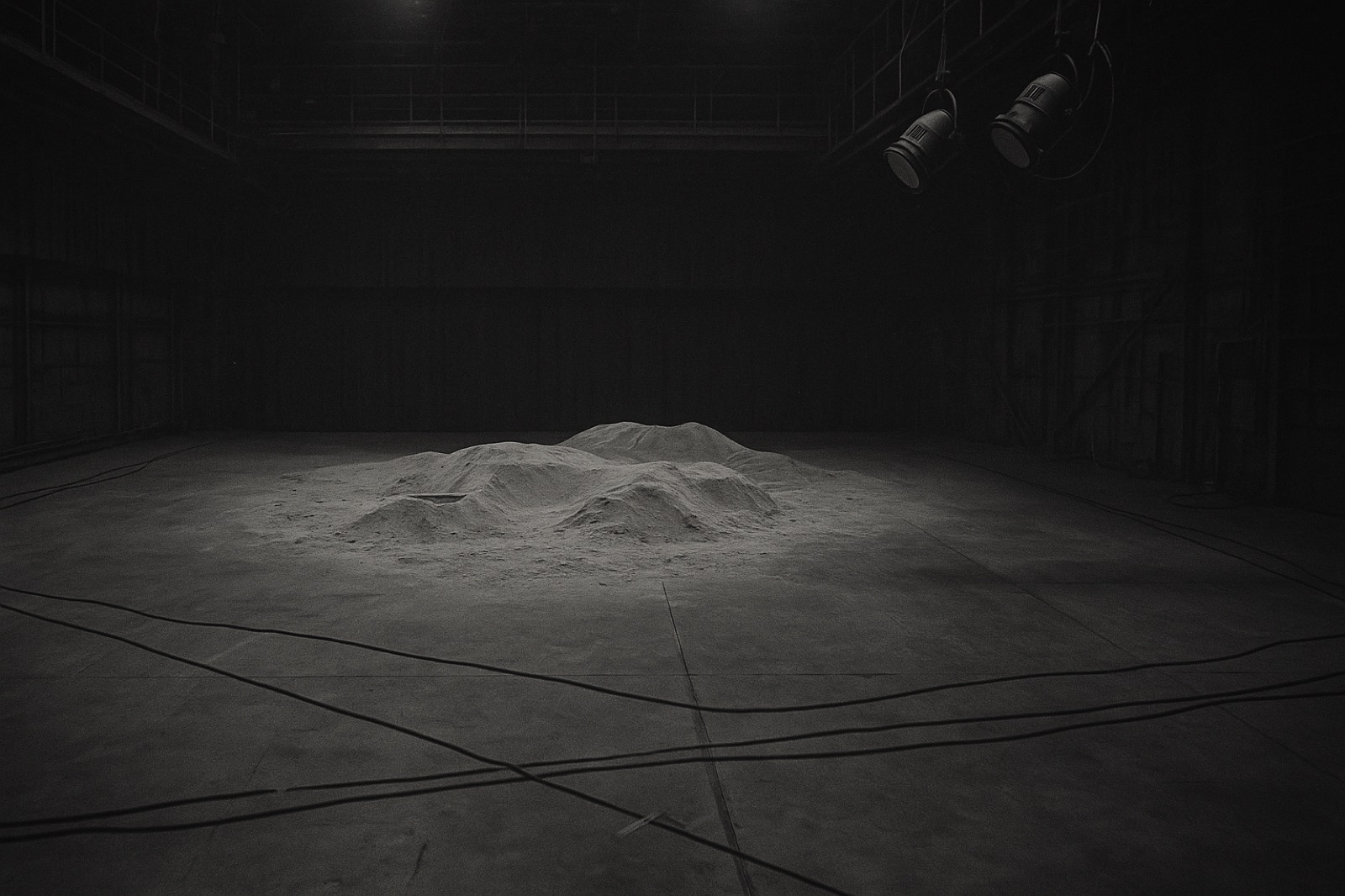
Claim 5: Stanley Kubrick filmed the landings
Stanley Kubrick had directed 2001: A Space Odyssey (1968) and demonstrated the visual-effects competence required to fabricate lunar imagery. Therefore, the theory holds, NASA hired him to direct the staged landings.
Resolution: No evidence connects Kubrick to NASA in any production capacity. Kubrick was in London from 1968 onward, working on A Clockwork Orange (1971) and subsequent films. His production records are extensively documented in his estate's archive at the University of the Arts London. The visual-effects technique used in 2001 (front projection with elaborate models) is itself documented by Douglas Trumbull's later accounts; applying it to the lunar setting would not have produced the specific photographic signatures of Apollo imagery (one-sixth gravity regolith dynamics, vacuum-specific particle behavior, specific solar lighting angles). The "Kubrick directed it" claim appeared most prominently in the 2002 mockumentary Dark Side of the Moon, directed by William Karel — itself a satire of the conspiracy genre, presented in interviews with figures including Donald Rumsfeld and Henry Kissinger that were themselves part of the joke. The mockumentary's intent has been widely misunderstood as evidence for the theory it satirized.
The bootprint
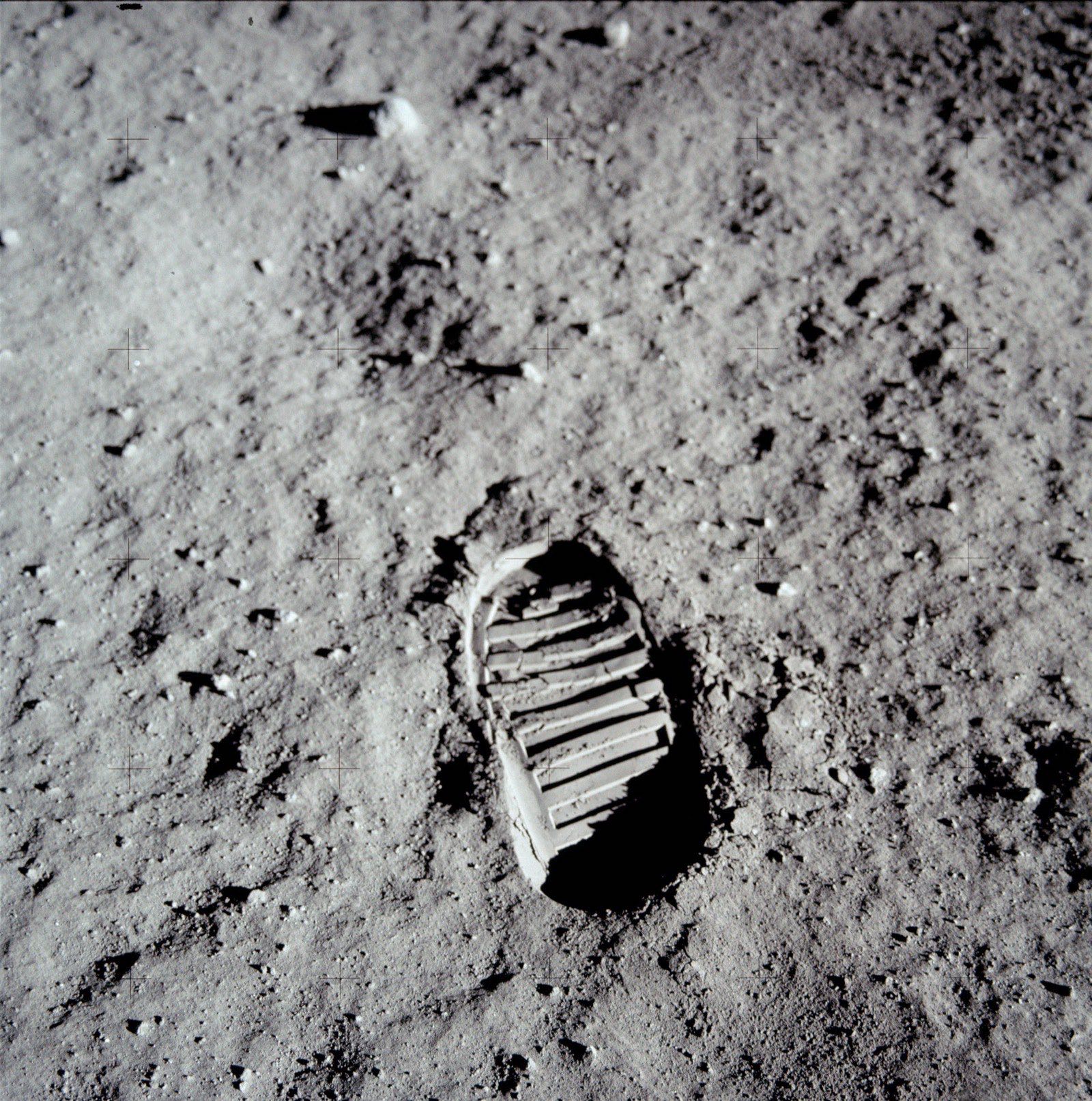
The single most-photographed feature of the Apollo 11 surface exploration is Buzz Aldrin's bootprint in the lunar regolith. The hoax theory has often focused on it: the print is too crisp, the theory holds, the dust would need atmospheric moisture to hold detail this well, and therefore the photograph proves the surface is wet sand on a soundstage.
The physics is the other way. Lunar regolith is, on average, a fine powder. Individual particles are typically 50-100 microns. The particles have been comminuted by 4 billion years of micrometeorite impact, then exposed to direct solar UV. The result is angular, electrostatically-charged dust grains that cohere strongly when compressed. The Soviet Luna 16 mission's automated drill-core returned regolith samples in 1970 that exhibited the same cohesive properties when handled in vacuum laboratory conditions on Earth. The bootprint detail is a signature of lunar regolith, not an inconsistency with it.
The same effect has been reproduced in laboratory conditions by NASA and JAXA researchers using simulated lunar regolith in vacuum chambers.
The Soviet test
The single strongest historical argument against the hoax theory is the Soviet acknowledgment. In 1969, the United States and the Soviet Union were the only two nations with operational deep-space tracking networks. The Soviet network at Yevpatoria received and analyzed the Apollo telemetry in real time. Soviet engineers attended every Apollo launch as part of the bilateral space-cooperation framework. Soviet astronomers tracked the spacecraft through optical telescopes.
The Soviet Academy of Sciences issued public statements after each landing acknowledging the missions as successful. Mstislav Keldysh — who as President of the Academy was responsible for Soviet space science — went further than acknowledgment: the Academy invited American astronauts to lecture at Soviet scientific conferences in 1970 and 1971.
In 1975, the Apollo-Soyuz Test Project — the first international crewed spaceflight — docked Apollo and Soyuz spacecraft in low Earth orbit. The two crews shared the same spacecraft for two days. They discussed their respective lunar (Soviet robotic) and crewed operations openly. The same Soviet engineers who would have had to detect a U.S. fraud worked with American counterparts in joint mission planning.
A coordinated U.S.-Soviet conspiracy to stage the entire Space Race — which is what the hoax theory requires — would have been the largest secret in human history. It has no documentary trace.
What the case actually is
The Moon landing hoax theory is, analytically, a case study in how conspiracy beliefs propagate. It has been treated as such by sociologists since the 1980s.
The theory does not survive engagement with the documentary record. The lunar samples exist. The retroreflectors work. The LRO images are independently verifiable. The Soviet tracking record is declassified. Each specific evidentiary claim has a documented resolution that requires reading at a freshman-physics level to follow.
What persists, when those resolutions are presented, is not a counter-argument. It is, in survey work since the 1990s, a generalized distrust — of government, of mainstream media, of institutional experts. The hoax theory functions less as a hypothesis about the moon and more as a marker of distrust about the institutions that report on the moon. This is documented in the academic literature on conspiracy beliefs, notably the work of Jovan Byford, Joseph Uscinski, and others.
The honest position for a publication like this one is to describe the theory accurately, present its specific claims without caricature, and present the documented evidence that responds to each claim. The reader can decide.
The cast
Why this case is filed as "mystery"
This is not a mystery about whether humans landed on the Moon. The evidence is dispositive. It is a "mystery" in the looser sense: why this particular conspiracy persists in public discourse despite the overwhelming documentary case against it. That second question — the sociology of conspiracy persistence — is an open research area in social psychology and political science.
The Moon landing hoax theory is what philosophers of science would call an unfalsifiable conspiracy: every new piece of evidence (LRO images, lunar samples, Soviet tracking data) can be re-framed by the theory's adherents as further evidence of the conspiracy's scope. This unfalsifiability is itself a marker of the theory's character as belief rather than hypothesis.
Sources
Primary documents:
- NASA, Apollo Program Summary Report (JSC-09423), April 1975.
- NASA Lunar Reconnaissance Orbiter Camera (LROC) archive, Arizona State University, 2009-present.
- Apollo 11 Lunar Sample Information Catalog (and equivalents for Apollo 12, 14, 15, 16, 17). NASA Curation Office, Johnson Space Center.
- USSR Academy of Sciences, public statements on Apollo 11-17, 1969-1972. Soviet archives released 1991-2010.
- Apache Point Observatory Lunar Laser-ranging Operation (APOLLO) data archive, 2006-present.
- Bill Kaysing, We Never Went to the Moon: America's Thirty Billion Dollar Swindle (Health Research, 1976). The foundational hoax-theory text.
Secondary investigative reporting: 7. Phil Plait, Bad Astronomy: Misconceptions and Misuses Revealed (Wiley, 2002). Chapters on lunar hoax claims. 8. James Oberg, "The Moon-Landing Conspiracy" — extensive series of articles for Skeptical Inquirer, 1990s-2000s. 9. Mythbusters Season 6, Episode 4: "NASA Moon Landing" (Discovery Channel, August 27, 2008). 10. Eric Bender, "The Persistent Belief That We Never Went to the Moon," Smithsonian Magazine, July 2019. 11. NASA, NASA Reaffirms Plans to Send Astronauts to the Moon (2019 press kit responding to anniversary-era resurgence of hoax-theory polling). 12. Conspiracy Theory: Did We Land on the Moon? (Fox Television, February 15, 2001) — the primary contemporary popular reference for the theory. 13. Dark Side of the Moon (William Karel, Arte/Point du Jour, 2002) — mockumentary widely misread as serious treatment. 14. Roger Launius, "Denying the Apollo Moon Landings," Acta Astronautica, 2011.
Academic scholarship: 15. Jovan Byford, Conspiracy Theories: A Critical Introduction (Palgrave Macmillan, 2011). 16. Joseph Uscinski & Joseph Parent, American Conspiracy Theories (Oxford University Press, 2014). 17. Karen Douglas et al., "The Psychology of Conspiracy Theories," Current Directions in Psychological Science, 2017.
Corrections & updates
2026-05-26: First publication.
Inspired this / based on it
Fox Television
Primary contemporary popular reference for the theory. Hosted by Mitch Pileggi.
Discovery Channel
Physical reconstruction of the major hoax-theory photographic claims and their resolutions.
William Karel / Arte
Mockumentary widely misread as serious treatment. Interviews with Donald Rumsfeld and Henry Kissinger are themselves part of the joke.
Peter Hyams · ★ 6.7
Fictional dramatization of a NASA-staged Mars mission. Contributed to the hoax-theory imaginative frame.
Phil Plait
Definitive popular-science treatment of the Moon-hoax claims. Wiley.
Joseph Uscinski & Joseph Parent
Political-science treatment of conspiracy-theory persistence including Moon-hoax data. Oxford UP.
Filed under
- #moon-landing
- #apollo-11
- #apollo-program
- #bill-kaysing
- #neil-armstrong
- #buzz-aldrin
- #nasa
- #tranquility-base
- #van-allen-belt
- #lunar-reconnaissance-orbiter
- #retroreflector
- #stanley-kubrick
- #fox-conspiracy-theory
- #1969
- #usa
- #moon
Click any tag for every article carrying it.
Continue reading
The Russian Sleep Experiment
On August 10, 2010, an anonymous user calling himself OrangeSoda posted a 1,200-word story on the Creepypasta Wiki. It described a Soviet experiment in which five political prisoners had been sealed in a sound-proofed chamber and exposed to a stimulant gas that kept them awake for thirty days. The story has no documentary basis. No declassified Russian archive contains anything resembling it. But over the next fifteen years it has become — to a significant fraction of the people who encounter it — historically true. This is the story of how a fiction acquires the texture of evidence.
The Snowden Disclosures
In May 2013, a 29-year-old NSA contractor named Edward Snowden boarded a flight from Honolulu to Hong Kong carrying four laptops loaded with classified documents from the world's largest signals-intelligence agency. Over the following months, *The Guardian*, *The Washington Post* and *Der Spiegel* published material from those drives that revealed the architecture of post-9/11 surveillance — PRISM, XKeyscore, Boundless Informant, MUSCULAR. Within ninety days, the global conversation about surveillance, sovereignty, and the limits of state power had shifted. Snowden has lived in Russia since August 2013.
Operation Mockingbird
Between 1948 and the mid-1970s, the Central Intelligence Agency cultivated paid and unpaid working relationships with American journalists, editors, and publishers across every major U.S. news organization. The architect was an OSS veteran named Frank Wisner. He called the network the 'Mighty Wurlitzer' — a theatre-organ metaphor for a machine that could play many instruments from a single console. The full scope was confirmed by the 1975 Church Committee, expanded upon in Carl Bernstein's 25,000-word 1977 Rolling Stone investigation, and partly declassified since. What the records have not yet given up is the operational name everyone agrees was attached to it.