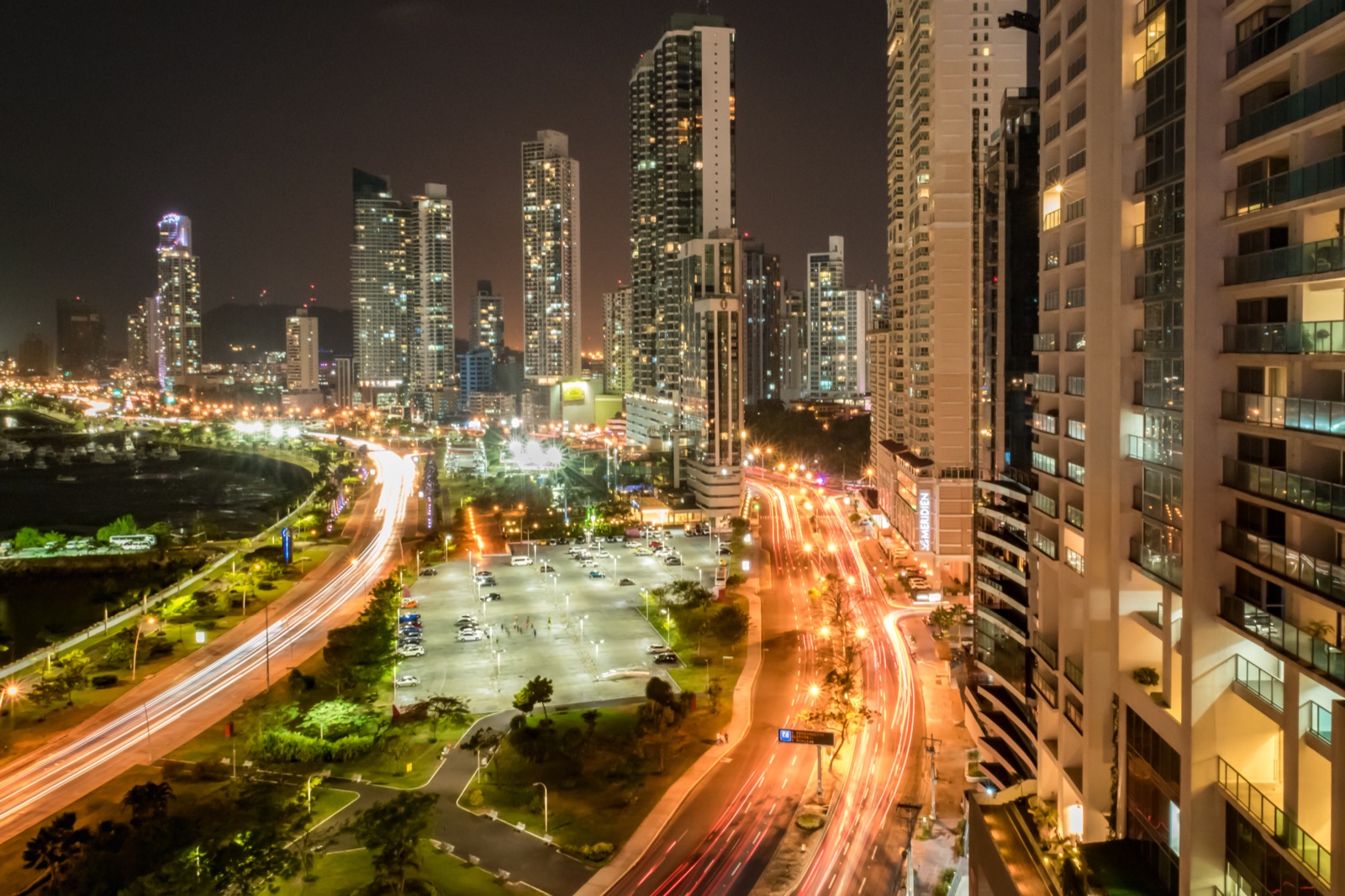
Panama City. The financial district of the Pacific coast capital — home to Mossack Fonseca and to one of the world's largest offshore-corporation registries. Wikimedia Commons, CC BY 3.0.
The Panama Papers
11.5 million documents, 376 journalists, one Sunday
- Category
- Finance & Economy
- Published
- Length
- 3,700 words · 17 min read
- Author
- The editors
The Panama Papers
11.5 million documents, 376 journalists, one Sunday.
What Mossack Fonseca was
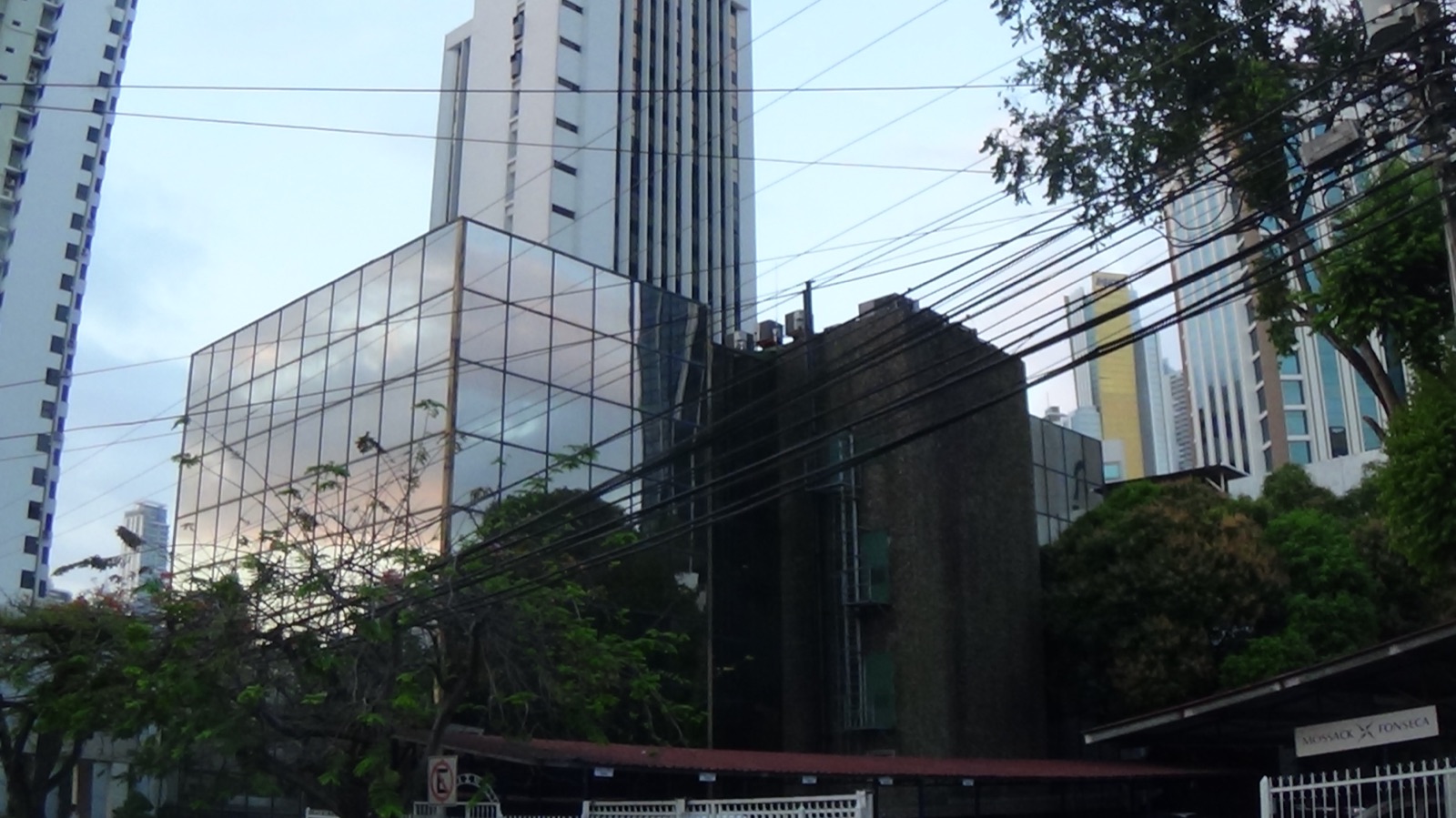
Mossack Fonseca had been founded in 1977 by two lawyers — Jürgen Mossack, who had immigrated to Panama from Germany as a child, and Ramón Fonseca Mora, a Panamanian writer and lawyer who would later serve in the Panamanian government. The firm specialized in what the international tax community calls corporate formation: the incorporation, registration, and ongoing administration of companies — most of them shell companies — in low-tax or zero-tax jurisdictions.
The business model was, in its operational mechanics, straightforward. A client (typically routed through an intermediary bank or law firm in a higher-jurisdiction country) would request a corporation. Mossack Fonseca would file the incorporation paperwork — typically in Panama, the British Virgin Islands, the Bahamas, the Seychelles, or Anguilla — using nominee directors and nominee shareholders (people who held the legal title but were not the actual beneficiaries). The actual beneficial owner of the corporation would be recorded only in confidential internal documents. The corporation could then hold bank accounts, real estate, art collections, yachts, business interests, or anything else the actual owner wished to hold without their name on the public record.
By 2015, Mossack Fonseca had created approximately 240,000 such corporations across its 35 country offices. The firm employed approximately 600 people. Annual revenue was estimated at approximately $42 million.
The legitimate use case for offshore corporate formation is real: multinational businesses use offshore vehicles for complex tax planning that is, in many cases, legal under the laws of all involved jurisdictions. Privacy considerations for high-net-worth individuals are real. Inheritance and family-business planning across multiple countries can require offshore vehicles. None of this is, in itself, the Panama Papers story.
The Panama Papers story is the other use case. The use of the same opacity mechanisms by:
- Sitting heads of state hiding state-derived wealth.
- Politicians' family members holding what was effectively laundered political-influence money.
- Organized-crime operations (Russian mafia, Mexican cartels, Saudi arms intermediaries) using offshore structures to integrate illicit cash into the legitimate banking system.
- Major corporations using shell-company structures to evade sanctions on Iran, Russia, North Korea, and other restricted jurisdictions.
- Wealthy individuals across approximately 200 countries hiding taxable income from their respective national authorities.
The 11.5 million documents established the operational details of these patterns at unprecedented scale and specificity.
The leak
In late January 2015, Bastian Obermayer received an encrypted message from an unknown person identifying themselves as "John Doe." The message read approximately: "Hello. This is John Doe. Interested in data? I'm happy to share."
Obermayer was a 39-year-old investigative reporter at the Süddeutsche Zeitung (SZ) — the Munich-based broadsheet that had been the German press partner on the 2014 Luxembourg Leaks (LuxLeaks) ICIJ investigation. He had been at SZ since 2007 and had built a career on financial-crime reporting.
Obermayer's first reaction, by his subsequent account, was appropriately suspicious. He asked what data. Doe sent a small sample. Obermayer's editor — Hans Leyendecker, head of SZ investigations — and his colleague Frederik Obermaier (whose similar name to Obermayer would create permanent confusion in international coverage) reviewed the sample. It was, on its face, genuine Mossack Fonseca internal documentation.
Doe transmitted documents in encrypted batches over the next year. The total set, when complete, was:
- 2.6 terabytes of data
- 11.5 million individual documents — emails, contracts, scanned passports, internal memos, shareholder records, beneficial-ownership filings
- 214,488 distinct offshore corporations
- Coverage spanning approximately 1977 to 2015
Doe transmitted everything through encrypted channels and refused all attempts to identify themselves further. They asked for no money. Their stated motivation, in the May 2016 John Doe Manifesto published in SZ after the initial reporting was complete, was:
The source has never been identified. They have continued to correspond with ICIJ through encrypted channels since 2016.
How 376 journalists kept the secret
The operational achievement of the Panama Papers — separate from its substantive content — was that 376 journalists at 109 news organizations across 76 countries worked the files for approximately a year without any pre-publication leak.
The coordination was managed by the International Consortium of Investigative Journalists (ICIJ), a Washington-based nonprofit organization founded in 1997 by Center for Public Integrity. By 2015, ICIJ had coordinated several large cross-border investigations including the 2013 Offshore Leaks (260 GB / 2.5 million files from a different offshore firm) and the 2014 Lux Leaks. The ICIJ technical infrastructure included:
- Secure document repository. A custom-built private server system using Apache Solr search, with 2-factor authentication and explicit access controls per partner.
- Encrypted communication. Mattermost (open-source Slack alternative) for journalist-to-journalist discussion, plus end-to-end-encrypted email for sensitive coordination.
- Document attribution discipline. Each partner published only the corporations / individuals from their own national focus; attribution to the source documents was managed centrally.
- Synchronized publication. All 109 partners agreed to a single publication time: 8:00 p.m. CET on Sunday, April 3, 2016 (later moved to 6:00 p.m. to coincide with the 8:00 p.m. Süddeutsche Zeitung television-news cycle in Germany).
The ICIJ team that managed the coordination was approximately 20 people in Washington, led by Director Gerard Ryle (an Irish- Australian journalist who had founded ICIJ's previous Offshore Leaks project).
The pre-publication discipline was, by the standards of contemporary newsrooms, remarkable. 376 reporters at 109 organizations in 76 countries did not produce a single pre-publication leak across 12 months of active work. The reasons, in subsequent journalist interviews, included:
- The professional reputational stakes for each partner organization were enormous; a defector would burn relationships not just with ICIJ but with every other partner organization.
- The technical infrastructure made unauthorized export difficult.
- The audience-revelation incentive (a synchronized worldwide publication) was greater than the early-leak incentive (a single scoop).
The publication
At 6:00 p.m. CET on Sunday, April 3, 2016, the first wave of Panama Papers stories was published. The lead stories:
- Süddeutsche Zeitung (Germany): Lead investigative package; multiple front-page articles.
- The Guardian (UK): Cameron family's offshore fund.
- El Confidencial (Spain): Spanish politicians and Pedro Almodóvar.
- Le Monde (France): French politicians and Marine Le Pen's National Front party financing.
- The Indian Express (India): 500+ Indian individuals and corporations.
- Aamulehti / Yle (Finland): Finnish officials.
- Kjarninn (Iceland): Prime Minister Sigmundur Davíð Gunnlaugsson's previously-undisclosed offshore company.
The Icelandic publication had the most immediate political consequences. Gunnlaugsson had been Iceland's Prime Minister since 2013, leading the centre-right Progressive Party. The Panama Papers revealed that he and his wife had owned an offshore company called Wintris Inc., incorporated in the British Virgin Islands by Mossack Fonseca in 2007. The company had held bonds in several Icelandic banks — banks that subsequently failed in the 2008 financial crisis and were restructured by the Icelandic government under Gunnlaugsson's own administration after he became Prime Minister.
Gunnlaugsson had not disclosed Wintris to the Icelandic parliament's register of financial interests. When Swedish public broadcaster SVT confronted him on camera with the documents three weeks before the publication date, he stood up and walked out of the interview.
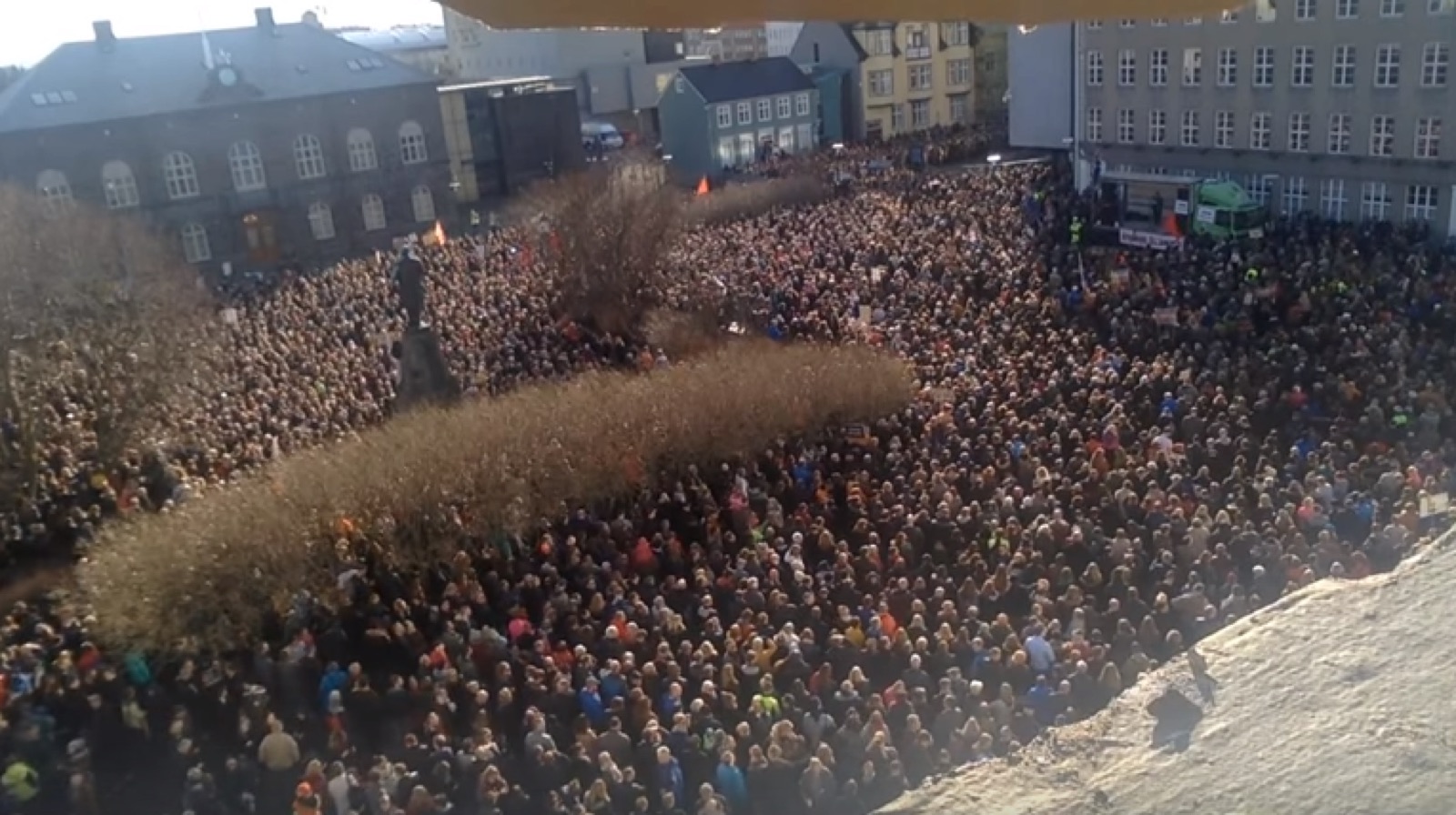
On the morning of Monday, April 4, 2016, approximately 22,000 Icelanders gathered in front of the Althingi (the Icelandic parliament) in Reykjavík to demand Gunnlaugsson's resignation. Iceland's population was approximately 330,000. The protest was, per capita, the largest protest in Iceland since World War II.
Gunnlaugsson resigned on April 5, 2016, less than 48 hours after publication. He was the first head of government to fall directly from the Panama Papers; he would not be the last.
Who else was named
The first round of Panama Papers coverage named approximately 140 politicians from more than 50 countries. The most consequential:
Vladimir Putin (Russia). The documents did not name Putin directly — that would have been a primary reason for publication in the Russian press, which Russia's media controls would have prevented. Instead, the documents named Sergei Roldugin, a cellist who had been one of Putin's closest personal friends since their childhood in Leningrad. Roldugin had served as the nominal beneficial owner of offshore corporations holding approximately $2 billion in assets. The structure was clearly a proxy ownership. The Russian state media's response was a campaign characterizing the entire investigation as Western-intelligence-orchestrated.
Sigmundur Davíð Gunnlaugsson (Iceland). Resigned April 5.
Mauricio Macri (Argentina). Argentine President; his Cabinet included two other Panama Papers-named officials. Argentine investigations followed; Macri was eventually acquitted in 2018.
Petro Poroshenko (Ukraine). Ukrainian President; the documents showed a Mossack Fonseca-incorporated holding company in the British Virgin Islands for his Roshen confectionery business during his presidency. Poroshenko was not charged.
David Cameron (UK). Cameron's father Ian had held an offshore investment fund (Blairmore Holdings) incorporated by Mossack Fonseca in 1982. Cameron's family had benefited from the fund. Cameron resigned as PM later in 2016 (over Brexit), but the Panama Papers contributed to the political climate.
The Royal Family of Saudi Arabia. King Salman and Crown Prince Mohammed bin Salman were named as beneficial owners of several offshore structures.
Lionel Messi (Argentina/Spain). Argentine football star; tax fraud case in Spain related to image rights routed through Panama-incorporated companies.
Pedro Almodóvar (Spain). Film director; tax-routing arrangements.
Bashar al-Assad's cousin (Syria). Rami Makhlouf, financier of the Syrian Assad regime.
The complete list of named individuals across all subsequent reporting and ICIJ database releases reaches approximately 4,000. The total number of beneficial owners in the documents — most of whom have never been publicly identified — is approximately 214,488.
What it cost
The Panama Papers had four distinct cost-categories:
Political consequences. Gunnlaugsson resigned. Pakistan's Prime Minister Nawaz Sharif was ousted by the Pakistani Supreme Court in 2017 in proceedings substantially based on Panama Papers evidence. The presidents of Argentina, Ukraine, and Iceland faced extended investigations. The European Parliament established the PANA Committee specifically to investigate Panama Papers revelations. Multiple jurisdictions adopted new beneficial- ownership transparency rules.
Tax recovery. By the end of 2024, governments worldwide had recovered approximately $1.36 billion in previously-undisclosed taxes directly attributable to Panama Papers leads. The figure represents a small fraction of the actual amount of capital documented as offshore in the leak.
Legal action against Mossack Fonseca. Mossack Fonseca itself was investigated in multiple jurisdictions. The firm closed operations in March 2018. Jürgen Mossack and Ramón Fonseca were charged with money laundering in Panama in 2020. They were acquitted in June 2024 on a procedural grounds (improperly collected evidence).
Press freedom consequences. Daphne Caruana Galizia, the Maltese investigative journalist who had been the leading reporter on Malta's Panama Papers exposures, was assassinated by car bomb in October 2017. Three subsequent convictions were obtained. Galizia's death made her the first journalist killed in direct connection with the Panama Papers.
Why the leak worked
The cast
What we still don't know
The identity of John Doe. The source has maintained anonymity through all subsequent communication. The motivation has been articulated; the identity has not been.
The complete beneficial-ownership list. Approximately 4,000 individuals have been publicly named through ICIJ's Offshore Leaks database and individual partner reporting. The remaining ~210,000 beneficial owners have not been publicly identified. ICIJ has, by editorial decision, only published the names of individuals where there is a clear public-interest case.
The full tax-recovery cascade. Many post-Panama-Papers tax investigations are confidential by the laws of the jurisdictions involved. The $1.36 billion publicly attributed to Panama Papers leads is a confirmed minimum; the actual recovery is almost certainly higher.
The successor industry. Mossack Fonseca closed. The offshore- formation industry did not. The post-Panama-Papers transparency rules (beneficial-ownership registries, BEPS-related rules, the European Union's 5th Anti-Money Laundering Directive) have constrained but not eliminated the same operational patterns.
Why this is a "confirmed" case
The Panama Papers is one of the most extensively documented financial-secrecy cases in modern history. The original documents are on file with ICIJ partner organizations. The legal proceedings in approximately 80 jurisdictions are matters of public record. The named individuals' responses (denials, acknowledgements, resignations) are documented.
What is sometimes still misunderstood — particularly by general audiences who recall the Panama Papers as a single 2016 news event — is the continuing nature of the case. The named individuals are still being investigated. The successor leaks (Paradise Papers 2017, Pandora Papers 2021) have established that the underlying offshore-formation industry has continued. The Panama Papers was the first major leak in what has become a multi-leak journalistic genre.
Sources
Primary documents:
- ICIJ, The Panama Papers — investigation portal at icij.org, including the Offshore Leaks Database. Continuously updated since April 3, 2016.
- John Doe Manifesto, published Süddeutsche Zeitung, May 6, 2016.
- Mossack Fonseca internal documents — selectively published by ICIJ partners 2016-2024.
- European Parliament PANA Committee Final Report, December 2017.
- Pakistani Supreme Court Judgment in Panama Papers case (Imran Ahmad Khan Niazi v. Mian Muhammad Nawaz Sharif), July 28, 2017.
- Panama Court ruling in Estado v. Mossack et al., June 28, 2024 (acquittal on procedural grounds).
Secondary investigative reporting: 7. Bastian Obermayer and Frederik Obermaier, The Panama Papers: Breaking the Story of How the Rich and Powerful Hide Their Money (Oneworld, 2016). The two-author memoir/investigation. 8. Jake Bernstein, Secrecy World: Inside the Panama Papers Investigation of Illicit Money Networks and the Global Elite (Henry Holt, 2017). 9. Frederik Obermaier and Bastian Obermayer, Panama Papers (German edition; Kiepenheuer & Witsch, 2016). 10. The Guardian, multi-correspondent coverage 2016-present. 11. Süddeutsche Zeitung, the home publication for the leak; comprehensive ongoing coverage. 12. Le Monde, El Confidencial, The Indian Express, Kjarninn, Aamulehti, Aftenposten, Politiken — the European and Indian partner-publication archives. 13. Daphne Caruana Galizia, blog archive Running Commentary — preserved at daphne.foundation. 14. Steven Soderbergh and Scott Z. Burns, The Laundromat (Netflix, 2019) — fictionalized dramatization.
Academic / scholarly: 15. Stephen Platt, Criminal Capital: How the Finance Industry Facilitates Crime (Palgrave Macmillan, 2015) — foundational context. 16. Brooke Harrington, Capital Without Borders: Wealth Managers and the One Percent (Harvard UP, 2016). 17. Nicholas Shaxson, The Finance Curse: How Global Finance Is Making Us All Poorer (Grove Press, 2018).
Corrections & updates
2026-05-26: First publication.
Inspired this / based on it
Steven Soderbergh / Netflix · ★ 6.3
Fictionalized dramatization. Meryl Streep, Gary Oldman as Mossack, Antonio Banderas as Fonseca.
Alex Winter / Hulu · ★ 6.8
Investigative documentary directed by the actor and Bill & Ted star turned investigative-doc director.
Bastian Obermayer & Frederik Obermaier
The participants' memoir-investigation. Oneworld Publications.
Jake Bernstein
ICIJ reporter on the project. Henry Holt.
Brooke Harrington
Sociological treatment of the offshore wealth-management industry. Harvard UP.
BBC / Hulu
On the assassination of Daphne Caruana Galizia, the Maltese journalist who was the lead reporter on Malta's Panama Papers exposures.
Filed under
- #panama-papers
- #mossack-fonseca
- #john-doe
- #bastian-obermayer
- #frederik-obermaier
- #icij
- #suddeutsche-zeitung
- #offshore
- #shell-companies
- #sigmundur-gunnlaugsson
- #iceland
- #david-cameron
- #putin
- #2016
- #latin-america
- #panama
- #tax-haven
- #pulitzer
Click any tag for every article carrying it.
Continue reading
Dieselgate
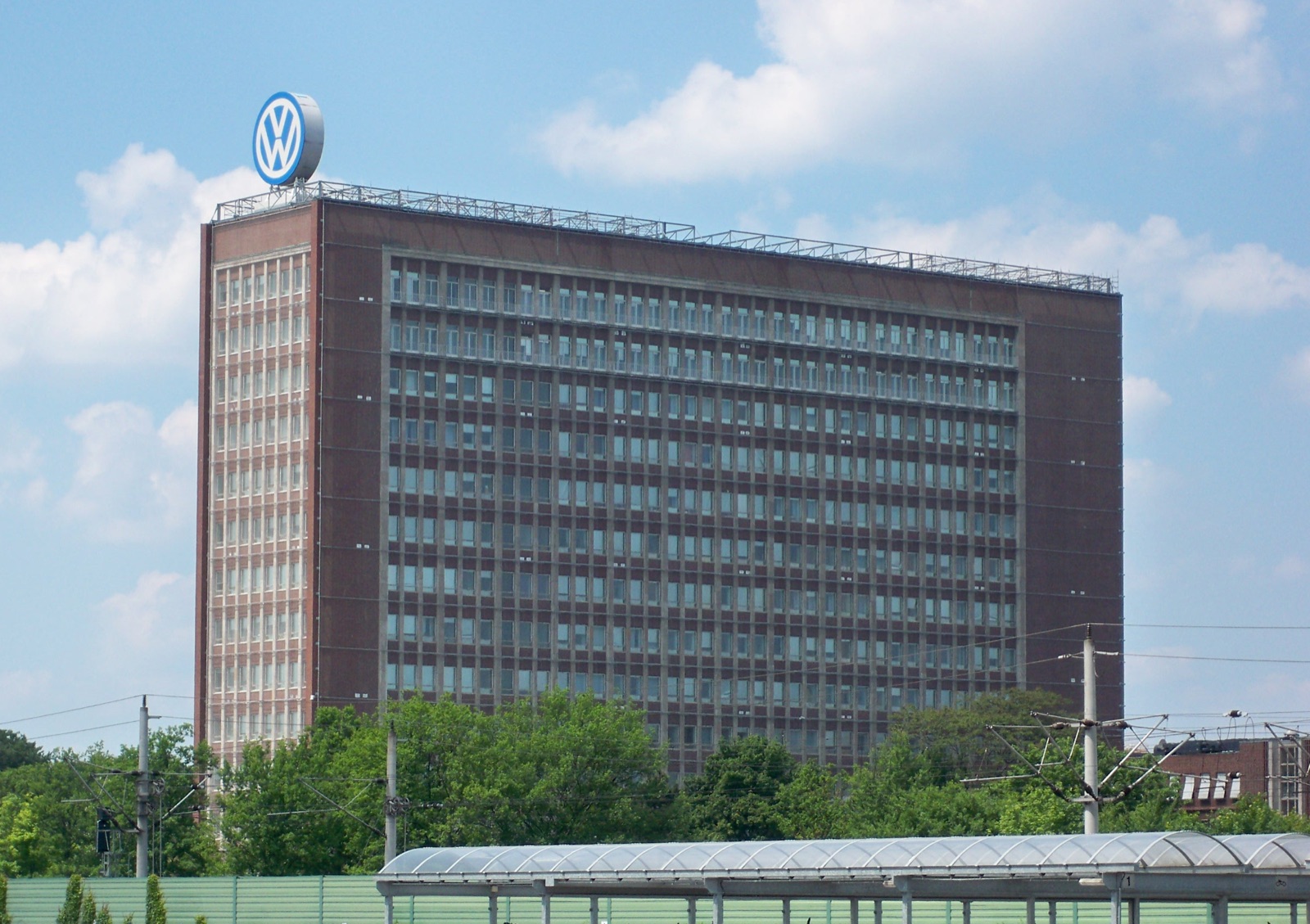
In late 2013, the International Council on Clean Transportation paid a small team at West Virginia University to put two diesel Volkswagens on the road from Los Angeles to Seattle, hooked up to portable emissions sensors. The team expected to find data confirming what Volkswagen's American marketing campaign had been claiming for years: that 'clean diesel' was real. Instead they found nitrogen-oxide emissions up to forty times the legal limit. Eighteen months later, on September 18, 2015, the U.S. EPA formally accused Volkswagen of installing software in eleven million cars that detected emissions tests and lied to them. By the end of the week, the CEO had resigned and Volkswagen had begun a six-year journey through $34 billion of fines and settlements.
The Snowden Disclosures
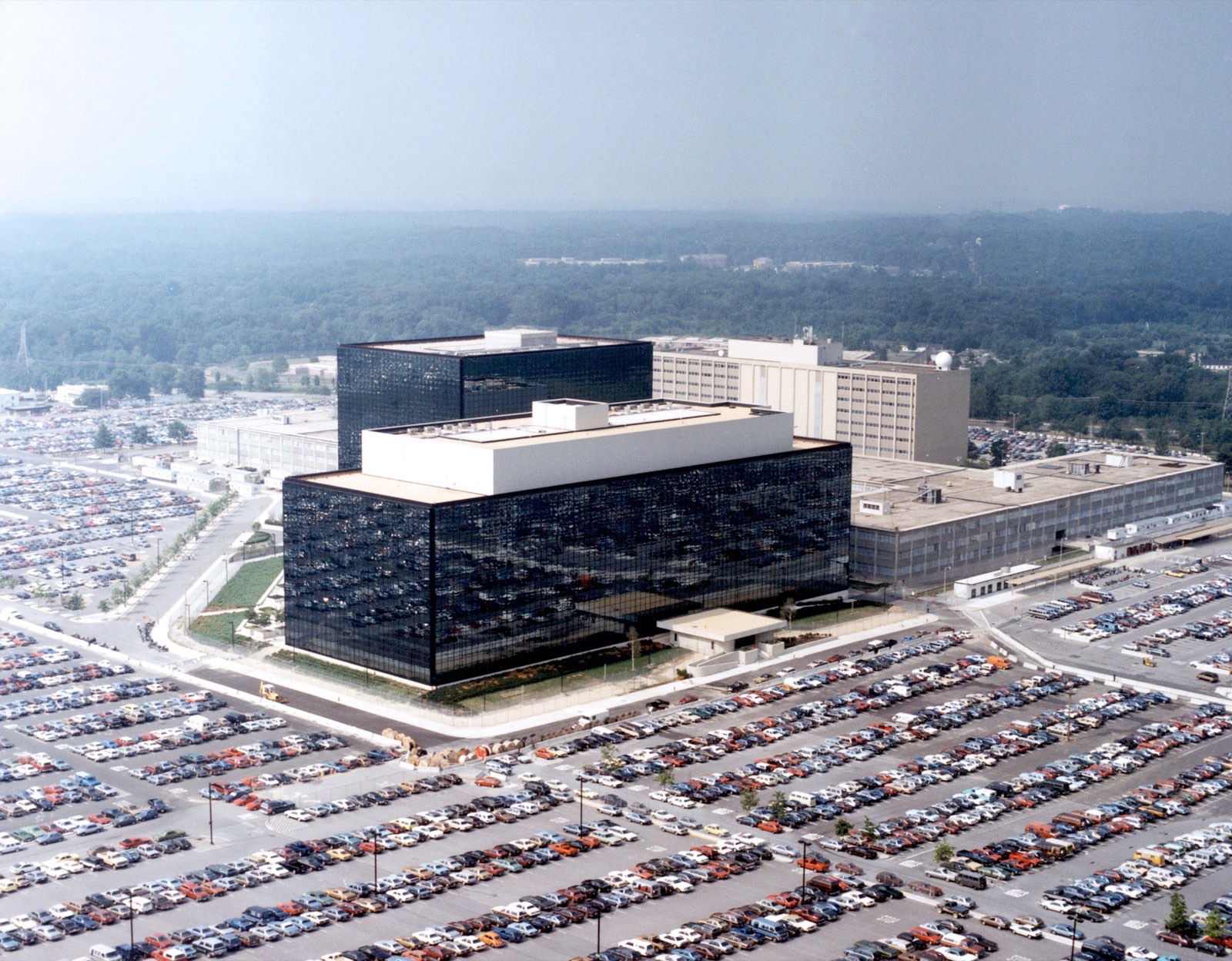
In May 2013, a 29-year-old NSA contractor named Edward Snowden boarded a flight from Honolulu to Hong Kong carrying four laptops loaded with classified documents from the world's largest signals-intelligence agency. Over the following months, *The Guardian*, *The Washington Post* and *Der Spiegel* published material from those drives that revealed the architecture of post-9/11 surveillance — PRISM, XKeyscore, Boundless Informant, MUSCULAR. Within ninety days, the global conversation about surveillance, sovereignty, and the limits of state power had shifted. Snowden has lived in Russia since August 2013.
Operation Mockingbird
Between 1948 and the mid-1970s, the Central Intelligence Agency cultivated paid and unpaid working relationships with American journalists, editors, and publishers across every major U.S. news organization. The architect was an OSS veteran named Frank Wisner. He called the network the 'Mighty Wurlitzer' — a theatre-organ metaphor for a machine that could play many instruments from a single console. The full scope was confirmed by the 1975 Church Committee, expanded upon in Carl Bernstein's 25,000-word 1977 Rolling Stone investigation, and partly declassified since. What the records have not yet given up is the operational name everyone agrees was attached to it.