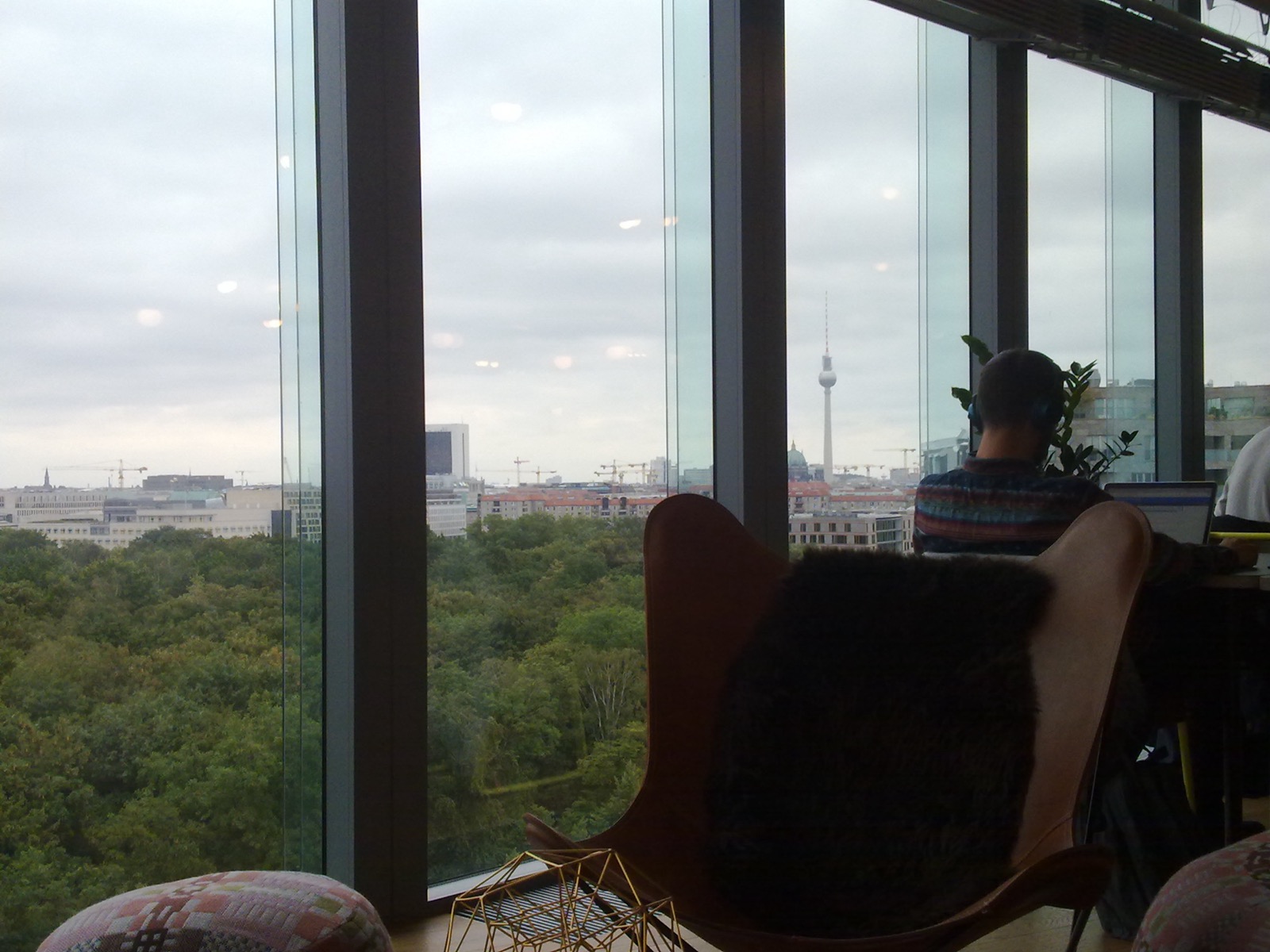
A WeWork coworking space in Berlin, with the city skyline beyond. The exposed design, the lounge furniture, the laptop-and-headphones aesthetic of community and creativity — this was the product WeWork sold, and the image it used to present itself not as a real-estate company but as a movement. Wikimedia Commons / Davidmoerike, CC0.
WeWork and the $47 Billion Office Company That Wasn't a Tech Company
United States, 2010–2019 — a charismatic founder turned a business that rented out office desks into a startup valued at $47 billion, by selling it as a world-changing technology company. Then it filed to go public, the world read the fine print, and the value collapsed in six weeks
- Category
- Finance & Economy
- Published
- Length
- 4,420 words · 19 min read
- Author
- The editors
The WeWork story is the rare cautionary tale that contains almost no crime. No one was prosecuted; no fraud was proven; the books, in the end, were largely there for anyone willing to read them. What makes it instructive is precisely that it was legal — that an ordinary business could be inflated to an extraordinary valuation, and tip toward collapse, entirely within the rules, on the strength of a story, a founder, and a flood of cheap capital looking for somewhere to go. WeWork is less a tale of deception than of collective delusion, and of the moment the delusion met the cold arithmetic of the public markets.
This is the story of the office company that thought it was a religion.
Adam Neumann and the gospel of "We"
At the centre was Adam Neumann, an Israeli-born entrepreneur of enormous charisma, height, and conviction. He co-founded WeWork in 2010 with Miguel McKelvey, and from early on he displayed a gift for making a mundane business sound transcendent. He spoke of WeWork not as a provider of desks but as a community that would address loneliness and alienation, a "we" generation's answer to a fragmented world; he talked of expanding into living (WeLive), education (WeGrow), and eventually everything, of "elevating the world's consciousness," and, in less guarded moments, of becoming president of the world, living forever, and amassing the first trillion-dollar — even trillionaire — fortune. He cultivated a rock-star founder persona, and it worked: investors found him mesmerising, and the more grandiose the vision, the more some of them seemed to believe.
The lifestyle matched the rhetoric, and became part of the legend. The private jet stocked with tequila and, on at least one flight, cannabis; the parties; the talk of changing the world delivered between shots of liquor; the barefoot walks; the surfing; the mansions — Neumann lived like the rock star he presented himself as, often on the company's money or on the proceeds of cashing out his shares. Some of this was simply the indulgence of a newly rich founder, but much of it bled into the business: the line between Adam Neumann's personal interests and WeWork's corporate ones grew steadily thinner, until the two were, in several concrete instances, the same. The cult of the founder was not just a marketing posture. It was a way of running — and ultimately nearly ruining — the company.
This matters because the entire WeWork phenomenon rested on persuading sophisticated people that an office-rental business was something far grander. The substance beneath the rhetoric was ordinary; the rhetoric was the product. Neumann's genius — and it was a kind of genius — was in the selling, in making investors feel they were buying into a movement and a once-in-a-generation founder rather than a real-estate arbitrage with good interior design.
The pitch: a tech company that rented desks
To understand both the rise and the fall, you have to understand the sleight of hand at the company's core. WeWork's actual business was straightforward and not new: it signed long-term leases on office space, spent money fitting that space out attractively, and then rented it to members on flexible, short-term terms, hoping to collect more in memberships than it paid in rent and build-out. This is a real business, but it is a real-estate business, and real-estate businesses are valued modestly — at some multiple of their earnings, like the office landlords they resemble.
Neumann's achievement was to get WeWork valued as a technology company instead. Tech companies command vastly higher valuations than property firms because they promise rapid, scalable growth and high margins — software costs little to copy, so each new customer is nearly pure profit. WeWork dressed itself in this logic: it spoke of "space as a service," of network effects, of a global community platform enabled by technology, of data and an app and the "we" ecosystem. The clever framing invited investors to apply tech multiples to real-estate economics — to value WeWork not as the landlord it was but as the next great platform it claimed to be. That gap between how it was valued and what it actually did was the whole game, and the source of both the $47 billion and its eventual collapse.
The money machine
What turned an over-hyped startup into a $47 billion one was a specific and enormous source of capital: SoftBank, the Japanese conglomerate run by the billionaire Masayoshi Son, and its colossal Vision Fund. In the late 2010s, SoftBank's Vision Fund — bankrolled substantially by Gulf sovereign wealth — was deploying nearly $100 billion into technology startups, on a philosophy of pouring vast sums into chosen companies to help them dominate their markets through sheer scale, an approach often called "blitzscaling." Son took to Neumann and to WeWork, and SoftBank invested billions, repeatedly, at ever-higher valuations.

This torrent of money did two things. It allowed WeWork to expand explosively, opening locations around the world at breakneck speed regardless of whether they were profitable, because growth, not profit, was the metric that justified the valuation. And it created a self-reinforcing illusion: each new SoftBank investment at a higher price set a higher valuation, which became the official number, which made the company seem more successful and justified the next round. The $47 billion was, to a significant degree, a figure SoftBank had effectively created by choosing to pay it. It reflected not the judgment of a broad market but the conviction of one extraordinarily deep-pocketed believer — and that distinction would prove fatal the moment the broad market got a vote.
There is a revealing irony in SoftBank's role. Son had built his reputation on bold, contrarian bets — most famously an early investment in the Chinese e-commerce giant Alibaba that returned many billions — and he approached the Vision Fund with the conviction that the way to win in technology was to identify the likely category winner and then fund it so lavishly that it could outspend and outgrow all rivals into dominance. Applied to genuine technology platforms with scalable economics, the logic had some force. Applied to WeWork, it was close to incoherent: pouring billions into a real-estate business so it could sign ever more long-term leases did not create a defensible, high-margin monopoly; it created a bigger pile of fixed obligations and losses. The strategy that had worked for Alibaba helped inflate a property company into a $47 billion fantasy — a reminder that a single spectacular success can give an investor the confidence, and the capital, to make an equally spectacular mistake.
The warning signs
For those willing to see them, the problems were not hidden. WeWork was losing tremendous amounts of money — roughly a dollar for every dollar of revenue at points — and its losses grew as it grew, because its expansion was funded by leases it would owe rent on for years against memberships that could evaporate in any recession. The faster it grew, the more it lost. This is the opposite of the scalable, high-margin economics that justified a tech valuation; it was, if anything, a business that became riskier the bigger it got.
Then there was Neumann's personal conduct, which blurred the line between founder and company in ways that alarmed even sympathetic observers. He personally bought stakes in buildings and then leased them to WeWork, profiting as both landlord and tenant. He trademarked the word "We" and arranged for the company to pay him millions for the right to use its own name — a transaction so brazen it was later unwound. He cashed out large sums while the company bled money. The governance was structured to give him near-total control, with super-voting shares and provisions that, at one point, would have let his family entrench control across generations. To insiders this looked less like a disciplined company than a vehicle for one man's vision and enrichment.
The S-1
All of this was tolerated, even celebrated, as long as WeWork stayed private, where valuations are set by negotiation and belief. The reckoning came when it tried to go public. In August 2019, WeWork filed its S-1, the prospectus that a company must publish before an initial public offering, disclosing its finances and risks to the investing public. It was meant to be a triumphant prelude to a blockbuster listing. Instead it was the document that destroyed the company's mystique.

Read closely — and now, as a public filing, it was read very closely by journalists, analysts, and investors — the S-1 was devastating. It revealed the scale of the losses; the dependence on continued infusions of cash; the structural mismatch of long-term liabilities and short-term income; and the litany of Neumann's self-dealing and the extraordinary governance arrangements. It was also full of the mystical language — the document opened by dedicating itself to "the energy of we" and "elevating the world's consciousness" — that, set against the grim financials, read less as visionary than as delusional. The gap between the cosmic rhetoric and the bleeding balance sheet was now visible to everyone, in black and white, filed with regulators. The spell that had held in the private market did not survive contact with public disclosure.
The collapse
What followed was one of the fastest destructions of value in modern business history. As investors and the press digested the S-1, WeWork's prospective valuation went into free fall. The number that had been $47 billion in the private market was, the public markets signalled, worth a fraction of that — estimates dropped toward $10 billion, then lower. Major investors balked; the bankers struggled to find buyers at any respectable price. Within weeks the company was forced to postpone, and then abandon, the IPO entirely. The failure of the offering was catastrophic, because WeWork had been counting on the cash it would raise — and on a loan tied to it — to keep funding its losses. Without the IPO, the company that had been worth $47 billion was suddenly facing the prospect of running out of money.
The board turned on its founder. Under pressure from investors, especially SoftBank, Adam Neumann was forced to step down as chief executive in September 2019, only weeks after the triumphant valuation. The man who was going to elevate the world's consciousness was removed from the company he had built, his vision having collided fatally with a prospectus.
The speed of the reversal was its most shocking feature. For years WeWork's valuation had only ever risen, each funding round ratifying a higher number, the story growing more expansive with the money. Then, in a matter of weeks in the early autumn of 2019, the entire edifice inverted: the triumphant IPO became a withdrawn one, the visionary founder became a liability to be removed, and a company celebrated as one of the most valuable startups on earth was suddenly fighting to avoid running out of cash. Nothing about the underlying business had changed in those six weeks — the offices were the same, the leases the same, the losses the same. What changed was that the business had been forced to show itself, and the gap between the story and the substance, invisible for years, became undeniable in days.
The bailout and the afterlife
WeWork did not immediately die; SoftBank, having so much invested and so much to lose from a total collapse, stepped in with a rescue package that gave it control and valued the company at a small fraction of its former height. Adam Neumann, remarkably, left with an enormous payout — a package reportedly worth around a billion dollars in stock, loans, and fees to depart the company he had nearly sunk — a detail that became emblematic of how founder-friendly the era's capital had become, and that struck many as a galling reward for failure.
The company limped on. In 2021 it finally went public, not through a traditional IPO but by merging with a special-purpose acquisition company (a SPAC), at a valuation far below its peak. But the underlying business never escaped the contradiction at its heart — long-term leases, short-term income — and the shift to remote work after 2020 hollowed out demand for its office space. In late 2023, WeWork filed for bankruptcy. The company once valued at $47 billion, hailed as a world-changing platform, ended as a cautionary footnote, its real-estate arithmetic having finally caught up with its cosmic ambitions.
What is established, and what it means
There is little factual dispute about WeWork; the events played out in public filings and headlines. What the case offers is a set of lessons about an era, and they are worth stating clearly.
The first is about the power and danger of cheap money. WeWork was a creature of a specific moment — years of very low interest rates and enormous pools of capital, like SoftBank's Vision Fund, desperate for returns and willing to bet vast sums on growth-at-any-cost stories. That environment could inflate a fundamentally ordinary business to an extraordinary valuation, because capital was so abundant and so hungry that the discipline of asking "does this actually make money?" was suspended in favour of "how big can it get?" WeWork is what that suspension looks like at the extreme.
The second is about founder mythology. Silicon Valley's romance with the visionary founder — the charismatic figure who sees what others cannot and must be given total control to realise an audacious dream — reached a kind of reductio ad absurdum in Adam Neumann. The very qualities that raised the money (grandiosity, conviction, the refusal to accept ordinary limits) were the qualities that endangered the company (self-dealing, reckless expansion, the blurring of founder and firm), and the governance structures that founder-worship had normalised gave him the rope to do real damage. WeWork is a case study in the costs of treating a salesman's confidence as a substitute for the boring disciplines of running a business.
In the end, WeWork is the purest parable of its financial era: not a crime, not a lie exactly, but a collective act of wishful thinking on a $47 billion scale, sustained by cheap money and a mesmerising founder until the cold light of a public filing dissolved it in six weeks. The office company that called itself a movement, that dedicated its prospectus to elevating the world's consciousness while losing a dollar for every dollar it earned, became the moment Silicon Valley's romance with the visionary founder and the growth-at-all-costs story met its limit. Adam Neumann walked away rich; SoftBank swallowed the losses; WeWork eventually went bankrupt; and the desks, all along, were just desks. The value that vanished had never really been there — and the most unsettling thing about the whole affair is how legal, how ordinary, and how repeatable it all was.
Sources
- WeWork (The We Company), Form S-1 registration statement filed with the SEC (August 2019) — primary.
- WeWork / SoftBank filings and disclosures on the rescue and subsequent restructuring (2019 onward) — primary.
- WeWork's 2023 bankruptcy filing — primary.
- Eliot Brown and Maureen Farrell, The Cult of We: WeWork, Adam Neumann, and the Great Startup Delusion (2021) — secondary.
- Reeves Wiedeman, Billion Dollar Loser: The Epic Rise and Spectacular Fall of Adam Neumann and WeWork (2020) — secondary.
- Wall Street Journal reporting by Eliot Brown and others on WeWork's finances, the S-1, and the collapse (2019) — secondary.
- WeWork: Or the Making and Breaking of a $47 Billion Unicorn (Hulu documentary, 2021) — secondary.
- Reporting by the New York Times, the Financial Times, and others on the IPO failure, Neumann's departure, and the bankruptcy (2019–2023) — secondary.
Inspired this / based on it
Eliot Brown and Maureen Farrell
Crown. The definitive account, by Wall Street Journal reporters.
Reeves Wiedeman
Little, Brown. A narrative biography of Neumann and the company.
Apple TV+
Dramatized miniseries with Jared Leto and Anne Hathaway as the Neumanns.
Filed under
- #wework
- #adam-neumann
- #softbank
- #startup
- #silicon-valley
- #venture-capital
- #ipo
- #real-estate
- #2010s
- #confirmed
Click any tag for every article carrying it.
Continue reading

Theranos and the Drop of Blood That Wasn't There
Elizabeth Holmes dropped out of Stanford at nineteen to build a company around an idea that sounded like the future: a small machine that could run a comprehensive battery of medical tests — hundreds of them — from a single drop of blood drawn painlessly from a finger-prick, cheaply and instantly, in any pharmacy or home. She called the company Theranos, dressed in a black turtleneck in conscious imitation of Steve Jobs, and spoke in a deep voice about democratising health care and saving lives. Silicon Valley believed her. So did some of the most powerful men in America, who joined her board: former secretaries of state Henry Kissinger and George Shultz, former defense secretary James Mattis, and others. So did the pharmacy giant Walgreens, which put Theranos blood-testing centres in its stores. By 2014 the company was valued at around nine billion dollars and Holmes, on paper, was the youngest self-made female billionaire in the world, hailed on magazine covers as the next Jobs. There was only one problem, and it was the whole problem: the machine did not work. It could not do what she claimed, it never had, and inside the company the tests on real patients were secretly being run, badly, on ordinary commercial analysers — producing results so unreliable that people received dangerously wrong information about their own blood. Theranos was not a brilliant idea that failed; it was, a court would eventually find, a fraud. This article tells the story of how a company built on a drop of blood that wasn't there fooled so many for so long, who finally exposed it, and what it revealed about the culture that made it possible.

The Panama Papers
At approximately 6:00 p.m. Central European Time on Sunday, April 3, 2016, news organizations on six continents simultaneously published the first results of an 18-month coordinated investigation into 11.5 million leaked documents from a single Panama-based law firm. The firm was Mossack Fonseca. The documents — totaling 2.6 terabytes, the largest single data leak in journalism history at that time — exposed the operations of 214,488 offshore corporations and the identities of their ultimate owners. The owners included 12 sitting heads of state, 128 senior politicians and government officials, members of the inner circles of Vladimir Putin and the Saudi Royal Family, the families of Xi Jinping and David Cameron, the President of Iceland (who resigned within 48 hours), Lionel Messi, Pedro Almodóvar, and dozens of others. The leaking source — known only as 'John Doe' and never identified — had delivered the documents over a period of approximately 12 months to two reporters at the Munich newspaper *Süddeutsche Zeitung*. The investigation was coordinated by the International Consortium of Investigative Journalists (ICIJ), based in Washington, D.C. 376 reporters at more than 100 news organizations in 76 countries worked on the documents in shared secure infrastructure for the entire 18 months without any pre-publication leak. The story won the 2017 Pulitzer Prize for Explanatory Reporting and triggered approximately $1.36 billion in unpaid-tax recoveries by governments worldwide between 2016 and 2024.
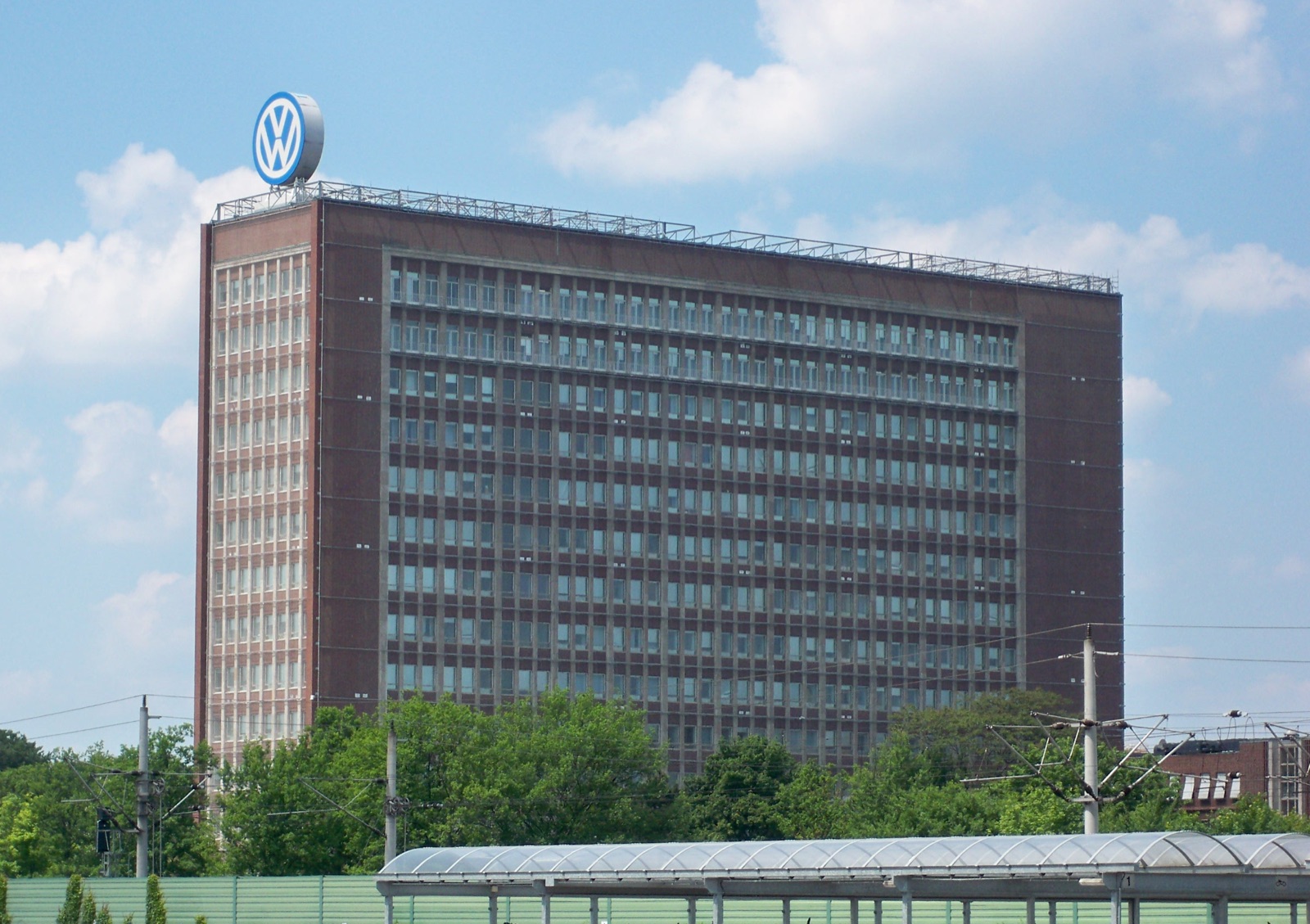
Dieselgate
In late 2013, the International Council on Clean Transportation paid a small team at West Virginia University to put two diesel Volkswagens on the road from Los Angeles to Seattle, hooked up to portable emissions sensors. The team expected to find data confirming what Volkswagen's American marketing campaign had been claiming for years: that 'clean diesel' was real. Instead they found nitrogen-oxide emissions up to forty times the legal limit. Eighteen months later, on September 18, 2015, the U.S. EPA formally accused Volkswagen of installing software in eleven million cars that detected emissions tests and lied to them. By the end of the week, the CEO had resigned and Volkswagen had begun a six-year journey through $34 billion of fines and settlements.