
The White Mountains of New Hampshire, through which Betty and Barney Hill were driving on the night of 19 September 1961 when they saw a light that seemed to follow them — the beginning of the first famous alien abduction case. Wikimedia Commons / CC BY-SA 3.0.
Betty and Barney Hill: The First Alien Abduction
United States, 1961 — A couple driving home through the New Hampshire mountains saw a light that followed them, arrived home with two hours they could not account for, and later, under hypnosis, described being taken aboard a craft. Their sincere account created the template for every alien abduction that followed
- Category
- Space & UFOlogy
- Published
- Length
- 3,550 words · 18 min read
- Author
- The editors
The Betty and Barney Hill case is arguably the single most influential UFO story ever told, not because of the strength of its evidence — which is, in the nature of the thing, entirely testimonial — but because of what it created. Before the Hills, there was the flying saucer: strange objects seen in the sky. After the Hills, and largely because of them, there was the alien abduction: the terrifying narrative of being taken, examined, and returned, which would become one of the most powerful and widespread forms of the UFO experience. To understand the Hills is to understand how a template is born, and it is also to grapple with one of the most important and contested tools in the whole subject: hypnosis, and the question of whether it recovers buried memories or manufactures vivid false ones. The Hills were sincere people who plainly experienced something real to them. The hard question is what that something was.
This is the story of the first alien abduction.
The drive
Betty and Barney Hill were, in the details of their lives, a notably grounded and credible couple, which is part of why their story carried such weight. Betty was a social worker, Barney a postal worker; they were active members of their community and of the civil-rights movement, an interracial couple in an era when that itself required courage. They were not thrill-seekers or obvious fantasists, and they had no history of telling wild tales. On the night of 19 September 1961, they were driving home to Portsmouth from a short vacation in Canada, taking the route south through the White Mountains of New Hampshire in the late hours, with little traffic on the dark mountain roads.


As they drove, they noticed a bright light in the sky, which seemed to grow larger and to keep pace with their car, as though following them. Uneasy, they watched it, and near the landmark known as Indian Head, Barney stopped the car, got out, and looked at the object through binoculars. He reported seeing not merely a light but a structured craft — and, most disturbingly, figures inside it, looking back at him. Gripped by fear, he hurried back to the car, and the couple drove home in alarm, hearing strange beeping sounds and feeling a kind of drowsiness descend.
The missing time
When the Hills reached home, they discovered something that troubled them more than the light itself: the drive had taken far longer than it should have, and there were about two hours they could not account for. Somehow, between the encounter with the light and their arrival home, roughly two hours had passed of which they had no clear memory — the phenomenon that would come to be called "missing time," and that would become a signature feature of abduction accounts. They also found small anomalies: Betty's dress was torn and stained, Barney's shoes scuffed, the watches stopped. Unsettled, they reported the sighting to the Air Force, but it was the missing time, and what began to surface from it, that would make their case extraordinary.
In the days and weeks that followed, Betty began to suffer vivid, recurring nightmares. In them, she and Barney were stopped on the road, taken from their car by small beings, led aboard a craft, and subjected to a physical examination, before being returned with their memory of it erased. She wrote the dreams down and shared them. Barney, meanwhile, developed serious anxiety, and the couple's distress over the events of that night did not fade. Seeking relief, and answers, they were eventually referred to a Boston psychiatrist, Dr. Benjamin Simon, who proposed to use hypnosis to help them recover and process the memories of the missing hours.
Under hypnosis
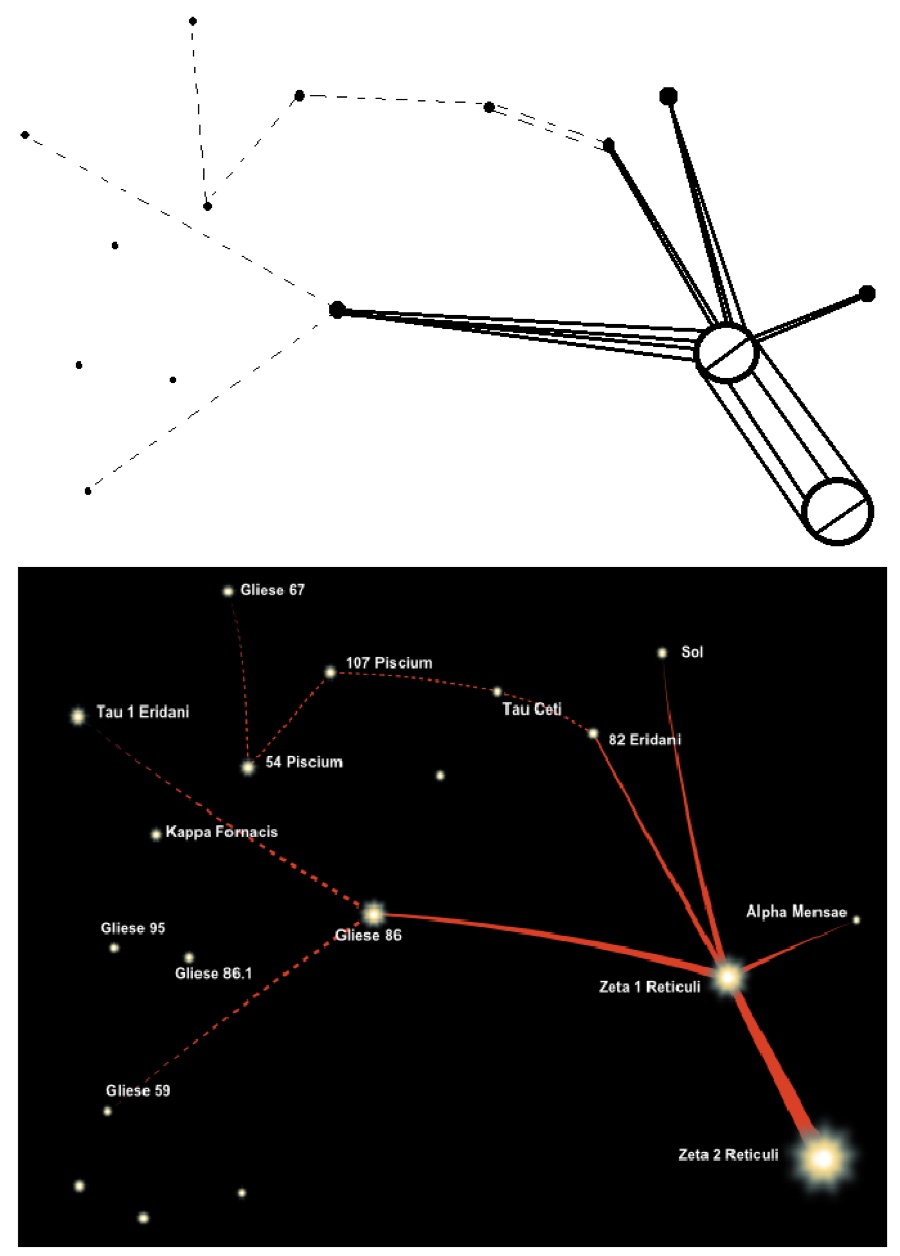
Over a series of sessions in 1964, Dr. Simon hypnotized Betty and Barney separately, and under hypnosis both recounted the story of an abduction. They described being taken from their car by small humanoid beings with large eyes, led aboard the craft, and subjected to a medical examination — the taking of skin and hair samples, the insertion of a needle, an inspection of their bodies. They described communicating with the beings. And Betty recounted a particular detail that would become famous: she said she had asked one of the beings where they came from, and had been shown a three-dimensional "star map" of stars and travel routes, which, after the sessions, she drew from memory.
Crucially, Dr. Simon — the very psychiatrist who conducted the hypnosis — did not conclude that the Hills had really been abducted. His assessment was that the abduction narrative was most likely a kind of shared fantasy or dream: that Betty's vivid nightmares, which she had recounted to Barney before the hypnosis, had been absorbed and elaborated by both of them, so that under hypnosis they produced a jointly constructed story rather than a recovered memory of a real event. The clinician closest to the case, in other words, thought its central content was psychological, not literal.
The star map and Zeta Reticuli
Betty Hill's star map took on a life of its own, and it became one of the case's most famous and most contested elements. In the years that followed, an amateur astronomer and schoolteacher named Marjorie Fish undertook to test the map against reality. She built three-dimensional models of the stars in the sun's neighborhood and searched for a pattern matching Betty's drawing, and she concluded that the map corresponded to the arrangement of stars as seen from the vicinity of Zeta Reticuli, a binary star system, suggesting that the visitors had come from there. The "Zeta Reticuli" claim became a celebrated piece of UFO lore.
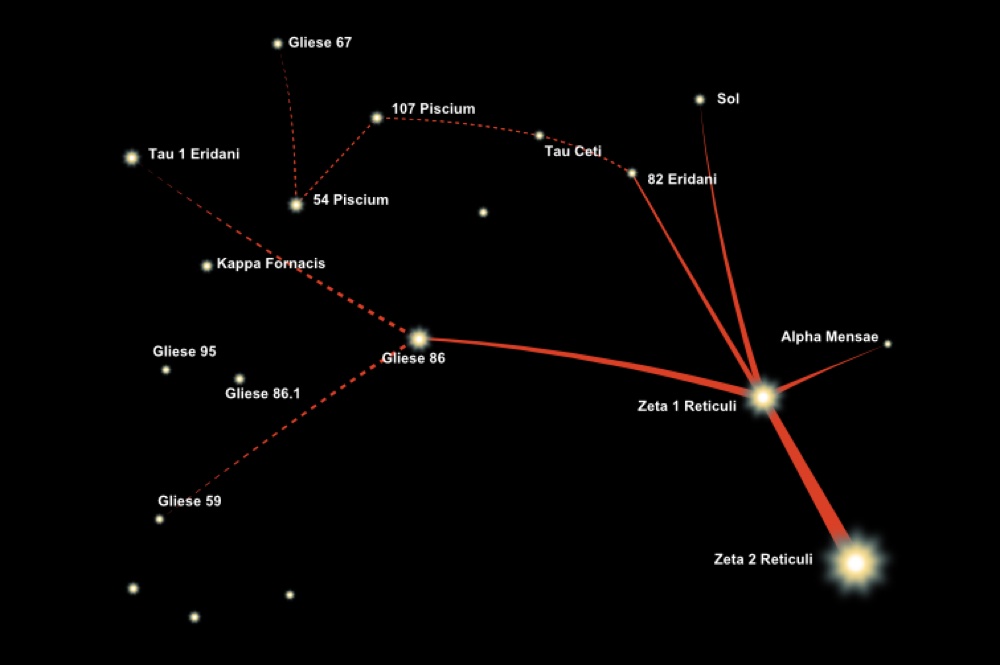
The Zeta Reticuli claim did not survive scrutiny well. Critics, including the astronomer Carl Sagan, pointed out the fundamental problem: Betty's map was a vague, hand-drawn pattern of dots and lines from a hypnotic memory, and with enough stars to choose from and enough freedom in how to orient and connect them, one can find a "match" to almost any such pattern; the apparent correspondence was subjective and lacked statistical significance. The exercise of hunting through the star catalog until a pattern fits is precisely the kind of procedure that generates false positives, and the match to Zeta Reticuli, however striking it was made to appear, does not stand as real evidence. The star map, the case's most concrete-seeming artifact, dissolves on examination into an ambiguous drawing fitted, after the fact, to a chosen set of stars.
The skeptical account and the cultural template
The skeptical reconstruction of the Hill case does not require calling the couple liars — they were, by all evidence, entirely sincere — but proposes that a real but ordinary experience was elaborated, through psychological and cultural processes, into the abduction narrative. On this account, the initial light may well have been a genuine misidentification — a bright planet such as Jupiter or a star, low in the sky and appearing to "follow" the moving car, or an aircraft — that frightened an already tired couple on a dark road. The "missing time" may have had ordinary causes, and the small physical anomalies correspondingly mundane ones. The vivid abduction content came later, first from Betty's nightmares — themselves shaped by the culture's growing saucer imagery — and then, decisively, from hypnosis, which took the seed of those dreams and, in its unreliable way, grew it into a detailed, jointly held narrative that both Hills came sincerely to believe.
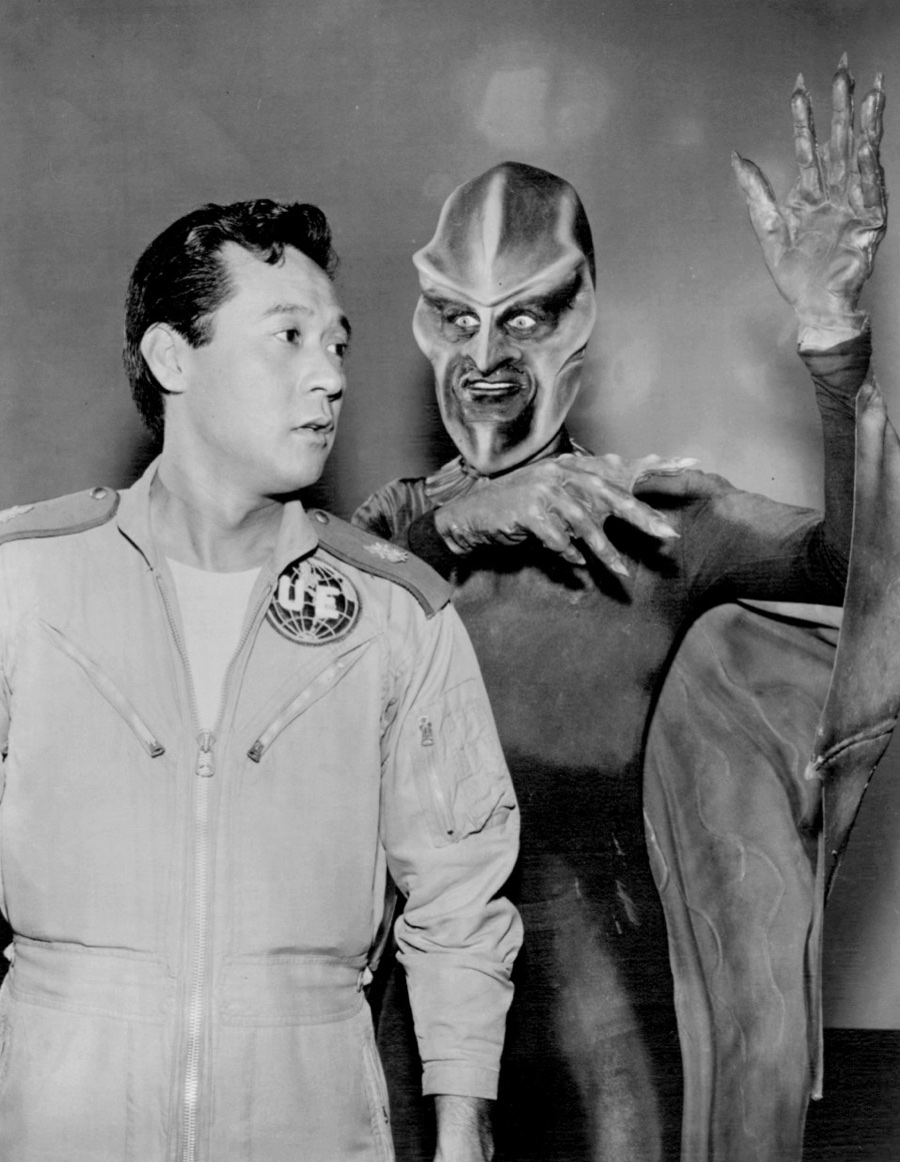
There is a specific and telling detail in support of this reading. The appearance Barney described for the beings under hypnosis — including distinctive features of their eyes — reportedly resembled the alien in an episode of the television series The Outer Limits that had aired only about a week and a half before his hypnosis session. If so, it is a vivid illustration of exactly how hypnotic confabulation works: the mind, prompted to produce a memory, draws on whatever material is available, including a science-fiction program seen on television days earlier, and weaves it into a narrative the subject experiences as genuine recollection. The beings the Hills "remembered" may have come not from another star but from a recent evening's viewing.
Some scholars have added a further, more speculative layer of interpretation, reading the Hills' experience through the lens of their time and circumstances. As an interracial couple in the America of 1961, active in the civil-rights struggle, the Hills lived under real and constant anxiety — about safety, about being watched and judged, about their bodies being subject to a hostile society's scrutiny. Some have suggested that the abduction narrative, with its themes of being seized by powerful strangers, examined against one's will, and made helpless, may have given symbolic form to those pressures. This reading is inevitably speculative and cannot be proven, and it should not be overstated; but it is a reminder that the content of such experiences, whatever their ultimate cause, does not arise in a vacuum. The mind that constructs a vivid narrative draws on the fears and materials of its own life and moment, and the Hills' life and moment were shaped by anxieties that the surface of a simple UFO story does not capture.
The meaning of the Hills
In the end, Betty and Barney Hill endure as the couple who, without intending to, wrote the script for the alien abduction. On a dark mountain road in 1961 they experienced something that frightened them — a light that seemed to follow, a lost stretch of time, a residue of dread — and in the years that followed, through Betty's nightmares and, above all, through the unreliable machinery of hypnosis, that experience grew into a detailed and sincere account of being taken aboard a craft and examined by beings from the stars. The most concrete artifact it produced, Betty's star map, dissolves under scrutiny into an ambiguous drawing fitted after the fact to a chosen constellation; the beings themselves may have stepped from a recent television screen; and the psychiatrist who drew the story out of them concluded it was a shared fantasy, not a fact. Yet the account, once told, became the founding myth of the abduction phenomenon, its every feature reproduced in thousands of later cases. The Hills were sincere, and that is precisely the point: their case is not a story about liars or about aliens, but about the astonishing capacity of the honest human mind, under the right conditions, to build a vivid and unshakable memory of something that never happened — and about how such a memory, given a name and a shape at the right cultural moment, can become a myth that outlives the truth it buried.
Inspired this / based on it
John G. Fuller
The Dial Press. The book that made the Hill case famous, based on the hypnosis transcripts.
Richard A. Colla
A TV film dramatizing the case, starring James Earl Jones as Barney Hill.
Filed under
- #betty-barney-hill
- #ufo
- #alien-abduction
- #new-hampshire
- #hypnosis
- #star-map
- #unsolved-mystery
- #1960s
- #mystery
Click any tag for every article carrying it.
Continue reading

Kenneth Arnold: The Sighting That Invented the Flying Saucer
On the afternoon of 24 June 1947, a businessman and private pilot named Kenneth Arnold was flying his small aircraft near Mount Rainier, in the Cascade Range of Washington state, when he saw something that would change the world's imagination. Nine bright objects were streaking through the sky, flying in a chain formation at tremendous speed, weaving between the mountain peaks — moving, by his estimate, far faster than any aircraft of the era could manage. When he landed and described what he had seen to reporters, he reached for an analogy for the way the objects moved: they flew, he said, erratically, dipping and skimming, 'like a saucer would if you skipped it across water.' A reporter distilled this into a memorable phrase, and within days the newspapers of America were full of the term 'flying saucers.' It was, in a sense, a misunderstanding: Arnold had been describing the motion of the objects, not their shape, and the objects themselves he described as more crescent- or heel-shaped than round. But the phrase 'flying saucer' had entered the language, and with it came the idea of the round, disc-shaped craft that would become the iconic image of the UFO for generations. Within weeks, reports of 'flying saucers' were pouring in from across the country, and the crash near Roswell followed in early July. The modern age of UFOs had begun. This is the story of Kenneth Arnold's sighting — of what he saw, of how a phrase was born from a description of motion, and of how a single ambiguous encounter launched a global phenomenon.
Project Blue Book: The Air Force's Long Study of UFOs
In the years after 1947, when the sighting by Kenneth Arnold and the events at Roswell launched the modern UFO era, the United States Air Force found itself confronting a steady stream of reports of unidentified objects in the sky — some from credible witnesses, some tracked on radar, all demanding some kind of official response in the anxious atmosphere of the early Cold War. The Air Force's answer was a series of official investigations, culminating in the longest and most famous of them: Project Blue Book, which ran from 1952 until 1969 and became the definitive government study of UFOs of its era. Over those seventeen years, Blue Book collected and examined more than twelve thousand reported sightings, seeking to determine what people were seeing and whether any of it threatened national security or represented technology beyond human capability. Its investigators concluded that the overwhelming majority of sightings had ordinary explanations — misidentified aircraft, weather balloons, stars and planets, atmospheric effects, and hoaxes — and that none of the cases provided evidence of extraterrestrial vehicles. Yet Blue Book also left behind a residue of several hundred cases that it could not explain, and it became the focus of a lasting controversy: was it a serious scientific effort that reached an honest, if unexciting, conclusion, or was it, as critics including its own scientific consultant came to argue, more a public-relations exercise designed to explain sightings away and reassure the public than to study them seriously? This is the story of Project Blue Book, of what it found and what it did not, and of the argument over how a government should investigate the unknown.
The Rendlesham Forest Incident: Britain's Most Famous UFO Case
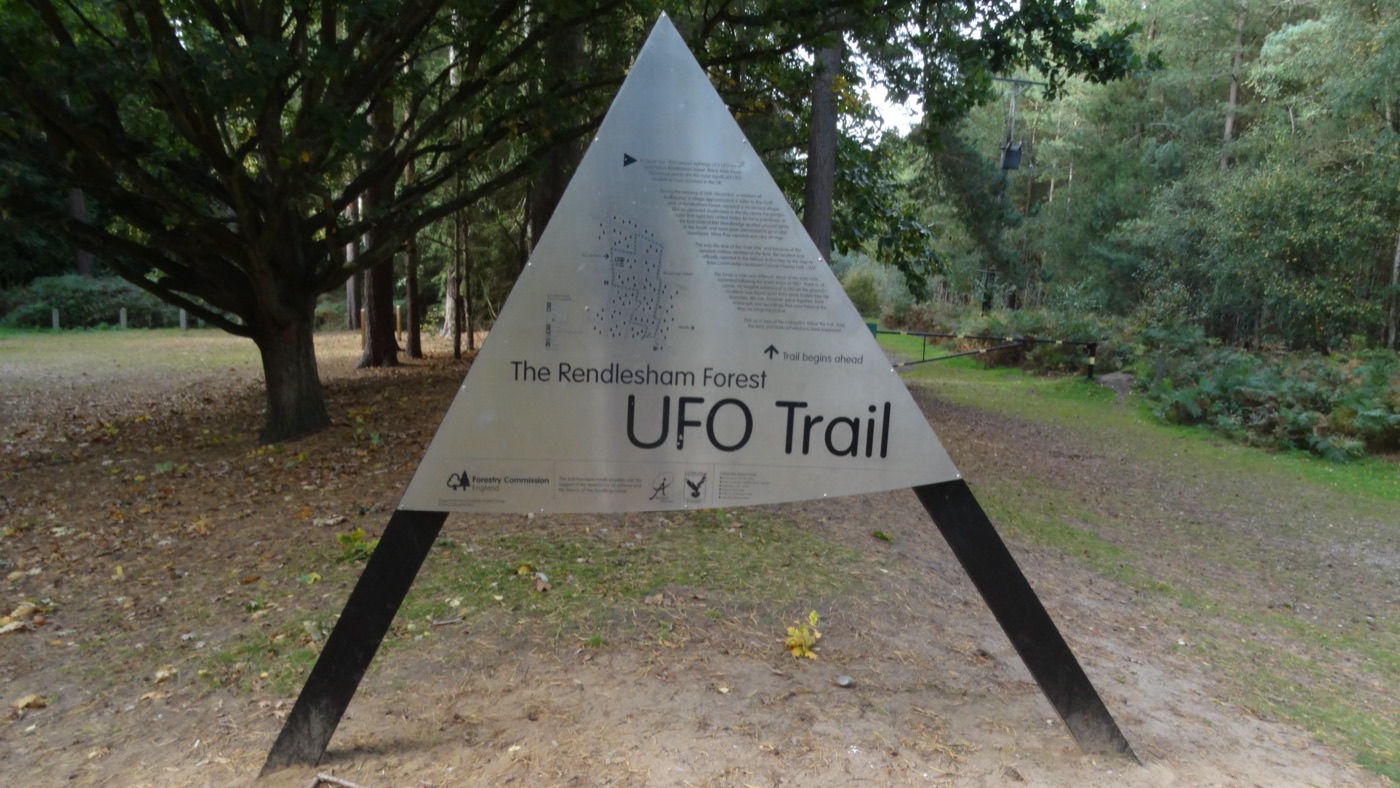
In the last week of December 1980, in Rendlesham Forest on the coast of Suffolk in eastern England, something happened that has been argued over ever since. The forest lay between two adjacent airbases, RAF Woodbridge and RAF Bentwaters, then used by the United States Air Force at the height of the Cold War, and it was American servicemen stationed there who became the witnesses to what is now often called 'Britain's Roswell.' In the small hours of 26 December, security personnel at the base saw strange lights descending into the forest, and, thinking an aircraft might have crashed, went in to investigate. What they reported finding — a metallic, structured craft with lights and strange markings, hovering or resting among the trees — became one of the most famous UFO accounts in the world. Two nights later the base's deputy commander, Lieutenant Colonel Charles Halt, led his own investigation into the forest and recorded it on tape as it unfolded, describing pulsing lights and objects in the sky. His subsequent official memorandum, released years later under freedom-of-information laws, gave the case a documentary weight that few UFO stories possess. And yet the incident has a strong and well-argued mundane explanation, centered on a nearby lighthouse, a bright meteor, and misperceived stars — an explanation the witnesses have always rejected. This is the story of what happened in Rendlesham Forest, and of why, more than four decades later, it remains unresolved.