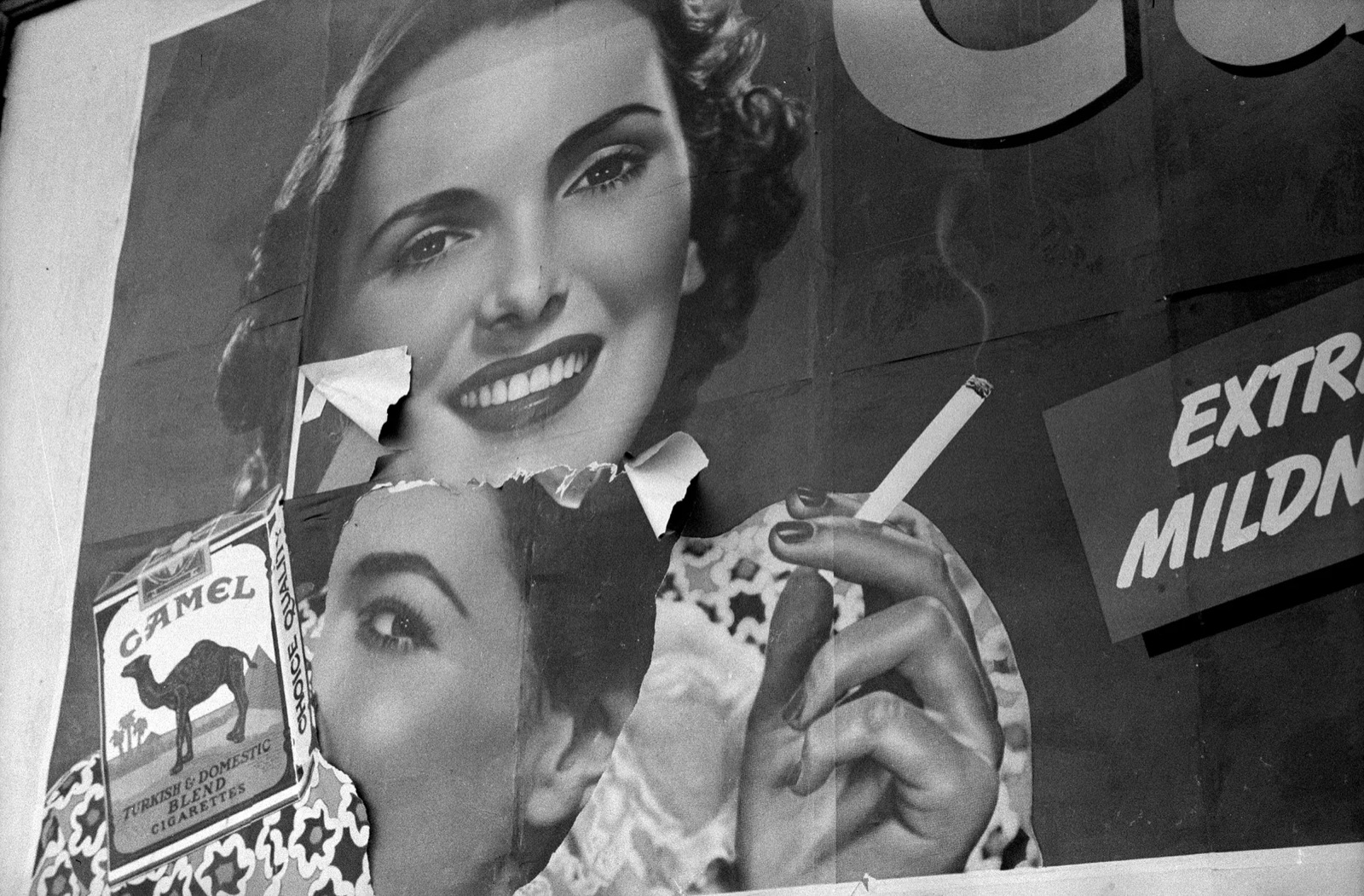
A small-town cigarette advertisement, Woodbine, Iowa, 1940. By the mid-1950s, cigarettes were the most heavily advertised consumer product in America. Wikimedia Commons, public domain.
Big Tobacco's Cancer Cover-Up
Doubt is our product
- Category
- Corporate Cover-ups
- Published
- Length
- 3,700 words · 17 min read
- Author
- The editors
Big Tobacco's Cancer Cover-Up
Doubt is our product.
The science before the meeting
The epidemiological link between cigarette smoking and lung cancer did not announce itself in a single 1953 paper. It accumulated over the preceding two decades. In Germany in the 1930s, Franz Hermann Müller had published case-control work suggesting a link; the work was substantially ignored internationally because of its publication context. Adolph Ochsner and Michael DeBakey at Tulane had reported a similar association in U.S. clinical observations in the early 1940s. By the late 1940s, multiple cancer-treatment clinics had begun gathering systematic smoking histories on lung- cancer patients.
The decisive papers came in 1950. Ernest Wynder and Evarts Graham, both at Washington University in St. Louis, published a case- control study of 684 lung-cancer patients in JAMA on May 27, 1950. The smoking history was statistically devastating: heavy smokers were dozens of times more likely to develop lung cancer than non-smokers. Five months later, Richard Doll and A. Bradford Hill of the U.K. Medical Research Council published a parallel case-control study in the British Medical Journal (September 30, 1950) with consistent findings.
The case studies generated public attention. The much larger prospective study by Doll and Hill — the "British Doctors Study" following 40,000 British medical practitioners — would be published in initial form in 1954. By 1956 it had confirmed that British doctors who smoked were dying of lung cancer at rates many times those of non-smoking doctors.
Reader's Digest — the largest-circulation popular magazine in America at approximately 16 million copies — ran the article Cancer by the Carton in December 1952. The article summarized the Wynder-Graham and Doll-Hill findings for a general audience. Within weeks, surveys showed dramatic declines in cigarette consumption among adults who had read the article. Tobacco company stock prices declined approximately 15-20% in the first quarter of 1953.
By the autumn of 1953, the industry knew that it faced an existential commercial problem. The science was settling; the public was hearing it; the question was what to do.
The Plaza Hotel meeting
The meeting at the Plaza Hotel in New York on December 14 and 15, 1953 has been described in considerable detail through the 1990s discovery process. The attendees:
- Paul Hahn — CEO, American Tobacco Company
- Edward Darr — CEO, R.J. Reynolds Tobacco
- Joseph Cullman, Sr. — Chairman, Philip Morris
- Herbert Kent — Chairman, Liggett & Myers
- O. Parker McComas — Chairman, Brown & Williamson
- George Allen — Chairman, Lorillard
- John W. Hill — President, Hill & Knowlton
The agenda, as preserved in Hill's notes and subsequently in discovery, was twofold: first, agree that the industry would respond as a coordinated whole rather than allowing the smaller companies to defect; second, develop a strategy that could be sustained against the scientific consensus.
Hill's proposal — accepted by the executives — had three elements:
-
A unified public statement denying that cigarettes were causally linked to cancer while pledging to investigate.
-
An industry-funded research organization (the Tobacco Industry Research Committee, TIRC) that would direct money to researchers exploring competing hypotheses — air pollution, asphalt, occupational exposure — and away from the smoking-cancer link.
-
A coordinated lobbying and litigation strategy that would treat any individual lawsuit as a threat to the industry as a whole and would defend the cases without admission or settlement.
The strategy was, in Hill's own internal description, "to create a counter-research and counter-publicity organization" against the cancer findings. The TIRC's funding was set at $1 million in its first year — equivalent to approximately $11 million in 2026 dollars.
The Frank Statement
The Frank Statement to Cigarette Smokers appeared in 448 American newspapers on January 4, 1954. The full text:
The advertisement also announced the formation of the Tobacco Industry Research Committee — "to provide aid and assistance to the research effort into all phases of tobacco use and health." The committee's chairman would be Clarence Cook Little, a former president of the University of Michigan and one of the most respected American biologists of his generation. Little's reputation was the foundation of the TIRC's public credibility.
What the Frank Statement did not say — but what subsequent discovery would establish — was that the participating companies already knew, from their own internal research:
- That cigarette smoke caused cancer in laboratory animals (Philip Morris internal studies, 1953).
- That nicotine was addictive (Brown & Williamson internal documents, 1957).
- That filter cigarettes were no safer than unfiltered (Liggett & Myers internal research, 1962).
All three of these findings were denied in industry public statements for the next 30-40 years.
Doubt is our product
The single most-quoted sentence in tobacco industry internal documents — and the operational doctrine of the cover-up — came from a 1969 internal memo by Frederick Glazier "F.G." Bowman, then the marketing director at Brown & Williamson:
The Bowman memo was not unique. Subsequent discovery in the mid-1990s revealed parallel formulations in the internal documents of every major tobacco company:
-
A 1979 R.J. Reynolds memo described the company's strategy as "to question and challenge the cause-and-effect arguments and to develop alternative theories."
-
A 1972 Philip Morris memo to Joseph Cullman III (Joseph Sr.'s son and successor) characterized the company's research-funding strategy as "designed to develop ammunition for the unholy war with the public health establishment."
-
A 1980 Lorillard memo characterized the Council for Tobacco Research as "more important as a public relations effort than as a research effort."
The pattern of doubt-production — outside-credentialed researchers funded to pursue alternative hypotheses, results selectively publicized, and the public told the science was unsettled when in fact the industry's own scientists had settled it — would subsequently be imitated by other industries facing health and environmental science challenges. The lead industry on lead in gasoline, the chemical industry on chlorofluorocarbons and ozone depletion, the fossil-fuel industry on climate change — all adopted variations of the tobacco playbook. The 2010 book Merchants of Doubt by Naomi Oreskes and Erik Conway documented this imitation pattern in detail.
The leak
The Brown & Williamson document leak by Merrell Williams was the single most consequential event in the legal unraveling of the cover-up.
Williams was a paralegal at Wyatt, Tarrant & Combs, the Louisville-based law firm that served as Brown & Williamson's outside counsel. He had been hired in 1988 to help with the review of internal company documents for litigation defense. Over five years, he made copies of approximately 4,000 pages of internal documents that he believed showed:
- Internal knowledge of carcinogenicity dating to the 1950s.
- Internal knowledge of nicotine addiction dating to the 1960s.
- Deliberate product modifications to increase nicotine delivery (cigarette engineering for addiction).
- Suppression of internal research findings.
- Coordination of public-denial statements between companies.
Williams quietly compiled the documents over the years he worked at the firm. In 1992, the firm dismissed him for unrelated reasons. He took the documents with him.
He attempted to interest several plaintiffs' lawyers in the material. In 1993, he provided the documents to Dr. Stanton Glantz at the University of California, San Francisco. Glantz organized the material, recognized its significance, and posted it to a publicly accessible archive at UCSF. The archive — initially called the Brown & Williamson Collection and now the Truth Tobacco Industry Documents library — comprises approximately 14 million pages of internal tobacco industry documents.
Brown & Williamson sued Williams for breach of confidentiality. The case was eventually settled. Glantz and UCSF were sued; the University of California refused to remove the documents and was ultimately vindicated.
The CEO testimony
On April 14, 1994, the seven chief executives of the United States' largest tobacco companies appeared before the House Energy and Commerce Subcommittee on Health, chaired by Representative Henry Waxman (D-CA). Each was sworn in. Each was asked, in turn:
"Do you believe nicotine is not addictive?"
Each of the seven answered yes:
- William Campbell — Philip Morris USA
- James Johnston — R.J. Reynolds Tobacco
- Joseph Taddeo — U.S. Tobacco Company
- Andrew Tisch — Lorillard Tobacco
- Edward Horrigan — Liggett Group
- Thomas Sandefur — Brown & Williamson
- Donald Johnston — American Tobacco
The seven CEOs' testimony became known as the "seven dwarfs" moment in subsequent litigation. It was factually contradicted by their own companies' internal documents — documents that, in some cases, the CEOs themselves had reviewed within the previous year.
The testimony was perjury, by any reasonable standard. No prosecution for perjury was ever brought. But the contradiction between the CEOs' sworn statements and the documentary record became the central evidence in subsequent civil litigation.
Jeffrey Wigand and the 60 Minutes interview
Jeffrey Wigand had been hired by Brown & Williamson in 1989 as Vice President of Research and Development. He had a PhD in biochemistry and endocrinology. He had been hired to lead B&W's nicotine-research program — specifically, to develop a "safer" cigarette through reduction of carcinogens while maintaining nicotine delivery.
By 1993, Wigand had concluded that the research-program objective was contradictory: the carcinogenicity reduction the company publicly pursued was incompatible with the nicotine-delivery optimization the company privately pursued. He documented his concerns. He was fired in March 1993 — ostensibly for unrelated reasons.
In 1995, Wigand was contacted by Lowell Bergman, an investigative producer at CBS's 60 Minutes. Wigand had been identified through plaintiffs'-lawyer contacts as a potential whistleblower. After extended discussions and with the protection of attorney-client privilege through Mississippi Attorney General Michael Moore's state tobacco lawsuit, Wigand agreed to give a videotaped interview.
The interview was conducted in 1995 with Mike Wallace. Bergman prepared the interview for air. CBS Corporation — fearing potential litigation from Brown & Williamson — initially refused to air it in November 1995. The story of the suppression became public; CBS aired the full interview on February 4, 1996.
The Wigand interview did not contain new factual revelations beyond what Williams's document leak had already established. What it provided was a face: a credentialed insider with a PhD testifying on broadcast television to what the documents showed. The interview became, in the public's understanding, the moment the industry was seen to be caught.
The Michael Mann film The Insider (1999) dramatized Wigand and Bergman's story. Russell Crowe played Wigand and Al Pacino played Bergman. The film was nominated for seven Academy Awards.
The Master Settlement Agreement
By 1996, several U.S. states had filed lawsuits against the major tobacco companies seeking reimbursement for Medicaid spending on smoking-related illness. Mississippi was first (May 1994 under Attorney General Michael Moore). By 1997, more than 40 states had joined.
The states' position — established by Moore and Mike Lewis, the private attorney who initiated the Mississippi case — was that state Medicaid funds had been used to treat smoking-related illnesses that the tobacco companies had knowingly caused through the cover-up. The legal theory was straightforward: the tobacco companies had committed fraud against the public, and the public (via state Medicaid programs) had paid the consequences.
The negotiations began in late 1997 between the state attorneys general (led by Michael Moore of Mississippi, Christine Gregoire of Washington, and others) and the chief legal officers of the tobacco companies.
The Master Settlement Agreement (MSA) was signed on November 23, 1998 by representatives of 46 U.S. states, the District of Columbia, and five U.S. territories with the four largest tobacco companies (Philip Morris USA, R.J. Reynolds, Brown & Williamson, and Lorillard) and dozens of smaller companies. Four states (Mississippi, Florida, Texas, and Minnesota) had already settled separately for total compensation of approximately $40 billion.
The MSA's terms:
- $206 billion to be paid by the companies to the settling states over 25 years.
- Restrictions on marketing to youth (banning cartoon characters, billboards near schools, brand-name sports sponsorship of youth-oriented events).
- Dissolution of the Council for Tobacco Research and the Tobacco Institute.
- Document disclosure — release of internal documents to the public archive (which became the UCSF Truth Tobacco Industry Documents library).
- Annual payments indexed to cigarette consumption — creating an ongoing economic incentive structure.
The MSA was the largest civil settlement in American history at the time.
The cast
What came after
The Master Settlement Agreement reshaped American tobacco regulation but did not end the cover-up's consequences. Several ongoing dimensions:
The international dimension. The U.S. settlement did not bind the U.S. tobacco companies' international operations. Philip Morris International (spun off from Philip Morris USA in 2008) continues to be a defendant in product-liability and public-health cases in Brazil, Canada, France, the Philippines, and other countries.
The litigation continues. Individual product-liability cases against the U.S. tobacco companies continued after 1998. The Engle class action in Florida — opened 1994, decertified in 2006 but with $145 billion in punitive damages partially preserved — generated thousands of "Engle progeny" individual cases.
The 2006 RICO ruling. Judge Gladys Kessler's 2006 ruling in U.S. v. Philip Morris found that the major tobacco companies had violated RICO over a 40-year scheme. The ruling required corrective public statements ("We deliberately deceived the public about the addictiveness of nicotine") that the companies were forced to publish in 2017 after the appeals were exhausted.
The transferred playbook. The tobacco doubt-production strategy has been documented as a model for parallel industries by Oreskes and Conway (Merchants of Doubt, 2010), Devra Davis (The Secret History of the War on Cancer, 2007), and others. The pattern continues to recur.
Why this is a "confirmed" case
Big Tobacco's cover-up is one of the most extensively documented corporate-deception cases in modern history. The internal documents exist in a publicly accessible archive of approximately 14 million pages. The legal record — civil, criminal investigation, and RICO — is extensive. The settlements and judgments are matters of public record.
What is sometimes still misunderstood — by general audiences who remember "the tobacco settlement" as an isolated event — is the structural lesson: that a coordinated industry effort over four decades was able to delay public-health intervention against a known carcinogen by approximately 40 years, costing an estimated 4 to 10 million American lives. The cover-up worked, in the sense of preserving corporate earnings for the duration. The eventual legal accounting captured a fraction of the actual cost.
What we still don't know
The full death toll. Estimates of excess smoking-attributable deaths in the U.S. cover-up period (1954-1998) range from 4 million (narrow attribution) to 10 million (broader cohort). Definitive attribution is impossible because the cover-up's specific contribution to delay is itself a counterfactual question.
The full coordination among the corporate scientific advisory boards. Some advisory-board records remain partially redacted in the Truth Tobacco Industry Documents archive.
The continuing international cover-ups. Philip Morris International and other successor companies have been documented to have continued doubt-production strategies in lower-income countries. The full scope of these efforts has not been comprehensively investigated.
Successor industries. The extent to which the tobacco playbook has been deliberately taught and transferred to other industries — versus being independently re-invented — is the subject of ongoing academic research. The Oreskes-Conway thesis (deliberate transfer through shared PR firms and think-tank infrastructure) has been substantially documented but remains under active investigation.
Sources
Primary documents:
- A Frank Statement to Cigarette Smokers. Tobacco Industry Research Committee, January 4, 1954. Reproduced in NEJM and Truth Tobacco Industry Documents.
- F.G. Bowman, Brown & Williamson internal memo, August 21, 1969. Truth Tobacco Industry Documents, UCSF.
- Master Settlement Agreement, November 23, 1998. Signed by Attorneys General of 46 states + DC + 5 territories with the major tobacco companies.
- Smoking and Health: Report of the Advisory Committee to the Surgeon General. U.S. Department of Health, Education and Welfare, January 11, 1964 (Luther Terry).
- United States v. Philip Morris USA, Inc., U.S. District Court D.C., final opinion of Judge Gladys Kessler, August 17, 2006. 1,683 pages.
- House Energy and Commerce Subcommittee on Health, hearing transcript, April 14, 1994 (the "seven dwarfs" testimony).
Secondary investigative reporting: 7. Allan Brandt, The Cigarette Century: The Rise, Fall, and Deadly Persistence of the Product That Defined America (Basic Books, 2007). The definitive scholarly treatment. 8. Stanton Glantz, John Slade, Lisa Bero, Peter Hanauer, and Deborah Barnes, The Cigarette Papers (University of California Press, 1996). The first comprehensive analysis of the leaked B&W documents. 9. Naomi Oreskes and Erik Conway, Merchants of Doubt: How a Handful of Scientists Obscured the Truth on Issues from Tobacco Smoke to Global Warming (Bloomsbury, 2010). 10. Marie Brenner, "The Man Who Knew Too Much," Vanity Fair, May 1996. The Jeffrey Wigand profile that became the basis for The Insider. 11. 60 Minutes, "Jeffrey Wigand: The Insider," CBS, February 4, 1996. 12. Frontline, "Inside the Tobacco Wars," PBS, multiple episodes 1994-2002. 13. The New York Times, multi-decade tobacco coverage, particularly Philip J. Hilts in the early 1990s. 14. Devra Davis, The Secret History of the War on Cancer (Basic Books, 2007). 15. Truth Tobacco Industry Documents (Truth Tobacco Industry Documents library at UCSF, 14 million pages, continuously updated).
Academic scholarship: 16. Lisa Bero, "Tobacco Industry Manipulation of Research," Public Health Reports, 2005. 17. Robert Proctor, Golden Holocaust: Origins of the Cigarette Catastrophe and the Case for Abolition (UC Press, 2011). 18. David Michaels, Doubt Is Their Product: How Industry's Assault on Science Threatens Your Health (Oxford UP, 2008). 19. Stephen Jay Gould, "Cigarettes and the Long-Tailed Mouse" — Natural History, 1995.
Corrections & updates
2026-05-26: First publication.
Inspired this / based on it
Michael Mann · ★ 7.8
Dramatization of Wigand and Bergman story. Russell Crowe, Al Pacino. 7 Academy Award nominations.
PBS Frontline
Multi-episode investigation of the cover-up and the 1990s legal unraveling.
Allan Brandt
The definitive scholarly treatment. Basic Books.
Naomi Oreskes & Erik Conway
The tobacco playbook as template for subsequent corporate cover-ups. Bloomsbury.
Robert Proctor
University of California Press; argues for the abolition framework.
Stanton Glantz, John Slade, Lisa Bero, Peter Hanauer, Deborah Barnes
First comprehensive analysis of the leaked Brown & Williamson documents. UC Press.
Filed under
- #big-tobacco
- #philip-morris
- #rj-reynolds
- #brown-williamson
- #lorillard
- #hill-knowlton
- #tirc
- #council-for-tobacco-research
- #jeffrey-wigand
- #merrell-williams
- #frank-statement
- #master-settlement-agreement
- #doubt-is-our-product
- #surgeon-general
- #1953
- #1998
- #north-america
- #usa
Click any tag for every article carrying it.
Continue reading

DuPont and PFOA
In October 1998, a West Virginia cattle farmer named Wilbur Tennant called a Cincinnati lawyer named Robert Bilott about 153 dead cows. The cows had been drinking from Dry Run Creek, three miles downstream from the DuPont Washington Works chemical plant. Tennant's home video showed cattle with bloody mouths, gum cancer, and stumbling gaits before they died. Bilott — a corporate-defense attorney at Taft Stettinius & Hollister who had spent his career representing chemical companies — agreed to look at the file as a personal favor to his grandmother, who knew the Tennant family. The look became a twenty-year case. By the time Bilott was finished, he had uncovered: that DuPont had been releasing perfluorooctanoic acid (PFOA, code-named 'C8') into the Ohio River and into landfills for over forty years; that DuPont had known PFOA was toxic since at least 1961; that the company's own animal studies in 1981 had shown birth defects in offspring of exposed female workers; and that approximately 99% of the U.S. population, by 2007, had detectable levels of PFOA in their blood. The 2005 EPA fine ($16.5 million) was the largest in U.S. environmental enforcement history at the time. The 2017 multi-district settlement was $670.7 million. The C8 Science Panel — established as part of an earlier 2005 class-action settlement — confirmed by 2012 that PFOA is causally linked to six diseases including kidney and testicular cancer. PFOA was phased out of U.S. production by 2015. Its environmental persistence — half-life in human blood is approximately 3.8 years — means that, by 2025, every American adult has some PFOA exposure dating from the production era. The chemical that made non-stick cookware possible is, in this sense, still with us.
Purdue Pharma and OxyContin
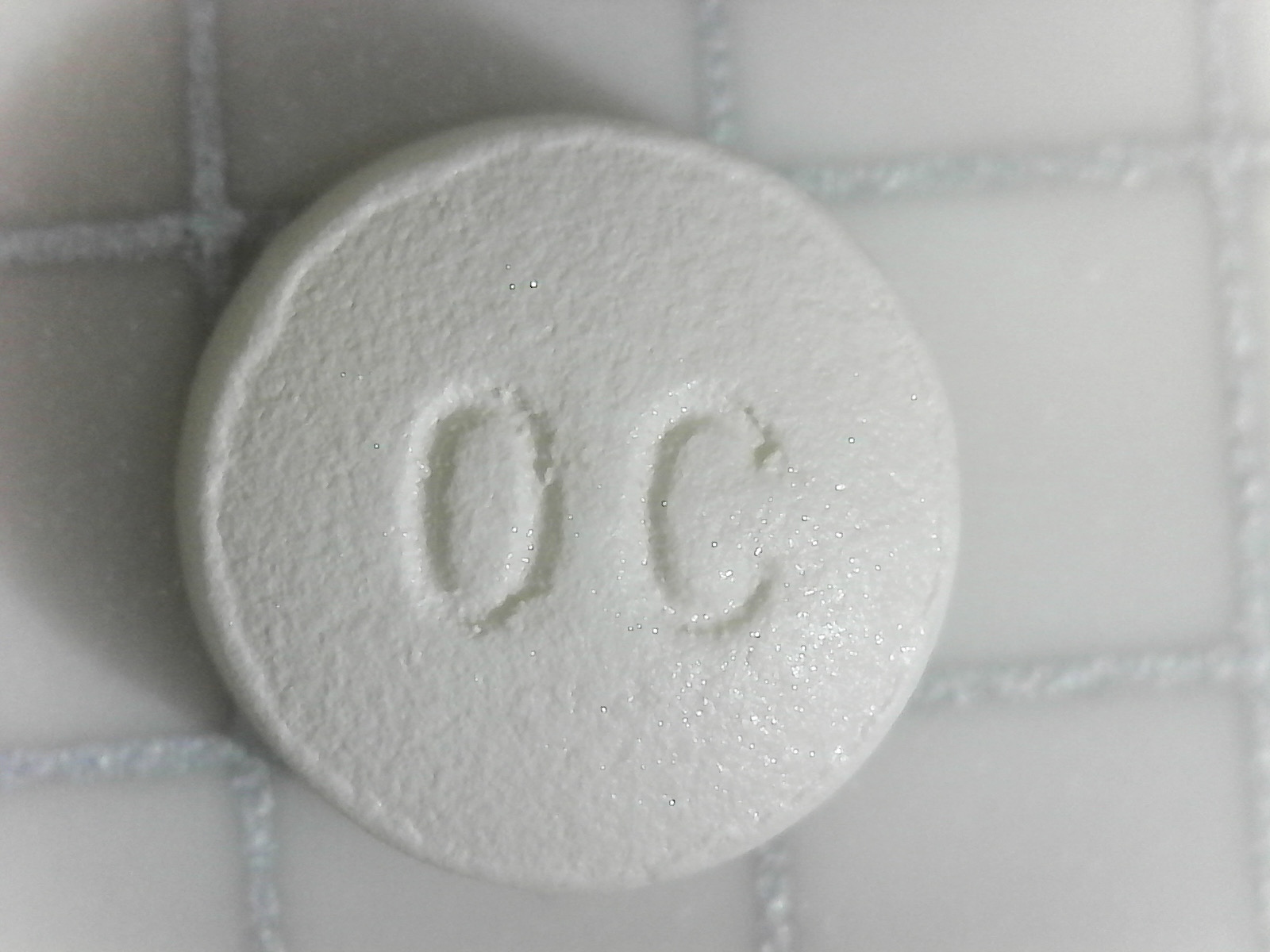
In December 1995, the U.S. Food and Drug Administration approved a new extended-release oxycodone formulation manufactured by the privately-held Stamford, Connecticut pharmaceutical company Purdue Pharma. The drug was called OxyContin. Its FDA-approved label stated that the controlled-release formulation 'is believed to reduce the abuse liability of the drug.' Within weeks of the January 1996 launch, Purdue's sales force was telling physicians that the risk of addiction was 'less than one percent' — a number drawn from a single 1980 letter to the editor in the *New England Journal of Medicine* that the company would, over the next twenty years, cite approximately 600 times in its promotional materials. The letter had observed 4 cases of addiction in 11,882 hospitalized patients given any opioid for any duration. It was not, by any reasonable standard, evidence for an outpatient sustained-release formulation. By 2010, OxyContin's annual revenue had reached approximately $3.1 billion. By 2017, drug overdose was the leading cause of death for Americans under 50. The cumulative U.S. opioid death toll from 1999 to 2023, by the CDC's count, exceeded 700,000. Purdue Pharma pleaded guilty to federal criminal misbranding charges in 2007 (paying $634.5 million) and again in 2020 (agreeing to $8.3 billion in penalties as part of a bankruptcy reorganization). The Sackler family — owners of Purdue throughout the period — were the subject of a separate $6 billion settlement that was struck down by the U.S. Supreme Court in 2024 (*Harrington v. Purdue Pharma*) and is, as of mid-2026, being renegotiated. Patrick Radden Keefe's 2021 book *Empire of Pain* is the most comprehensive single-volume treatment of the case.
Dieselgate
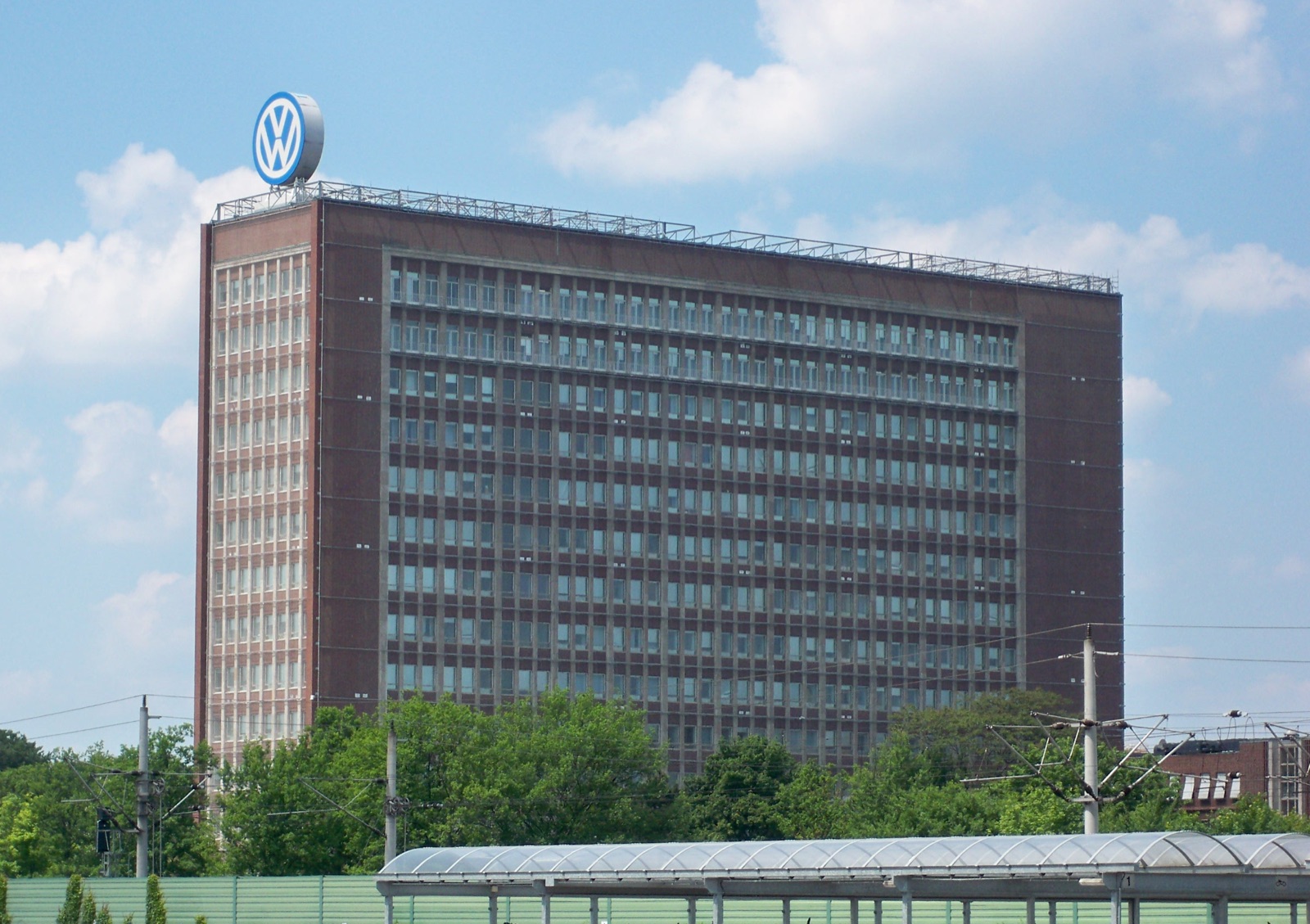
In late 2013, the International Council on Clean Transportation paid a small team at West Virginia University to put two diesel Volkswagens on the road from Los Angeles to Seattle, hooked up to portable emissions sensors. The team expected to find data confirming what Volkswagen's American marketing campaign had been claiming for years: that 'clean diesel' was real. Instead they found nitrogen-oxide emissions up to forty times the legal limit. Eighteen months later, on September 18, 2015, the U.S. EPA formally accused Volkswagen of installing software in eleven million cars that detected emissions tests and lied to them. By the end of the week, the CEO had resigned and Volkswagen had begun a six-year journey through $34 billion of fines and settlements.