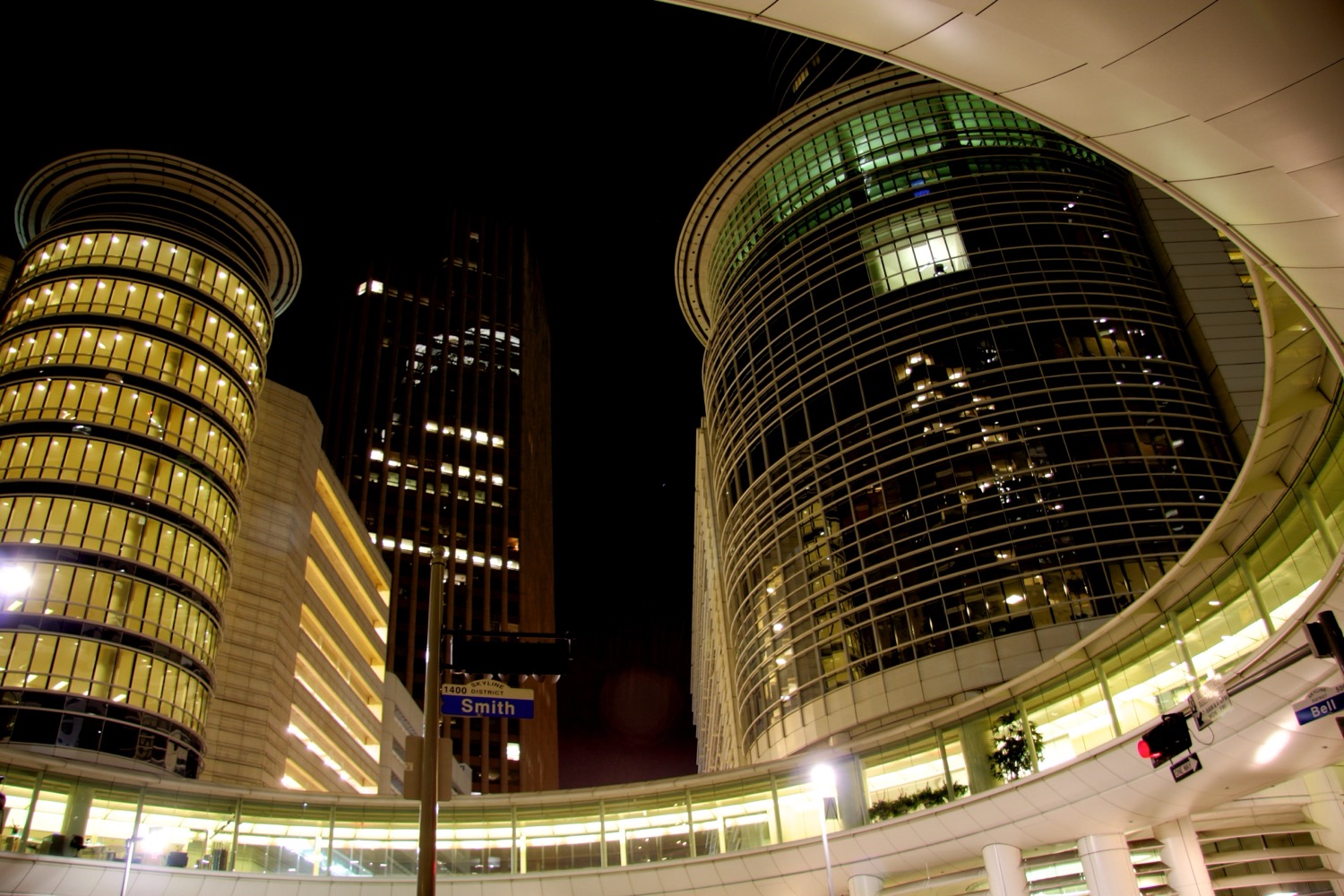
The Enron complex in downtown Houston, its two towers joined by a curved skybridge. From here, Enron projected the image of a visionary, world-changing energy company — until 2001, when it was revealed that its profits were substantially an accounting illusion. Within six weeks it was bankrupt. Wikimedia Commons / Alex, CC BY 2.0.
Enron and the Most Innovative Company That Never Really Made Money
United States, 1985–2001 — Enron was named America's most innovative company six years running, a $60 billion energy giant that had supposedly reinvented business. The innovation was the accounting. When the illusion broke, it collapsed in six weeks, taking 20,000 jobs and one of the world's great audit firms with it
- Category
- Finance & Economy
- Published
- Length
- 4,040 words · 20 min read
- Author
- The editors
Enron is the foundational corporate-fraud story of the modern era — the case that gave the world the template, and much of the vocabulary, for understanding how a celebrated, sophisticated, seemingly successful company can be hollow at the core. Nearly every fraud story that came after it, from WorldCom to Wirecard, was understood partly through the lens Enron provided: aggressive accounting, hidden liabilities, a worshipful market, captured auditors, and a culture that confused the manipulation of numbers with the creation of value. To understand Enron is to understand the anatomy of the corporate fraud itself.
This is the story of the most innovative company that never really made money.
From pipelines to a trading empire
Enron was created in 1985 from the merger of two natural-gas pipeline companies, and for its first years it was what it appeared to be: a solid, unglamorous operator of physical energy infrastructure. Its chairman, Kenneth Lay, was an economist and a believer in the deregulation of energy markets, which was opening up new opportunities to trade gas and electricity as commodities. The transformation of Enron from a pipeline company into something far more ambitious came with the arrival of Jeffrey Skilling, a brilliant and aggressive former consultant who became the architect of the new Enron.

Skilling's vision was to make Enron "asset-light": rather than owning pipelines and power plants, it would be a kind of financial intermediary for energy — a market-maker that bought and sold gas, electricity, and eventually a bewildering array of other commodities and contracts, from broadband capacity to weather derivatives. This was genuinely innovative in concept, and for a time Enron really did pioneer new energy-trading markets. But the model also created the conditions for fraud, because a trading-and-contracts business, unlike a pipeline, does not have simple, physical, easily-valued earnings. Its profits depend on how you value complex, long-term, often illiquid deals — and that valuation, it turned out, was where the magic and the deception lived.
Mark-to-market
The first great engine of Enron's illusion was an accounting method called mark-to-market. In a normal business, you book revenue as you actually earn it — when the gas is delivered and paid for, over the life of a contract. Mark-to-market accounting, which Enron won permission to use and then applied aggressively, allowed it to do something different: to estimate the total future profit of a long-term deal and book that entire projected profit as income immediately, the moment the deal was signed.

The danger of this is obvious once stated. The "profit" booked was a projection, a guess about how a deal would perform over many years — and Enron had every incentive to make those guesses optimistic, because the rosier the projection, the more profit it could report now. A deal that might in reality lose money could be booked as a large immediate gain, and by the time reality diverged from the projection, the executives had their bonuses and the stock had its boost. Mark-to-market turned Enron's earnings into something close to a work of fiction: profits conjured from optimistic forecasts rather than earned from actual results. And because reported earnings drove the stock price, and executives' pay and the company's whole self-image were tied to the stock, the pressure to keep booking ever-larger projected profits was relentless.
The off-balance-sheet machine
The second engine was even more elaborate, and it is the part of the Enron story most associated with genuine fraud rather than aggressive accounting. To sustain the illusion, Enron needed to hide the debts and losses that were piling up behind the glamorous facade — the deals that went bad, the borrowing that funded its expansion, the assets that were worth less than claimed. The man who engineered the machine for hiding them was the chief financial officer, Andrew Fastow.
Fastow created a vast and intricate network of what are called special purpose entities, or SPEs — separate legal entities, partnerships, and shell companies, with names like LJM (after his wife and children) and a series called the "Raptors." On paper, these entities were independent of Enron, which allowed Enron to move debts and underperforming assets off its own balance sheet and into them, so that Enron's published accounts looked far healthier than the reality. Enron could "sell" troubled assets to these entities to book a gain and remove the liability from view, even though the entities were funded and controlled in ways that made the independence largely fictional — and even though Fastow himself was personally profiting from running some of them, an extraordinary conflict of interest. The SPEs were a machine for manufacturing earnings and concealing debt, and they let Enron present a picture of prosperity that the underlying business did not support.
The culture
The fraud did not happen in a vacuum; it grew in a corporate culture uniquely suited to producing it. Enron under Skilling was aggressive, arrogant, and obsessed with the stock price and with appearing to be the smartest operation in the room. It used a brutal employee-ranking system known as "rank and yank," in which workers were graded against one another and the lowest performers regularly fired — a system that rewarded those who delivered the numbers and punished anyone who might raise inconvenient questions. Self-belief curdled into a sense of invincibility; the company came to see itself as too clever, too revolutionary, to be bound by the ordinary rules.
That arrogance had real-world consequences beyond the accounting. Enron was a central player in the California electricity crisis of 2000–2001, when energy traders gamed the state's newly deregulated market to drive up prices, contributing to blackouts and enormous costs for ordinary Californians; later evidence, including recorded traders' calls, revealed a cynical willingness to exploit the market and the public. The culture that booked imaginary profits and hid real debts was the same culture that treated a public energy crisis as a profit opportunity. It was a company that had lost the distinction between cleverness and integrity.
There was also a powerful element of political and intellectual capture in how Enron sustained its reputation. Kenneth Lay was deeply connected in Washington, a major political donor with access to the highest levels of government, and Enron's championing of energy deregulation gave it allies and influence that helped deflect scrutiny. Wall Street analysts, many at banks that earned lucrative fees from Enron's business, lavished the stock with "buy" ratings and were slow to question it; the financial press celebrated Skilling and Lay as visionaries; and the auditors and lawyers who might have raised objections were paid by, and dependent on, the company they were supposed to check. Enron had assembled around itself a whole ecosystem with an interest in its success and little incentive to look too hard — the same pattern of captured gatekeepers that recurs through these stories. The company was not policed into honesty because almost everyone who might have policed it was, in one way or another, on the payroll or in the thrall of the story.
The cracks
For years, the market believed, and few asked hard questions. The unravelling began with people who did. In early 2001, a journalist named Bethany McLean published an article in Fortune with the simple, pointed title "Is Enron Overpriced?", questioning how the company actually made its money and noting that its finances were nearly impossible to understand from its filings. It was a rare note of public skepticism about a beloved stock, and it irritated Enron's leadership, who treated the question as something close to heresy.
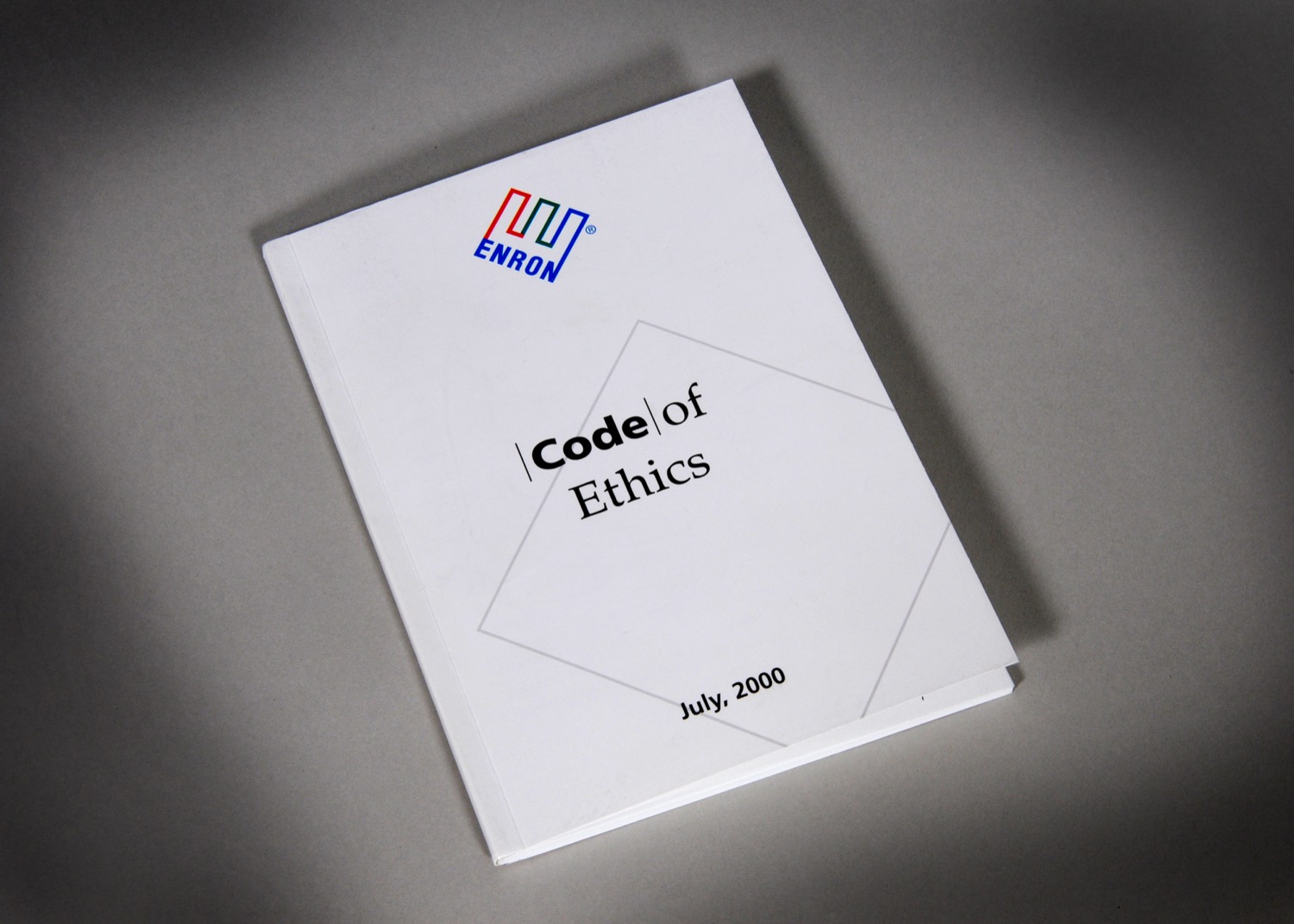
Then, in August 2001, Jeffrey Skilling abruptly resigned as chief executive after only months in the top job, citing personal reasons — a departure that, in hindsight, looked like a man leaving before the storm broke. That same month, an Enron executive named Sherron Watkins wrote a now-famous memo to Kenneth Lay warning that she feared the company would "implode in a wave of accounting scandals," laying out, from the inside, the dangers of the off-balance-sheet schemes. Watkins became one of the defining whistleblowers of the era. The warnings, internal and external, were converging on the truth.
The collapse
The end, when it came, was astonishingly fast. In October 2001, Enron reported a large quarterly loss and disclosed a huge reduction in shareholder equity related to the off-balance-sheet entities — the first public crack in the facade. As analysts and journalists began to probe the SPEs, confidence evaporated. The company was forced to restate years of earnings, admitting that profits it had reported had not been real and that it had effectively hidden enormous debts. The stock, which had traded at $90 the year before, began a death spiral toward pennies. A proposed rescue merger with the smaller rival Dynegy collapsed once Dynegy saw the true state of Enron's books. Credit-rating agencies downgraded Enron's debt to junk, cutting off its ability to borrow and trade. On 2 December 2001, Enron filed for bankruptcy — at the time, the largest in American history. A company worth around $60 billion at its peak had been reduced to almost nothing in roughly six weeks.
Arthur Andersen and the human cost
The damage radiated far beyond Enron's executives. Twenty thousand employees lost their jobs, and many lost their retirement savings as well, because their pension plans had been heavily invested in Enron stock that was now worthless — even as senior insiders had been selling their own shares while publicly encouraging employees to keep buying. The image of ordinary workers wiped out while executives cashed out became one of the most enduring and bitter symbols of the scandal.
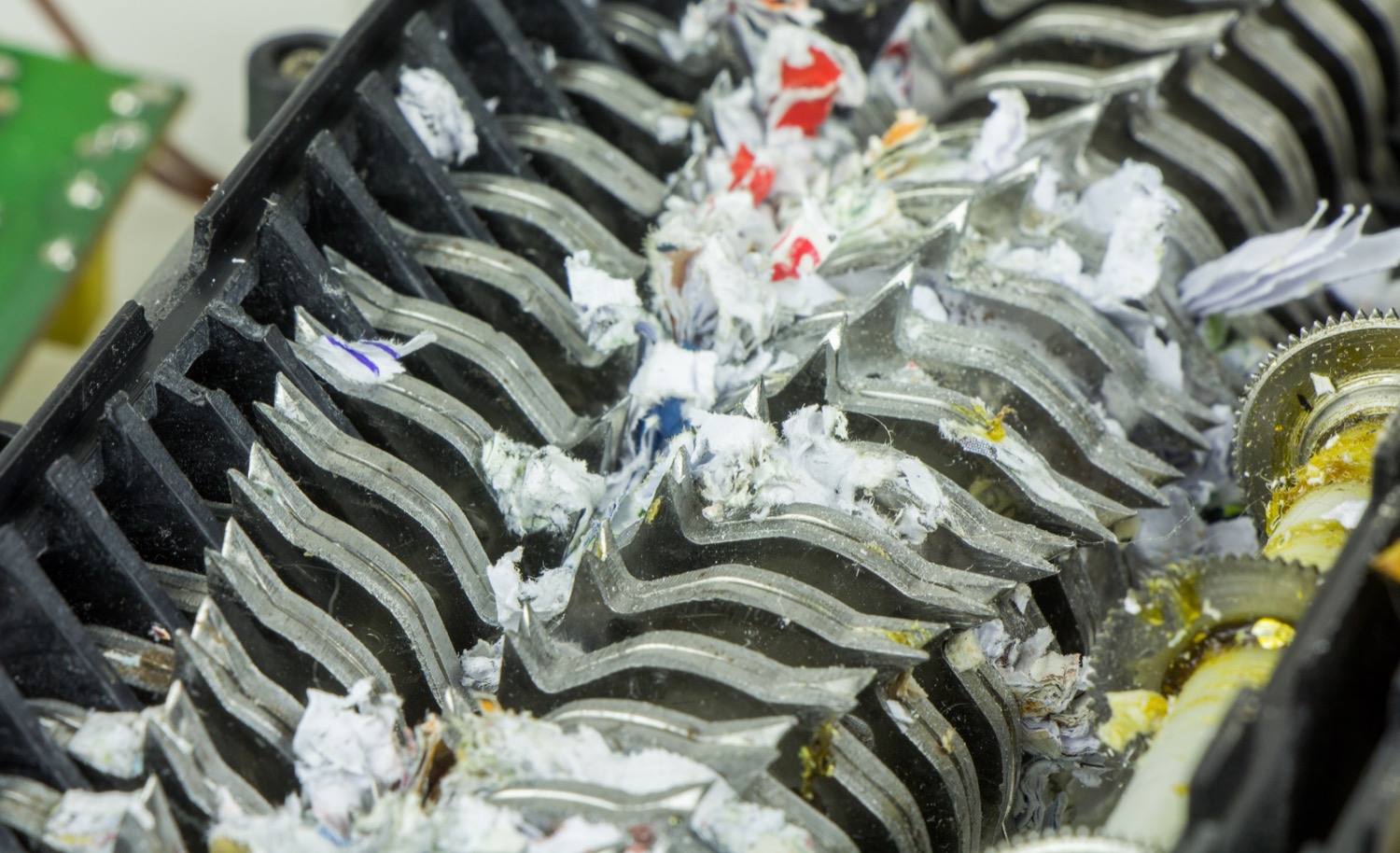
The collapse also destroyed Arthur Andersen, one of the "Big Five" global accounting firms and Enron's auditor. Andersen had signed off on Enron's accounts for years, failing in its fundamental duty to catch the fraud — and worse, as the investigation closed in, Andersen employees shredded a large volume of Enron-related documents. The firm was convicted of obstruction of justice (a conviction later overturned by the Supreme Court on a technicality, but far too late to matter), and the reputational catastrophe was fatal: clients fled, and Arthur Andersen, an institution that had existed for nearly ninety years and employed tens of thousands worldwide, effectively ceased to exist. A great audit firm had been brought down by its failure to police, and then its complicity in concealing, a single client's fraud.
The reckoning
The legal aftermath was sweeping. Andrew Fastow, the CFO who built the off-balance-sheet machine, pleaded guilty, cooperated with prosecutors, and served years in prison. Jeffrey Skilling and Kenneth Lay were tried and convicted in 2006 on multiple counts of fraud and conspiracy. Skilling received a long prison sentence (later reduced); Kenneth Lay was also convicted but died of a heart attack before sentencing, his convictions vacated as a result. A number of other executives faced charges. For once in this archive, the principal architects of a great fraud were substantially held to account in court.
The broader response reshaped corporate America. The Enron scandal, and the WorldCom fraud that followed it months later, prompted Congress to pass the Sarbanes-Oxley Act of 2002, a sweeping law that tightened the rules on corporate accounting, made executives personally certify their financial statements, strengthened the independence and oversight of auditors (creating a new board to regulate them), and increased penalties for fraud. Whether Sarbanes-Oxley fully achieved its aims is debated, and later frauds showed that determined deception could still slip through — but the scale of the reform reflected the depth of the shock Enron delivered to the system's confidence in itself.
What is established, and what it means
The facts of Enron are settled by exhaustive investigation and criminal convictions: the profits were substantially illusory, the debts were hidden in off-the-books entities, the executives knew, and the auditor failed and then obstructed. The lessons, two decades on, remain the template for understanding corporate fraud.
The first is that complexity is the friend of fraud. Enron's accounting was so byzantine — the mark-to-market estimates, the hundreds of SPEs, the intricate financial structures — that almost no outsider, and perhaps few insiders, could fully understand it, and that incomprehensibility was not a bug but a feature. When a company's finances cannot be understood from its filings, that opacity should be treated not as a sign of sophistication to be admired but as a warning to be feared. Bethany McLean's great insight was simply to ask how Enron actually made its money and to take seriously the fact that the answer was unclear.
The second is the danger of a culture that worships the stock price. Everything that went wrong at Enron — the aggressive accounting, the hidden debts, the rank-and-yank ruthlessness, the suppression of doubt — flowed from an obsession with reporting ever-higher earnings to drive an ever-higher share price, on which executives' wealth and the company's self-image depended. When the appearance of success becomes more important than its substance, and when everyone's incentives align to protect the appearance, the machinery of fraud assembles itself almost naturally. Enron is the case study in how a company can be destroyed not by a single villain's scheme but by a whole system bending, step by step, toward the manufacture of an illusion.
In the end, Enron is the corporate fraud against which all others are measured — the moment American business looked at its most celebrated star and discovered a void. For six years the world admired the innovation; it turned out the innovation was the art of the illusion. The towers in Houston, the soaring stock, the visionary executives, the revolutionary trading empire — all of it rested on profits that had been imagined and debts that had been hidden, and when someone finally asked the simple question of how the company actually made money, the answer brought the whole thing down in six weeks. Twenty thousand people paid with their livelihoods; a ninety-year-old audit firm paid with its existence; and the word "Enron" entered the language as the name for a company that is magnificent on the outside and hollow within. It taught the lesson the rest of this archive keeps repeating in new forms: that the appearance of success is not success, that incomprehensible finances are a warning and not a wonder, and that the most dangerous frauds are the ones a whole admiring world has agreed to call genius.
Sources
- Bethany McLean and Peter Elkind, The Smartest Guys in the Room: The Amazing Rise and Scandalous Fall of Enron (2003) — the definitive account — secondary.
- The Powers Report (Report of the Special Investigative Committee of the Board of Directors of Enron, 2002) — primary.
- The US bankruptcy filings and the records of the criminal prosecutions of Skilling, Lay, and Fastow (2002–2006) — primary.
- Bethany McLean, "Is Enron Overpriced?", Fortune (2001) — primary.
- Sherron Watkins's 2001 memo to Kenneth Lay, and her congressional testimony — primary.
- The Sarbanes-Oxley Act of 2002 and its legislative record — primary.
- Enron: The Smartest Guys in the Room (documentary, dir. Alex Gibney, 2005) — secondary.
- Reporting by The New York Times, The Wall Street Journal, and others on the collapse, the California energy crisis, and the trials (2001–2006) — secondary.
Inspired this / based on it
Bethany McLean and Peter Elkind
Portfolio. The definitive account of the Enron scandal.
Alex Gibney
Magnolia. The acclaimed documentary based on the book.
Lucy Prebble
A stage play dramatizing the rise and fall of the company.
Filed under
- #enron-2001
- #fraud
- #accounting-fraud
- #jeffrey-skilling
- #kenneth-lay
- #andrew-fastow
- #arthur-andersen
- #corporate-collapse
- #2000s
- #confirmed
Click any tag for every article carrying it.
Continue reading

WorldCom and the $11 Billion Accounting Fraud
By the turn of the millennium, WorldCom was one of the largest telecommunications companies on earth — a sprawling empire assembled in barely a decade by a former milkman and basketball coach named Bernard Ebbers, who had bought up dozens of rivals to turn a tiny Mississippi long-distance reseller into a colossus that carried a huge share of the world's internet traffic and owned the famous MCI brand. Then the telecom bubble burst, revenues sagged, and the company faced an impossible problem: how to keep reporting the steady profits that Wall Street demanded when the underlying business was deteriorating. The answer, devised by its finance department, was breathtakingly simple and entirely fraudulent. Ordinary operating expenses — the fees WorldCom paid other networks to carry its calls — were quietly reclassified as long-term capital investments, the way a company might treat the cost of building a factory. With a few accounting entries, billions of dollars in costs vanished from the books and reappeared as assets, and the losses turned, on paper, into healthy profits. The deception eventually totalled some $11 billion, the largest accounting fraud yet seen. It was uncovered not by regulators or outside auditors but by WorldCom's own internal-audit team — a handful of people led by a vice-president named Cynthia Cooper, who pursued the anomalies in secret, often at night, against the resistance of the company's own chief financial officer. When they brought their findings to the board in June 2002, the company collapsed into the biggest bankruptcy in American history, its CEO was sent to prison for twenty-five years, and Congress passed a sweeping law that changed how every public company in the country keeps its books. This is the story of the fraud, the woman who exposed it, and the reckoning that followed.

Bernie Madoff and the Biggest Ponzi Scheme in History
Bernard L. Madoff was not a fringe hustler but a pillar of Wall Street. He had helped build the Nasdaq stock market and served as its chairman; he ran a respected market-making firm; he moved easily among the wealthy, the philanthropic, and the powerful. And alongside his legitimate business, he ran an investment-advisory operation that was, for decades, the envy of finance: a fund that delivered remarkably steady, positive returns year after year, in good markets and bad, never seeming to lose money. To be allowed to invest with Madoff was a mark of status, a privilege extended to wealthy individuals, charities, university endowments, banks, and feeder funds around the world. There was only one problem, and it was total: the investments did not exist. Madoff was not generating those steady returns by any strategy at all. He was running a Ponzi scheme — paying the 'returns' and redemptions of existing investors with the fresh money of new ones, while no real trading took place. For decades it worked, because as long as more money came in than went out, the scheme could continue and the statements could show whatever Madoff wanted them to show. When the financial crisis of 2008 triggered a wave of withdrawals he could not meet, the scheme collapsed, and the scale of it stunned the world: customer account statements showed about $65 billion that did not exist, built on perhaps $17–20 billion of real money that investors had actually handed over and that was now largely gone. It was the largest Ponzi scheme in history. And the most damning detail of all was that a financial analyst named Harry Markopolos had been telling the Securities and Exchange Commission, repeatedly and in detail, for nine years, that Madoff was a fraud — and had been ignored. This article tells the story of the respectable man who ran the biggest financial fraud ever, the warnings the watchdogs missed, and the lives it destroyed.

Wirecard and the €1.9 Billion That Never Existed
For years, Wirecard was a German success story almost too good to question. A digital-payments processor based outside Munich, it had risen from obscurity to become one of the most valuable companies in the country — admitted in 2018 to the DAX, the index of Germany's thirty biggest blue-chip firms, replacing a venerable bank. It was hailed as proof that Germany, too, could produce a world-beating technology champion, a fintech to rival Silicon Valley, and its share price soared to give it a value of around 24 billion euros. There was only one problem, and it was a fatal one: a large part of the company was fiction. In June 2020, Wirecard was forced to admit that 1.9 billion euros it claimed to be holding in trustee accounts in Asia — a sum representing the bulk of its supposed profits — could not be found, and, in the company's own startling words, probably did not exist. The admission detonated one of the largest accounting frauds in modern European history. The company collapsed into insolvency within days; its chief executive was arrested; and its chief operating officer, Jan Marsalek, vanished, fleeing the country and surfacing in the orbit of Russian intelligence. The most damning part was that the alarm had been sounding for years: the Financial Times, in a long and lonely investigation, had reported again and again that Wirecard's numbers did not add up — only to be attacked, sued, and investigated itself, while German regulators went after the journalists and short-sellers rather than the company. This article tells the story of the money that never existed, the reporters who refused to let it go, and how a country's pride blinded it to a fraud in plain sight.