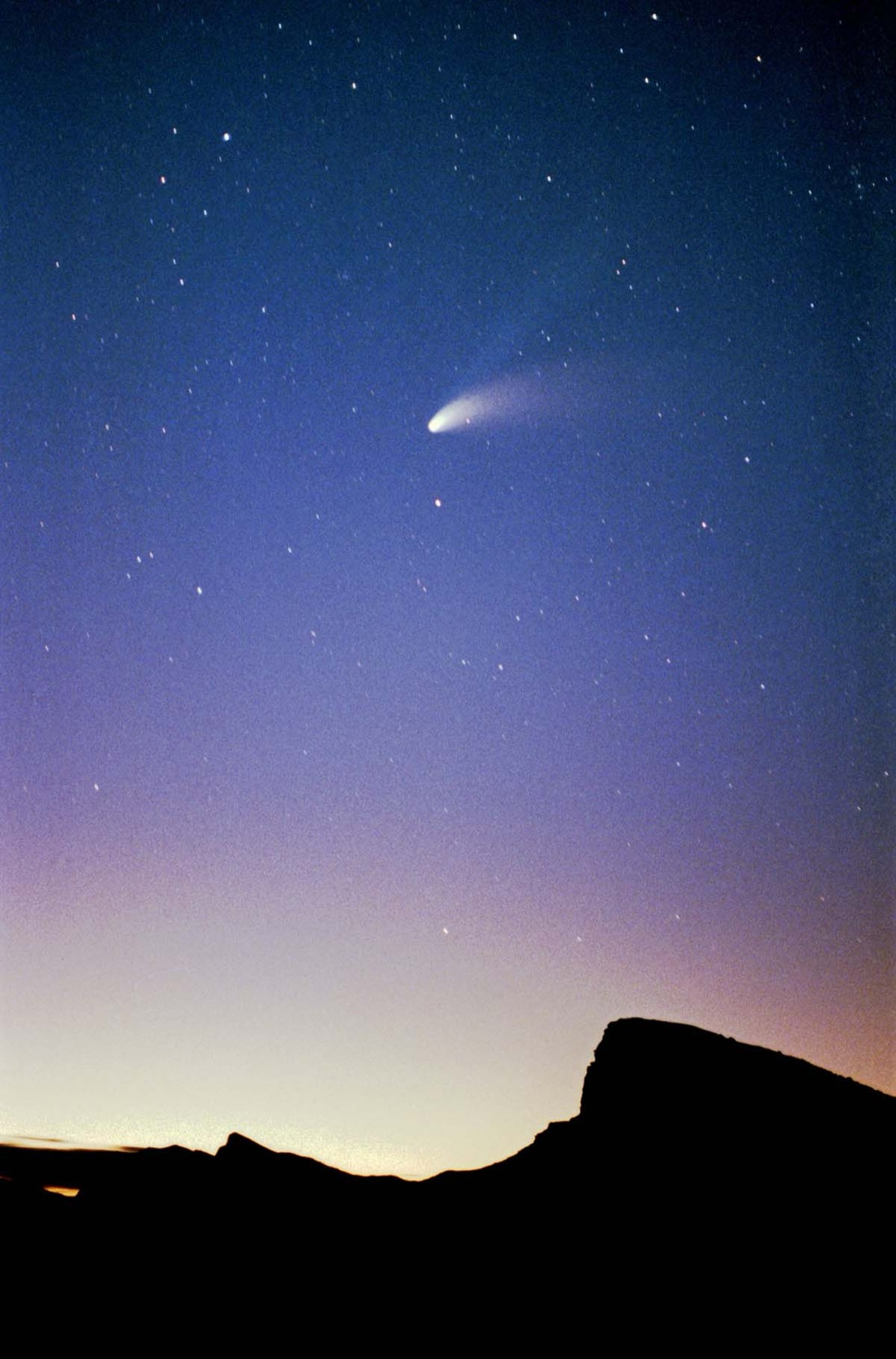
Comet Hale-Bopp over Death Valley in 1997. Its arrival, amid a rumor that a spacecraft trailed hidden behind it, convinced the members of Heaven's Gate that the sign they had awaited for twenty years had come. Wikimedia Commons / CC BY-SA 3.0.
Heaven's Gate: The UFO Cult That Died to Reach the Comet
United States, 1997 — Thirty-nine people believed a spacecraft was hidden behind the comet Hale-Bopp, waiting to carry them to a higher level of existence. To board it, they thought, they had to leave their bodies behind. They died calmly, methodically, and by their own hands
- Category
- Religion, Cults & Spirituality
- Published
- Length
- 3,550 words · 19 min read
- Author
- The editors
Heaven's Gate presents a different and in some ways more perplexing puzzle than the coerced mass deaths of a group like the Peoples Temple. There were no armed guards here, no children killed first, no overruled voice of dissent; the thirty-nine who died at Rancho Santa Fe were adults who, as far as the evidence shows, chose their deaths freely and calmly, in the sincere conviction that they were graduating to a higher plane of existence. This is the harder thing to comprehend: not that people were forced to die, but that people wanted to, because a belief system had made death appear to them not as an end but as a transformation, a boarding of the long-awaited craft. To understand Heaven's Gate is to grapple with how a coherent, all-encompassing belief can reframe the most basic human instinct — the will to live — into an obstacle to be overcome. It requires taking the members seriously as people, which is the opposite of mocking them.
This is the story of the group that died to reach the stars.
The belief
To understand Heaven's Gate, one has to take its worldview seriously, however strange it appears, because it was the coherence of that worldview, not mere gullibility, that led its members to their deaths. The group was founded in the 1970s by Marshall Applewhite and Bonnie Nettles, a pair who came to believe they were the "two witnesses" prophesied in the biblical Book of Revelation, sent to prepare a select few for a journey beyond the Earth. They took names — over the years, most enduringly "Do" and "Ti" — and gathered followers, traveling and recruiting across the United States with a message that blended Christian apocalyptic themes, New Age spirituality, and the era's fascination with UFOs.
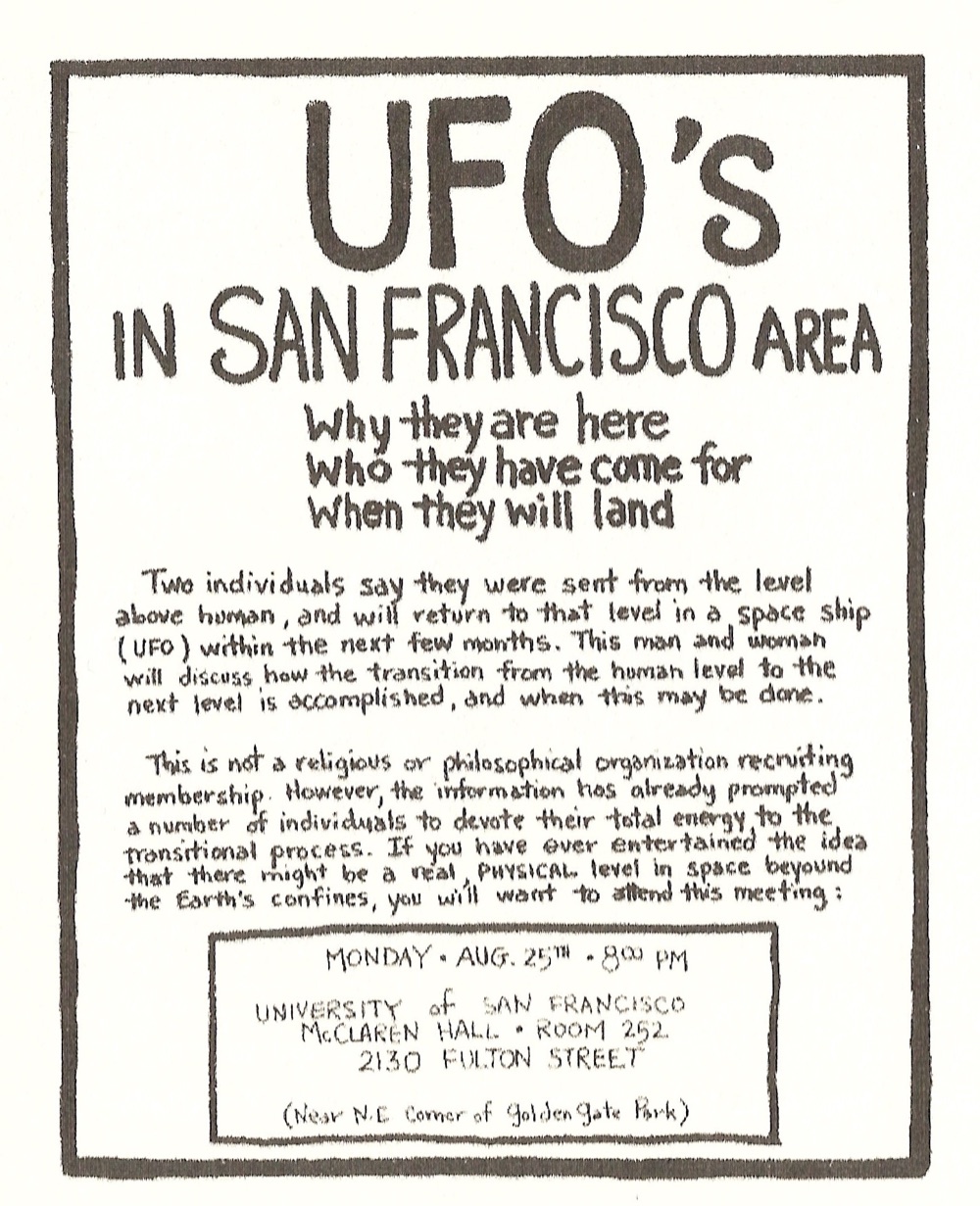
The core of the belief was the idea of the "Next Level." Heaven's Gate taught that above humanity existed a genderless, immortal extraterrestrial level of being — the "Evolutionary Level Above Human" — and that the purpose of human life, for those who were ready, was to graduate to it. The human body, in this teaching, was not the self but merely a "vehicle" or "container," a temporary garment to be shed when the time came. Salvation meant leaving the body behind and ascending, aboard a spacecraft, to the Next Level. This framing — the body as a disposable vehicle — would prove central and fatal, because it made the destruction of the body appear not as death but as a necessary step toward true life.
The life
For roughly two decades, the members of Heaven's Gate lived according to this belief with remarkable discipline and self-denial. They abandoned their former identities, families, and possessions to join the group. They lived communally and in strict celibacy — Applewhite and several male members underwent voluntary castration to remove the distraction of sexuality, a measure of the totality of their commitment. They followed elaborate rules governing every aspect of daily life, a regimen they called "the process," designed to purify them of human attachments and prepare them for the Next Level. They referred to themselves as a "crew" or a "class," and to Applewhite and Nettles as their teachers.

The members came from varied backgrounds and had, in many cases, left behind ordinary lives — jobs, families, homes — to follow the group. Some had been with Applewhite and Nettles since the 1970s; others had joined later. What united them was not desperation or obvious instability but a shared search for meaning and transcendence that the group's cosmology seemed to answer. This is worth emphasizing because the popular image of a cult member as a broken or foolish person is largely a comforting myth. The people of Heaven's Gate were, for the most part, capable adults who had found in the group a totalizing sense of purpose — and it was precisely their capability and commitment, turned inward and sealed off from the world, that carried them to the end.
Bonnie Nettles — "Ti" — died of cancer in 1985, more than a decade before the group's end. Her death was a significant event for the group, and it shaped Applewhite's evolving theology; if a member of the "Next Level" could leave her vehicle through illness, the idea of deliberately leaving one's vehicle became more thinkable. Applewhite, now the sole leader, carried the group forward through the following years, its members waiting, disciplined and expectant, for the sign that would tell them it was time to go.
The internet-age group
Heaven's Gate was, in one respect, strikingly modern: it was a cult of the internet age. To support themselves, members ran a web-design business, and the group maintained a website explaining its beliefs and offering its message to the world — a website that, remarkably, still exists, maintained after the deaths by a few surviving former members. In an era when the World Wide Web was new, Heaven's Gate used it to proselytize, presenting its cosmology in earnest, homemade web pages that survive as an eerie primary source. The group's members were not isolated primitives but educated people, comfortable with the technology of their time, which makes their fate all the more sobering.

The members supported themselves quietly, moved from place to place, and kept largely to themselves, an obscure group that attracted little public attention in its final years. They were waiting. And in early 1997, they became convinced that the wait was over.
The website they left behind has become an unusual kind of artifact. Preserved and still online decades later, maintained by a couple of former members who did not die, it presents the group's beliefs in their own earnest words — the doctrine of the Next Level, the warnings about the human world, the invitation to a way of life its authors genuinely believed was salvation. To read it is to encounter not the ravings of the obviously mad but a strange internal coherence, a complete system explained patiently and, in its own terms, logically. That coherence is part of what makes Heaven's Gate so unsettling: the belief that killed its members was not a chaotic delusion but an ordered worldview, argued and elaborated, that thirty-nine people found convincing enough to die for.
The comet
The trigger was the comet Hale-Bopp, one of the brightest and most widely observed comets of the twentieth century, which became a spectacular sight in the night sky in early 1997. As millions of people admired it, a rumor spread — propagated on the radio and the early internet — that a mysterious object, a "companion" or spacecraft, was following along behind the comet, hidden from ordinary view. The claim originated in a misidentified star in an amateur photograph and was entirely false, a piece of astronomical misinformation. But to Heaven's Gate, it was the sign.
The "companion" rumor is itself a small case study in how misinformation spreads and finds its mark. An amateur astronomer had photographed Hale-Bopp and captured, near it, a fuzzy object he could not identify; it was in fact a known star, distorted by the imaging, but before that mundane explanation caught up, the image and the claim of a mysterious "Saturn-like object" trailing the comet spread through radio programs devoted to the paranormal — most notably the popular late-night show hosted by Art Bell — and across the young internet. For most listeners it was an intriguing curiosity, quickly forgotten. For a group that had spent twenty years waiting for exactly such a sign, it was confirmation of everything they believed. The same false rumor washed harmlessly over millions and, reaching the one audience primed to act on it, became a summons to death — a reminder that information does not fall on neutral ground, but on minds already shaped to receive it in particular ways.
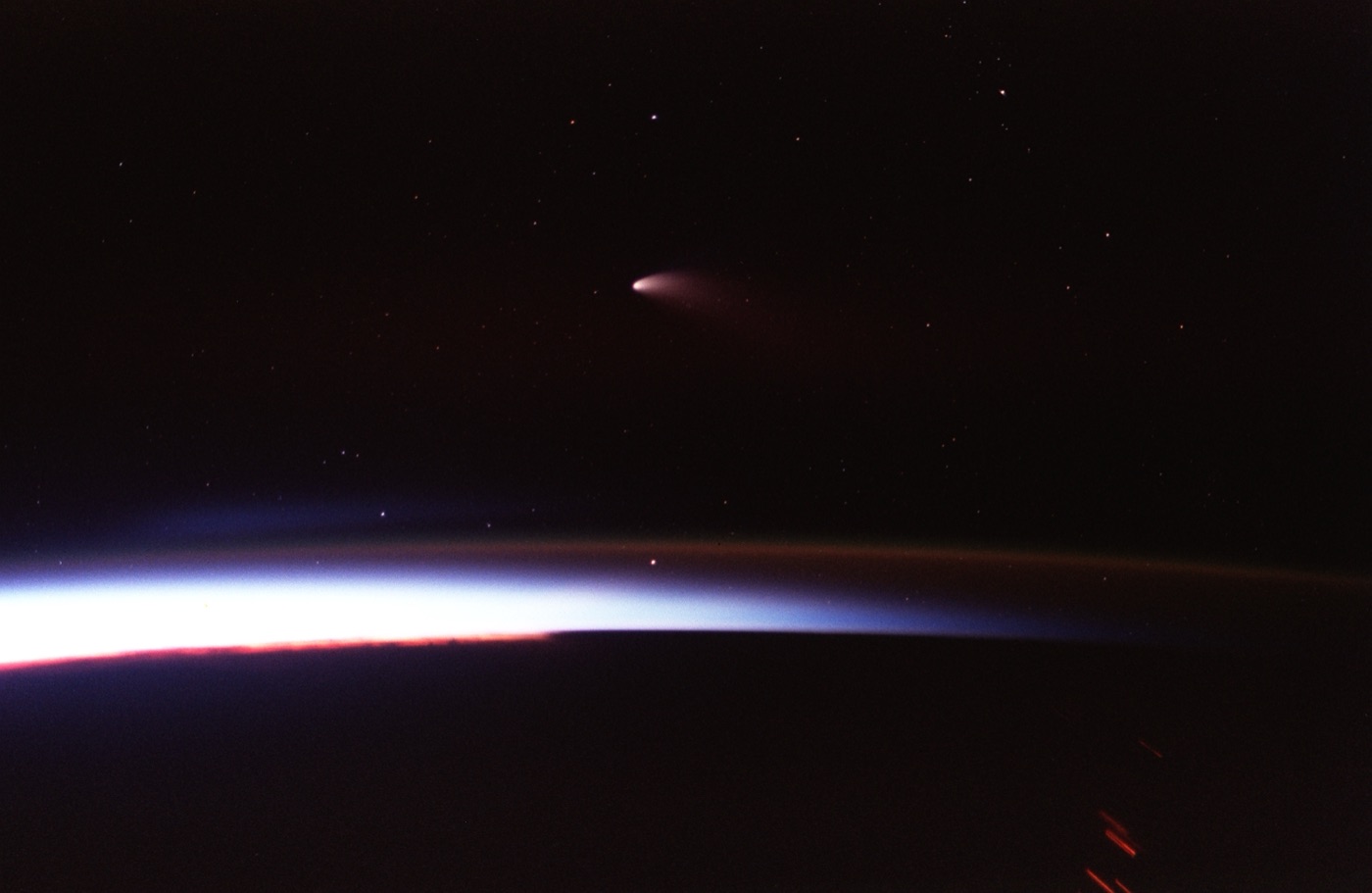
Applewhite concluded that the spacecraft trailing Hale-Bopp was the vessel that had come to carry the group to the Next Level — the moment they had prepared for through two decades of waiting. There was, in the group's logic, only one thing left to do. To board the craft, they had to leave their earthly vehicles behind. The comet, in their eyes, was not a beautiful visitor to be admired but a summons to depart, and they resolved to answer it.
The departure

The deaths were carried out with a chilling calm and method that distinguished Heaven's Gate from more chaotic tragedies. Over roughly three days, the thirty-nine ended their lives in successive groups, each group assisting and then cleaning up after the previous one, so that the process unfolded in an orderly sequence. They consumed a lethal mixture of the sedative phenobarbital in applesauce or pudding, along with vodka, and then secured plastic bags over their heads to ensure death. When the earlier members had died, later ones arranged them with care — covering each body with a purple cloth, laying them out neatly on their beds. Then those members took their own lives in turn, until Applewhite and the last few remained to complete the process.
The scene that was eventually discovered spoke of a group that had approached its death not with terror but with a serene, even joyful, sense of purpose. All thirty-nine were dressed identically, in black shirts and sweatpants and black-and-white Nike sneakers, and each had a small bag packed with a few belongings and a little money, as though preparing to travel. They had left behind farewell videos, recorded in the days before, in which members spoke calmly and happily of their excitement to be leaving, describing their deaths not as suicide but as a graduation, a shedding of their vehicles to join the Next Level. To the watching world, these serene farewells were perhaps the most disturbing element of all: the members did not seem coerced or despairing, but genuinely convinced and at peace with what they were doing.
Understanding, not mocking
In the end, Heaven's Gate stands as one of the strangest and most sobering tragedies of belief in modern history — not a story of coercion or fraud, but of thirty-nine people who died calmly, willingly, and in perfect sincerity, because a worldview they had embraced for two decades had taught them that death was a doorway. When the comet Hale-Bopp crossed the sky in 1997, trailing a rumor of a spacecraft that did not exist, they saw in it the summons they had awaited, and they answered it in the belief that they were shedding their earthly vehicles to ascend to a higher realm. They left behind their serene farewell videos, their still-standing website, and a world struggling to comprehend how such a thing could be freely chosen. To understand them is not to endorse their belief but to grasp its power — to see how a complete and sincerely held idea, sealed away from doubt, can lead reasoning adults to redefine dying as homecoming. The members of Heaven's Gate were captured not by a gun but by an idea, and that, in its way, is the more unsettling captivity, because it is the one that can wear the face of freedom. They believed they were going home. What they left was a warning about the worlds we can build inside our own convictions, and how far, once inside them, human beings will go.
Inspired this / based on it
HBO Max
A documentary series on the group, drawing on former members and archival material.
Glynn Washington / Stitcher
A documentary podcast series on the group and its beliefs.
Filed under
- #heavens-gate
- #marshall-applewhite
- #ufo-religion
- #cult
- #hale-bopp
- #mass-suicide
- #rancho-santa-fe
- #religious-movements
- #1990s
- #confirmed
Click any tag for every article carrying it.
Continue reading
Jonestown: How a Dream of Justice Became a Massacre
The Peoples Temple did not begin as a death cult. It began, in the 1950s and 1960s, as a church that preached racial integration and social justice at a time when both were radical, that fed the poor and cared for the addicted and the elderly, and that drew to it thousands of idealistic people — many of them Black, many of them poor, many of them sincere seekers of a better and fairer world. At its head was Jim Jones, a charismatic preacher who could speak movingly of equality and who built real influence in California, courted by politicians and admired by progressives. But behind the movement's humane public face, Jones was constructing something else: a system of total control, sustained by manipulation, humiliation, sexual and physical abuse, financial exploitation, and a deepening, drug-fueled paranoia. As scrutiny closed in, he moved his followers to a remote agricultural settlement carved out of the Guyanese jungle — Jonestown — where, cut off from the outside world and utterly under his power, some thousand people lived in isolation and fear. When a United States congressman flew in to investigate reports of abuse, Jones had him murdered at a nearby airstrip. And that same day, 18 November 1978, he set in motion the final act he had long rehearsed: the deaths of everyone in Jonestown. More than nine hundred people died, poisoned with cyanide — many of them forced, many coerced, and more than three hundred of them children who could not consent at all. It was not, for most of the victims, a suicide. It was a massacre. This is the story of how a dream of justice became one of the worst atrocities of its kind in modern history — and of the people who died in it.
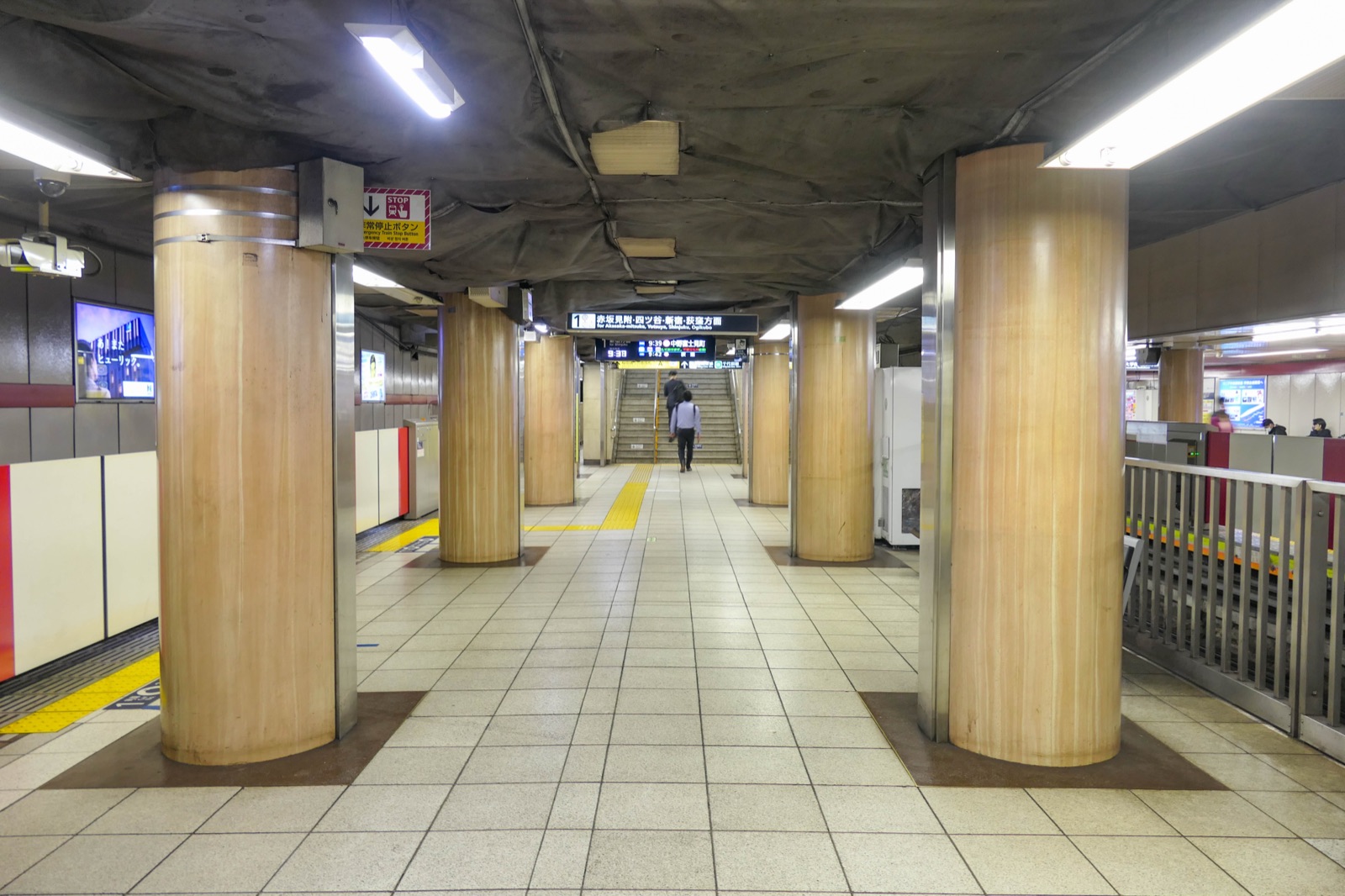
Aum Shinrikyo and the Tokyo Subway Attack
At 7:48 a.m. on Monday, March 20, 1995, five members of the Japanese new-religious-movement *Aum Shinrikyo* boarded five different trains on three converging Tokyo subway lines. Each carried two or three plastic bags wrapped in newspaper, each bag containing approximately 600 milliliters of impure liquid sarin. As the trains approached Kasumigaseki station — the station at the political heart of Tokyo, beneath the National Diet, the Supreme Court, and the major ministries — each man set down his package, pierced the bags with the sharpened tip of an umbrella, and stepped off at the next station. The released sarin evaporated through the morning commute. The first 911 call came at 8:09 a.m. By the time the trains had been cleared, hospitals across Tokyo were processing the largest mass-casualty event in Japanese postwar history: 13 dead (a 14th died of injuries 14 years later), approximately 5,800 injured, of whom approximately 1,000 required hospitalization. The attackers belonged to a cult that, in 1989, had been registered as a recognized religious organization with Japanese authorities, and by 1995 claimed approximately 40,000 members worldwide. Its founder, Shoko Asahara — a half-blind acupuncturist and yoga instructor — had ordered the attack as part of a planned millenarian apocalypse that would establish Aum theocratic rule in Japan. Asahara was executed by hanging on July 6, 2018, together with six other Aum senior figures. The attack remains the single most consequential act of chemical-weapon terrorism by a non-state actor in modern history.
The Order of the Solar Temple: Death as a 'Transit' to the Stars
The Order of the Solar Temple was, on the surface, an unlikely candidate for catastrophe. Its members were not the poor or the desperate but, in many cases, educated and affluent professionals across Switzerland, France, and French-speaking Canada, drawn to a movement that wrapped itself in the romance of the medieval Knights Templar, in esoteric ritual and secret initiations, and in a grand cosmology of spiritual ascent. At its head were two men: Joseph Di Mambro, the shadowy organizer and guru who ran the order and staged its mystical illusions, and Luc Jouret, a charismatic Belgian doctor who was its public face and preacher. Together they taught their followers that the world was doomed, hurtling toward an environmental and spiritual apocalypse, and that the members of the Temple were a spiritual elite who could escape the coming ruin — not by surviving it, but by leaving the Earth altogether. Death, in the order's teaching, was not an end but a 'transit,' a voluntary passage to a higher realm of existence associated with the star Sirius, where the faithful would continue their journey. In October 1994, as the order fractured under financial strain, defections, scrutiny, and internal paranoia, that teaching turned lethal. Over a single period, dozens of members died in Switzerland and Canada, in a horrifying combination of suicide and murder; further deaths followed in France in 1995 and in Canada again in 1997. In all, some 74 people died, among them children who could not possibly have chosen 'transit.' This is the story of the Order of the Solar Temple, and of a belief that turned death into a doorway.