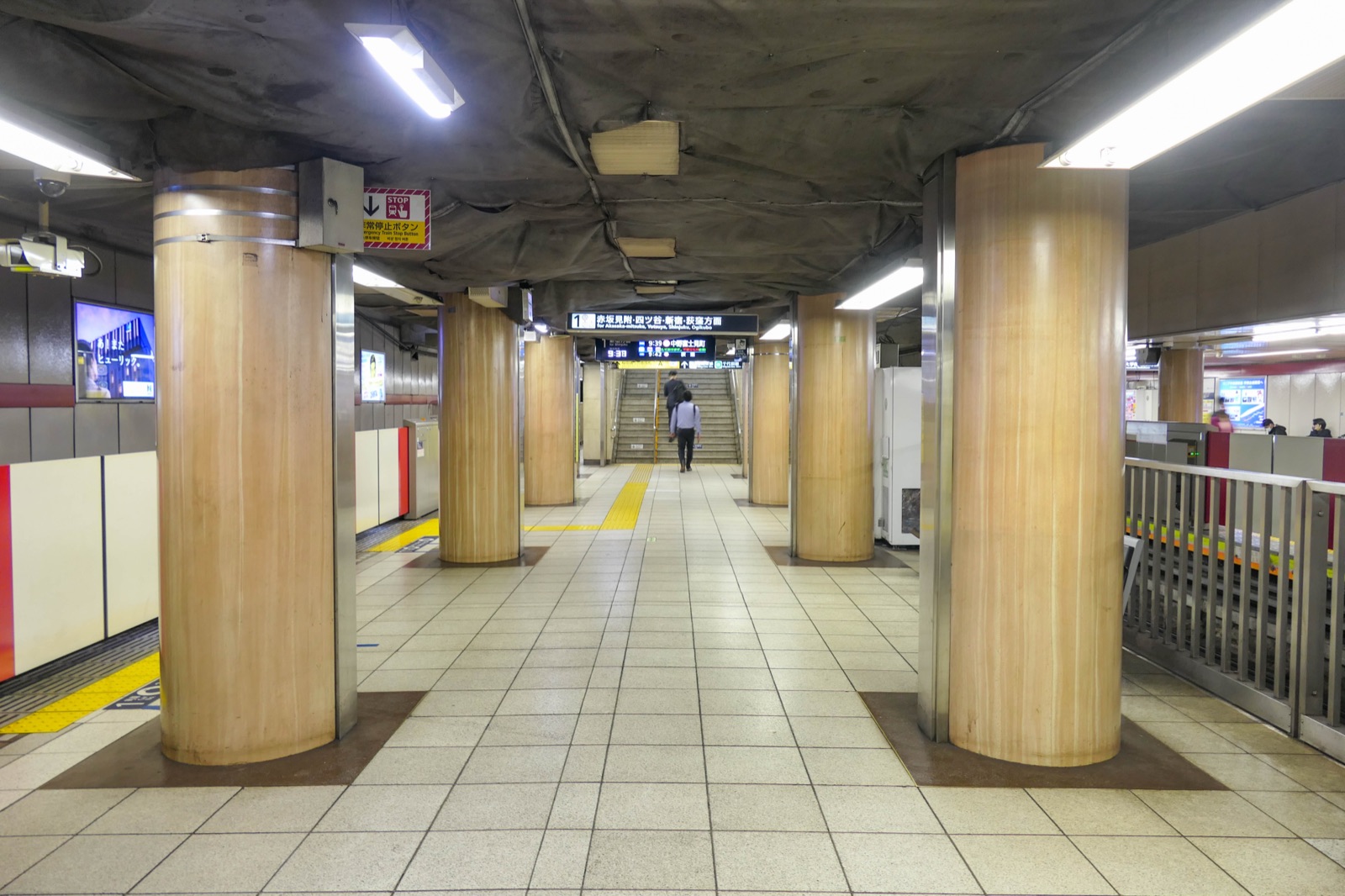
Kasumigaseki Station on the Tokyo Metro Hibiya, Marunouchi, and Chiyoda Lines. The station — at the political heart of Tokyo beneath the Diet building and major ministries — was the convergence target of the March 20, 1995 attack. Wikimedia Commons, CC BY-SA 4.0.
Aum Shinrikyo and the Tokyo Subway Attack
March 20, 1995 — the morning rush
- Category
- Religion, Cults & Spirituality
- Published
- Length
- 3,700 words · 17 min read
- Author
- The editors
Aum Shinrikyo and the Tokyo Subway Attack
March 20, 1995 — the morning rush.
The founder
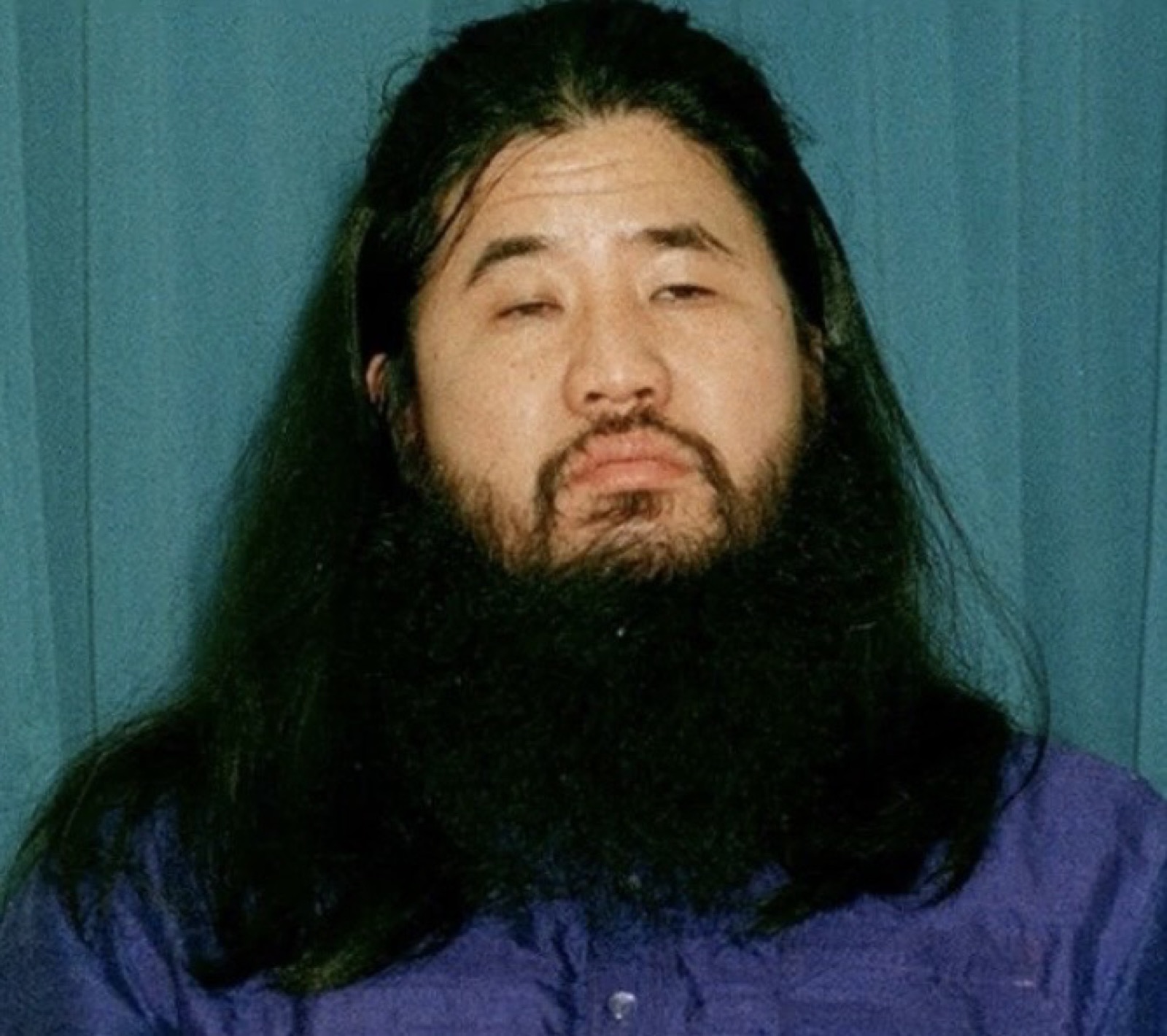
Chizuo Matsumoto was born March 2, 1955 in Yatsushiro, Kumamoto prefecture — a small city in southwestern Japan. He was the fourth of seven children in a poor family of tatami (straw-mat) makers. He was partially blind from infantile glaucoma in his left eye; legally blind in both eyes from his mid-teens.
He attended a school for the blind in Kumamoto from age 6 through high school, graduating in 1975. He moved to Tokyo with the intention of studying medicine at Tokyo University (Todai); he failed the entrance examination twice. He worked as an acupuncturist's apprentice in Tokyo from 1977 to 1983 while studying various forms of traditional Asian medicine.
In 1982, Matsumoto opened his own acupuncture and traditional- medicine clinic in Tokyo's Funabashi district. In 1984, he opened a small yoga school called Aum Shinsen-no-Kai in Shibuya. He took the religious name Shoko Asahara — combining the family name of his wife Tomoko Ishii (whom he had married in 1978) with a Sanskrit-derived first name.
In 1986, after a trip to India during which he reportedly met the Dalai Lama, Asahara renamed his organization Aum Shinrikyo ("Aum Supreme Truth"). The "Aum" was the Hindu/Buddhist sacred syllable; "Shinrikyo" combined the Japanese characters for "truth-teaching." The organization's theological synthesis combined elements of Tibetan Buddhism, Vajrayana initiation practice, Hindu mantra meditation, Shiva-worship, and Asahara's own apocalyptic interpretations of the Book of Revelation and Nostradamus's prophecies.
By 1989, Aum had grown sufficiently — approximately 1,300 members at that point — that Asahara applied for registration as a recognized religious corporation under Japanese law. The registration was approved in August 1989. The corporation status granted Aum:
- Tax exemption on religious-purpose assets.
- Protection of internal operations from routine government oversight.
- Religious-freedom protections under Japanese constitutional law.
The grant was politically controversial at the time; some Tokyo prefectural officials had recommended against approval based on preliminary investigations of Aum-related disputes. The recommendation was overridden.
What Aum believed
Aum's theology between 1989 and 1995 took an increasingly millenarian turn. Asahara's published works during this period — particularly Declaring Myself the Christ (1992) and Disaster Approaches the Land of the Rising Sun (1995) — articulated:
- An imminent global apocalypse, scheduled by various Asahara pronouncements for 1997, 1999, or 2000.
- The apocalypse would be a nuclear or chemical war initiated by the United States against Japan.
- Aum members would survive the apocalypse through advanced spiritual practices and physical separation from mainstream Japanese society.
- After the apocalypse, Asahara would establish a Shambhala kingdom (a Tibetan Buddhist eschatological concept) with Aum members as the ruling class.
The theology evolved, beginning around 1992, to include an operational dimension: that Aum members had a religious obligation to bring about the apocalypse rather than merely prepare for it. This shift — from passive eschatology to active millennialism — was the theological frame within which the chemical-weapons program developed.
The program's operational head was Seiichi Endo, a 32-year-old Aum member with a master's degree in genetic engineering from Kyoto University. Endo had joined Aum in 1987. By 1993 he was overseeing a chemical and biological research staff of approximately 60-80 Aum members, many of whom held science and engineering degrees from Japanese universities.
What was at Kamikuishiki
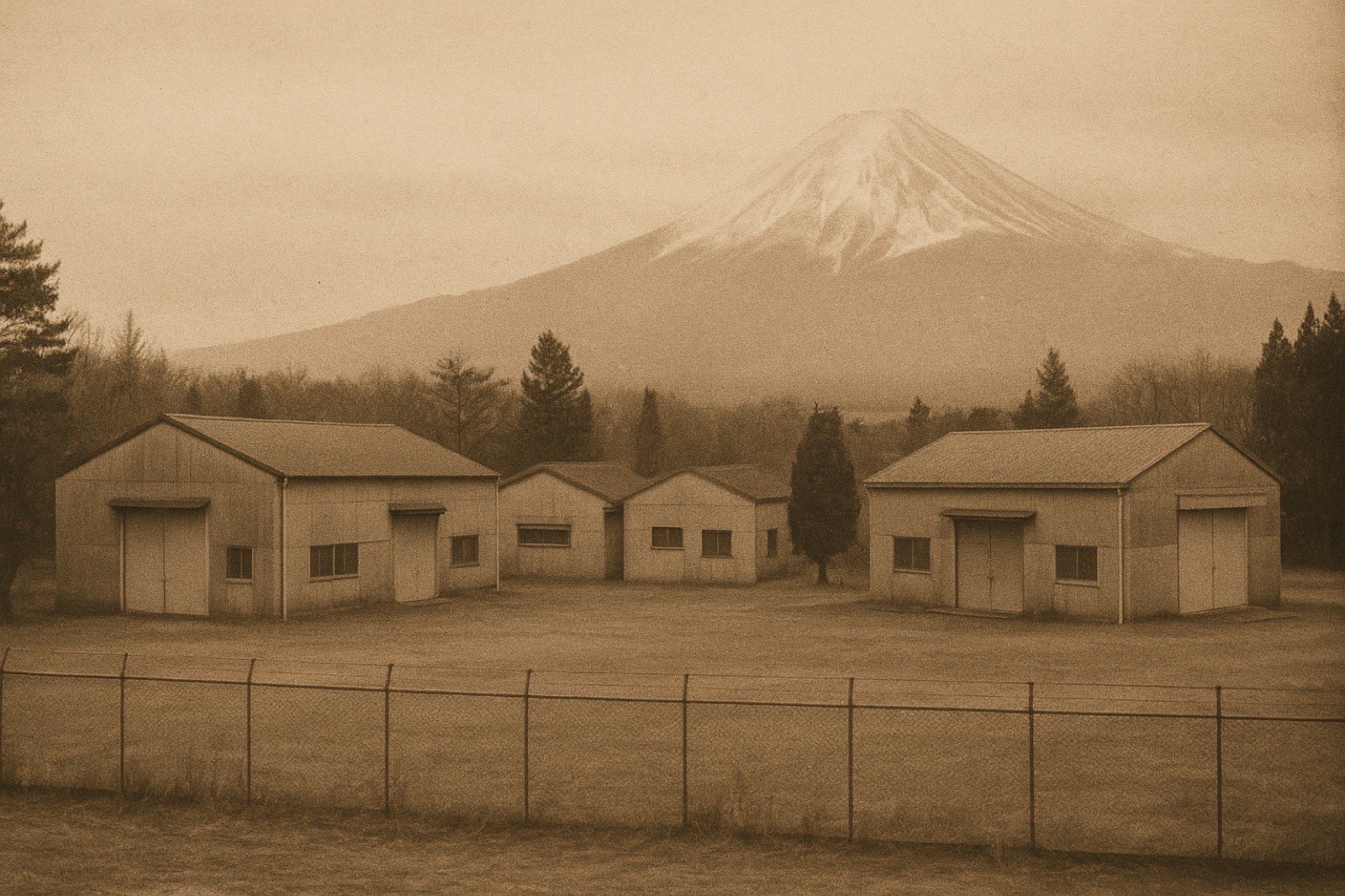
The Aum compound at Kamikuishiki — a small village (population approximately 1,000) at the northwestern foot of Mt Fuji — was established in 1989 and expanded continuously through 1994. By 1995, the Kamikuishiki complex consisted of approximately 30 buildings on a 13-hectare site, housing approximately 2,000 resident Aum members. The buildings were nondescript pre- fabricated warehouses and converted farm buildings.
What the buildings contained, as the police searches of March 22, 1995 and subsequent weeks revealed:
Satian 7 (the largest building) housed a complete chemical- weapons production line. The facility had been designed by Aum chemists with reference to U.S. and Soviet open-literature descriptions of sarin production. The production line included:
- Methylphosphonyl difluoride (DF) — sarin's most critical precursor — produced via a multi-step synthesis from methylphosphonic dichloride.
- A second-stage reactor for converting DF to sarin (methylphosphonofluoridate) using isopropyl alcohol.
- Storage tanks, ventilation, and decontamination infrastructure.
Satian 2 housed a separate biological-research facility. Aum chemists had been attempting, with limited success, to produce weaponized Bacillus anthracis (anthrax) and Clostridium botulinum (botulinum toxin) since approximately 1990. An attempted aerosolized-anthrax attack on the Japanese Diet Building in June 1993 had failed — Aum had used a non-virulent Bacillus anthracis strain it had obtained from a veterinary laboratory.
Satian 5 housed Aum's Russian helicopter project. In late 1993, Aum had purchased a Mil Mi-17 military transport helicopter from former Soviet military stocks in Russia. The helicopter — disassembled in Russia, shipped to Japan as "agricultural equipment," and partially reassembled at Kamikuishiki — was intended for aerial delivery of chemical weapons over Tokyo during the planned apocalypse.
Storage facilities held approximately 12 metric tons of chemical precursors, several thousand gas masks, large quantities of dual-use chemical equipment (centrifuges, reaction vessels, glassware), and approximately $7 million in cash.
Matsumoto
The Aum chemical-weapons program's first operational deployment came not in Tokyo but in Matsumoto, a city of approximately 200,000 in Nagano prefecture in central Japan. Aum had been losing a civil-court case in Matsumoto involving a real-estate dispute. The three judges hearing the case lived in a residential neighborhood near the courthouse.
On the evening of June 27, 1994 — the night before the judges were scheduled to issue their ruling — an Aum-modified truck released approximately 12-20 kilograms of sarin vapor into the residential neighborhood. The release lasted approximately 20 minutes.
The Matsumoto attack killed 8 people and injured approximately 500-600. The three target judges were among those injured; the ruling against Aum was subsequently delayed and eventually abandoned as Aum was dissolved in 2000.
The Japanese police investigation of the Matsumoto attack initially focused on a local resident named Yoshiyuki Kono, who had himself been injured in the attack and whose backyard had been falsely identified as the location of a chemical reaction. Kono's nine-month wrongful suspicion would later be widely cited as one of the most consequential Japanese police investigative failures of the postwar period.
By December 1994, Aum had been identified as a likely suspect in the Matsumoto attack by investigative journalists and by some within the Japanese National Police Agency. The institutional decision to pursue Aum was delayed by political-religious sensitivities — Aum's religious-corporation status created legal hurdles for an aggressive investigation — and by the police's own institutional momentum on the Kono theory.
By February 1995, Aum's senior leadership had become aware that police investigation was closing in. The Tokyo subway attack was planned in approximately the first three weeks of March 1995 as a way to disrupt the investigation by creating a much larger crisis the police would have to manage.
March 20
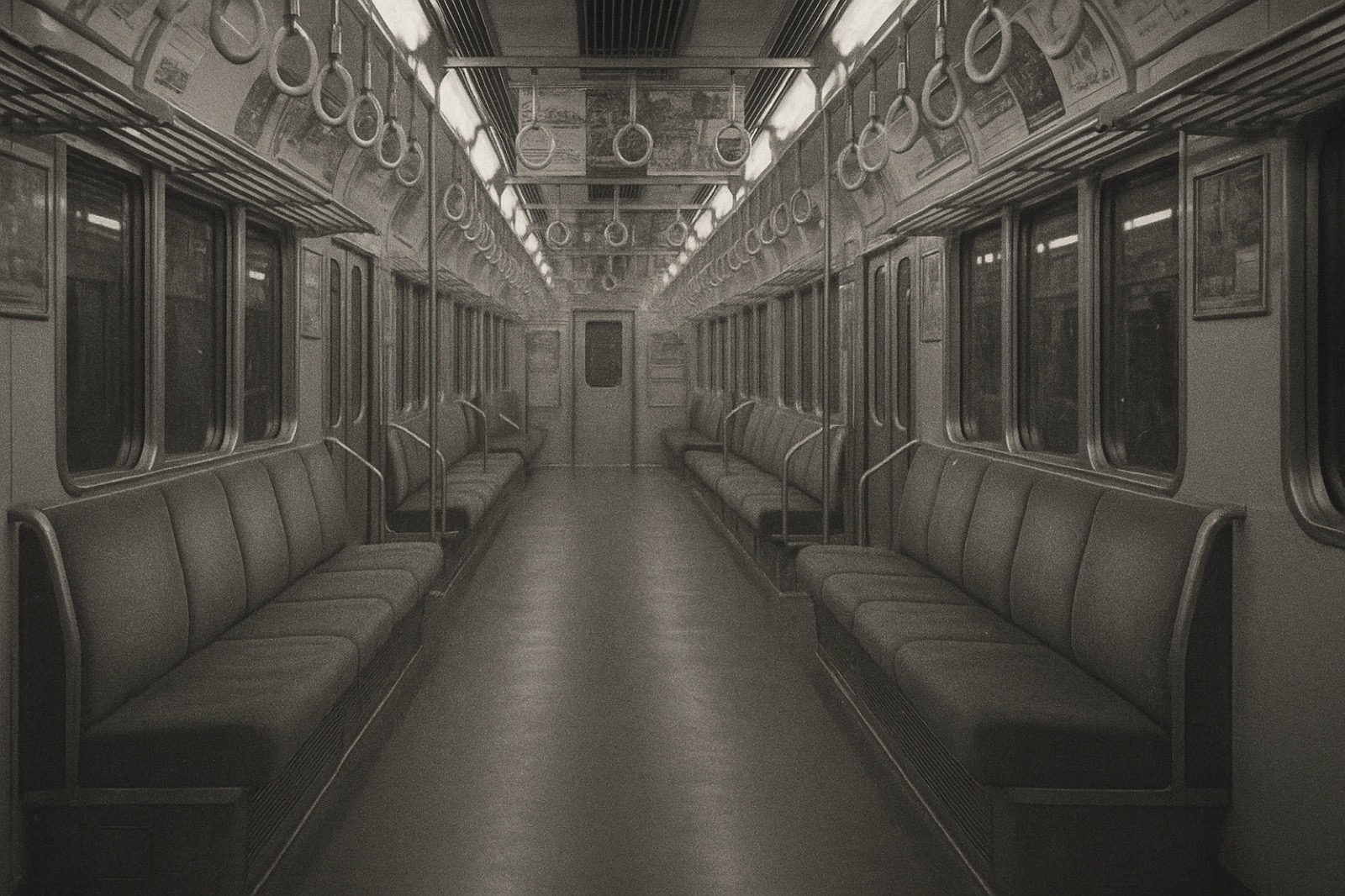
The operational planning for the Tokyo attack was substantially managed by Hideo Murai (Aum's "Science and Technology Minister") in coordination with Endo. The five attackers selected — all senior Aum members in their late twenties to mid-thirties — were:
- Ikuo Hayashi (45 at the time) — Cardiologist; Marunouchi Line train
- Kenichi Hirose (30) — Physicist; Marunouchi Line train
- Toru Toyoda (27) — Doctoral physicist; Hibiya Line train
- Masato Yokoyama (31) — Engineer; Marunouchi Line train
- Yasuo Hayashi (36) — Electronics engineer; Hibiya Line train (different from Ikuo Hayashi)
Each attacker carried two bags of liquid sarin and a small needle-tipped umbrella. The standard procedure was:
- Board a designated train at a designated upstream station.
- Place the bags on the floor of the train car.
- Pierce the bags with the umbrella tip.
- Disembark at the next station.
The five attackers boarded between 7:48 and 8:13 a.m. They disembarked between 7:55 and 8:35 a.m. Each was met by an Aum driver waiting at the disembarkation station; each was driven to a different Aum safe house.
The released sarin began evaporating immediately. The five trains continued their normal operations for approximately 30-40 minutes after the releases. The first 911 call — from a Hibiya Line train — was logged at 8:09 a.m.
Tokyo's emergency response was rapid but limited by the inability to immediately identify the agent. Hospitals across Tokyo had received standing notifications about possible nerve- agent attacks following the Matsumoto incident; some had stockpiled atropine and pralidoxime (the standard nerve-agent antidotes). St. Luke's International Hospital alone treated 640 casualties that morning. Tokyo Metropolitan Hospital processed 278.
By 11:30 a.m., the Japanese National Chemical Warfare Defense Unit had confirmed the agent as sarin. By 1:00 p.m., the identification had been linked to the Matsumoto attack.
The death toll on March 20 was 13. A 14th victim, Sachiko Asakawa, remained in a coma until her death in 2008. Long-term medical effects on the broader injured population — persistent neurological symptoms, PTSD, ongoing respiratory complications — have been documented through 2025.
Asahara and the trials
On March 22, 1995 — two days after the subway attack — police raids on 25 Aum facilities began simultaneously across Japan. The raids continued for approximately three weeks. Approximately 12 metric tons of chemicals, the Mil Mi-17 helicopter, the biological-warfare research equipment, approximately $7 million in cash, and substantial documentary evidence were seized.
Shoko Asahara was arrested at the Kamikuishiki compound on May 16, 1995, after a 56-day manhunt. He had been hiding in a small sealed wall-cavity in Satian 6. His arrest required the use of police saws to cut through the wall.
The criminal trials of Aum members began in 1996 and continued until 2011. The Tokyo District Court trial of Asahara himself lasted approximately 8 years — from April 1996 to February 2004. The court convicted him of 13 counts:
- Conspiracy to commit murder (the Tokyo subway attack)
- 11 counts of murder (specific individuals killed in Aum operations including Tsutsumi Sakamoto and his family in 1989)
- Attempted murder (other Aum operations)
Asahara declined to defend himself substantively during the trial. His lawyers, by his own subsequent communication, considered his actions criminal under the legal framework but argued that the religious-charisma context constituted mitigation. The defense was rejected.
Asahara was sentenced to death by hanging on February 27, 2004. His appeals were rejected through 2006 and 2011. He was hanged on July 6, 2018, at the Tokyo Detention Center. Six other Aum senior figures — Endo, Murai (already murdered in 1995 by yakuza- linked killers), Ikuo Hayashi (who pleaded guilty and received life imprisonment), Kenichi Hirose, Toru Toyoda, Masato Yokoyama, and Yasuo Hayashi — were hanged on July 6 or July 26, 2018. The total death-sentence executions were 13. Approximately 180 other Aum members received prison sentences ranging from 3 years to life.
The successor
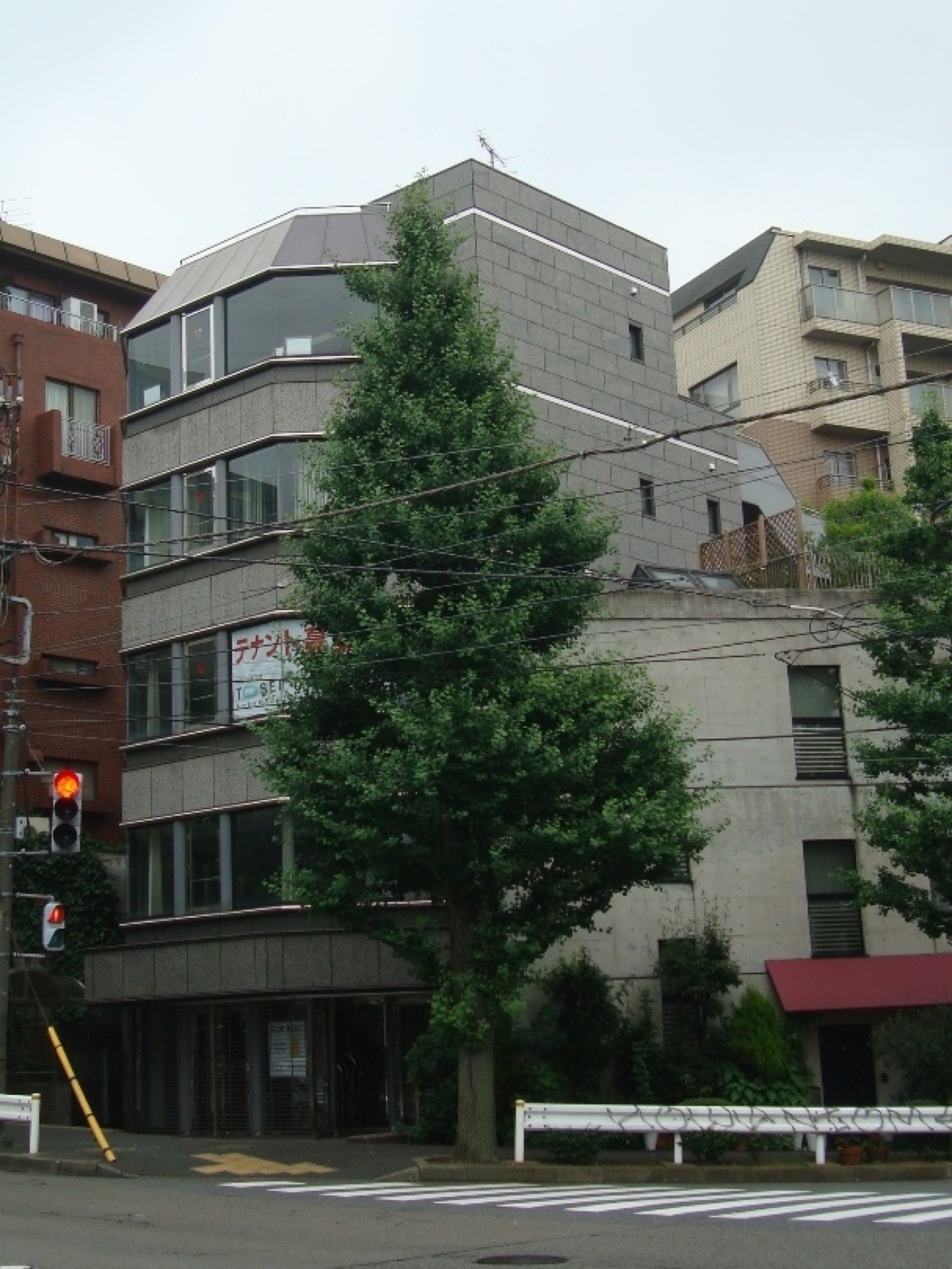
Aum Shinrikyo as a corporate entity was dissolved by Japanese court order on October 30, 2000, after the criminal trials had established the organization's responsibility for the subway attack and other crimes. The dissolution was carried out under the Religious Corporations Law's provisions for organizations found to have committed criminal acts.
The dissolution did not eliminate the membership network. Two successor organizations emerged:
Aleph (アレフ) — Renamed from "Aum" to "Aleph" in 2000 and to its current name in 2003. The main successor organization; operationally led by Aum survivor Joyu Fumihiro. Approximately 1,650 members as of the most recent (2023) Public Security Intelligence Agency assessment.
Hikari no Wa (光の輪, "Circle of Light") — Founded 2007 as a splinter group led by Joyu Fumihiro himself after his departure from Aleph. Approximately 200 members.
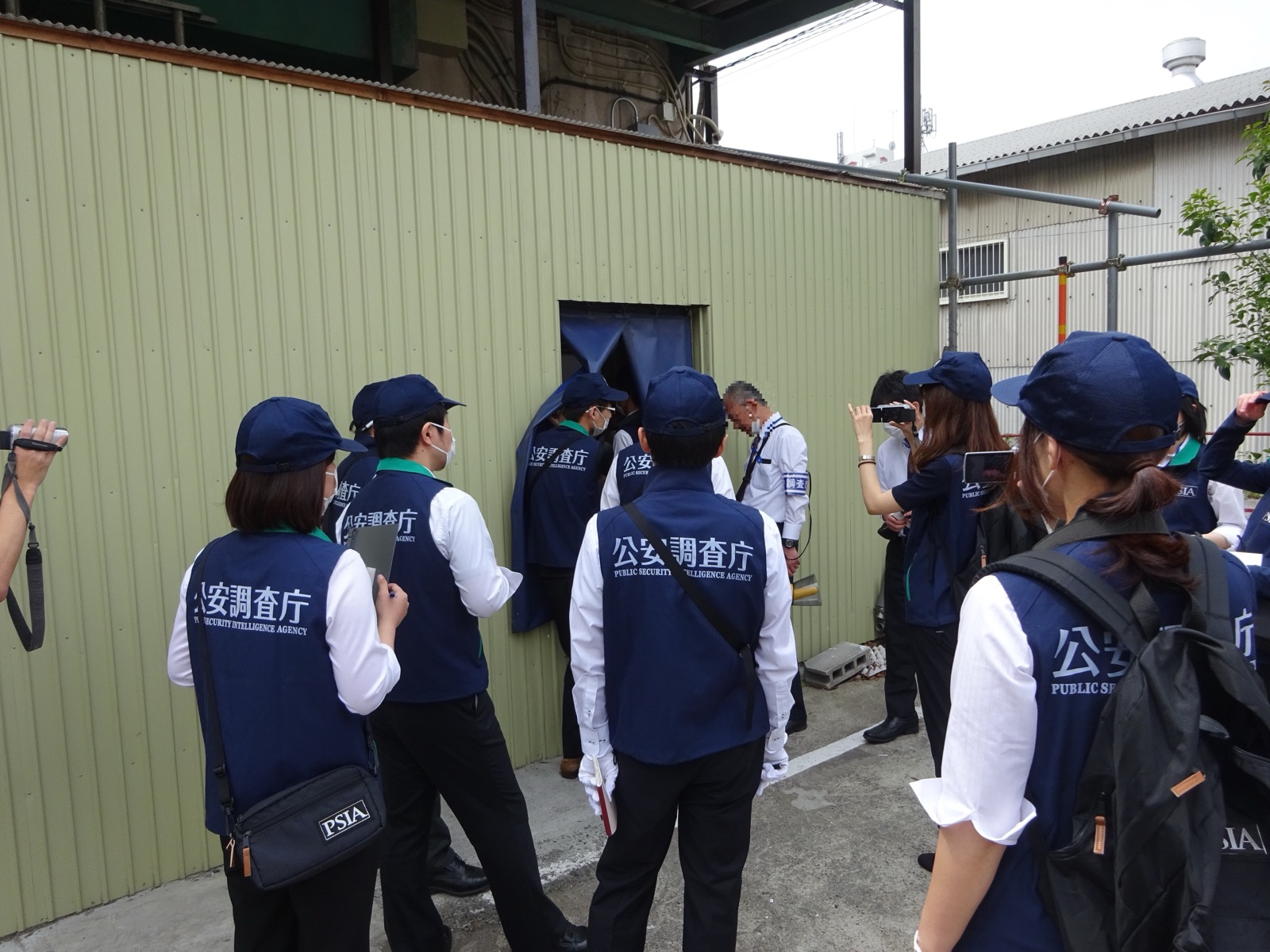
Both organizations operate under restrictive surveillance by the Japanese Public Security Intelligence Agency (PSIA) under the Group Regulation Law. The surveillance includes monthly membership-and-finance reporting, restrictions on facility use, and ongoing PSIA monitoring. As of 2025, both organizations are required to file detailed reports of their activities every three months.
The cast
Why this case is filed as "confirmed"
The Aum Shinrikyo / Tokyo subway attack is one of the most extensively documented cases of non-state chemical weapons terrorism in modern history. The criminal trial record (192 convictions, 13 death sentences, full judicial transcripts), the post-attack Japanese police evidentiary collection, Haruki Murakami's Underground interviews, and the continuing PSIA surveillance reporting together constitute a documentary base that is substantially complete.
What is sometimes still misunderstood — particularly by Western audiences whose knowledge of the case may be limited to the Tokyo subway attack itself — is the scale of Aum's pre-attack operations. The 1989 Sakamoto family murder, the 1990 Diet anthrax attempt, the 1994 Matsumoto attack, and the multiple internal-discipline murders within Aum's own compound (members killed for attempting to leave) together constituted a sustained multi-year violent operation that the Tokyo attack was the public-facing culmination of.
What we still don't know
The full pre-1995 attack record. Aum is documented to have been responsible for approximately 27 deaths before the subway attack, including the 8 Matsumoto victims, the Sakamoto family, and approximately 16 internal Aum members killed in disciplinary operations. Some additional cases — particularly disappearances of former members — remain partially unresolved.
The international dimension. Aum's Russian membership (approximately 30,000 at peak), its Australian Banjawarn Station operation (sarin and uranium-related testing), and its 1994 attempt to purchase a Russian nuclear weapon from former Soviet military stocks have been substantially documented but the full international scope remains incompletely catalogued.
The successor organizations' current operations. Aleph and Hikari no Wa are under PSIA surveillance but their full operational picture is limited-disclosure. The 2025 PSIA assessment characterized both as "subject to continuing restrictions."
Sources
Primary documents:
- Tokyo District Court trial transcripts in State v. Asahara (1996-2004) and related Aum cases (1996-2011). Selected portions available through Japanese Diet Library.
- Japan National Police Agency, White Paper on Police 1996 (special section on Aum Shinrikyo).
- Japan Public Security Intelligence Agency, annual assessments of Aleph and Hikari no Wa, 2001-2024.
- Japan Diet Special Committee on Aum Shinrikyo, hearings 1995-1996.
- Subway-system records of the March 20, 1995 incident — Tokyo Metro and Teito Rapid Transit Authority operational logs.
Secondary investigative reporting: 6. Haruki Murakami, Underground: The Tokyo Gas Attack and the Japanese Psyche (Vintage, English 2001; Japanese original 1997). The most-cited single work on the case; extended interviews with 60 victims and 8 Aum members. 7. David Kaplan and Andrew Marshall, The Cult at the End of the World: The Incredible Story of Aum (Crown, 1996). The foundational Western journalistic treatment. 8. Ian Reader, Religious Violence in Contemporary Japan: The Case of Aum Shinrikyo (Curzon Press, 2000). The standard academic treatment. 9. Robert Jay Lifton, Destroying the World to Save It: Aum Shinrikyo, Apocalyptic Violence, and the New Global Terrorism (Henry Holt, 1999). 10. The Japan Times, Asahi Shimbun, Mainichi Shimbun — comprehensive Japanese press coverage 1995-2018. 11. The New York Times, multi-correspondent coverage including Nicholas D. Kristof. 12. PBS Frontline, "Aum Shinrikyo: The Final Threat," 1998.
Academic / specialist scholarship: 13. Mark Mullins, "Aum Shinrikyo as an Apocalyptic Movement" — in Catherine Wessinger, ed., Millennium, Messiahs, and Mayhem (Routledge, 1997). 14. Brad Beasley, "From Lab to Cult: Aum's Chemical Weapons Program" — Studies in Conflict & Terrorism, 2010. 15. James Smith, "The Sarin Truck of Matsumoto" — Journal of Mass Casualty Incidents, 2003.
Corrections & updates
2026-05-28: First publication.
Inspired this / based on it
Haruki Murakami
Interviews with 60 victims and 8 Aum members. The most-cited single work on the case. Japanese 1997 / English Vintage 2001.
David Kaplan & Andrew Marshall
The foundational Western journalistic treatment. Crown.
Tatsuya Mori · ★ 7.3
Documentary following Aum spokesman Hiroshi Araki during the period 1995-97. Most-cited Japanese cinema-vérité treatment.
Tatsuya Mori
Sequel to *A*; follows the Aum movement's reorganization as Aleph.
PBS Frontline
Investigative documentary on Aum's international operations including the Australian Banjawarn site.
Robert Jay Lifton
Henry Holt. Psychiatric analysis of Aum's ideology.
Filed under
- #aum-shinrikyo
- #shoko-asahara
- #tokyo-subway-attack
- #kasumigaseki
- #kamikuishiki
- #japan
- #1995
- #asia
- #matsumoto
- #chemical-warfare
- #domestic-terrorism
- #religious-cult
Click any tag for every article carrying it.
Continue reading
MK-Ultra
Between 1953 and 1973, the Central Intelligence Agency ran one of the most ambitious — and least restrained — human-experimentation programs in American history. The goal was mind control. The subjects rarely knew they were subjects. By the time the public found out, most of the records had been burned.
The Russian Sleep Experiment
On August 10, 2010, an anonymous user calling himself OrangeSoda posted a 1,200-word story on the Creepypasta Wiki. It described a Soviet experiment in which five political prisoners had been sealed in a sound-proofed chamber and exposed to a stimulant gas that kept them awake for thirty days. The story has no documentary basis. No declassified Russian archive contains anything resembling it. But over the next fifteen years it has become — to a significant fraction of the people who encounter it — historically true. This is the story of how a fiction acquires the texture of evidence.
The Tuskegee Syphilis Study
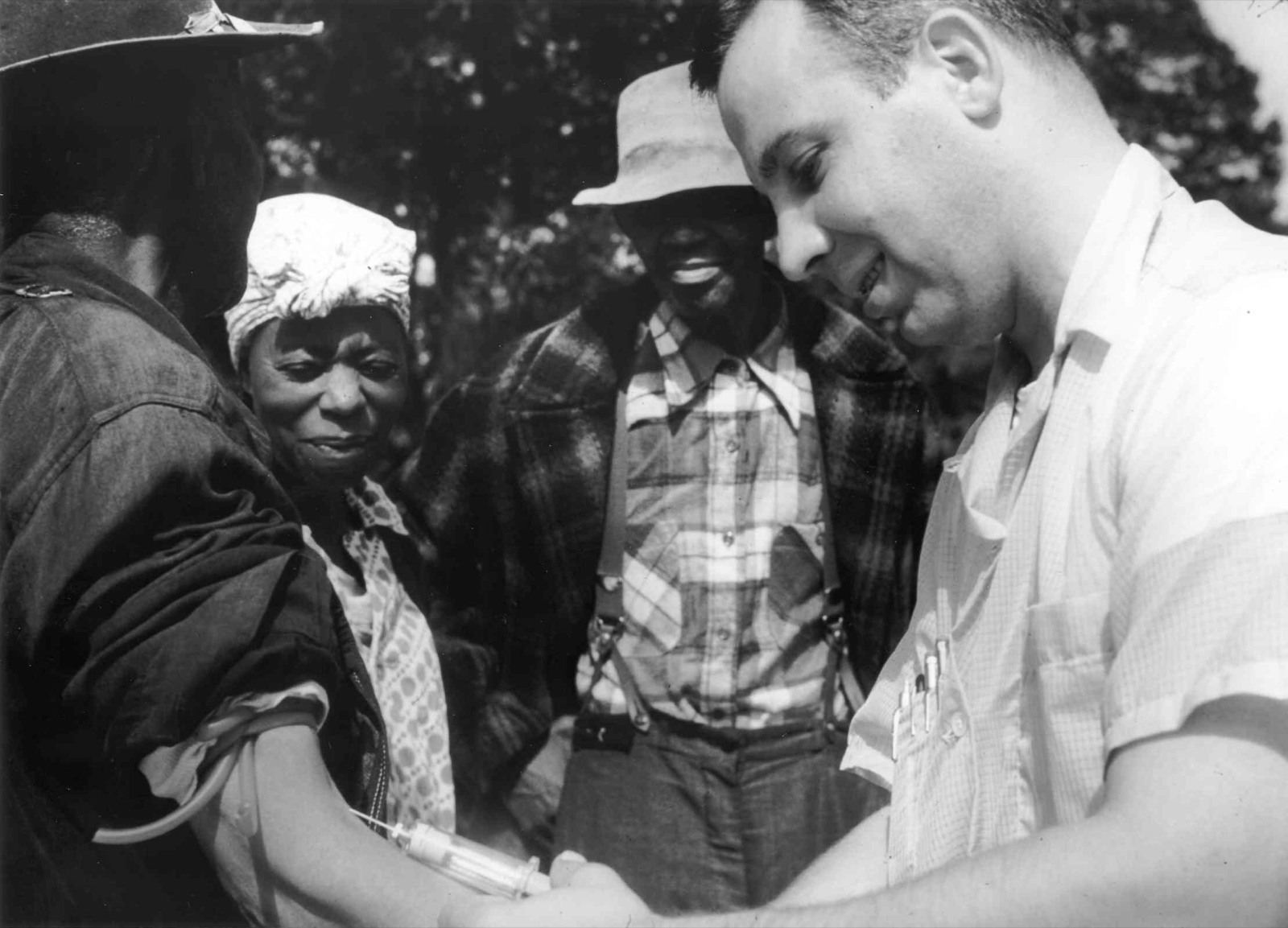
In 1932, the U.S. Public Health Service began a study of 399 Black men in Macon County, Alabama, who had syphilis. They were told they were being treated. They were not. For forty years — including the twenty-five years after penicillin became standard care — the Public Health Service watched the disease take its course. A whistleblower's documents reached the Associated Press on July 25, 1972, and the study ended a few months later. President Clinton apologized on behalf of the United States government in 1997.