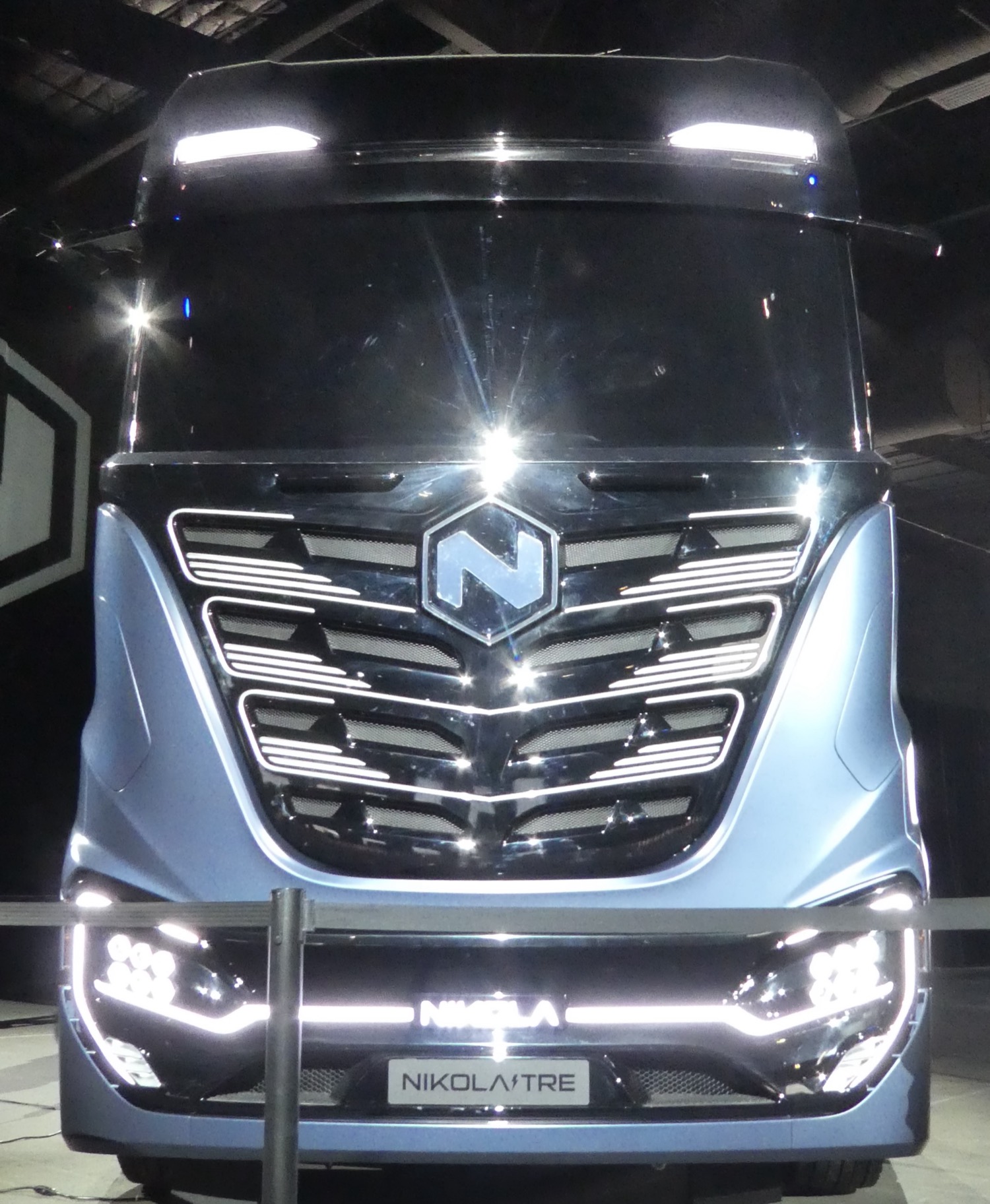
A Nikola Tre electric truck on display. Nikola promised to revolutionise freight with zero-emission battery and hydrogen trucks, and briefly reached a stock-market value above Ford's — without ever having sold a vehicle. The gap between the gleaming prototypes and the working technology was the heart of the fraud. Wikimedia Commons / Raquel Baranow, CC BY-SA 4.0.
Nikola and the Electric Truck That Rolled Downhill
United States, 2014–2022 — an electric-truck startup promised a revolution in zero-emission freight and reached a stock-market value greater than Ford, without selling a single vehicle. Its showcase 'truck in motion' was just rolling down a hill. The founder was convicted of fraud
- Category
- Finance & Economy
- Published
- Length
- 3,760 words · 18 min read
- Author
- The editors
The Nikola story has a single image at its centre that captures the whole affair: a truck rolling silently downhill, filmed to look like it was driving, when in fact it had no working engine at all. That image is a near-perfect metaphor for the company itself — something that appeared to move under its own power but was in reality coasting on gravity and illusion. Nikola is the most literal of the cautionary tales in this archive, because its central deception was so concrete and so visual: not a complex financial fraud or a misrepresented lab result, but a truck that could not drive, shown driving.
This is the story of the truck that rolled downhill.
The next Elon Musk
Trevor Milton was a serial entrepreneur with a gift for salesmanship and a vision of clean trucking. Founding Nikola in the mid-2010s, he aimed at one of the dirtiest, most fossil-fuel-dependent corners of transportation: long-haul freight, where heavy diesel trucks burn enormous quantities of fuel and emit vast amounts of carbon and pollution. The promise of replacing them with quiet, clean, electric-and-hydrogen trucks was genuinely compelling — the freight industry is huge, the environmental stakes real, and a company that could deliver workable zero-emission trucks would be enormously valuable. Milton named his company Nikola, after the inventor Nikola Tesla, an unmistakable signal that he meant to be to trucks what Tesla (which had claimed the surname) was to cars, and he cast himself in the Musk mould: the visionary founder building the impossible future.
The pitch worked. Nikola attracted investment, partnerships with established industrial and automotive firms, and a wave of enthusiasm from investors eager for the next Tesla, the next great electric-vehicle story. Milton made bold, specific claims: that Nikola had working trucks, breakthrough battery and hydrogen technology, billions of dollars in binding orders, and the ability to produce its own hydrogen cheaply. He spoke with the absolute confidence of a man describing accomplished facts. The combination of a vital green mission, a charismatic founder, and the Tesla-shaped hole in investors' imaginations made Nikola a sensation before it had delivered anything at all.
The endorsement of established players added crucial credibility. Major industrial and automotive companies entered into partnerships and investments with Nikola, lending the startup the legitimacy of their names — much as Theranos had drawn authority from its eminent board. When serious, experienced corporations agreed to work with Nikola, it signalled to the market that the technology must be sound; surely they had done their due diligence. This is the same circular machinery of credibility that recurs across these cases: the presence of credible partners substitutes for independent verification, each party assuming that someone else has checked, and the accumulated prestige discourages the skepticism that might have exposed the problem. The partners were not the fraudsters, but their involvement helped the fraud, by making it unthinkable that so many sophisticated organisations could all be backing something hollow.
The SPAC and the surge
Nikola reached the public markets in June 2020 not through a traditional initial public offering but through a merger with a special-purpose acquisition company, or SPAC — a then-fashionable shortcut to going public, in which an already-listed shell company merges with a private firm, taking it public with less of the scrutiny a conventional IPO involves. The SPAC boom of that era was a key enabler of the Nikola story: it let a pre-revenue company with grand promises reach ordinary investors quickly, riding hype rather than proven results.
The result was a frenzy. Nikola's stock soared after the merger, and at its peak the company's market value briefly surpassed that of Ford Motor Company — a firm founded in 1903 that sells millions of vehicles a year. A company that had never sold a single truck was, for a moment, worth more than one of the largest automakers on earth. This was the SPAC-and- EV-hype era at its most extreme, a valuation utterly detached from anything Nikola had actually produced, sustained entirely by belief in Milton's vision and the fear of missing the next Tesla. It could not last, and it took a skeptic to puncture it.
It is worth dwelling on the role of the short-seller, because it is double-edged and instructive. Short-sellers — investors who profit when a stock falls — are often cast as villains, betting against companies and talking down their prospects for personal gain, and Hindenburg Research, which exposed Nikola, did indeed stand to make money if Nikola's shares dropped. This financial motive is real and worth being clear-eyed about. But the Nikola case, like the Wirecard case before it, illustrates the genuine social value that skeptical, profit-motivated investigators can provide. Because they are betting against the consensus, short-sellers have a powerful incentive to find the truth that everyone else, swept up in the enthusiasm, would rather not see — and the resources and motivation to dig for it. In a market where almost everyone profits from a story being true, the short-seller is sometimes the only well-resourced party who profits from it being false, and therefore the only one looking hard for the lie. That the exposure of two of the era's biggest frauds came substantially from short-sellers, not regulators, is a comment on where the incentives to find fraud actually lie.
The truck that rolled downhill
The puncture came on 10 September 2020, when Hindenburg Research, a firm that specialises in investigating companies and betting against their stock (short-selling), published a detailed report calling Nikola "an intricate fraud built on dozens of lies." The report catalogued allegations that Milton had repeatedly made false or grossly exaggerated claims about Nikola's technology and progress. But one revelation crystallised the whole thing, because it was so simple and so damning.

Years earlier, Nikola had released a slick promotional video showing one of its prototype trucks, the Nikola One, apparently cruising along a road under its own power — visual proof that the vehicle was real and worked. The Hindenburg report, drawing on sources, revealed that this was staged: the truck did not actually function: it had no working powertrain. To create the illusion of a driving truck, the company had towed it to the top of a hill and simply let it roll down, filming it from an angle that made the gravity-powered coast look like self-propelled motion. The video's title had described the truck as "in motion" — technically true, in the most deceptive possible sense. Nikola did not deny the basic fact; it argued the company had never explicitly said the truck was driving under its own power. But the damage was done: the image of the rolling truck became the symbol of the entire fraud, an almost too-perfect metaphor for a company coasting on illusion.
The collapse and the trial
The Hindenburg report detonated under Nikola. The stock fell sharply; regulators — the Securities and Exchange Commission and the Department of Justice — opened investigations; and within about two weeks, Trevor Milton resigned from the company he had founded. The partnerships and deals that had lent Nikola credibility wobbled. The company tried to distance itself from its founder and continue under new leadership, but the story that had powered its rise — the visionary Milton and his ready-to-go clean trucks — was destroyed.
The legal reckoning fell on Milton personally. He was charged with securities fraud and wire fraud, accused of deceiving investors — particularly the retail investors who had piled into the stock — through false and misleading statements about Nikola's products and prospects. At trial in 2022, prosecutors argued he had knowingly lied to pump up the company's value; the defence argued he was an optimistic founder whose statements were aspirational, not criminal. In October 2022, a jury convicted Trevor Milton on multiple fraud counts. He was later sentenced to four years in prison. Nikola the company limped on for a while under different management, actually delivering some trucks eventually, but never escaped the shadow of its origins, and ultimately filed for bankruptcy. The truck that rolled downhill had, in the end, taken the whole company with it.
There is a nuance worth preserving in the verdict, because the Nikola story is not quite as simple as "it was all fake." Some of Nikola's ambitions were real, and the company, under new leadership after Milton's departure, did eventually build and deliver a number of actual electric trucks — the technology was not pure vapour, and the underlying goal of cleaner freight was legitimate. Milton's crime was not that zero-emission trucking is impossible or that Nikola never made anything; it was that he lied about what the company had already achieved, representing aspirations and prototypes as accomplished, working realities in order to inflate the stock and enrich himself. This is the same distinction that runs through all these cases: the line is not between dreamers and realists, but between honest ambition — which may fail — and deliberate misrepresentation of present fact, which is fraud. Nikola's dream of clean trucks was permissible, even admirable. The lie that the dream was already real was the crime.
What is established, and what it means
The facts are settled by a jury verdict: Trevor Milton made false statements to investors about Nikola's technology and progress, and that was fraud. The lessons echo and sharpen those of the other tech-hype collapses, with a few distinctive twists.
The first is about the power of a virtuous mission to disarm scrutiny. Like FTX's effective altruism and Theranos's democratised health care, Nikola's clean-energy mission was not just a business plan but a moral halo. Saving the planet from the emissions of dirty diesel trucks was a goal investors wanted to believe in and feel good about funding, and that enthusiasm softened the hard questions about whether the technology actually worked. The green-tech boom, like the crypto boom and the biotech boom before it, created an atmosphere in which a compelling mission and a confident founder could substitute for a working product — at least until someone checked.
The second is about the SPAC era and the democratisation of hype. The SPAC mechanism that took Nikola public was, in this period, a pipeline through which pre-revenue companies with grand promises reached ordinary retail investors faster and with less scrutiny than a traditional IPO would have allowed. Many of the people who lost money on Nikola were not sophisticated funds but individuals caught up in the EV gold rush, drawn in by the hype and the fear of missing the next Tesla. The case became part of a broader reckoning with the SPAC boom, much of which produced similar stories of inflated promises and subsequent collapse.
In the end, Nikola is the genre's clearest picture of itself. A company with a thrilling mission and a charismatic founder, valued by an excited market at more than a century-old automaker, all on the strength of promises about trucks that did not yet work — and one unforgettable demonstration that turned out to be a truck rolling down a hill. Trevor Milton sold a future as though it were a present, and for a while the market bought it, until a skeptic with a camera and a short position pointed out that the celebrated truck had never been driving at all. The conviction that followed drew the same line the other cases draw: that dreaming big and selling hard is the engine of innovation, but that lying to investors about what your product can actually do is a crime. Nikola's truck really was in motion when they filmed it. It simply had no power of its own — which, in the end, was the truest thing anyone ever showed about the company.
Sources
- Hindenburg Research, "Nikola: How to Parlay an Ocean of Lies into a Partnership with the Largest Auto OEM in America" (September 2020) — primary/secondary.
- United States Securities and Exchange Commission, charges and settlement relating to Nikola and Trevor Milton — primary.
- United States Department of Justice, the prosecution of Trevor Milton, and the trial record (2022) — primary.
- The verdict and sentencing of Trevor Milton (2022–2023) — primary.
- Nikola Corporation's own statements responding to the allegations (2020) — primary.
- Reporting by the Financial Times, Bloomberg, the Wall Street Journal, and others on Nikola's rise, the report, and the trial (2020–2023) — secondary.
- Coverage of the SPAC boom and the electric-vehicle hype cycle of 2020–2021 — secondary.
Inspired this / based on it
Hindenburg Research
The short-seller report that exposed the fraud, including the rolling-truck video.
Filed under
Click any tag for every article carrying it.
Continue reading
Theranos and the Drop of Blood That Wasn't There
Elizabeth Holmes dropped out of Stanford at nineteen to build a company around an idea that sounded like the future: a small machine that could run a comprehensive battery of medical tests — hundreds of them — from a single drop of blood drawn painlessly from a finger-prick, cheaply and instantly, in any pharmacy or home. She called the company Theranos, dressed in a black turtleneck in conscious imitation of Steve Jobs, and spoke in a deep voice about democratising health care and saving lives. Silicon Valley believed her. So did some of the most powerful men in America, who joined her board: former secretaries of state Henry Kissinger and George Shultz, former defense secretary James Mattis, and others. So did the pharmacy giant Walgreens, which put Theranos blood-testing centres in its stores. By 2014 the company was valued at around nine billion dollars and Holmes, on paper, was the youngest self-made female billionaire in the world, hailed on magazine covers as the next Jobs. There was only one problem, and it was the whole problem: the machine did not work. It could not do what she claimed, it never had, and inside the company the tests on real patients were secretly being run, badly, on ordinary commercial analysers — producing results so unreliable that people received dangerously wrong information about their own blood. Theranos was not a brilliant idea that failed; it was, a court would eventually find, a fraud. This article tells the story of how a company built on a drop of blood that wasn't there fooled so many for so long, who finally exposed it, and what it revealed about the culture that made it possible.

FTX and the Crypto King Who Gambled With Other People's Money
Sam Bankman-Fried looked nothing like a master of the financial universe, and that was part of the appeal. He slept on a beanbag, wore cargo shorts and a rumpled T-shirt to meetings with the most powerful investors in the world, played video games while pitching them, and let his hair grow into a famous unruly mop. He talked not about getting rich but about giving it all away — a devotee of 'effective altruism,' the philosophy of earning as much as possible in order to donate it to causes that do the most good. By 2022 his cryptocurrency exchange, FTX, was valued at around $32 billion, one of the largest in the world; his face was on a Miami sports arena and a Super Bowl commercial; he had become the acceptable, philanthropic face of a chaotic crypto industry, courted by celebrities, politicians, and regulators alike. And then, over about ten days in November 2022, the whole edifice collapsed with stunning speed. It emerged that roughly $8 billion of FTX customers' money was simply gone — that the exchange had secretly funnelled its customers' deposits to Bankman-Fried's affiliated hedge fund, Alameda Research, which had gambled and lost much of it. There was no sophisticated technology failure and no clever scheme that merely went wrong; a court would find it was straightforward fraud and theft on an enormous scale. Bankman-Fried was arrested, tried, convicted on all counts, and in 2024 sentenced to 25 years in prison. This article tells the story of how a young man in shorts became the king of crypto, how he stole billions while presenting himself as the industry's most ethical figure, and how it all came apart in less than two weeks.
WeWork and the $47 Billion Office Company That Wasn't a Tech Company
Adam Neumann walked barefoot through New York, flew on a private jet stocked with tequila and marijuana, and told people he intended to become the world's first trillionaire, to live forever, to solve the problem of homelessness, and to 'elevate the world's consciousness.' His company, WeWork, was — when you stripped away the mysticism — a business that signed long-term leases on office buildings, fitted them out with exposed brick, free beer, and communal sofas, and rented the space back to startups and freelancers on short-term, flexible terms. It was, in plain terms, a commercial real-estate company. But Neumann did not sell it as one. He sold WeWork as a technology company, a community, a movement, a 'physical social network' that would transform how people worked and lived; and Silicon Valley, awash in cheap money and hungry for the next world-changing platform, believed him. Backed above all by the Japanese conglomerate SoftBank, WeWork reached a private valuation of about $47 billion by early 2019, making it one of the most valuable startups in the world. Then, in the late summer of 2019, the company filed the paperwork to go public — and the spell broke. Investors and journalists read the prospectus and found enormous losses, an unsustainable business model, bizarre self-dealing by the founder, and governance so lopsided it bordered on absurd. In about six weeks, WeWork's valuation cratered from $47 billion toward single-digit billions, the public offering was abandoned, and Neumann was pushed out. Unlike some of its fellow cautionary tales, WeWork was not a criminal fraud — no one went to prison. It was something subtler and, in its way, more revealing: a legal, dazzling demonstration of how cheap money and a magnetic founder can inflate a fairly ordinary business into a fantasy, and how fast the fantasy can pop. This is the story of how that happened.