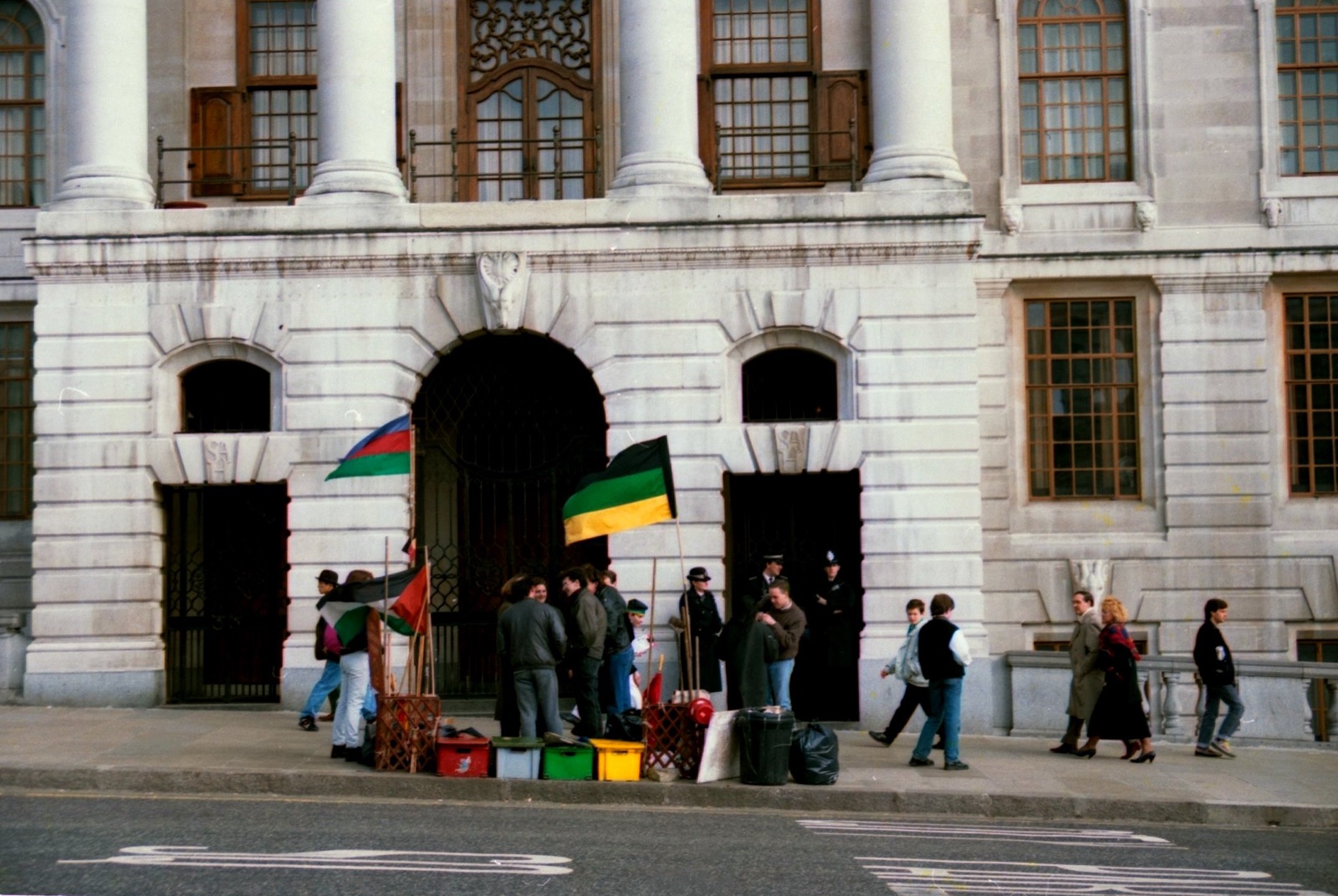
An anti-apartheid vigil outside South Africa House in London, 1989, the flags of the African National Congress flying against the building. By the 1980s the apartheid government saw itself as under a 'total onslaught' — and behind the public confrontation, it had built a covert programme to poison the opponents it could not defeat in the open. Wikimedia Commons / rahuldlucca, CC BY 2.0.
Project Coast and the Apartheid State's Secret Chemistry of Death
South Africa, 1981–1995 — a cardiologist nicknamed 'Dr Death' ran the apartheid regime's covert chemical and biological weapons programme: assassination poisons, vats of Ecstasy, and a research project to quietly sterilise Black South Africans. Then he was acquitted of everything
- Category
- State & Intelligence Operations
- Published
- Length
- 4,490 words · 20 min read
- Author
- The editors
The apartheid state spent its final years convinced that it was fighting for survival against a coordinated communist plot — a "total onslaught," in the regime's phrase, that justified total response. It had a secret nuclear programme, a network of assassination units, and, from 1981, a covert chemical and biological weapons project run through the South African Defence Force. That project was Project Coast, and what is known about it comes not from a battlefield but from a courtroom and a truth commission — from the documents Wouter Basson could not destroy in time and the witnesses who eventually testified against him.
This is the story of how a democracy's predecessor weaponised its doctors and chemists, and of why almost no one was ever punished for it.
The total onslaught
To understand why a government would build laboratories to poison its own citizens, you have to understand the siege mentality of late apartheid. By the early 1980s the white-minority regime in Pretoria was fighting on several fronts at once: a long bush war in South West Africa (now Namibia) against the SWAPO independence movement and its Cuban-backed Angolan allies; an escalating armed campaign by the African National Congress; and, at home, waves of township uprisings that the state met with states of emergency, mass detention, and death squads. The governing ideology held that all of this was orchestrated from Moscow — a "total onslaught" against Christian, capitalist South Africa — and that it demanded a "total strategy" in response, one that recognised no clear line between soldier and civilian, or between defence and murder.
It was in this climate that the surgeon general's office of the SADF, with the approval of the military and political leadership, authorised a secret programme to give South Africa a chemical and biological warfare capability — partly, officials claimed, as a defence against the chemical weapons their enemies might use, and partly, the evidence suggests, as a toolkit for assassination and control. The man chosen to run it was already a rising star of military medicine: Wouter Basson, the personal cardiologist to the prime minister, P.W. Botha.
There was a dark irony in this. South Africa had signed the 1972 Biological Weapons Convention, which banned exactly the kind of programme it was now secretly building, and it would later be among the states bound by the Chemical Weapons Convention. Project Coast was, from its inception, a treaty violation hidden inside a government that presented itself to the West as a bulwark of order against communism. Its existence was known to only a tiny circle — a handful of generals, the surgeon general's office, and the political leadership — and its budget was concealed within the larger secret expenditures of a militarised state. That secrecy was not incidental. It was the programme's whole architecture, and it would prove as durable as anything the laboratories produced.
Dr Death and his companies
Basson was, by all accounts, exceptionally able — charismatic, energetic, and trusted at the highest levels. Given effectively a free hand and a generous secret budget, he travelled the world in the early 1980s studying foreign chemical and biological programmes, and then built South Africa's own from the ground up. To keep it hidden, Project Coast operated through a cluster of ostensibly private front companies that did the actual research and production. The two most important were Roodeplaat Research Laboratories (RRL), which handled the biological side, and Delta G Scientific, which handled the chemical side; others, such as Protechnik and Medchem, rounded out the network. On paper they were commercial ventures. In reality they were arms of the state, funded through a covert financial maze that Basson controlled and that later made it nearly impossible to trace where the money — and there was a great deal of it — had gone.
Basson himself became the programme's indispensable man and its single point of failure. In the early 1980s he made a series of study tours abroad — to Europe, the United States, and elsewhere — gathering knowledge of how other states ran their chemical and biological efforts, and he returned to assemble a domestic capability with remarkable speed. Colleagues described him as the kind of figure around whom a secret enterprise naturally organises: clever enough to direct the science, charming enough to keep his political masters reassured, and careful enough to ensure that the records, the money, and the chain of command all ran through him. It was a structure that gave the state perfect deniability while it lasted — and that, when it collapsed, left prosecutors chasing a programme whose every thread led back to one man and then stopped.
What came out of these laboratories, as later documented by the Truth and Reconciliation Commission and in Basson's own trial, was a catalogue of horrors disguised as ordinary objects. RRL cultured deadly pathogens — anthrax, cholera, botulinum toxin, Salmonella, and others. Delta G synthesised toxic chemicals and the raw materials for incapacitating agents. And the programme's "applied" work — the part designed for use against actual human targets — turned these into delivery systems built for deniability.
The poisons and their targets
The most concrete proof that Project Coast was an assassination programme, and not merely a defensive research effort, lies in the attacks on named individuals. The best-documented is the case of the Reverend Frank Chikane, a prominent anti-apartheid cleric and general secretary of the South African Council of Churches. In 1989, Chikane fell gravely ill on a trip abroad, collapsing repeatedly and nearly dying; doctors in the United States eventually identified the cause as poisoning by an organophosphate — the same class of chemical used in nerve agents and pesticides. The poison had been applied to his clothing, so that it was absorbed through his skin as he travelled. Years later, operatives of the programme admitted before the TRC that Chikane's luggage had been deliberately contaminated. He survived only because he happened to be near sophisticated medical care.
Chikane survived. According to testimony, many others did not. The most chilling allegations concern the border war in Namibia, where witnesses told the TRC that SWAPO prisoners — by some accounts around two hundred — were sedated with muscle relaxants by Basson and then loaded onto aircraft and dropped, unconscious, into the sea, so that they would simply disappear. The parallel to the "death flights" of [[argentina-dirty-war]] in Argentina is exact, and it is one of the gravest charges ever levelled at the programme, though — like much else — it was never proven against Basson in court.
The Chikane case and the Namibia allegations sit at opposite ends of the programme's range — one a meticulous, individually targeted poisoning that the victim happened to survive, the other a mass killing meant to leave no bodies at all. Between them lay a continuum of smaller operations: the doctoring of a target's food or drink, the contaminated everyday object left where it would be picked up, the lethal injection administered to a prisoner who would afterward be recorded as having died of natural causes. What unites them is a single design principle, repeated at every scale — that the death should never be traceable to the state that caused it. It was murder engineered to look like misfortune, carried out by men with medical and scientific training who had sworn, in their professions, to do the opposite.
The vats of Ecstasy
One of the strangest threads of the Project Coast story is the drugs. Under the banner of developing "non-lethal" incapacitating agents for crowd control, Delta G Scientific manufactured enormous quantities — by the kilogram and then the ton — of methaqualone (the sedative sold illegally as Mandrax, hugely popular in South Africa) and of MDMA, the drug known as Ecstasy. Basson's explanation was that the military wanted a chemical that could subdue rioting crowds without killing them, and that these substances were being researched and stockpiled for that purpose.
The quantities, however, were wildly out of proportion to any plausible testing programme — enough, prosecutors later argued, to flood the illegal market — and no usable crowd-control weapon ever emerged from the work. To many observers the drug operation looked less like weapons research than like a state-protected narcotics enterprise, generating cash that vanished into the same untraceable financial network that funded everything else. What is certain is that a government laboratory, on the public purse, was producing street drugs by the ton. What the drugs were really for remains one of the programme's unresolved questions.
The fertility project
Of everything attributed to Project Coast, the allegation that has drawn the most horror is also the one that must be stated most precisely, because precision is the only honest way to handle it. According to documents and testimony, one strand of the programme's research was directed at fertility — specifically, at the possibility of developing an "anti-fertility" vaccine that could be administered to Black South Africans, covertly and without their consent, in order to reduce the Black birth rate. Scientists associated with RRL travelled to study reproductive immunology, and the goal, as recorded in the evidence, was a substance that could be selectively applied to one population.
It is essential to be exact about what this was and was not. The intent — to use medicine as a tool of racial population control — is documented in the programme's own record and in TRC testimony. But the weapon was never achieved. There is no evidence that a working race-selective sterilant was ever produced, let alone deployed; the underlying science of a genuinely "race-specific" biological agent was, and is, not feasible. So the fertility project belongs to the category of monstrous ambition rather than accomplished atrocity. That distinction matters — but it does not soften the fact that a modern state set its scientists the task of quietly sterilising people on the basis of their race, and wrote it down.
The idea did not come from nowhere. The apartheid state was obsessed with demography — with the arithmetic by which a white minority could continue to rule a Black majority — and it pursued that obsession through forced removals, racial classification, and the denial of citizenship. A covert sterilant aimed at Black South Africans was, in that light, not an aberration but an extension of the regime's central logic into the laboratory: the same demographic anxiety that drove apartheid's laws, now handed to its chemists. That the science defeated them is a fact of biology, not a sign of restraint.
The unravelling
A programme designed to leave no trace very nearly succeeded in disappearing. As apartheid wound down between 1990 and 1994, Project Coast was formally scaled back, and there were efforts to destroy or privatise its assets and to shred its records. But Basson, by accounts, kept his own archive — steel trunks of documents — apparently as insurance. And in the new South Africa, the protections he had once enjoyed were gone.
The thread that finally pulled the programme into the light was an ordinary criminal one. In January 1997, Basson was arrested in a police sting while allegedly selling Ecstasy tablets. The arrest led investigators to the trunks of documents, and what they contained — records of the front companies, the projects, the money — turned a drug bust into the exposure of an entire covert weapons programme. At almost the same moment, South Africa's Truth and Reconciliation Commission, chaired by Archbishop Desmond Tutu, was beginning to hear evidence about the apartheid state's dirtiest secrets.
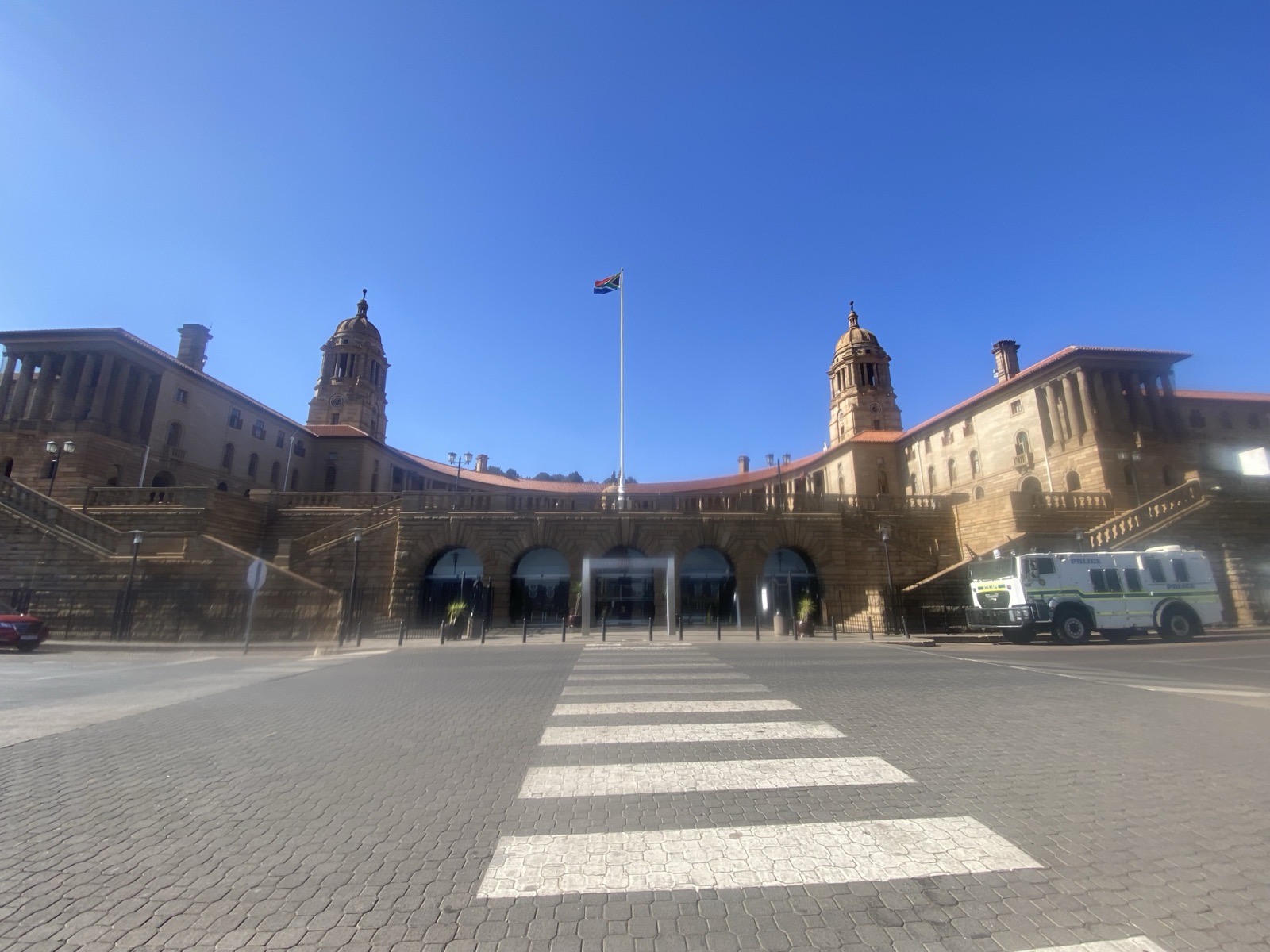
In 1998 the TRC held special hearings on chemical and biological warfare, and for the first time the outlines of Project Coast were laid out in public: the front companies, the poisons, the "applicators," the drugs, and the fertility research. Former operatives described what they had made and, in some cases, what they had done with it. The picture that emerged was of a programme that had crossed every line between defence and murder — and of a state that had funded it knowingly and then tried to bury it.
There was also an international dimension that is often forgotten. As apartheid was ending, the governments of the United States and the United Kingdom grew alarmed about Project Coast — not out of sympathy for its victims so much as fear of where its expertise and its stockpiles might end up. In the early 1990s, Western officials pressed Pretoria to shut the programme down and to ensure that its scientists, its agents, and its know-how did not proliferate to other states or onto the open market in the chaos of transition. The concern was concrete: a programme built to be deniable was, by the same token, a programme that could disperse without a trace. Whether everything Project Coast created was truly accounted for when it was wound down is a question that has never been answered with confidence.
The trial and the acquittal
If the exposure of Project Coast looked like the beginning of a reckoning, the trial of Wouter Basson became the opposite. Basson declined amnesty from the TRC — which would have required a full confession — and instead chose to face prosecution. His trial began in 1999 in the Pretoria High Court before Judge Willie Hartzenberg, on an indictment that originally ran to 67 charges, including murder, conspiracy to murder, fraud, and drug offences.
It went badly for the state from the start. Early in the proceedings, the judge quashed six charges relating to crimes allegedly committed outside South Africa — including the deaths of the SWAPO prisoners in Namibia — on jurisdictional grounds, removing some of the gravest allegations from the case. As the trial wore on across nearly three years, the prosecution accused Hartzenberg of open bias toward the defence and asked him to recuse himself; he refused. In April 2002, Basson was acquitted on all remaining charges. "Dr Death" walked out of court a free man, having been found legally guilty of nothing at all.
The acquittal left South Africa in an unusual position. The existence and broad nature of Project Coast were not seriously in doubt — they were documented by the TRC, supported by the recovered records, and described by participants. And yet the one man who had run it had been cleared in a court of law, and the politicians and generals who authorised it were never charged at all. The programme had been built so carefully for deniability that even after it was exposed, it remained, in the strict legal sense, almost unattributable.
What is established, and what is not
As with every entry in this archive, it is worth separating what the record establishes from what remains uncertain or contested.
What is established: that apartheid South Africa ran a covert chemical and biological weapons programme called Project Coast from 1981; that it operated through front companies, chiefly Roodeplaat Research Laboratories and Delta G Scientific; that it cultured dangerous pathogens, manufactured assassination poisons and an inventory of "applicators," and produced very large quantities of Ecstasy and Mandrax; that it pursued research aimed at an anti-fertility agent to be used covertly against Black South Africans; and that real people, including Frank Chikane, were poisoned. These facts rest on the TRC's findings, recovered documents, the trial record, and the work of researchers such as Chandré Gould and Peter Folb.
What is contested or unproven: the full death toll and the specific fate of individual victims, much of which rests on testimony rather than surviving documents; the truth about where the programme's money went; and Basson's personal criminal responsibility, on which a court acquitted him. The fertility "weapon," it bears repeating, was an aim and not an achievement — there is no evidence it was ever made to work. And the question of who, above Basson, ordered and knew — the generals and ministers of the apartheid state — was never answered in any courtroom.
In the end, Project Coast stands as a particular kind of warning — not about a secret that was kept, but about one that was told. The apartheid state's chemists really did try to industrialise murder and to weaponise reproduction; their own country dragged the proof into the light; and still the man at the centre walked free, and the men above him were never named in a dock. The record is open. The account was never settled.
Sources
- Truth and Reconciliation Commission of South Africa, Final Report (1998), and the special hearings on chemical and biological warfare — primary.
- State v Wouter Basson, Pretoria High Court trial record (1999–2002) — primary.
- Constitutional Court of South Africa, S v Basson judgment (2005) — primary.
- Health Professions Council of South Africa, finding of unprofessional conduct against Wouter Basson (2013) — primary.
- Chandré Gould and Peter Folb, Project Coast: Apartheid's Chemical and Biological Warfare Programme (UNIDIR, 2002) — academic.
- Marlene Burger and Chandré Gould, Secrets and Lies: Wouter Basson and South Africa's Chemical and Biological Warfare Programme (Zebra Press, 2002) — secondary.
- Tom Mangold and Jeff Goldberg, Plague Wars: The Terrifying Reality of Biological Warfare (1999) — secondary.
- Testimony of Project Coast operatives and of victims to the TRC, including evidence relating to the poisoning of Frank Chikane — primary.
- Stephen Burger and Chandré Gould, scholarship on the programme's fertility research — academic.
- The New York Times, The Guardian, and BBC reporting on the Basson trial and verdict (1999–2005) — secondary.
- Helen Purkitt and Stephen Burgess, South Africa's Weapons of Mass Destruction (Indiana University Press, 2005) — academic.
Inspired this / based on it
BBC / PBS Frontline
Television investigation into state biological-weapons programmes, including Project Coast, that preceded the book of the same name.
Marlene Burger and Chandré Gould
Zebra Press. The definitive narrative account, drawn from the trial and the TRC.
Tom Mangold and Jeff Goldberg
St. Martin's Press. Places Project Coast alongside the Soviet and other state CBW programmes.
Chandré Gould and Peter Folb
UNIDIR. The scholarly reference study of the programme.
Filed under
- #project-coast
- #apartheid
- #south-africa
- #chemical-weapons
- #biological-weapons
- #wouter-basson
- #truth-and-reconciliation
- #assassination
- #cold-war
- #1980s
- #confirmed
Click any tag for every article carrying it.
Continue reading
Unit 731
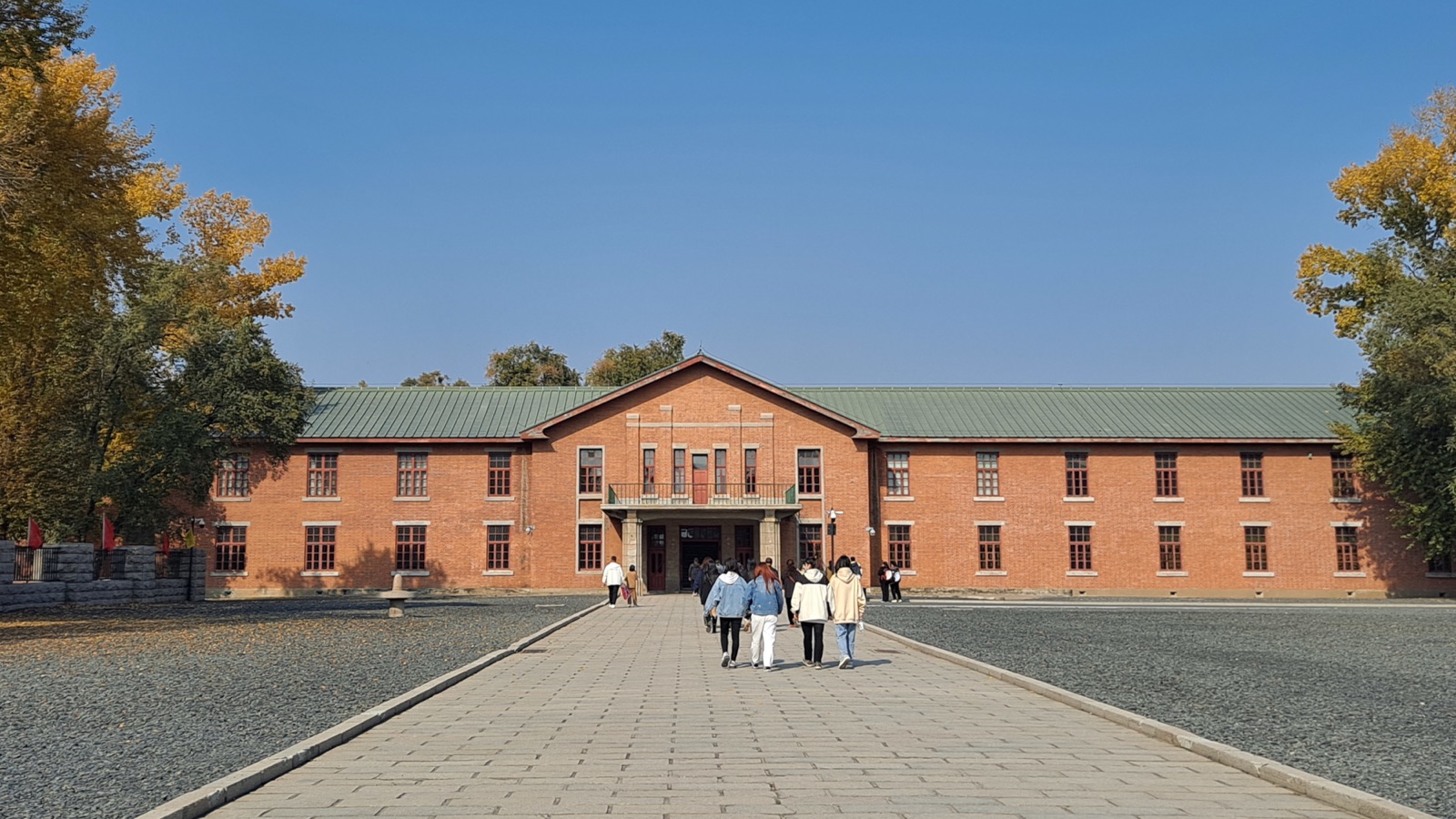
Between 1936 and 1945, the Imperial Japanese Army operated a 6-square-kilometer biological-warfare research compound at Pingfang, 24 kilometers south of the city of Harbin in Japanese-occupied Manchuria. The compound's bureaucratic designation was the *Epidemic Prevention and Water Purification Department of the Kwantung Army* — Unit 731 (七三一部隊, *Nana-san-ichi Butai*) was the unit number. Under its founding director, Surgeon General Shirō Ishii (1892-1959), Unit 731 conducted a sustained program of lethal medical experimentation on prisoners — primarily Chinese, but including Korean, Russian, and Allied POW subjects. The experiments included vivisection without anesthesia, deliberate frostbite induction and amputation, deliberate infection with plague, anthrax, cholera, typhus, and other pathogens, weapons-testing experiments using captured prisoners as targets, and field-testing of biological weapons on Chinese civilians in cities including Ningbo (1940) and Changde (1941). The total number of victims is contested; the most-cited estimates range from 3,000 to 12,000 direct experimental subjects plus a much larger number of Chinese civilians killed in field-deployment operations (estimates range from 200,000 to 580,000 across Chinese cities). When Soviet forces declared war on Japan in August 1945, Unit 731 personnel destroyed the Pingfang compound, killed the remaining ~400 prisoners, and escaped to Japan. Twelve Unit 731 staff were prosecuted at the 1949 Soviet Khabarovsk War Crime Trial; none were prosecuted at the 1946-1948 Allied International Military Tribunal for the Far East (the Tokyo Trials). General Ishii and his senior officers received explicit immunity from prosecution from U.S. occupation authorities under General Douglas MacArthur, in exchange for the surrender of Unit 731's research records and Ishii's personal cooperation. The U.S. Army declassification of approximately 100,000 pages of Unit 731-related material between 1999 and 2007 established the operational details of the immunity arrangement. The Japanese government did not formally acknowledge Unit 731 until 2002; it has not formally apologized.
MK-Ultra
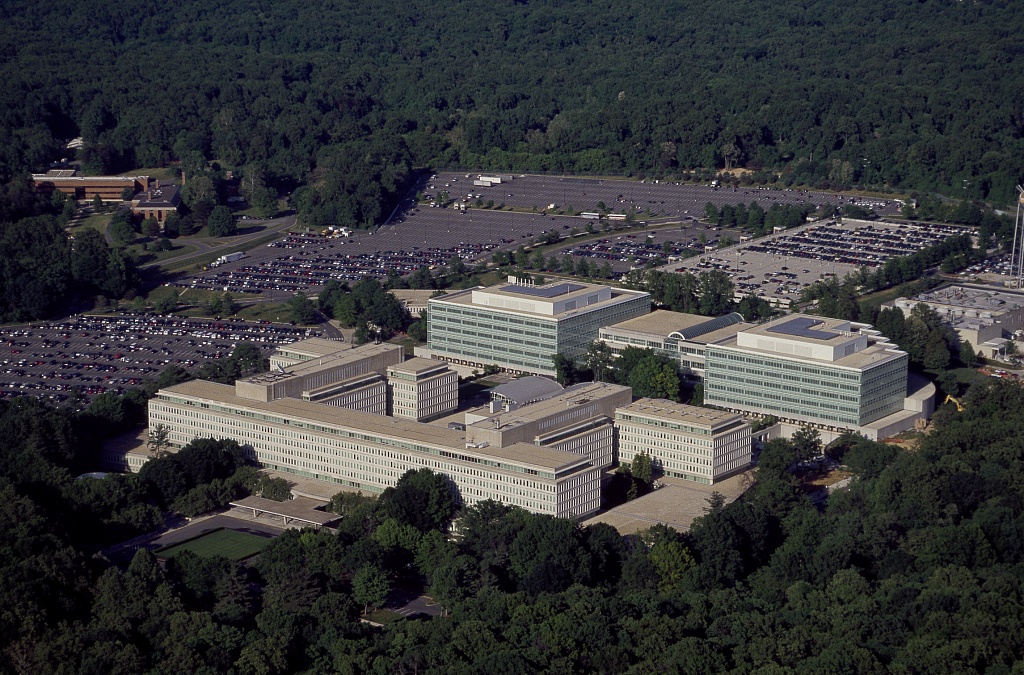
Between 1953 and 1973, the Central Intelligence Agency ran one of the most ambitious — and least restrained — human-experimentation programs in American history. The goal was mind control. The subjects rarely knew they were subjects. By the time the public found out, most of the records had been burned.
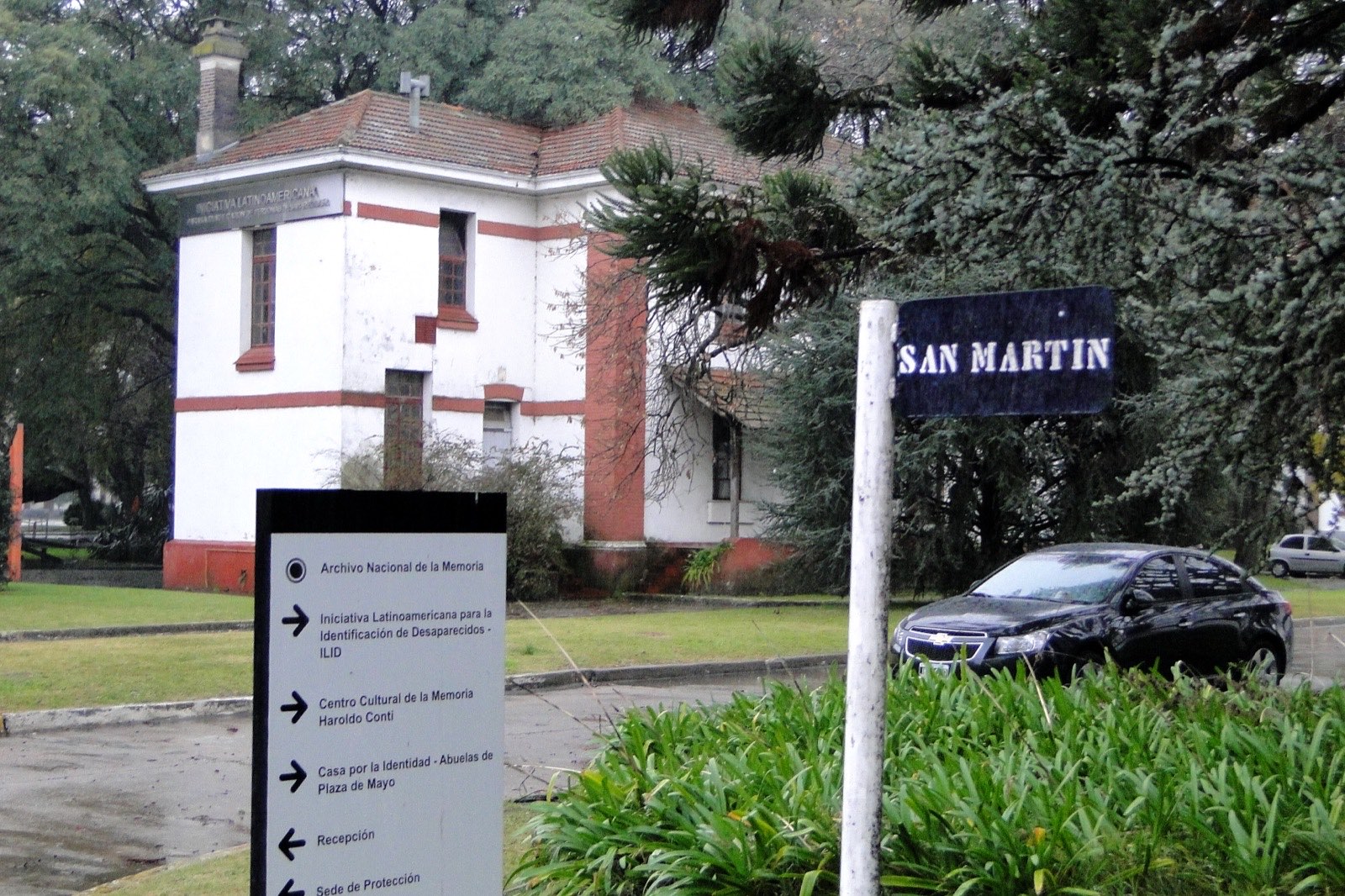
Argentina's Dirty War
On March 24, 1976, a military junta led by General Jorge Rafael Videla seized power from President María Estela 'Isabel' Martínez de Perón in a coup that the United States had been quietly informed about in advance. Over the next seven years, the junta operated approximately 340 clandestine detention centers across Argentina. An estimated 30,000 people — students, journalists, trade unionists, priests, psychoanalysts, and the children of perceived opponents — were 'disappeared.' The single largest detention site, the Escuela de Mecánica de la Armada (ESMA), processed roughly 5,000 detainees, of whom approximately 90% were murdered. Some were drugged and dropped from naval aircraft into the Río de la Plata. Approximately 500 babies were taken from pregnant detainees and given to military families. The Madres de Plaza de Mayo — mothers and grandmothers in white headscarves — began circling the square in front of the presidential palace every Thursday from April 1977 demanding their children's return. The regime ended in December 1983 after the Falklands defeat. The Trial of the Juntas in 1985 convicted five top commanders, including Videla.