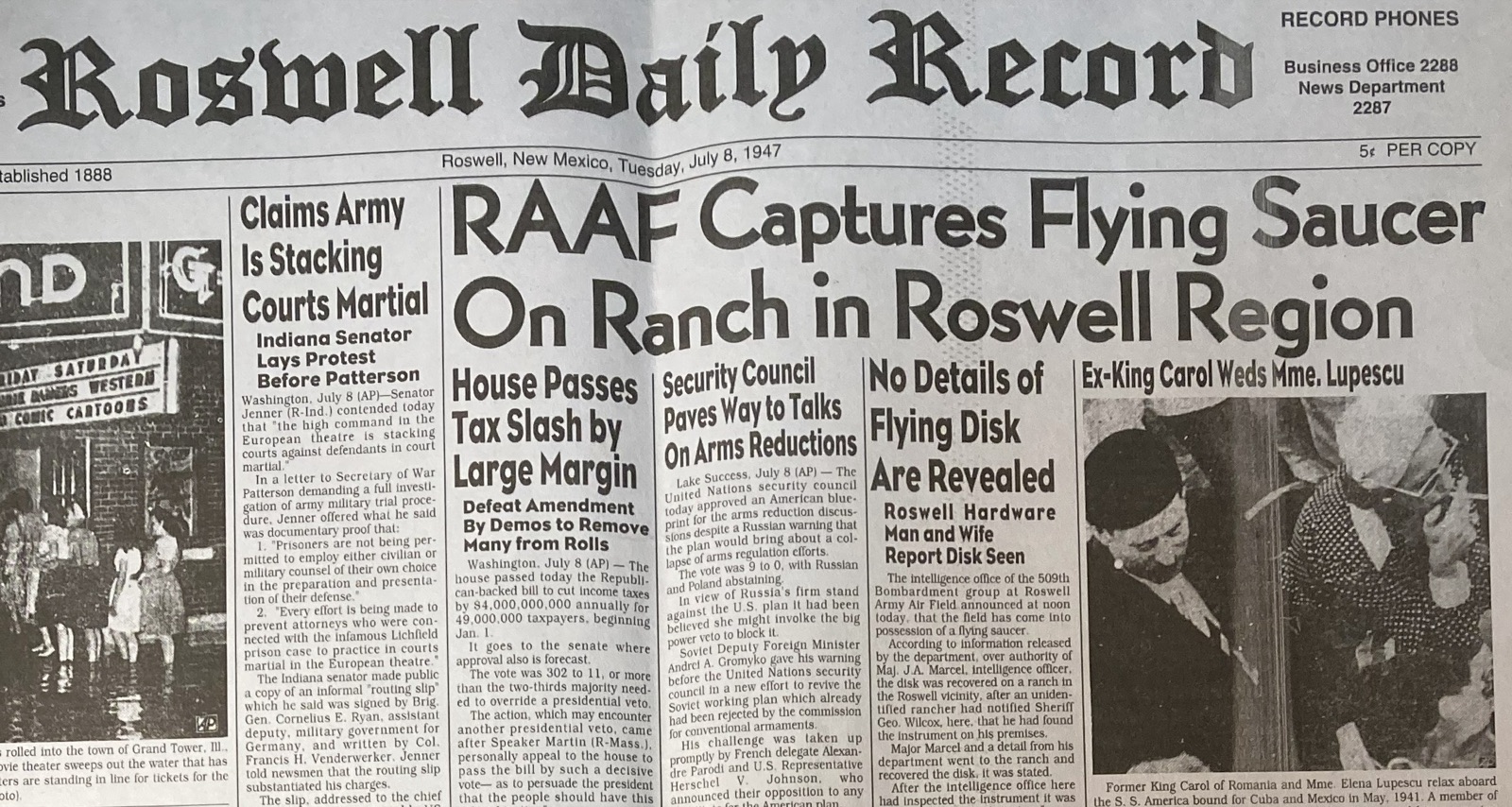
The front page of the *Roswell Daily Record*, July 8, 1947. The lead story carries the U.S. Army Air Force's own public information release. Four hours later the Army would publicly retract it. The page is now in the public domain and is one of the foundational documents in the case. Wikimedia Commons, public domain.
Roswell 1947 & Area 51
What was on the ranch, what was at Groom Lake, what neither one was
- Category
- Space & UFOlogy
- Published
- Length
- 3,650 words · 17 min read
- Author
- The editors
Roswell 1947 & Area 51
What was on the ranch, what was at Groom Lake, what neither one was.
The press release
On the morning of July 8, 1947, Lieutenant Walter Haut, the public information officer at the Roswell Army Air Field, issued a press release on the RAAF's letterhead. The release read, in its entirety:
"The many rumors regarding the flying disc became a reality yesterday when the intelligence office of the 509th Bomb Group of the Eighth Air Force, Roswell Army Air Field, was fortunate enough to gain possession of a disc through the cooperation of one of the local ranchers and the sheriff's office of Chaves County. The flying object landed on a ranch near Roswell sometime last week."
The 509th Bomb Group, at the time, was the only nuclear-weapons- delivery unit in the United States Army Air Force. It had dropped the atomic bombs on Hiroshima and Nagasaki two years earlier. Its press releases were not casual.
The release was telephoned to the Associated Press and the United Press in Albuquerque. By noon, it was on national wires. The Roswell Daily Record, the local afternoon paper, carried it on the front page under the headline "RAAF Captures Flying Saucer On Ranch in Roswell Region." Other afternoon papers across the United States carried the AP version.
Four hours later, the Eighth Air Force headquarters at Fort Worth Army Air Field, Texas, held a counter-press conference. Brigadier General Roger Ramey, the Eighth Air Force commander, presented what he identified as the recovered material — a small pile of foil, rubber, paper-backed reflective material, and balsa wood sticks laid out on the floor of his office. He told the assembled reporters that the material was the remains of a Rawin radar-target weather balloon. Press photographs of Ramey with the debris were distributed.
The story was over by the morning of July 9. The follow-up coverage characterized the original release as an embarrassed misidentification by RAAF personnel.
For the next thirty-one years, the case effectively did not exist.
What was on the ranch
The ranch in question was the J.B. Foster Ranch in Lincoln County, New Mexico — approximately 75 miles northwest of Roswell, near the town of Corona. The foreman was William "Mac" Brazel (his full name was William Ware Brazel, born 1899, called Mac all his life). He had been working the ranch for the Foster family since 1941.
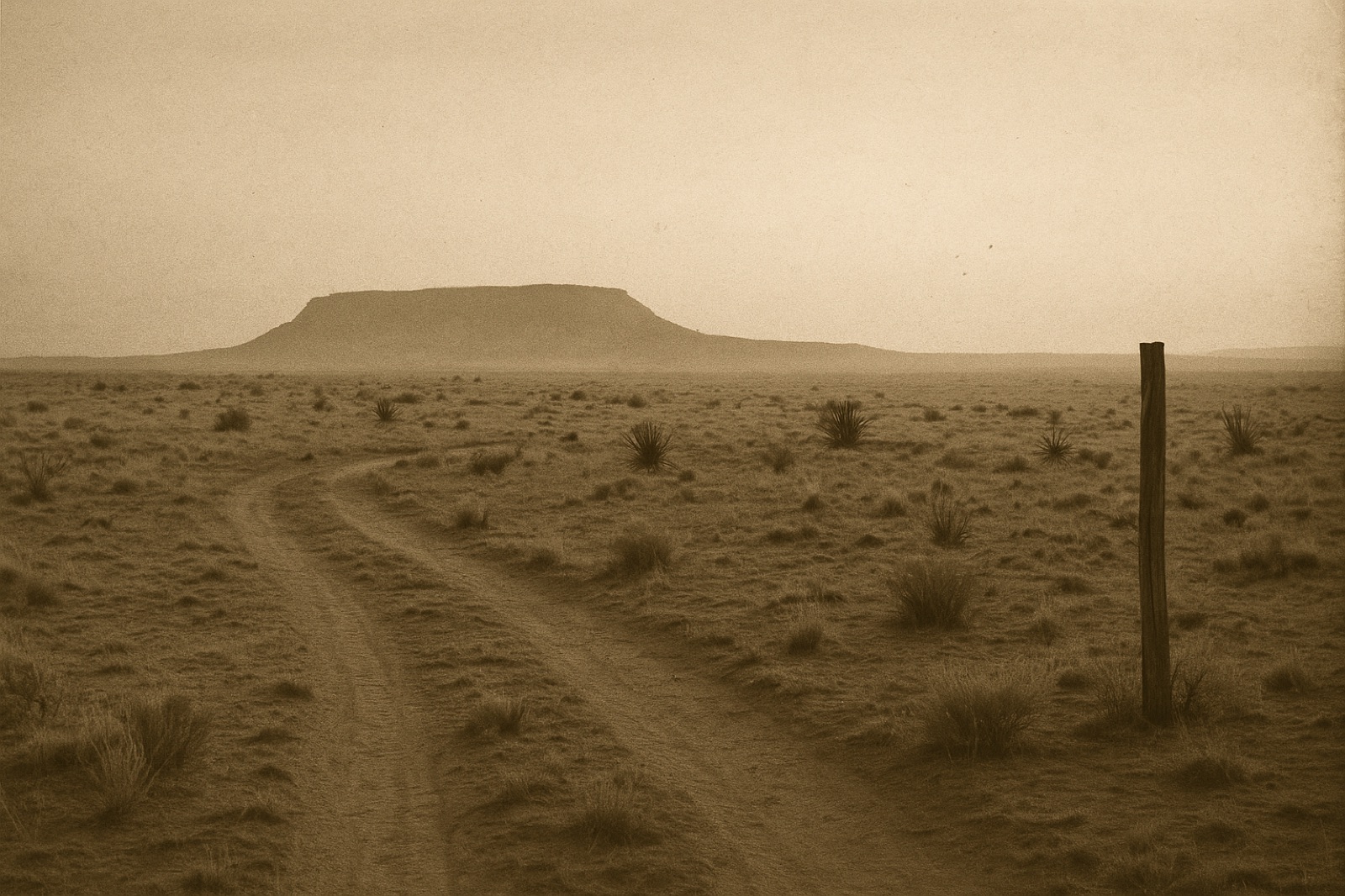
By Brazel's own subsequent account — given to the Roswell Daily Record on July 9, 1947, the day after the brief press storm — he had been riding the ranch on either July 4 or 5 with his seven-year-old neighbor Dee Proctor when he found the debris field. The field was approximately 200 yards long and several feet wide, scattered across pastureland. The material included aluminum-foil- like sheets, balsa-wood-like sticks (some of which had what Brazel described as "figures" or "designs" on them), rubber-like strips, and reflective paper-backed material.
Brazel left the material on the ranch for several days. On July 6 or 7, he traveled to Roswell on a routine ranch errand and mentioned the debris to George Wilcox, the Chaves County sheriff. Wilcox called the RAAF. Major Jesse Marcel (intelligence officer) and Captain Sheridan Cavitt (counter-intelligence) drove out to the ranch with Brazel on July 7. They camped on the ranch that night and collected the debris on July 8.
Marcel's subsequent description of the debris — in his 1978 and 1979 interviews with Stanton Friedman — became one of the foundational documents of the case. He described, in summary, a material that was foil-like but could not be torn, dented, or permanently deformed; balsa-wood-like sticks that were almost weightless but had unusual tensile strength; and small parchment- like fragments with what looked like geometric or possibly hieroglyphic markings.
What Marcel had recovered, according to the 1994 Air Force report, was the upper acoustic-array section of one of NYU Project Mogul's balloon trains.
Project Mogul
Project Mogul was a classified program of the United States Army Air Force, conducted by NYU's College of Engineering under contract to the Army's Geophysical Research Directorate. The operational name within NYU was Project ARTHUR. It ran from April 1947 to early 1949. Its goal was to detect Soviet nuclear weapons tests by acoustic monitoring at the tropopause — the atmospheric layer at approximately 18-20 km altitude where sound waves from distant atmospheric explosions are channeled by temperature inversions, allowing long-range propagation.
The program's instrumentation consisted of balloon-launched microphone arrays, each suspended on a multi-balloon train that could ascend to and station at the target altitude for days at a time. The trains were launched from Alamogordo Army Air Field, New Mexico — approximately 130 km west-southwest of the Foster Ranch. Most flights were tracked by radar (the rawin reflectors served both as tracking targets and as instrument deployment platforms).
Flight #4, by the 1994 Air Force report's analysis, was launched on June 4, 1947 — one month before the Foster Ranch discovery. The flight's radar track was lost over Arabela, New Mexico — within approximately 30 km of the Foster Ranch. Subsequent recovery of the flight equipment was not documented in NYU records, consistent with the equipment having fallen to the ground unrecovered. The 1994 report's analysis concluded that the most likely source of the Foster Ranch debris was Flight #4.
The 1994 report addresses, in 25 pages of detail, the specific materials of the Mogul flights — neoprene balloons, rawin radar reflectors with metallized paper backing, balsa wood structural elements, microphone components — against the descriptions provided by Marcel and others. The match is, by the report's analysis, specific and detailed.
The reason the 1947 press could not investigate this resolution was that Mogul was classified TOP SECRET. The Roswell weather-balloon cover story was protective of the classified program; the actual program could not be discussed by Ramey, by the RAAF, or by anyone involved.
The 1978 re-emergence
Stanton Friedman was a 44-year-old physicist who had been working in the U.S. nuclear-engineering industry since 1956 — for General Electric, Aerojet, and Westinghouse on various reactor programs. He had become interested in UFO research in 1958 and, by 1978, was giving paid lectures on UFOs and the supposed government cover-up to college audiences.
In February 1978, Friedman gave a lecture at Louisiana State University. A Baton Rouge TV producer named Marcel Watercutter came up after the lecture and mentioned that his next-door neighbor in Houma, Louisiana — a retired Army major named Jesse Marcel — had once told him that he had handled wreckage from a flying saucer in New Mexico in 1947.
Friedman tracked Marcel down. He interviewed him by phone in February 1978. He visited him in Louisiana in late 1978 and recorded a longer interview. He shared the material with Charles Berlitz and William Moore.
Berlitz and Moore's The Roswell Incident, published in 1980 by Grosset & Dunlap, was the first widely-circulated book-length treatment of the case. It established the basic narrative — Marcel's debris recovery, the press release, Ramey's cover story, and the implication that the actual recovered material had been extraterrestrial.
From 1980 forward, additional witnesses came forward — some contacted by Friedman, some by Moore, some by subsequent researchers including Kevin Randle and Donald Schmitt. The witness roster eventually included claims of:
- Multiple debris-field examinations after Marcel's original recovery.
- Recovery of "alien bodies" at separate, secondary crash sites.
- Roswell hospital morgue receipt of non-human bodies (Glenn Dennis claim, 1989).
- Witnessed transport of recovered material through Roswell streets (multiple secondary witnesses, 1980s-90s).
By the early 1990s, the Roswell case had become a substantial American conspiracy narrative — independent of any specific documentary evidence beyond Marcel's 1978 recollections of events 30 years prior.
The 1994 and 1997 reports
In 1993, U.S. Representative Steven Schiff (R-New Mexico) requested that the U.S. General Accounting Office (GAO) investigate what the U.S. Air Force knew about the 1947 events. The GAO request prompted the Air Force to conduct its own internal review.
The Roswell Report: Fact vs. Fiction in the New Mexico Desert was published in September 1994. It was 992 pages including appendices. Its central conclusion: the 1947 debris was from a Project Mogul balloon train, most probably Flight #4 of June 4, 1947.
The Roswell Report: Case Closed, published in June 1997, was 231 pages. It addressed the subsequent "alien body" witness accounts. Its central conclusion: the body accounts were most likely transposed memories of anthropomorphic test dummies dropped from high altitude in Operation High Dive (1953-1959) — a parachute research program in which life-sized humanoid dummies were released from balloons over New Mexico to study the limits of high-altitude bailout. Some of the High Dive drops occurred within 30-50 km of Roswell. The dummies were transported through Roswell on the way to and from the test ranges.
The 1997 report acknowledges, plainly, that the High Dive timing does not match the 1947 events the witnesses described. The report's argument is that the witnesses had transposed time — remembering events from the mid-1950s as having occurred in 1947. Whether this is plausible psychologically, and whether the report addresses the witness testimony adequately, has been disputed by UFO researchers ever since.
Area 51
The Roswell case has been linked, in conspiracy narratives since the 1980s, to the secret testing facility in southern Nevada known informally as Area 51 — a designation derived from a 1950s grid map of the Atomic Energy Commission's Nevada Test Site.
The facility, located on the dry lakebed at Groom Lake, was established in 1955 to test the Lockheed U-2 spy plane. It has been used since then for the testing of, in publicly acknowledged form: the A-12/SR-71 series, the F-117 stealth fighter, various unmanned aerial vehicles, and the F-22 and F-35 programs.
The U.S. government did not formally acknowledge the facility's existence by name until August 2013. On that date, the CIA released — under a Freedom of Information Act request from George Washington University's National Security Archive — a redacted version of The Central Intelligence Agency and Overhead Reconnaissance: The U-2 and OXCART Programs, 1954-1974, a 1992 internal CIA history that referenced the facility by name. The release was processed as part of the routine declassification of material more than 25 years old.
The Area 51 connection to Roswell, in the conspiracy narrative, posits that recovered material from the 1947 ranch — possibly including alien bodies — was eventually transported to Groom Lake for reverse engineering. The connection has no documentary support; it is, in conspiracy-theory terms, an inferred linkage between two separately classified programs.
What Area 51 actually was, in 1955-1974, was a U-2 / A-12 spy plane testing facility — extensively documented in the 2013 release — and what it has been since is a successor facility for similar testing programs. None of the documentary evidence connects it to the 1947 ranch debris.
The cast
Why this case is filed as "mystery"
Like the Moon-landing-hoax theory, Roswell is filed as "mystery" not because the factual question is genuinely open — the documentary case for Project Mogul is comprehensive — but because the popular question persists. Polling has consistently shown a substantial fraction of Americans (varying by phrasing between 12% and 40%) believe that the U.S. government has knowledge of extraterrestrial visitation and that Roswell 1947 was part of it.
The persistence of the Roswell narrative is, like the Moon hoax, a social phenomenon worth understanding on its own terms — separate from the factual question, which is settled.
What we still don't know
The specific identity of the Mogul flight. The 1994 report identifies Flight #4 as the most probable source but the launch log for Flight #4 is incomplete. Subsequent NYU records research has variously supported and complicated the identification.
The 200+ subsequent witness accounts. A complete forensic analysis of which subsequent accounts are independent of Friedman's original 1978 work, and which are not, has not been completed in the academic literature. Skeptics and proponents agree on the disagreement here.
The remaining classified material. Some Mogul and Mogul-adjacent flight records remain classified. Whether further declassification would add detail to the Flight #4 reconstruction is uncertain.
The Glenn Dennis account. The mortician's 1989 account of morgue inquiries has been the subject of multiple investigations. The discrepancies in his recollections have been documented; the question of whether the underlying event occurred at all remains contested.
Sources
Primary documents:
- The Roswell Report: Fact vs. Fiction in the New Mexico Desert. U.S. Air Force, September 1994. 992 pages.
- The Roswell Report: Case Closed. U.S. Air Force, June 1997. 231 pages.
- The Central Intelligence Agency and Overhead Reconnaissance: The U-2 and OXCART Programs, 1954-1974. CIA, 1992; declassified August 2013.
- Roswell Daily Record, July 8 and July 9, 1947 issues. Reproduced in multiple archives.
- RAAF press release of July 8, 1947 (drafted by Lt. Walter Haut). Reproduced in The Roswell Report (1994).
- Stanton Friedman, audio recordings of Jesse Marcel interviews, 1978-1979. Held at the Roswell Public Library archive.
Secondary investigative reporting: 7. Charles Berlitz and William Moore, The Roswell Incident (Grosset & Dunlap, 1980). 8. Stanton Friedman and Don Berliner, Crash at Corona: The U.S. Military Retrieval and Cover-up of a UFO (Marlowe, 1992; revised 1997). 9. Kevin Randle and Donald Schmitt, UFO Crash at Roswell (Avon, 1991). 10. Karl Pflock, Roswell: Inconvenient Facts and the Will to Believe (Prometheus Books, 2001). Skeptical treatment by a former believer. 11. Annie Jacobsen, Area 51: An Uncensored History of America's Top Secret Military Base (Little, Brown, 2011). 12. Tim Weiner, Legacy of Ashes: The History of the CIA (Doubleday, 2007). U-2 and A-12 program context. 13. Carey & Schmitt, Witness to Roswell (New Page, 2007). 14. Robert Powell et al., Investigation: 1947 Roswell (Independent investigation 2017). 15. Joe Nickell, Real-Life X-Files (University Press of Kentucky, 2001). Skeptical investigation of multiple Roswell witness accounts. 16. The New York Times, Roswell archive coverage 1947-2024.
Academic / scholarly: 17. Benson Saler, Charles Ziegler, & Charles Moore, UFO Crash at Roswell: The Genesis of a Modern Myth (Smithsonian Institution Press, 1997). The standard anthropological/sociological treatment. 18. Bridget Brown, They Know Us Better Than We Know Ourselves: The History and Politics of Alien Abduction (NYU Press, 2007).
Corrections & updates
2026-05-26: First publication.
Inspired this / based on it
Chris Carter (Fox) · ★ 8.6
Nine-season series that reframed UFO conspiracy theory for the 1990s; multiple Roswell episodes including "The Erlenmeyer Flask" (1994) and "Anasazi" (1995).
Roland Emmerich · ★ 7
Mainstreamed the Area 51 narrative for global audiences. Box-office leader of 1996.
History Channel
Three-season series; multiple Roswell-investigation episodes.
Charles Berlitz & William Moore
The foundational text of the modern Roswell narrative. Grosset & Dunlap.
Annie Jacobsen
Investigative history of the Groom Lake facility. Little, Brown.
Benson Saler, Charles Ziegler & Charles Moore
Smithsonian Institution Press; the standard anthropological treatment.
Filed under
- #roswell
- #ufo
- #area-51
- #groom-lake
- #jesse-marcel
- #mac-brazel
- #stanton-friedman
- #project-mogul
- #raaf
- #509th-bomb-group
- #roswell-daily-record
- #1947
- #usa
- #new-mexico
- #nevada
- #declassified
- #cia
- #u-2
Click any tag for every article carrying it.
Continue reading
The Moon Landing Hoax Theory
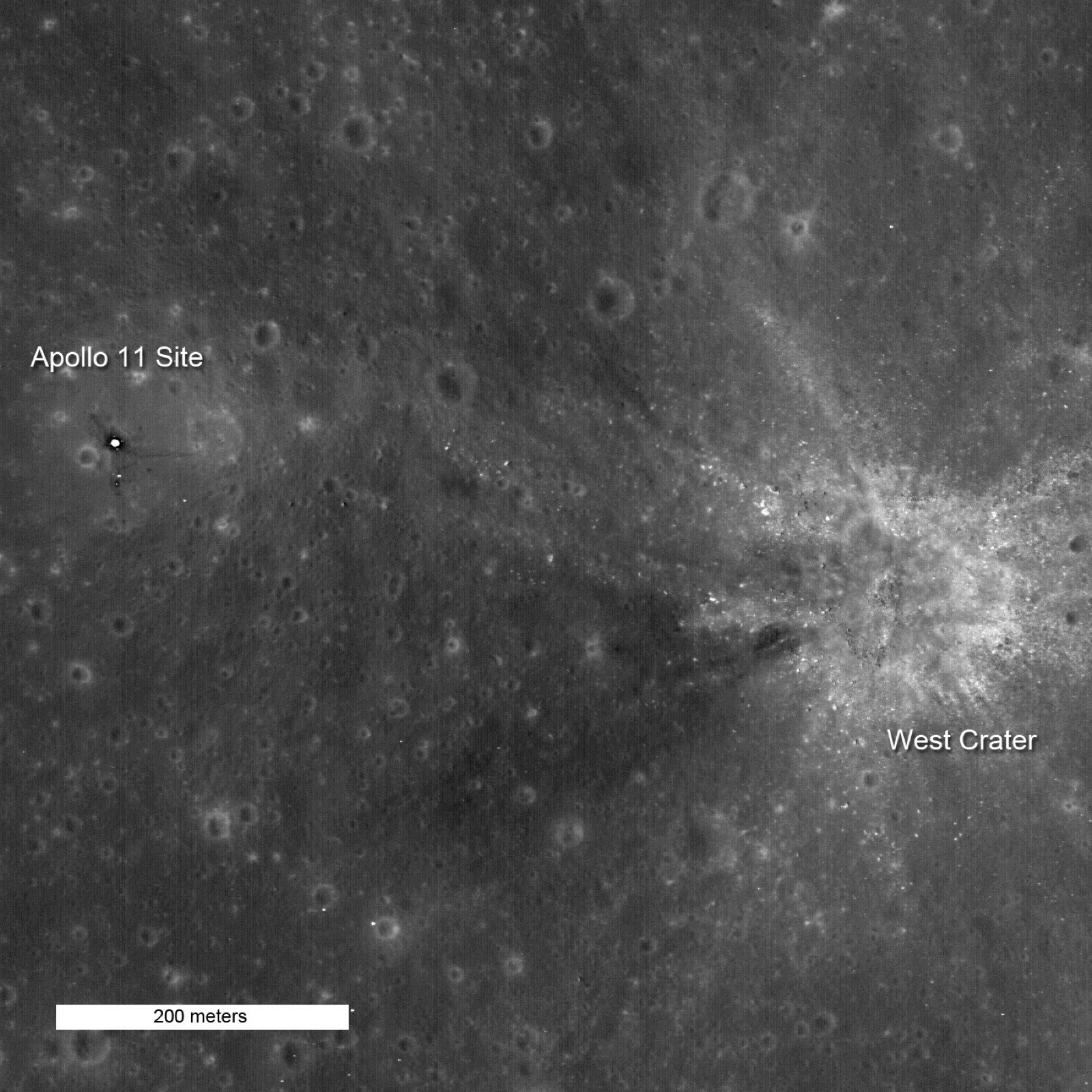
Between July 1969 and December 1972, twelve Americans walked on the Moon across six successful Apollo lunar missions. The astronauts brought back 382 kilograms of lunar rock, planted six retroreflector arrays still in active use today, and left behind hardware that the NASA Lunar Reconnaissance Orbiter has photographed from lunar orbit since 2009. The Soviet Union — which had every conceivable reason to expose a fraud — tracked the missions in real time on its own deep-space network at Yevpatoria, congratulated the United States publicly, and never disputed that the landings occurred. The hoax theory, which originated in a 1976 self-published book by a former Rocketdyne technical writer named Bill Kaysing, claims that all six landings were staged in a film studio. The theory has been polled at 6-20% of American adults in various surveys since the early 2000s. This article describes the theory, addresses each of its central evidentiary claims, and explains why the scientific and historical communities consider the case for the landings overwhelming.
Operation Paperclip
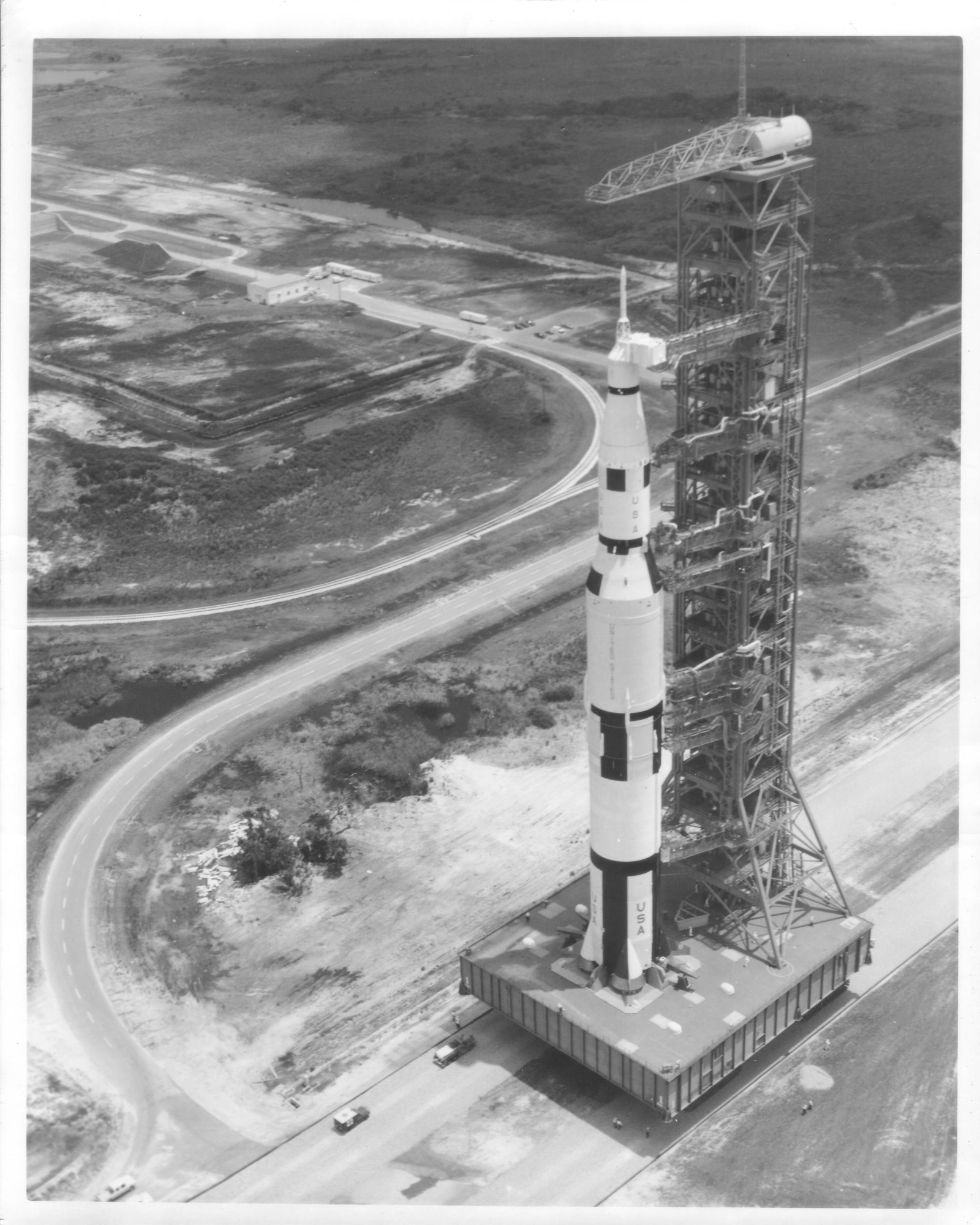
Between 1945 and 1959, the U.S. Army Ordnance Corps and the Joint Intelligence Objectives Agency secretly transported more than 1,600 German scientists, engineers, and technicians from defeated Nazi Germany to the United States — together with files that had been quietly stripped of references to Nazi Party membership, SS rank, and slave-labour exploitation. The clip on the folder was where the program got its name. The most prominent of the imported men was Wernher von Braun, designer of the V-2 ballistic missile, who twenty-four years later watched the Saturn V — a rocket built by his Huntsville team — lift Apollo 11 toward the Moon.
Operation Mockingbird
Between 1948 and the mid-1970s, the Central Intelligence Agency cultivated paid and unpaid working relationships with American journalists, editors, and publishers across every major U.S. news organization. The architect was an OSS veteran named Frank Wisner. He called the network the 'Mighty Wurlitzer' — a theatre-organ metaphor for a machine that could play many instruments from a single console. The full scope was confirmed by the 1975 Church Committee, expanded upon in Carl Bernstein's 25,000-word 1977 Rolling Stone investigation, and partly declassified since. What the records have not yet given up is the operational name everyone agrees was attached to it.