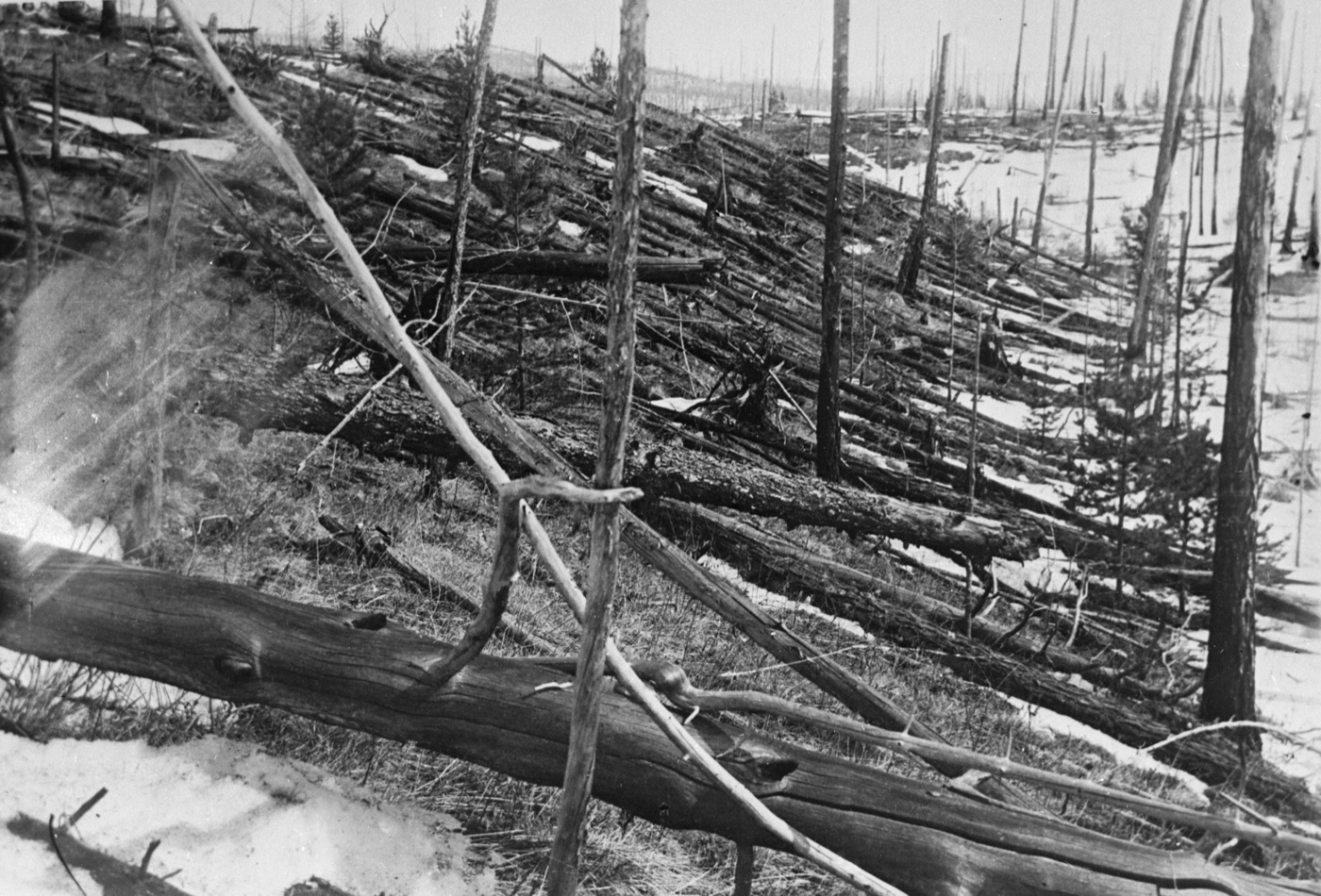
The flattened forest of Tunguska, photographed during Leonid Kulik's expedition around 1929 — two decades after the blast. Millions of trees were knocked down in a radial pattern pointing away from the explosion. Wikimedia Commons / Public domain.
Tunguska: The Cosmic Explosion That Flattened a Forest
Siberia, 1908 — A blast hundreds of times more powerful than the Hiroshima bomb leveled two thousand square kilometers of Siberian forest. There was no crater, and no scientist reached the site for nearly twenty years — leaving a puzzle that bred wild theories and one sober, frightening answer
- Category
- Space & UFOlogy
- Published
- Length
- 3,550 words · 19 min read
- Author
- The editors
The Tunguska event occupies an unusual place among the world's mysteries, because its central question has, in fact, largely been answered — and yet it remains shrouded in an aura of the inexplicable that it has never quite shed. The broad cause is now well established among scientists: a cosmic body, an asteroid or a comet fragment, exploded in the atmosphere over Siberia in a catastrophic airburst. But the long delay before anyone could investigate, the eerie absence of a crater, and the sheer scale of the devastation combined to make Tunguska a magnet for speculation, and the wilder theories it attracted have given it a reputation more mysterious than the evidence warrants. The real Tunguska is in some ways less strange than the legends — and in one important way, far more frightening, because what happened there could happen again.
This is the story of the great Siberian explosion.
The morning the sky exploded
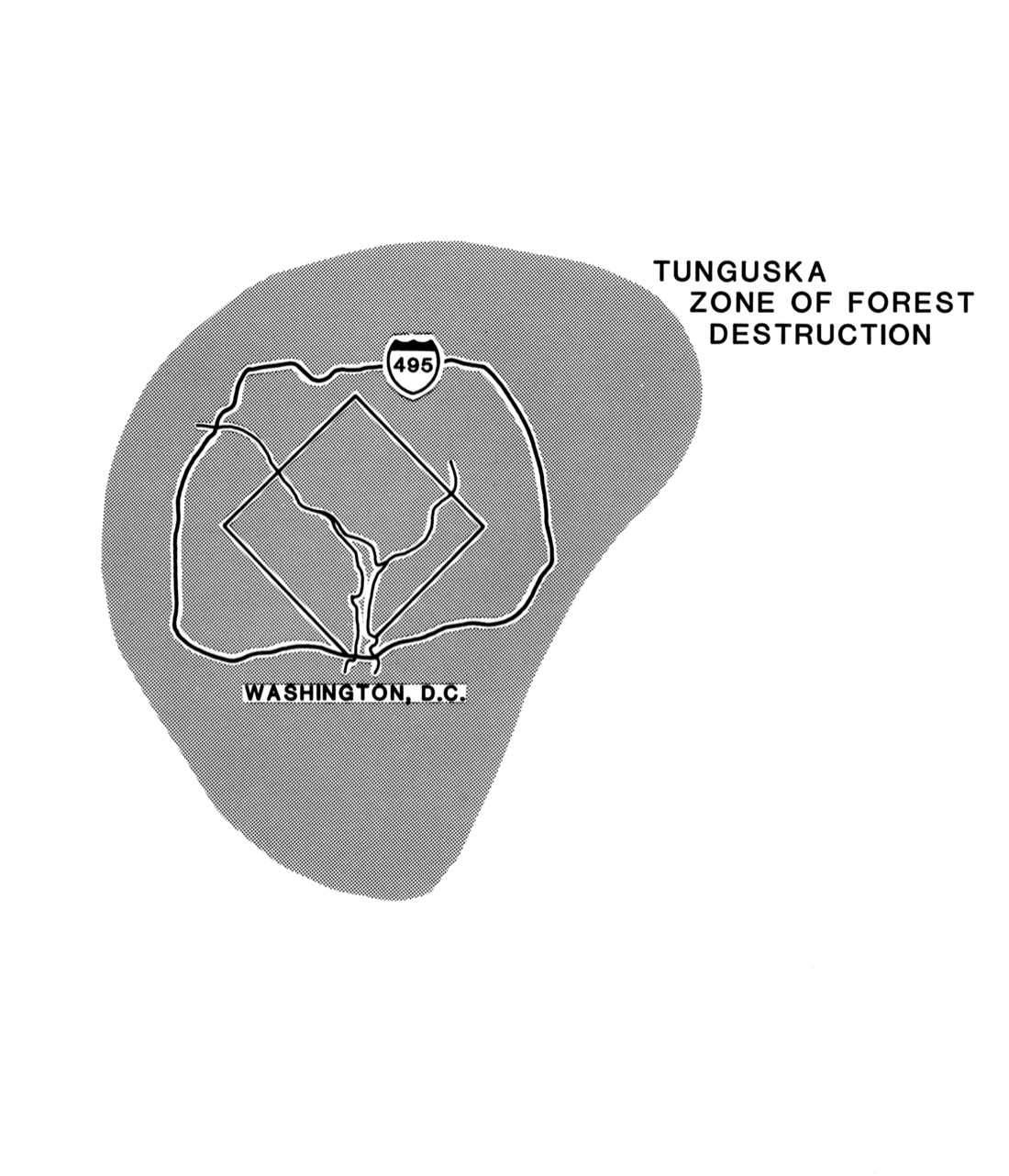
The morning of 30 June 1908 was clear over the taiga of central Siberia, the vast forest wilderness drained by the Tunguska rivers. The region was one of the emptiest places on Earth, home to scattered communities of the Indigenous Evenki people and a handful of Russian settlers and traders, and that emptiness is the reason a catastrophe of almost unimaginable violence killed, as far as is known, virtually no one. Had the same explosion occurred over a city, it would have been one of the deadliest events in human history. Over the Tunguska basin, it leveled a forest and was witnessed by relatively few.
What those witnesses saw and felt was terrifying. Across a huge area, people reported a blinding column or pillar of fire moving across the sky, brighter than the sun; then a tremendous flash, and a succession of thunderous explosions audible hundreds of kilometers away. A wave of heat and a powerful blast of wind followed. At the trading post of Vanavara, about sixty-five kilometers from the epicenter — the nearest inhabited point — witnesses were knocked off their feet, felt searing heat, and saw the sky split by fire, while windows shattered around them. Among the Evenki closer to the center, the blast flattened their forest, killed reindeer, and destroyed dwellings, and the survivors spoke of a catastrophe sent from the sky.
The account later given by the man at Vanavara — seated on his porch at the trading post when the blast came — became the most vivid testimony of the event. He described the sky to the north splitting and the whole northern sky appearing covered with fire; he felt a heat so intense that he thought his shirt had caught alight, before a tremendous sound threw him from the porch and across the ground, and a wind followed that flattened crops and rattled the buildings. Such accounts, collected from scattered witnesses years afterward, were remarkably consistent in their essentials — the fire in the sky, the searing heat, the deafening serial explosions, the shaking earth — and together they painted a picture of an event whose center, wherever it lay in the trackless forest, had been almost inconceivably violent. It was these testimonies, as much as anything, that drew scientists at last toward the Tunguska basin.
The signature of the explosion was written across half the planet. In the nights that followed, the skies over Europe and Asia glowed with an eerie luminescence — noctilucent clouds and atmospheric light caused by dust and ice carried high into the upper atmosphere by the blast — so bright that, in places as distant as London, people could reportedly read a newspaper outdoors at midnight. Scientists across Europe recorded the strange phenomena without understanding their cause, and pressure waves from the explosion were detected on instruments around the world. Something immense had happened, but for those outside Siberia its source was a mystery, and for those in Siberia it was an isolated cataclysm in a place almost no one could reach.
The long wait
What turned the Tunguska event into an enduring puzzle was the extraordinary delay before anyone could study it. The site was staggeringly remote — hundreds of kilometers from the nearest town, across roadless swamp and forest — and in 1908 Russia had little capacity and less urgency to investigate a blast in an empty corner of Siberia. Then history intervened: the First World War, the Russian Revolution of 1917, and the brutal civil war that followed convulsed the country for years, and the strange explosion in the taiga was forgotten by all but a few. Nearly two decades passed before science came to Tunguska.
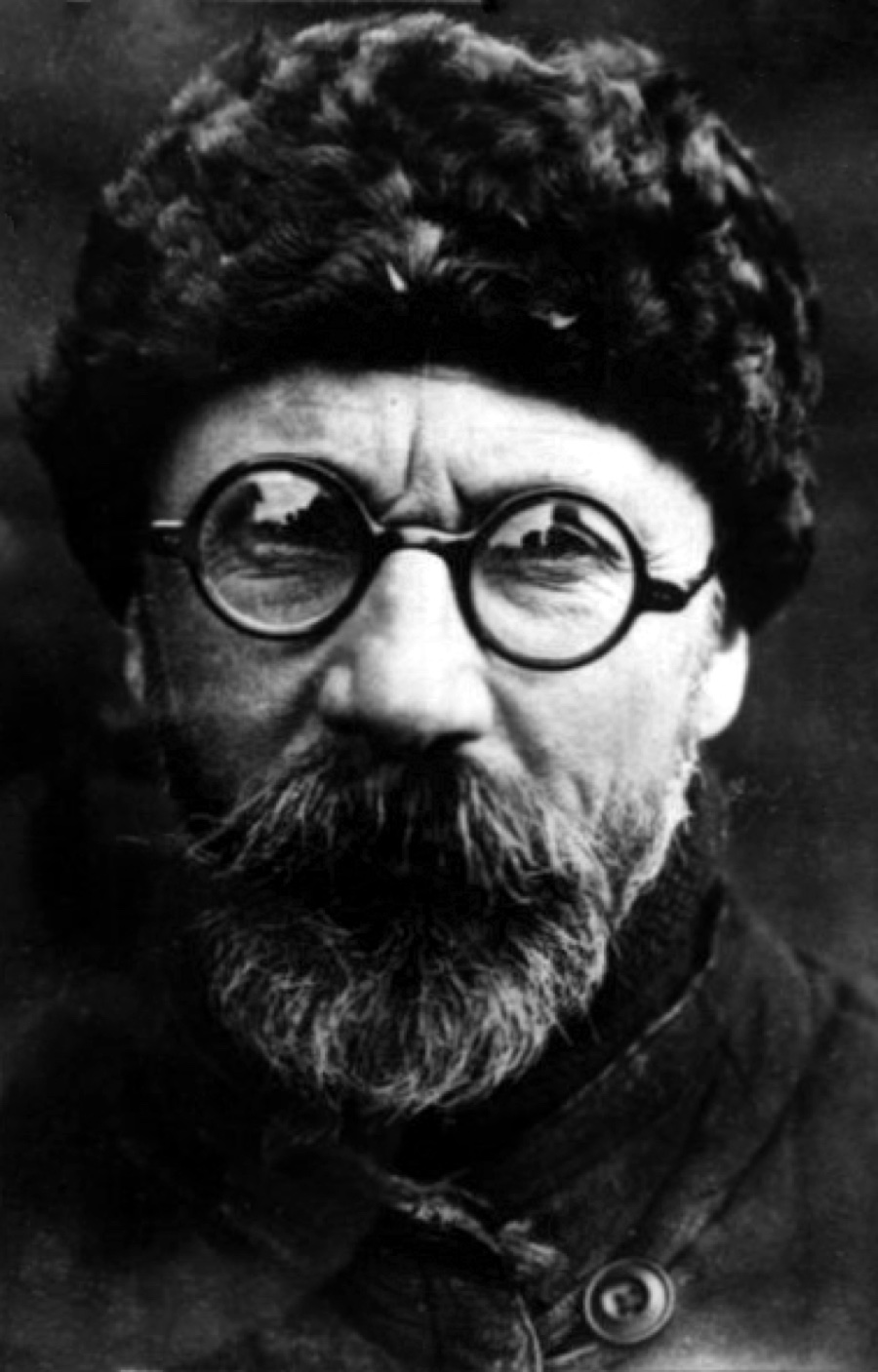
The man who finally brought science to the site was Leonid Kulik, a mineralogist who became convinced that a great meteorite had fallen in the Tunguska region and resolved to find it. After preliminary work, he led an expedition that reached the devastated zone in 1927, and what he encountered was astonishing. Across an enormous area, the forest had been flattened, millions of trees thrown to the ground and lying parallel, all pointing away from a central area, as if a giant hand had pressed the forest flat. It was unmistakable evidence of a blast of colossal power radiating from a single point in the sky.
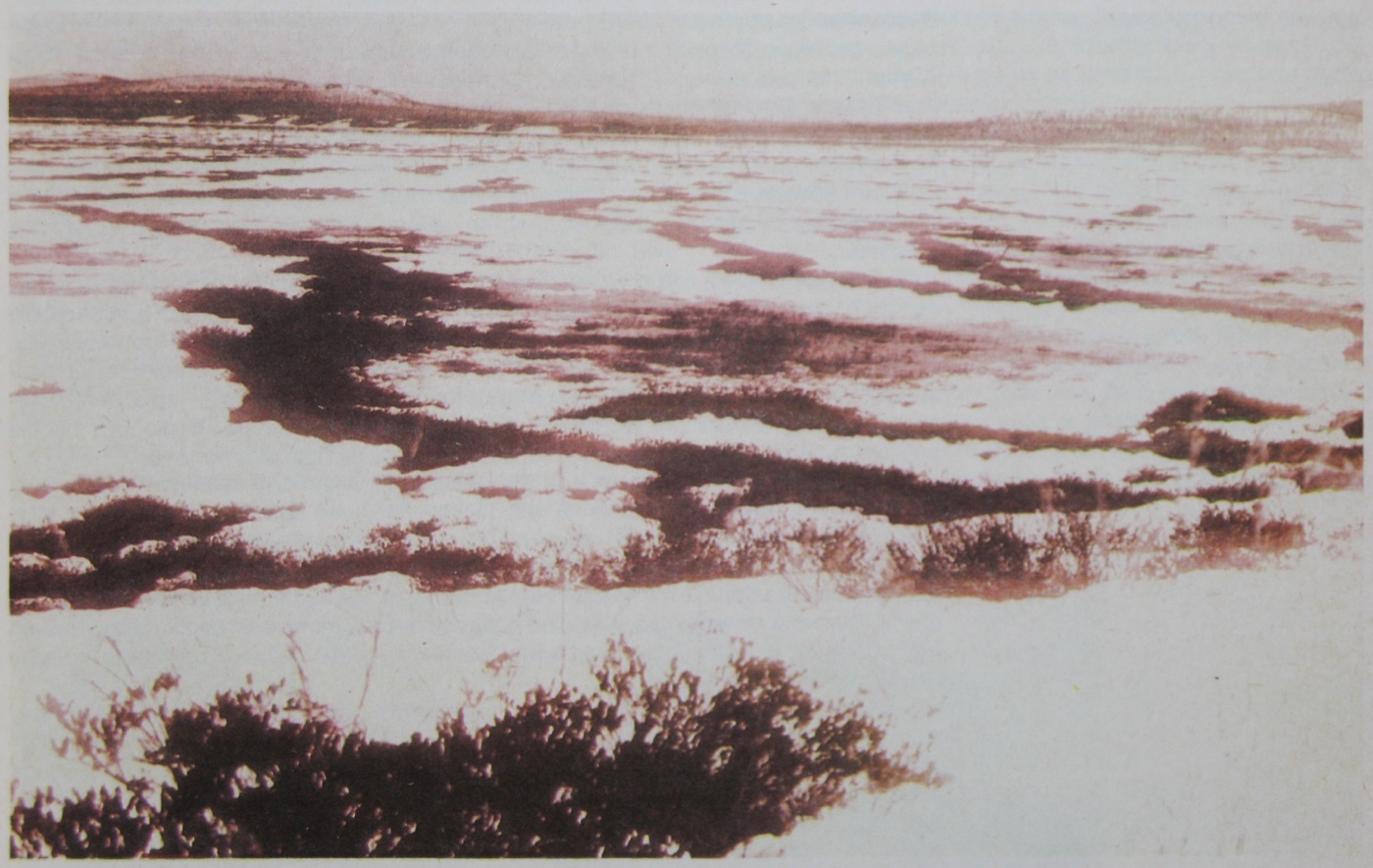
But Kulik's central quest was frustrated. He searched for the meteorite and the crater he was sure must lie at the center of the devastation — and he could not find them. There was no great impact crater, no huge buried iron meteorite, none of the things a falling space rock was expected to leave. At the very center, instead, he found a stand of trees left standing upright but stripped bare of their branches, like a forest of telegraph poles — the same effect later observed directly beneath nuclear airbursts, where the blast comes straight down. Kulik returned to Tunguska on several expeditions through the 1930s, searching in vain for the meteorite; he never found it, and he died during the Second World War. The absence of a crater was the heart of the mystery — and, it would turn out, the key to its solution.
The airburst
The explanation that science has converged upon resolves the paradox of the crater that was not there. The Tunguska event was not an impact on the ground but an explosion in the air. A cosmic body — most likely a stony asteroid, though a fragment of a comet has also been proposed — estimated at perhaps fifty to sixty meters or more across, entered Earth's atmosphere at a speed of tens of kilometers per second. As it plunged into the thickening air, the stresses and the immense heat of its passage caused it to fragment and then to detonate, in a catastrophic airburst, several kilometers above the surface. Most of the body was vaporized and dispersed in the explosion before it could strike the ground.
This understanding did not arrive all at once. Kulik and his contemporaries had assumed, as most would have, that a great meteorite must have struck and buried itself in the ground, and the failure to find it puzzled investigators for years. It was the comparison with nuclear explosions, after 1945, that proved especially illuminating: the pattern Kulik had documented at Tunguska — the radial flattening with a stand of stripped, upright trees at the very center — matched precisely what was observed beneath the atomic airbursts at Hiroshima and in weapons tests, where the blast descends from above. The recognition that an exploding body in the air, not an impact on the ground, produced the Tunguska devastation gradually became the consensus through the second half of the twentieth century, as the physics of atmospheric entry and airbursts came to be better understood. Tunguska thus helped teach science a lesson it had not fully grasped before: that the most likely way for a modest cosmic body to do catastrophic damage is not to crater the ground but to explode in the sky above it.
The airburst explanation accounts for all the principal features of the event: the colossal blast and heat, the radial flattening, the upright trees at the center, the lack of a crater, and the absence of large meteorite fragments. Over the following decades, scientists found further supporting evidence — microscopic spherules and traces of material of likely extraterrestrial origin embedded in the soil and in the resin of trees from the area, consistent with the dust of a disintegrated cosmic body. Modern modeling of how asteroids and comets behave on entering the atmosphere has reproduced the Tunguska effects convincingly. The case that Tunguska was a cosmic airburst is, in the mainstream of science, settled.
Research has continued at the site into modern times, refining the picture and probing the remaining questions. Investigators have studied the patterns of the felled trees to pinpoint the location and height of the blast, examined the chemistry of the soil and the peat bogs for the chemical traces a cosmic body would leave, and analyzed the growth of the forest that regrew after the devastation. One much-discussed proposal held that a small lake near the epicenter, Lake Cheko, might be a crater gouged by a surviving fragment of the body — a claim that would imply at least part of the object reached the ground. But this hypothesis has been disputed by other researchers, who argue the lake predates 1908 or shows none of the features a fresh impact crater should have, and it remains unconfirmed. These are the kinds of questions that still occupy Tunguska specialists — the fine details of the body and the blast — and they sit comfortably within the airburst framework rather than challenging it.
The theories that grew in the gap
The persistence of the exotic theories, despite the scientific consensus, says more about the appeal of mystery than about the evidence. A remote, long-delayed investigation, a missing crater, and a blast of nuclear scale before the nuclear age make for an irresistible canvas, and Tunguska has been painted with every kind of speculation. But the romance of the inexplicable should not obscure the sober and well-supported truth, which is dramatic enough on its own: that a rock from space exploded over Siberia with the force of a large hydrogen bomb, and that we were lucky it happened where it did.
The warning from the sky
In the end, Tunguska is the mystery whose solution is more sobering than its legends. A body from space exploded over the Siberian taiga with the force of a large nuclear weapon, flattened a forest the size of a great city, lit the night skies of a hemisphere, and left no crater because it detonated in the air — and because the region was so remote and the times so turbulent, no one reached the site to understand it for almost twenty years. Into that gap rushed the theories of black holes and antimatter and alien craft, and they have clung to Tunguska ever since, lending it a strangeness the facts do not require. The facts themselves are clear enough, and they carry a warning sharper than any fantasy: that what happened over Tunguska was an ordinary cosmic event of a kind that will recur, and that the only real question it leaves us is whether, when the next one comes, we will have learned enough to see it coming. The forest that fell in 1908 is long since regrown. The hazard that felled it has not gone anywhere.
Inspired this / based on it
Vladimir Rubtsov
Springer. A detailed scientific survey of the event and the investigations.
Various
One of many documentaries on the event; the science points firmly to a cosmic airburst.
Filed under
- #tunguska-1908
- #tunguska-event
- #airburst
- #asteroid
- #meteor
- #siberia
- #leonid-kulik
- #planetary-defense
- #1900s
- #mystery
Click any tag for every article carrying it.
Continue reading
Dyatlov Pass
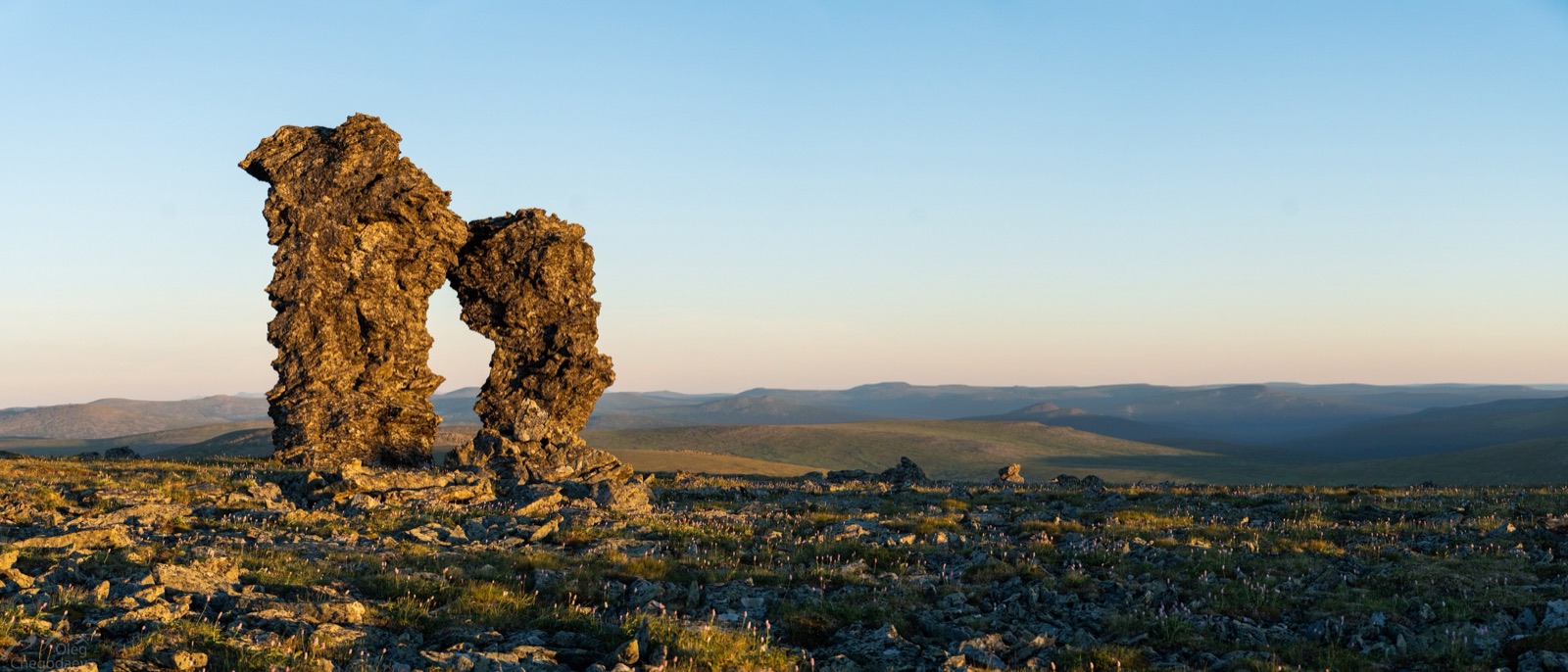
On the afternoon of February 1, 1959, a group of nine experienced Soviet ski-tourists — eight men and one woman, all between 20 and 38 years old, all members or alumni of the Ural Polytechnical Institute in Sverdlovsk (now Yekaterinburg) — pitched a four-pole canvas tent on the eastern slope of an undistinguished 1,079-meter mountain in the northern Urals named, in the Mansi language, Kholat Syakhl — 'Dead Mountain.' The group was led by 23-year-old Igor Dyatlov, a fifth-year radio-engineering student. The party had skied approximately 280 kilometers from the closest railway terminus over the prior nine days. Their planned summit, the following day, was the higher Otorten peak ten kilometers north. None of them reached it. When a search party located the abandoned tent on February 26, it had been cut open from the inside. Most of the group's clothing and equipment was still inside. The first three bodies — including Dyatlov — were found later that day, scattered along the slope below the tent, dressed only in underwear or light layers, none in proper outer clothing, none in their boots. Two further bodies were found nearer the tent over the following weeks. The final four bodies — including the only female member, Lyudmila Dubinina — were not located until May 4, 1959, in a snow-covered ravine approximately 1.5 kilometers downslope. Three of those four had massive internal trauma — equivalent in the words of the autopsy report to high-speed automobile-collision injuries — without corresponding external wounds. Two had missing soft tissue: Dubinina lacked her tongue and eyes. Some of the recovered clothing tested positive for elevated beta-particle radiation. The Soviet criminal investigation concluded in May 1959 that the deaths were caused by 'a compelling natural force which the hikers were unable to overcome.' The Russian Procurator-General's Office reopened the case in 2019 and concluded in July 2020 that the cause was a slab avalanche followed by hypothermia and disorientation. A 2021 computational study published in *Communications Earth & Environment* by Alpine snow scientists at EPFL Lausanne provided a quantitative mechanical model supporting the slab-avalanche conclusion. The case is closed in Russia. It is, in international public discussion, the most-debated cold-weather forensic mystery of the 20th century.
The Voynich Manuscript
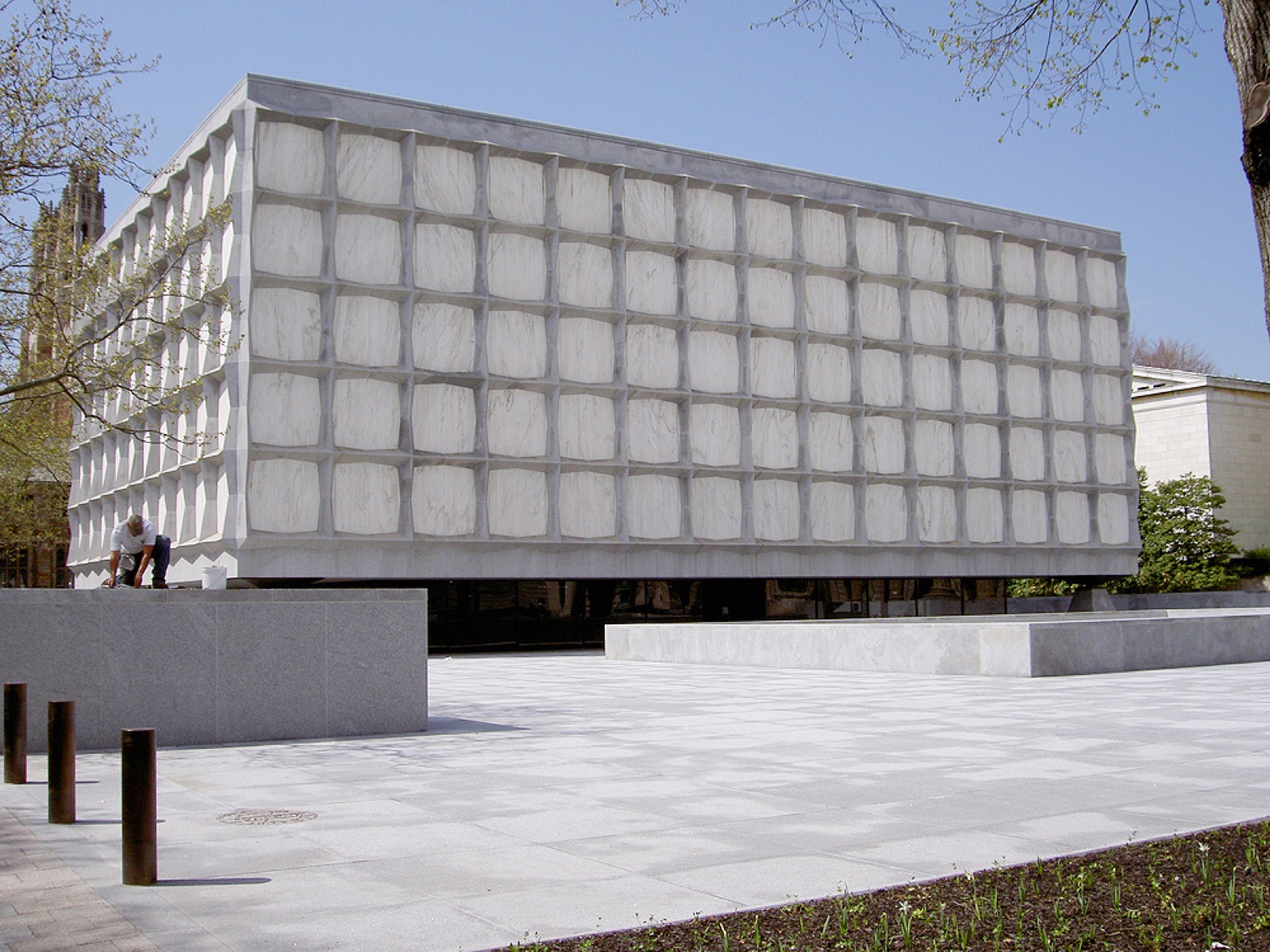
Sometime between 1404 and 1438 — the period to which the University of Arizona's accelerator mass spectrometry laboratory carbon-dated four samples of its vellum in 2009 — someone, almost certainly in northern Italy, produced a 240-page illustrated manuscript in a script that no one before or since has been able to read. The codex is now held as MS 408 of the Beinecke Rare Book and Manuscript Library at Yale University. It is one of the most studied documents in existence. It has been examined by the leading cryptographers of two centuries — including the team at the U.S. Army's Signal Intelligence Service that broke Japanese diplomatic codes in 1940 — and by the leading natural-language statisticians and machine-learning researchers of the present generation. Every claimed decipherment, of which there have been several dozen, has been rejected by the broader academic consensus. The script — colloquially 'Voynichese' — exhibits statistical patterns that resemble those of natural human languages while corresponding to no known language. The illustrations are recognizably medieval in style but depict, in their botanical sections, plants that match no identified species, and in their balneological sections, scenes of small naked female figures in green pools connected by what appear to be plumbing systems. The manuscript surfaced in the historical record in 1639 (a letter from a Bohemian alchemist to the Jesuit polymath Athanasius Kircher), disappeared again, and re-emerged in 1912 when the Polish-American bookseller Wilfrid Voynich purchased it from a Jesuit college near Rome. It has been at Yale since 1969. The Beinecke made it freely downloadable in 2020. The case file is mathematical, philological, and codicological. It is open in every sense.
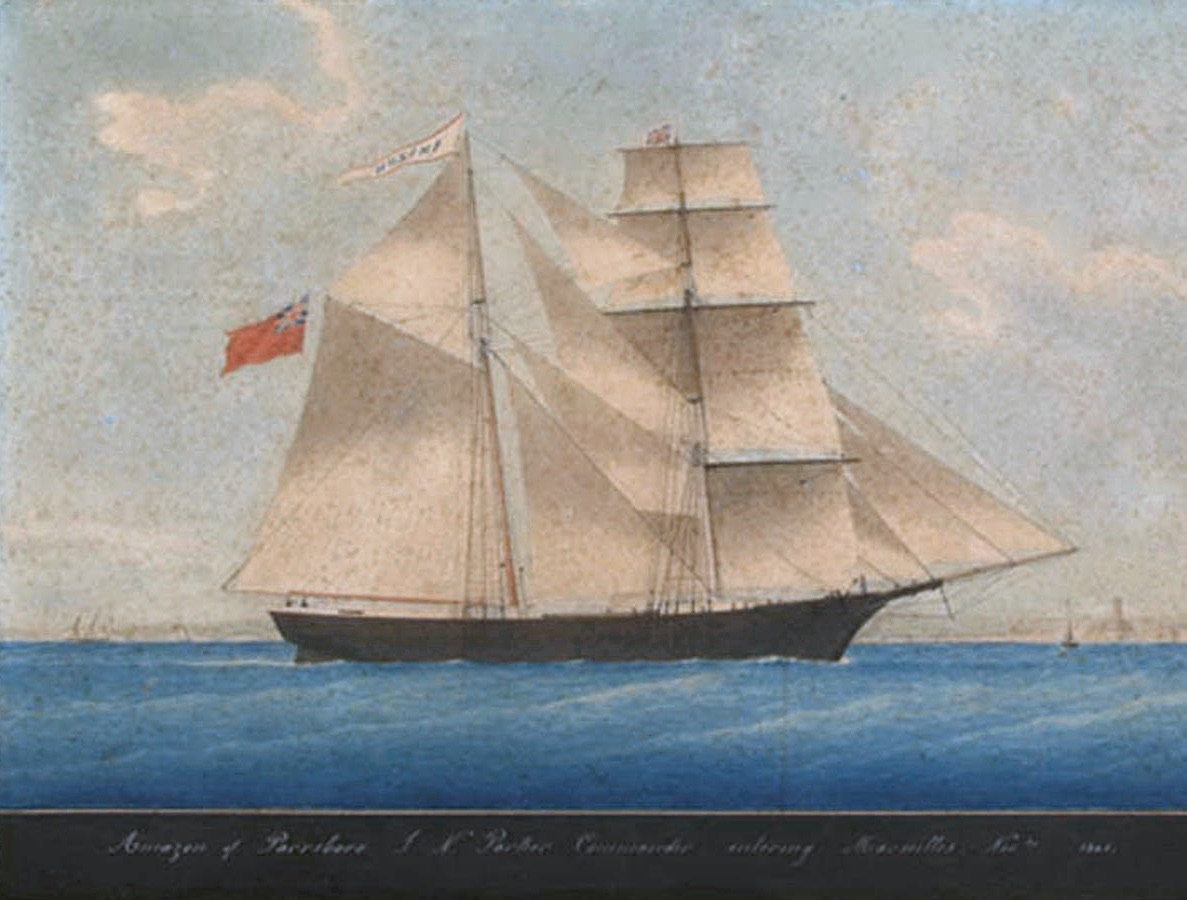
The Mary Celeste and the Ship That Sailed Itself
On December 5, 1872, the crew of the British brigantine Dei Gratia, several hundred miles west of Portugal, sighted another two-masted ship moving strangely across the swell — sails partly set, yawing as if no one had the helm. They closed on her, hailed her, got no answer, and sent a boarding party across. The ship was the Mary Celeste, an American merchant brigantine that had left New York a month earlier bound for Genoa with a cargo of industrial alcohol, and she was deserted. There was no one at the wheel and no one below; there was no sign of violence, no sign of robbery, no disorder beyond what a few days of unattended sailing would explain. The cargo sat almost untouched in the hold. There was ample food and fresh water. The crew's oilskins and boots and pipes were still where they had been left, and the captain's wife had left behind her harmonium and her child's toys. The ship was seaworthy and could have sailed on for months. But the ten people who had been aboard — Captain Benjamin Briggs, his wife Sarah, their two-year-old daughter Sophia, and seven crew — were gone, and so was the ship's single lifeboat, a small yawl that appeared to have been deliberately launched. No trace of any of them was ever found. The Mary Celeste became, and has remained, the most famous mystery in the history of the sea: not a wreck, not a massacre, but a sound ship abandoned in calm circumstances by people who had every reason to stay aboard. This article reconstructs what was actually found, what the Gibraltar inquiry made of it, and which of the many explanations — the credible and the lurid — best fits the strange, orderly emptiness of the ship that sailed itself.