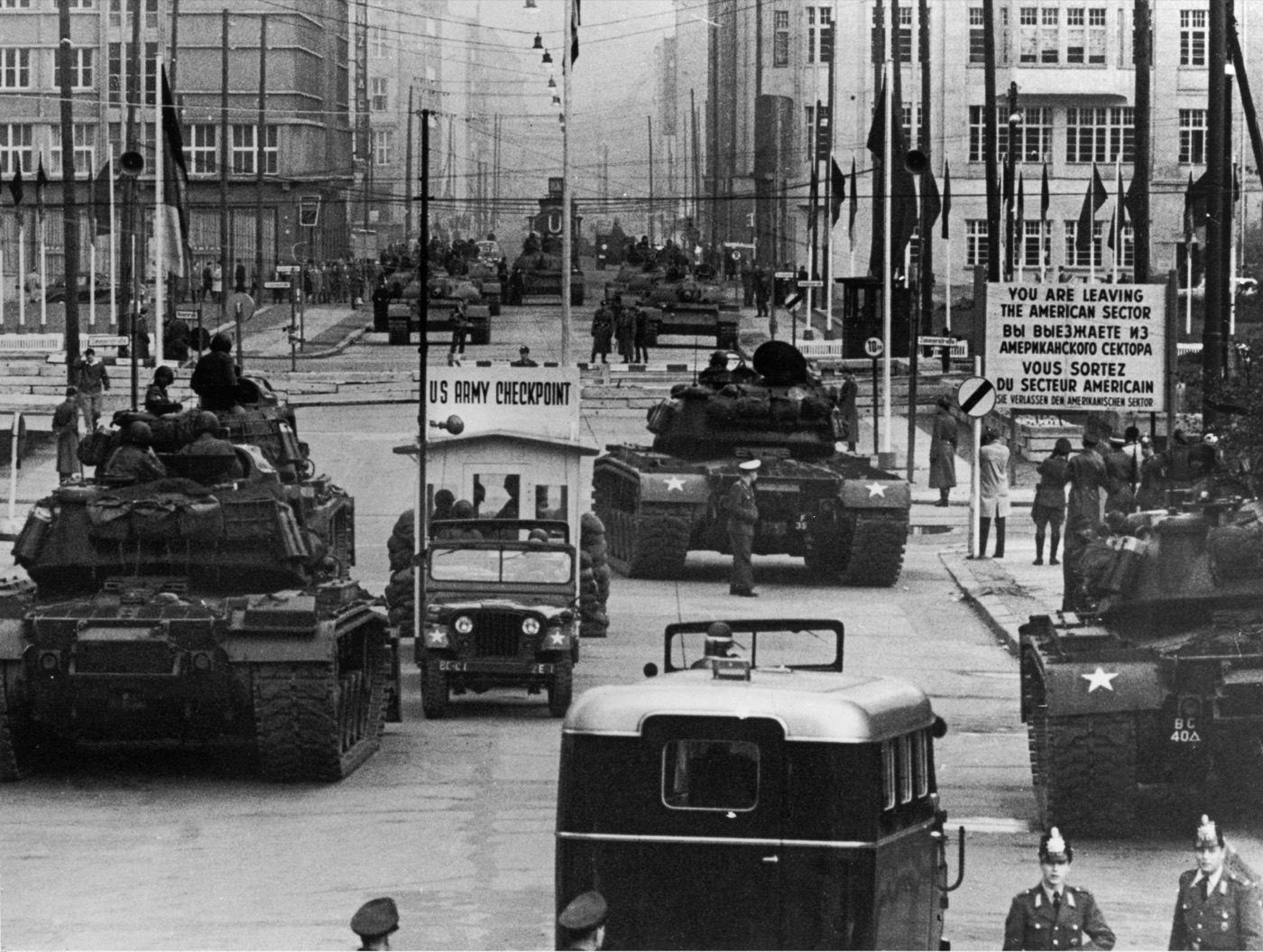
American and Soviet tanks face off at Checkpoint Charlie, Berlin, October 1961. Two months after the Wall went up, a dispute over access brought the superpowers' tanks muzzle to muzzle — the closest the Berlin crisis came to open war. Wikimedia Commons / U.S. Army, Public domain.
The Building of the Berlin Wall, 1961
Germany, 1961 — One Sunday morning in August, East Germany sealed the open border that ran through the heart of Berlin, dividing a city overnight with barbed wire and then concrete. The West, caught off guard, did nothing to stop it — because a wall, however brutal, was better than a war
- Category
- Cold War Files
- Published
- Length
- 3,850 words · 20 min read
- Author
- The editors
The Berlin Wall is so familiar a symbol — of the Cold War, of communist tyranny, of division and its eventual fall — that it is easy to forget it was once a sudden, shocking event: a city cut in half over a single weekend, families separated by a line of wire that had not been there the night before. The Wall did not grow gradually or arrive by announcement. It appeared, in its first crude form, almost overnight, the product of a secret decision executed with military precision while Berlin slept. And the Western response to it — outrage in public, calculated inaction in practice — revealed one of the central and uncomfortable truths of the nuclear age: that there were brutalities the free world would denounce but not fight, because the alternative was a war no one could survive.
This is the story of how, and why, Berlin was divided.
The open wound
The division of Germany was a product of the Second World War's end. The victorious Allies split the defeated country into occupation zones, and as the wartime alliance curdled into the Cold War, those zones hardened into two states: the Federal Republic of Germany in the west, tied to the United States and Western Europe, and the German Democratic Republic in the east, a communist state under Soviet domination. Berlin, the old capital, lay deep within the eastern state, but it too had been divided among the Allies, leaving West Berlin as an island of the Western world surrounded by communist territory — an anomaly the Soviets resented and repeatedly tried to squeeze, most dramatically in the 1948–49 blockade that the West defeated with the Berlin Airlift.
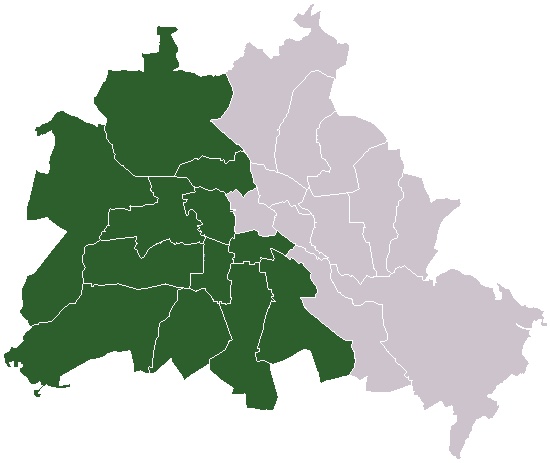
The peculiar geography created a peculiar problem for the East. Even as the border between the two German states was fortified and sealed in the countryside, the boundary within Berlin remained relatively open: the city's subway and elevated railways crossed between sectors, and an East German could, with care, travel to East Berlin and simply cross into West Berlin, and from there be flown out to West Germany. Berlin was the great loophole in the Iron Curtain, the one place where the closed world of the Soviet bloc still had a door ajar. And through that door, people poured.
The haemorrhage
The numbers were staggering and, for East Germany, existential. Across the 1950s, millions of East Germans voted against their state with their feet, leaving through Berlin for a freer and more prosperous life in the West. They were not, for the most part, the old or the desperate but the young and capable — the professionals and skilled workers whose departure bled the East German economy of the talent it needed to function. A state that cannot keep its own people, and that is losing precisely its most productive citizens year after year, faces a slow death, and East Germany's leaders knew it.
The refugee crisis was unfolding against a backdrop of acute superpower tension over Berlin itself. Since 1958, Khrushchev had been pressing the West with a series of ultimatums, demanding that the Western powers withdraw from West Berlin and turn it into a "free city," and threatening to sign a separate peace treaty with East Germany that would hand it control over the access routes. The Western powers refused to abandon West Berlin, and the resulting standoff — the Berlin Crisis — was among the most dangerous of the entire Cold War. When the young President Kennedy met Khrushchev at the Vienna summit in June 1961, the Soviet leader pressed him hard on Berlin, and Kennedy came away shaken, convinced that the city might be the place where the Cold War turned hot. It was in this charged atmosphere, with the world's attention fixed on Berlin and the refugee outflow surging to record levels, that the decision to seal the border was taken.
By 1961 the crisis had become acute, and the East's leader, Walter Ulbricht, pressed the Soviet leader, Nikita Khrushchev, for permission to seal the Berlin border. It was a delicate decision. Closing the border would be a propaganda disaster, an open admission that people had to be imprisoned to keep them in the socialist paradise. But the alternative — allowing the bleed to continue — was worse. Famously, in June 1961, when a journalist asked Ulbricht whether a state border would be erected at the Brandenburg Gate, he replied that no one had any intention of building a wall: "Niemand hat die Absicht, eine Mauer zu errichten." It was a lie, and it inadvertently introduced the very word — wall — into the public imagination weeks before the thing itself appeared.
The weekend the city was cut
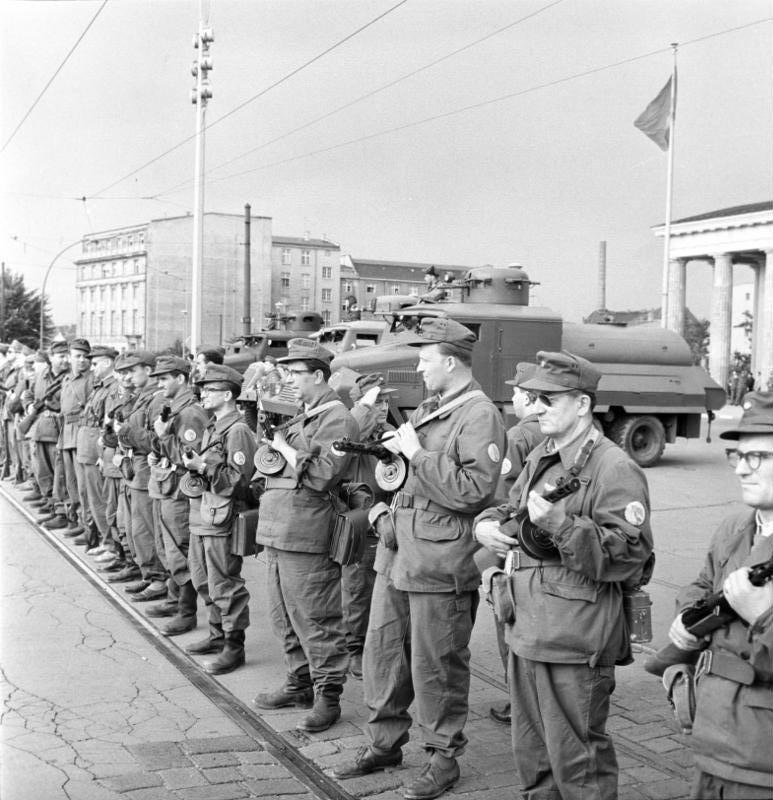
The operation was planned in secret and executed with care. The date chosen was the night of Saturday 12 into Sunday 13 August 1961 — a weekend, in the small hours, when traffic was lightest and resistance least likely. In the darkness, East German troops, police, and paramilitary "combat groups" moved into position all along the boundary between East and West Berlin. They tore up streets, strung barbed wire, and set up barriers, sealing the sector border block by block. By the time Berliners awoke on Sunday morning, the open city was gone.
The human consequences were immediate and wrenching. The boundary did not run along some empty frontier but straight through the living fabric of a great city — down the middle of streets, through squares, between houses and the pavements they faced. Families found themselves on opposite sides; people who worked in one half and lived in the other were cut off from their jobs; couples, parents and children, friends were separated with no warning and no farewell. On streets like Bernauer Strasse, where the buildings stood in the East but their front doors opened onto a Western pavement, people leapt from upper windows to reach the West before the openings were bricked up; some were caught, some injured, and the first deaths soon followed. Within days the provisional wire was being replaced by something more permanent.
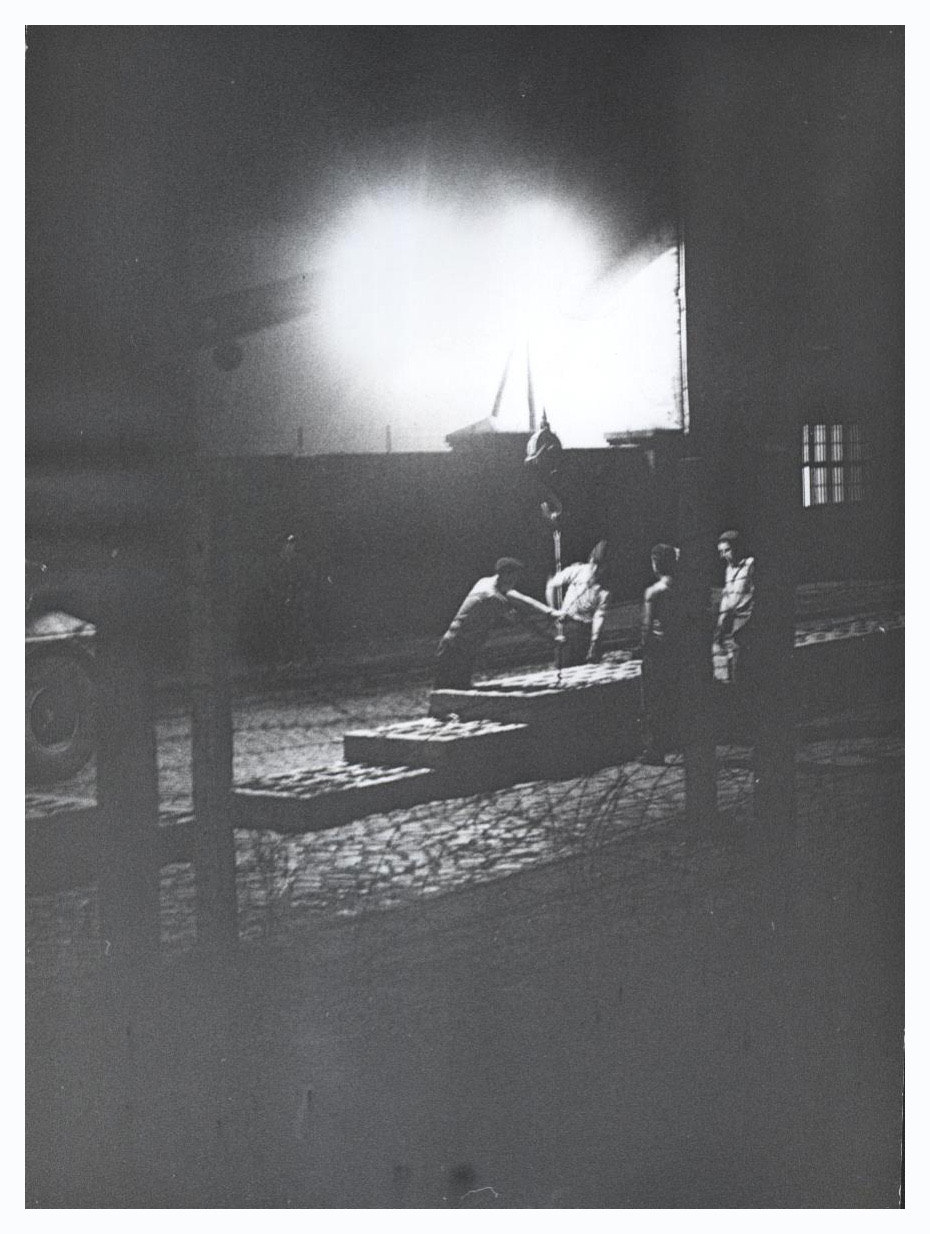
What began as a line of wire grew, over the months and years that followed, into an elaborate system of control: a concrete wall, then a second inner wall, with a patrolled "death strip" between them raked smooth to show footprints, lined with watchtowers, floodlights, trip-wires, dog runs, and guards under orders to shoot those who tried to cross. The Wall would eventually encircle the whole of West Berlin, a hundred-mile ring sealing the Western island off from the surrounding East. The improvisation of one August weekend had become a permanent fortification of the Cold War.
The West watches
The most consequential fact about the building of the Wall is what the Western powers did in response, which was, in the end, nothing that could stop it. The United States, Britain, and France protested loudly through diplomatic channels, condemning the closure as a violation of the postwar agreements on Berlin. But they did not send troops to tear down the wire, and they did not threaten war. The restraint was deliberate, and it reflected a cold strategic logic that the Western leaders, above all President John F. Kennedy, understood clearly.
Kennedy's reasoning rested on a distinction between the things the West would fight for and the things it would not. The Western position in Berlin had always rested on three essentials: the presence of Western troops in West Berlin, free access to the city from West Germany, and the freedom of West Berlin's own people. These the United States had pledged to defend, and these the Wall did not touch. The Wall sealed off the East and imprisoned East Germans, but it left the West's vital interests intact. To go to war to keep the border open — to risk a nuclear exchange over the Soviet bloc's treatment of its own citizens — was a price no American president would pay. As Kennedy reportedly put it in private, a wall was a great deal better than a war. It was not a heroic position, and it left East Germans to their fate, but it was a rational one in the shadow of the bomb.
Kennedy did take steps to reassure the anxious West Berliners that their freedom remained guaranteed. He sent Vice-President Lyndon Johnson to the city and dispatched a reinforcement of troops down the autobahn from West Germany, a demonstration that the Western commitment to West Berlin was unbroken even as the East sealed its side. The message was carefully calibrated: the West would not challenge the Wall, but it would defend its own.
Checkpoint Charlie
The restraint did not mean the crisis was over, and within weeks it nearly turned to violence at the most famous crossing point of all. In October 1961, a dispute arose over the rights of Western officials and military personnel to cross into East Berlin without being subjected to East German controls — a point of principle, since the West did not formally recognise East German authority over the sector boundary. The confrontation escalated at Checkpoint Charlie, the Allied crossing point in the heart of the city, where on 27–28 October American and Soviet tanks were brought up to face each other directly across the line.
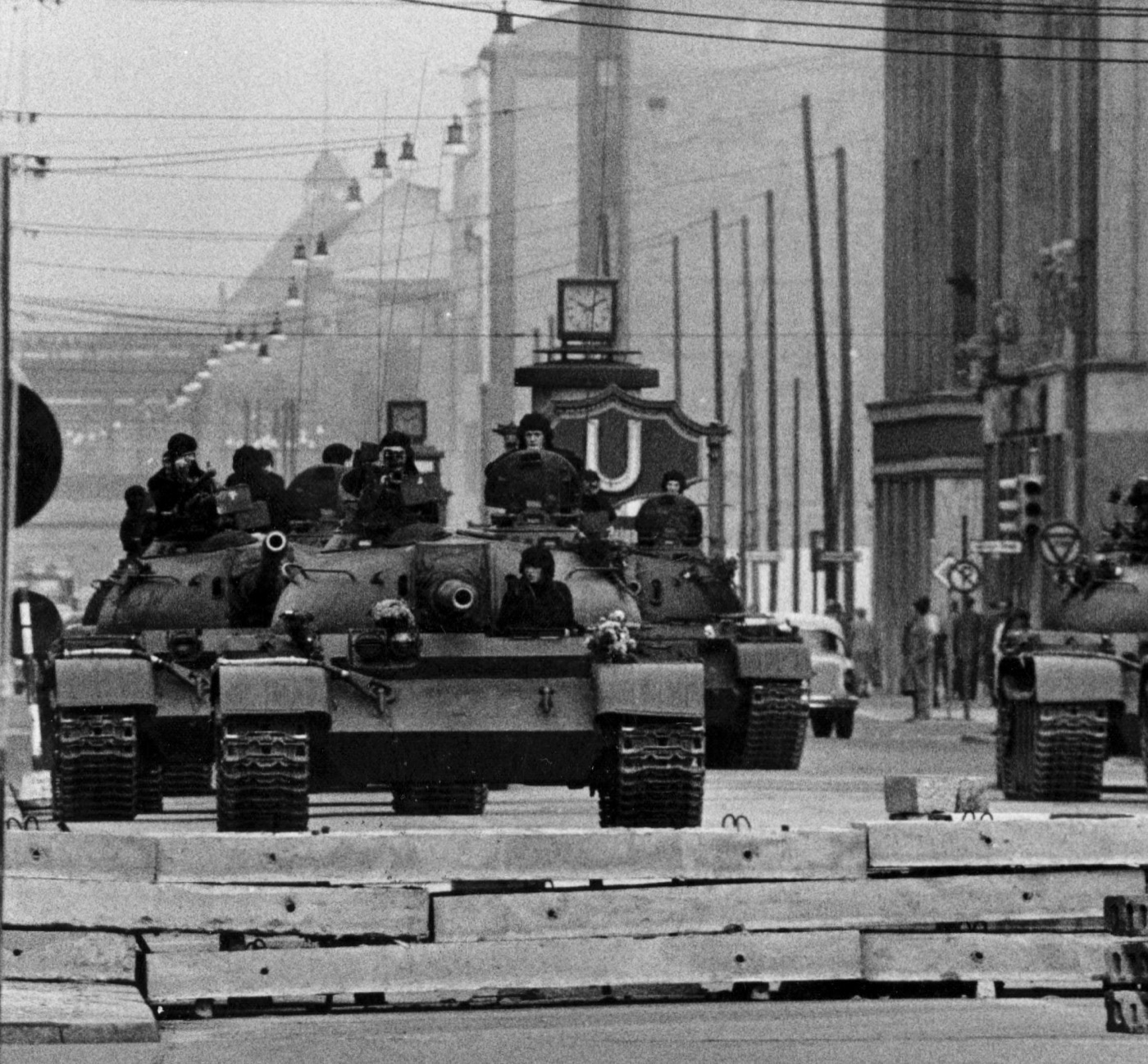
For about sixteen hours, the tanks stood muzzle to muzzle, perhaps a hundred yards apart, guns loaded, in the most direct tank-to-tank confrontation between the superpowers of the entire Cold War. A single nervous gunner or rash order could have started a shooting war in the centre of Europe. The standoff was defused not by the commanders on the spot but at the highest level, through a back-channel exchange between Kennedy and Khrushchev in which both sides agreed to pull their tanks back, one at a time, in a carefully choreographed de-escalation. Neither leader wanted war over Berlin, and both drew back from the brink. But the episode showed how close the divided city could bring the world to catastrophe.
The Wall stands
In its own brutal terms, the Wall worked. The flood of refugees was reduced to a trickle; the haemorrhage that had threatened East Germany's existence was stanched, and the East German state, stabilised, would endure for another twenty-eight years. The Soviet bloc had solved its Berlin problem not by winning the city but by walling its own people in — an admission of failure so total that no amount of propaganda could fully disguise it. The Wall was the clearest possible refutation of the claim that people lived in the communist East by choice.
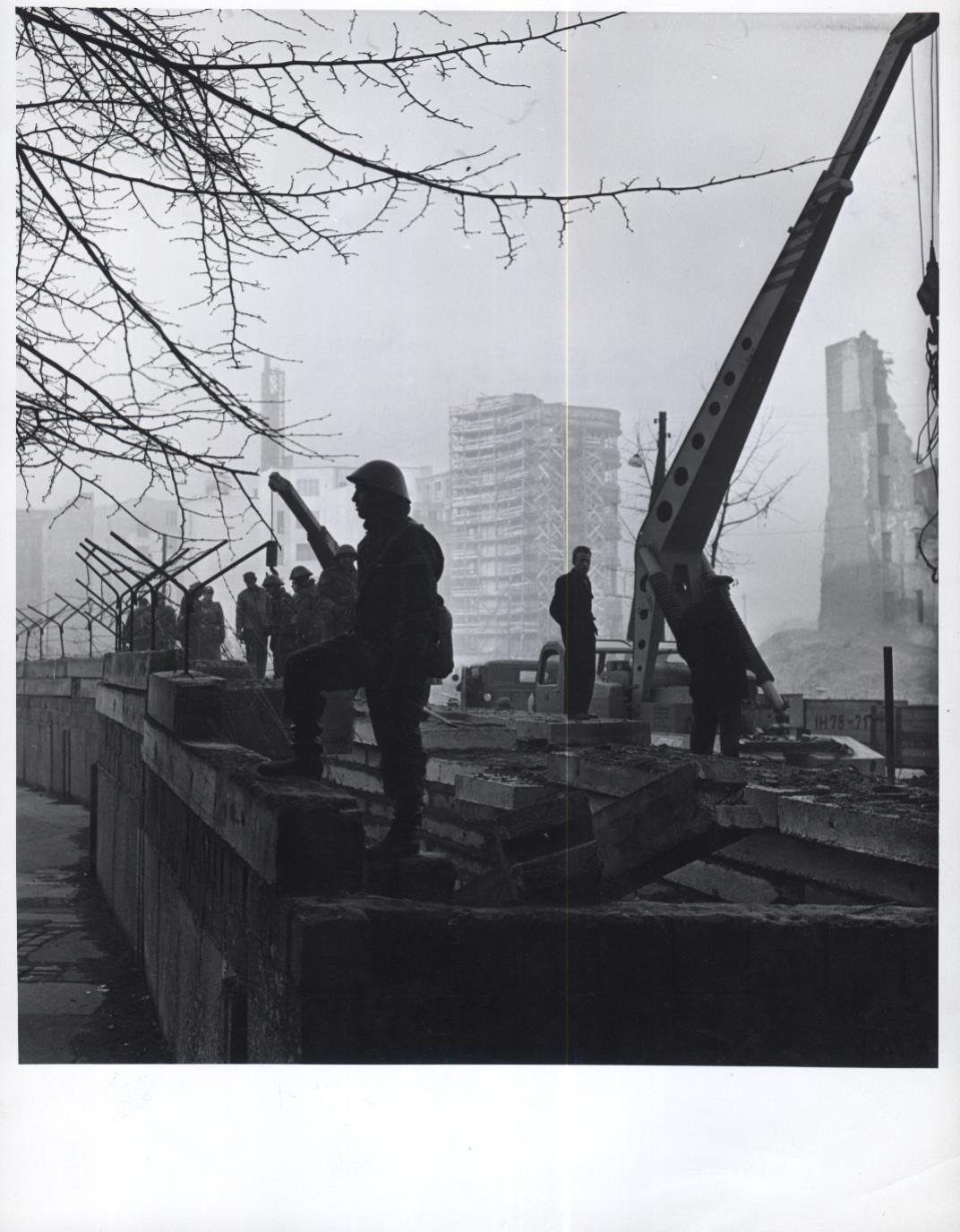
The human cost accumulated across the decades the Wall stood. Many people died trying to cross it — shot by guards, drowned in the border canals, killed in falls and failed escapes — and their stories became part of the Wall's grim legend, from Ida Siekmann, who died leaping from a Bernauer Strasse window in the Wall's first days, to Peter Fechter, an eighteen-year-old shot in 1962 and left to bleed to death in the death strip in full view of Western onlookers. The exact toll is debated, but well over a hundred people are reckoned to have died at the Berlin Wall. Each was a person who had judged the risk of the guns worth the chance of freedom.
The Wall also became the supreme symbol of the Cold War, the place where its abstractions took concrete form. It was to the Wall that Western leaders came to make their declarations: Kennedy in 1963, proclaiming his solidarity with the city's people in the famous words "Ich bin ein Berliner," and Ronald Reagan in 1987, demanding before the Brandenburg Gate that the Soviet leader "tear down this wall." When the Wall finally fell in November 1989, swept away by the revolutions that ended communism in Eastern Europe, its collapse became the defining image of the Cold War's end — the mirror image of the night in 1961 when it had gone up.
The meaning of the Wall
In the end, the Berlin Wall stands in memory as the Cold War made visible — a hundred miles of concrete and wire that turned an ideological division into a physical fact, and a city into the front line of a global confrontation. It went up in a single weekend, the secret decision of a failing state determined to imprison the citizens it could not persuade to stay, and the free world, for all its outrage, let it stand because the alternative was a war that might have consumed everything. For twenty-eight years it divided a people and symbolised a divided world, and more than a hundred died in its shadow reaching for the freedom on the other side. That it finally fell — peacefully, swept away by the very people it had caged — is the redemption of the story. But the morning it rose, dividing a sleeping city block by block, remains one of the Cold War's darkest and most revealing moments: the day the world learned which injustices it would denounce, and which it would, for fear of something worse, allow to stand.
Inspired this / based on it
Frederick Kempe
Putnam. A detailed account of the crisis and the building of the Wall.
Various
Numerous documentaries chronicle the Wall's construction, history, and fall in 1989.
Filed under
- #berlin-wall-1961
- #berlin-wall
- #cold-war
- #east-germany
- #checkpoint-charlie
- #kennedy
- #khrushchev
- #iron-curtain
- #1960s
- #confirmed
Click any tag for every article carrying it.
Continue reading
The USS Pueblo: The Spy Ship North Korea Captured
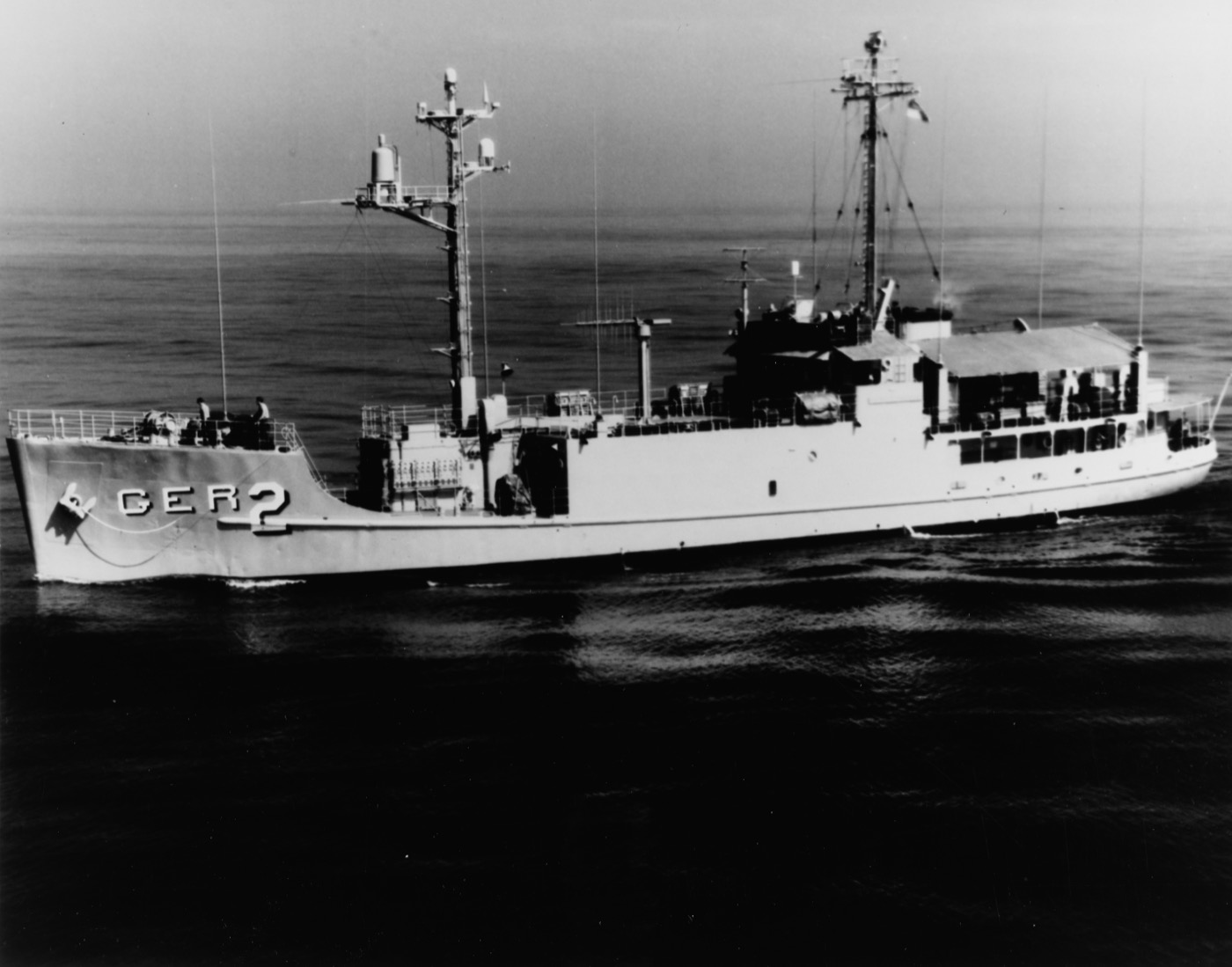
On 23 January 1968, a lightly armed United States Navy intelligence ship called the USS Pueblo was gathering electronic and signals intelligence off the coast of North Korea when it was surrounded by North Korean patrol boats and a submarine chaser, fired upon, boarded, and captured. One American sailor was killed in the assault; the other eighty-two men aboard were taken prisoner and carried into North Korea, where they would be held, beaten, starved, and paraded for propaganda for the next eleven months. The seizure was a profound humiliation for the United States — a commissioned warship taken on the high seas, its crew held hostage, its cargo of secret cryptographic equipment and documents falling into the hands of a hostile communist state. And yet the world's most powerful nation found that it could do almost nothing about it. The United States was at that moment consumed by the war in Vietnam, where the Tet Offensive was about to erupt, and it could not risk a second war on the Korean peninsula to recover one small ship. So instead of force, it turned to negotiation, and after eleven agonising months of talks the crew was freed only when an American general signed a humiliating false confession admitting the ship had been spying inside North Korean waters — a document the United States publicly repudiated even as it signed. The men came home; the ship did not. To this day the USS Pueblo remains in North Korean hands, a trophy of the Cold War moored in Pyongyang, and it is still, officially, a commissioned vessel of the United States Navy. This is the story of its capture, its crew's long ordeal, and the strange, unresolved standoff it became.
The Cambridge Five and the Spies at the Heart of British Intelligence
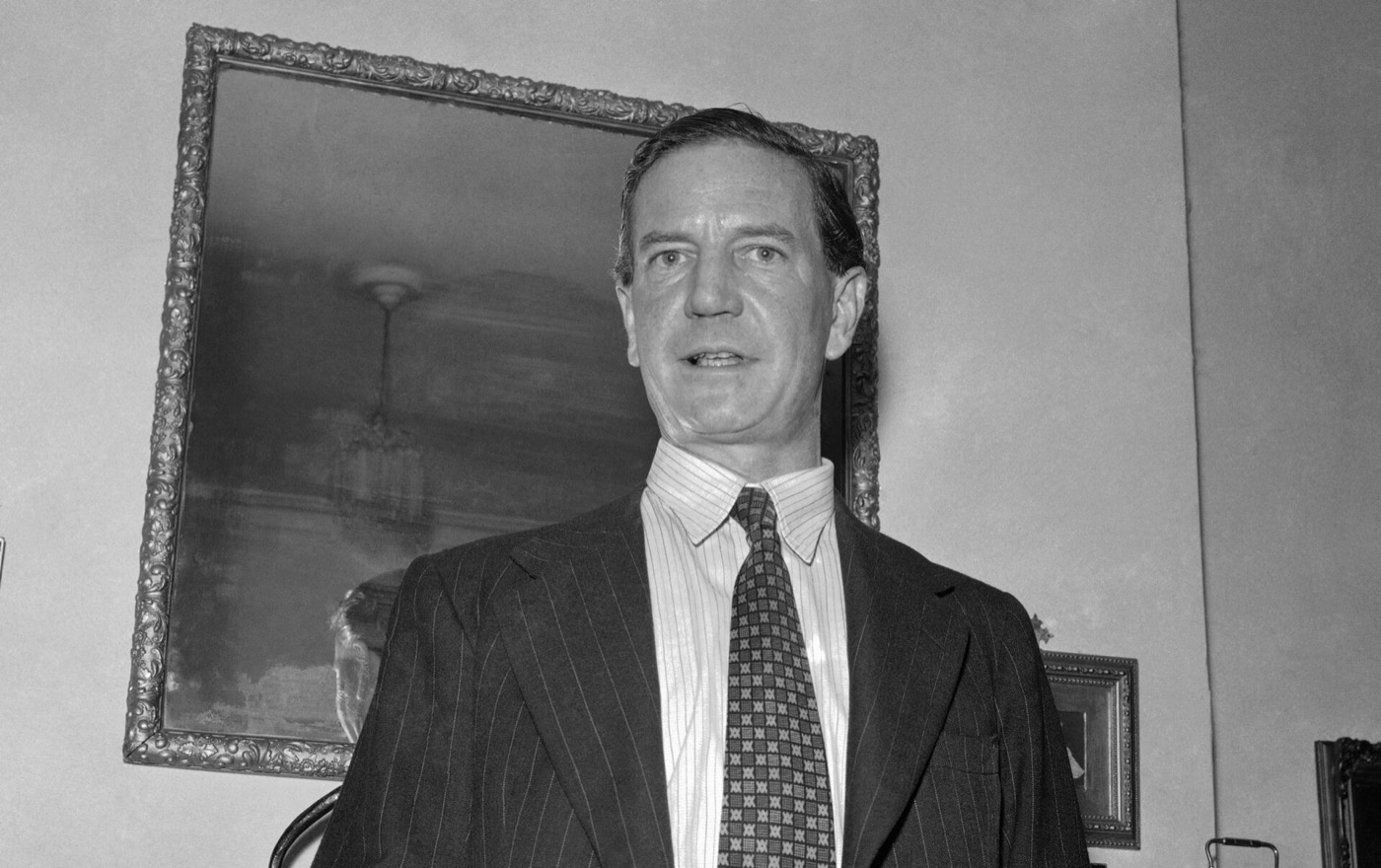
In the 1930s, Soviet intelligence undertook one of the most ambitious recruitment operations in the history of espionage: rather than buying secrets from disgruntled clerks, it would cultivate brilliant young Britons at the start of their careers, men of the right schools and the right accents who could be guided, over decades, into the very heart of the British establishment. The most famous of these recruits were five Cambridge University men — Kim Philby, Guy Burgess, Donald Maclean, Anthony Blunt, and John Cairncross — who became known as the Cambridge Five. They were not desperate or marginal figures but charming, talented members of the elite, and that was precisely the point. Over the following decades they penetrated the Foreign Office, the security service MI5, the secret intelligence service MI6, and the wartime codebreaking establishment, passing a torrent of British and American secrets to Moscow. Philby rose so high within MI6 that he was considered a future chief of the service — while serving the entire time as a Soviet agent, even as he was nominally in charge of countering the Soviet threat. The ring began to unravel in 1951, when Burgess and Maclean vanished to Moscow one step ahead of exposure; Philby fell under suspicion but was protected by an establishment unable to believe one of its own could be a traitor, and he did not flee to Moscow until 1963. Blunt, by then a knighted royal art adviser, secretly confessed but was not publicly named until 1979. The damage they did — to operations, to agents, to trust between Britain and its allies — was immense and, in places, fatal. This is the story of how five men of the establishment betrayed it from within, and how the establishment's own blindness let them.
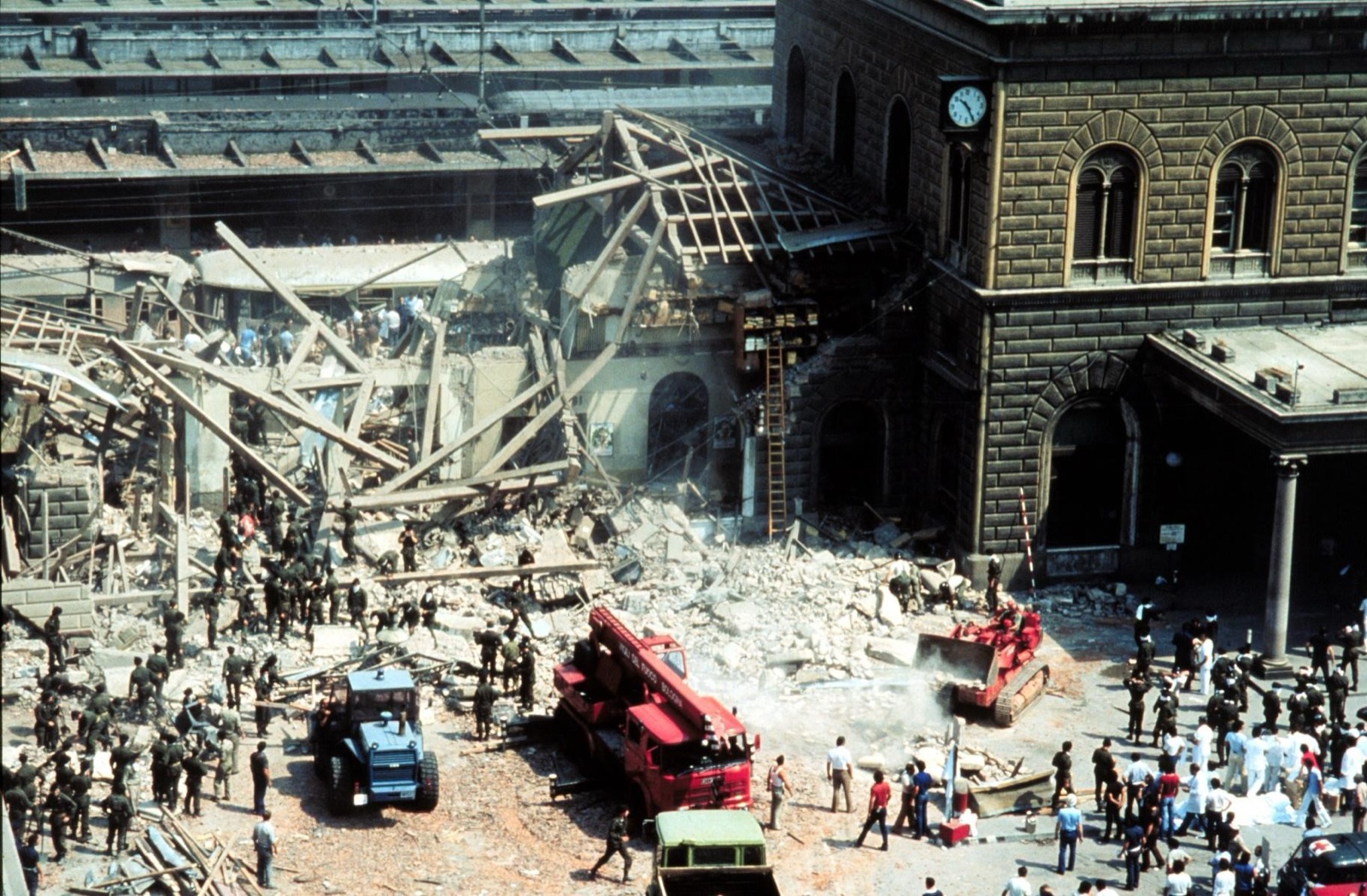
Operation Gladio
From 1956 onward, NATO and the CIA helped build clandestine paramilitary networks across Western Europe — Italy, Belgium, West Germany, France, the Netherlands, Greece, Turkey, Spain, Portugal — designed to wage guerrilla war if the Red Army crossed the Iron Curtain. The Red Army never crossed. The networks did not disband. In Italy, where the operation was codenamed Gladio, the same structures became entangled with right-wing terror that killed hundreds of civilians between 1969 and 1984. The network's existence was confirmed by the Italian Prime Minister, in Parliament, on October 24, 1990.