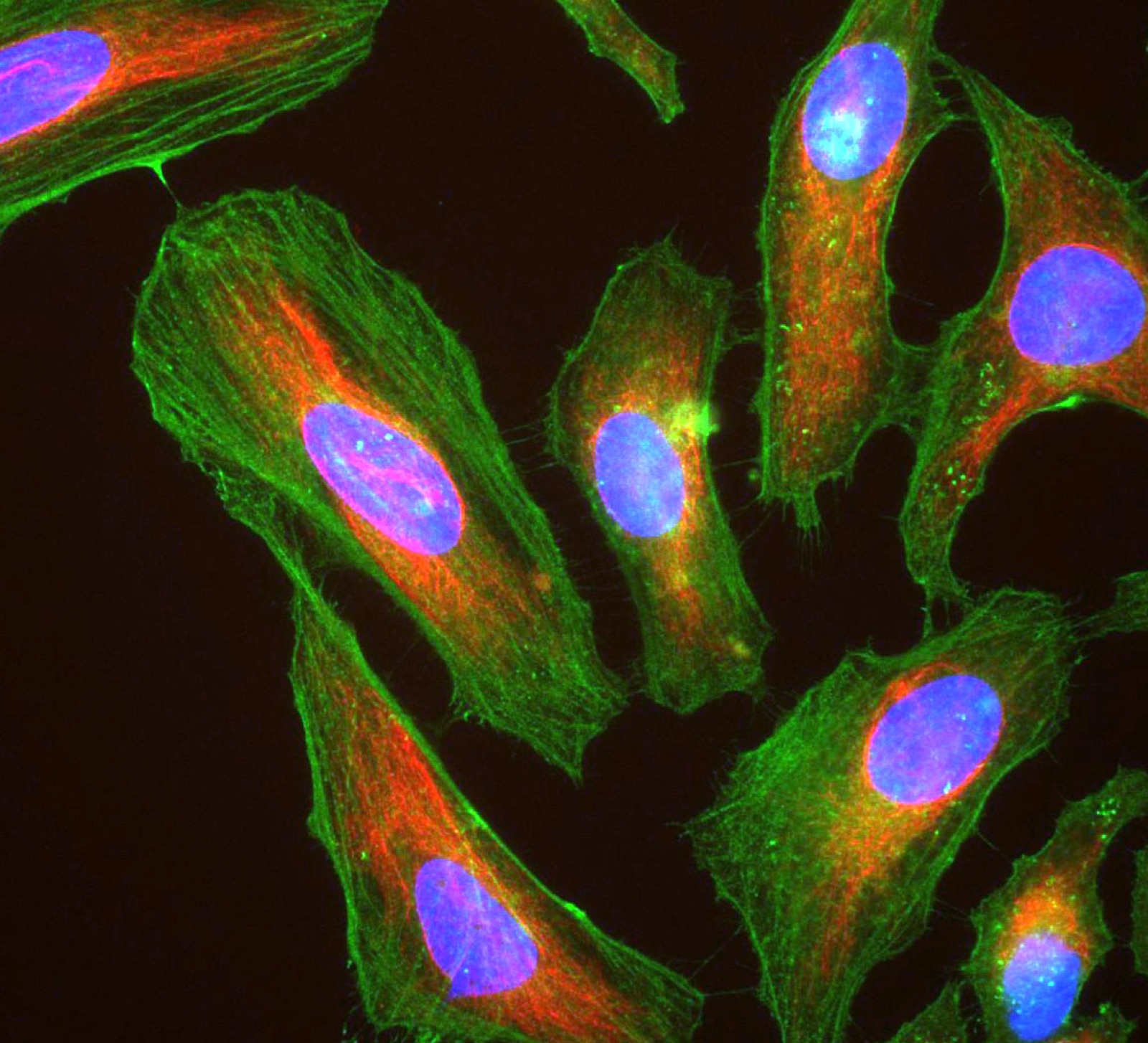
HeLa cells under fluorescence microscopy — the actin filaments stained green, vimentin red, and the DNA of each nucleus blue. Grown from a sample of Henrietta Lacks's cervical cancer taken in 1951 without her knowledge, they were the first human cells to survive and divide indefinitely in culture, and became one of the most widely used tools in all of biology. Wikimedia Commons / GerryShaw, CC BY-SA 3.0.
Henrietta Lacks and the Cells That Would Not Die
Baltimore, 1951 onward — a poor Black woman's cancer cells, taken without her knowledge as she was dying, became the first immortal human cell line and one of the most important tools in the history of medicine. Her family did not find out for twenty-five years, and was never paid
- Category
- Health & Medicine
- Published
- Length
- 4,340 words · 20 min read
- Author
- The editors
The story of Henrietta Lacks holds two things that are hard to hold at once. One is a genuine wonder of science: an immortal line of human cells that has saved or improved an almost uncountable number of lives. The other is a quiet injustice: those cells were taken from a dying woman without her knowledge, used to build careers and fortunes, and her own family was left out of all of it — uninformed, uncompensated, and for years not even told. Neither cancels the other. The good that came from HeLa is real, and so is the wrong done to the woman it came from, and the discomfort of holding both is the honest response to her story.
This is the story of the woman, the cells, and the debt.
Henrietta
She was born Loretta Pleasant in 1920 in Roanoke, Virginia, and raised in the tobacco country of Clover, in a cabin that had once been slave quarters on the plantation where her ancestors had been enslaved. She married her cousin David "Day" Lacks, had five children, and during the Second World War moved north to Turner Station, a Black community near Baltimore, where Day found work in the steel mills. By the accounts of those who knew her, she was warm, vivid, fond of dancing and of painting her nails red — a particular person, which is worth insisting on, because history would soon reduce her to a code of four letters.
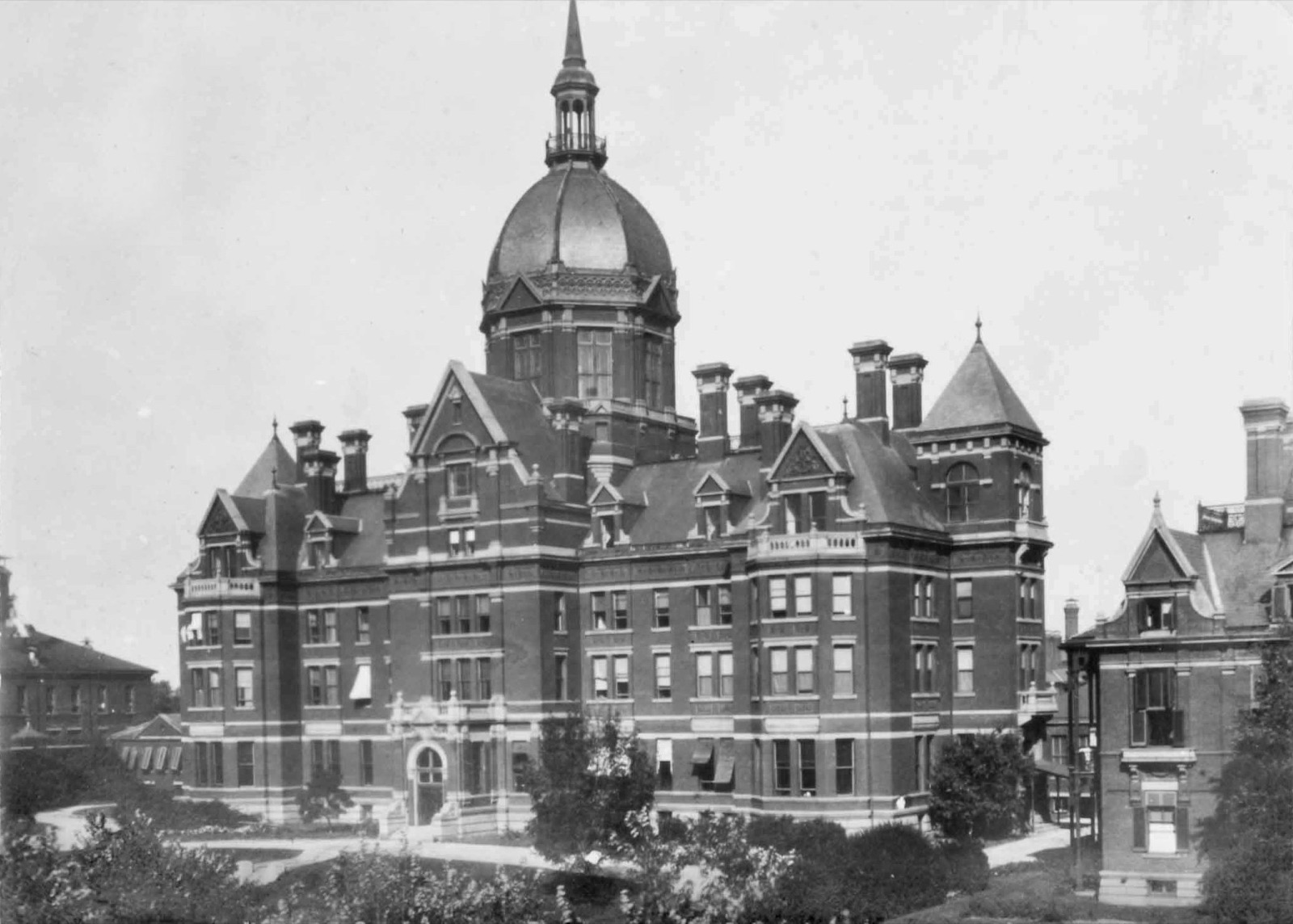
In early 1951 Henrietta felt what she described as a "knot" inside her, and bleeding that was not her period. At Johns Hopkins, doctors found a malignant tumour on her cervix — an unusually aggressive cancer that would spread through her body with terrible speed. She was treated with radium, the standard of the day, the tubes sewn temporarily into place. During one of these procedures, a surgeon removed two dime-sized pieces of tissue from her cervix — one from the tumour, one from healthy tissue nearby — without asking her, and without telling her. The samples were carried to the laboratory of Dr George Gey, the head of tissue culture research at Hopkins, who for years had been trying, and failing, to grow human cells that would live outside the body. Henrietta knew nothing of any of this. She underwent her treatment, grew sicker, and on October 4, 1951, she died. She was thirty-one, and was buried in an unmarked grave in Clover, near the cabin where she was born.
The manner of her dying matters to the story, because it underlines how little the medical system of her time regarded her as a person whose wishes counted. Henrietta was treated in the "colored" ward, a segregated section of even this comparatively progressive hospital, and her cancer — driven, it would later turn out, by a virus — was ferociously aggressive, spreading until tumours studded her organs. She was in agonising pain at the end. The doctors who treated her were, in their own terms, doing their best for a desperately ill charity patient; the same doctors saw nothing remarkable, and certainly nothing requiring permission, in shaving off a sample of her tumour to hand to the laboratory upstairs. The two facts sit together uneasily and truthfully: she was cared for, and she was used, and the people doing both did not think the second required asking.
The immortal line
What happened to Henrietta's cells in Gey's laboratory was, in purely scientific terms, extraordinary. Human cells grown in culture had always died after a limited number of divisions, frustrating every attempt to study them at length. Henrietta's cancer cells did not. They thrived, doubling roughly every twenty-four hours, growing with a vigour that astonished the lab. They were, in effect, immortal — a line that could be kept alive and multiplied indefinitely, the first time anyone had achieved this with human tissue. Gey labelled the culture "HeLa," from Henrietta Lacks, and, true to the scientific culture of the time, began giving samples away to any researcher who wanted them, free of charge.
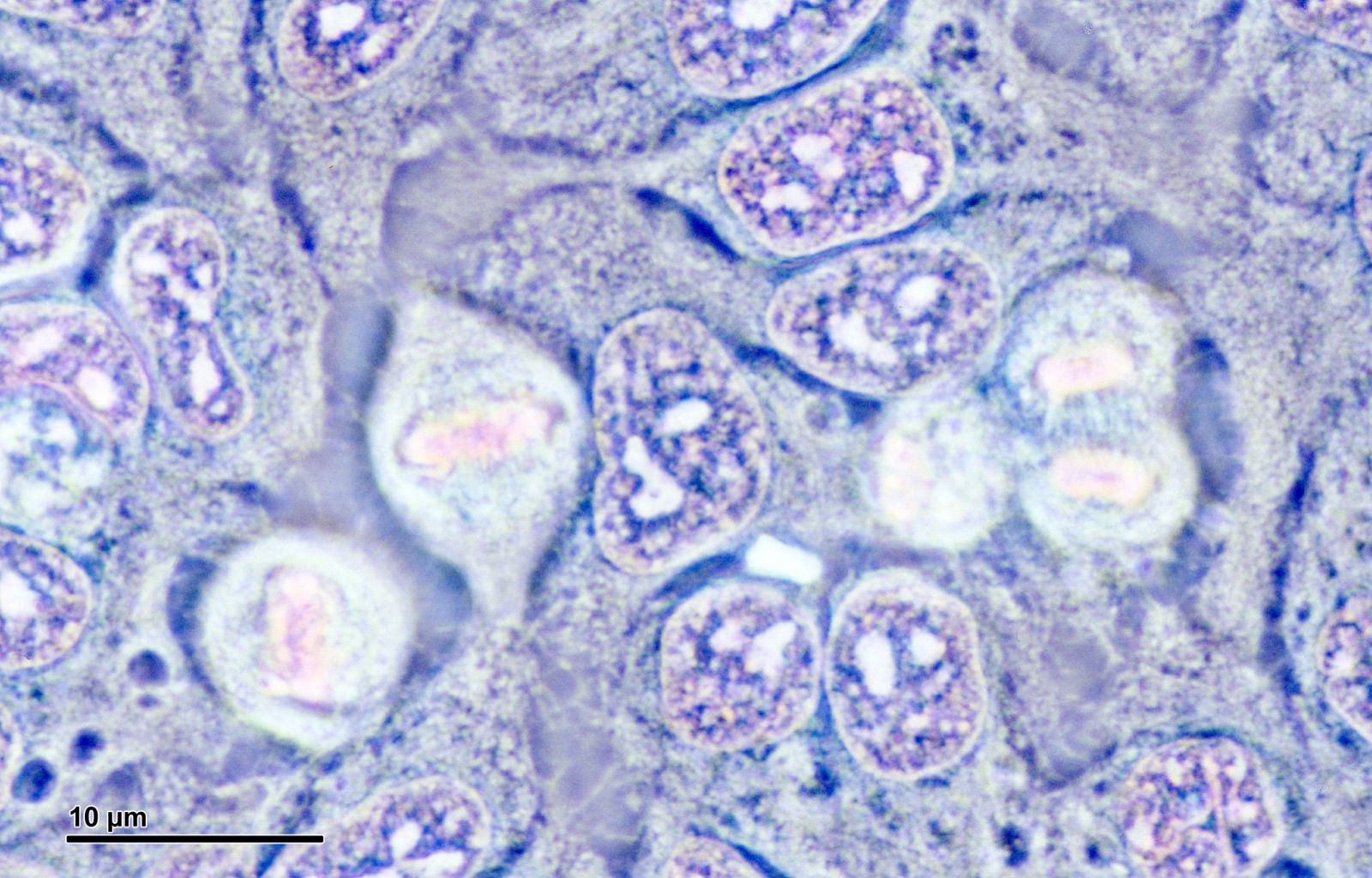
From that generosity, and from the cells' sheer robustness, HeLa spread across the world with astonishing speed. They were easy to grow, easy to ship, and they survived conditions that killed more delicate cultures. Laboratories everywhere adopted them as a standard human cell — a living, dividing piece of human biology that any researcher could keep on a shelf and experiment on at will. Within a few years, the cells of a woman who had died unknown in a Baltimore charity ward were growing in laboratories on multiple continents, and the science being done on them was beginning to change medicine.
Why HeLa was immortal when other cells were not is itself part of the story, and a clue to the cancer that killed her. Normal human cells can divide only a limited number of times before they stop — a built-in countdown, later named the Hayflick limit, tied to the gradual shortening of the protective caps on the ends of chromosomes. Cancer cells can escape that countdown, and Henrietta's had escaped it with unusual completeness: her tumour, it would eventually be understood, was driven by the human papillomavirus (HPV), which had switched on the cellular machinery that keeps the chromosome caps from eroding, allowing the cells to divide forever. The very aggressiveness that made her cancer fatal was what made her cells immortal in a dish. The biology that killed Henrietta Lacks is the same biology that made HeLa one of the most useful objects in the history of medicine — a cruelty and a gift folded into the same cells.
What HeLa built
It is genuinely difficult to overstate what HeLa cells have contributed to science, because they were there at the start of so much of it. The first great application came almost immediately: when Jonas Salk developed his polio vaccine in the early 1950s, HeLa cells — which proved able to grow poliovirus in quantity — were used to test and help produce it, accelerating one of the great public- health triumphs of the century. From there the list runs on and on.
And HeLa was not only a gift to science; it became a product. As demand grew, companies began mass-producing HeLa cells and selling them to laboratories — a commercial trade that, over time, formed part of a bioproducts industry worth billions. Vials of Henrietta's cells could be ordered from a catalogue. The cells had become, in the most literal sense, a commodity: bought, sold, and shipped around the world, generating revenue for many — and nothing at all for the family of the woman whose body had produced them.
Two threads of the HeLa story carry a particular sting. The first is a kind of redemption: HeLa cells were central to the research that established that HPV — the virus that had caused Henrietta's own cancer — causes cervical cancer, work that ultimately led to the HPV vaccine now given to millions of girls and boys to prevent the very disease that killed her. The cells taken from her tumour helped build the tool that could have saved her. The second thread is darker: HeLa proved so vigorous that, over the years, it escaped its cultures and contaminated laboratories worldwide, silently overgrowing and corrupting other cell lines until untold numbers of experiments turned out to have been performed, unknowingly, on Henrietta Lacks's cells. The woman whose consent was never sought ended up, in a sense, infiltrating the whole enterprise of cell biology — an unruly, immortal presence that science could neither fully control nor honestly ignore.
The family left behind
For more than twenty years, while HeLa conquered the world's laboratories, Henrietta's husband and children knew nothing about it. They knew only that Henrietta had died young and painfully of cancer. The cells were often attributed, in the early literature, to a "Helen Lane" or "Helen Larson" — pseudonyms that further severed the line from the woman — and no one from the scientific world had told her family that a part of her was alive and multiplying in laboratories across the planet.
The family found out almost by accident, and in a way that compounded the wrong. By the 1970s, HeLa had become so aggressive and widespread that it was contaminating and overgrowing other cell cultures in labs around the world, corrupting experiments. To sort out the contamination, researchers wanted genetic samples from Henrietta's blood relatives, and so, in the mid-1970s, scientists contacted the Lacks family and drew their blood — without ever clearly explaining why. Some family members came away believing they were being tested for the cancer that had killed their mother. Slowly, painfully, and largely on their own, they pieced together the truth: that Henrietta's cells had been taken without consent, had become famous and commercially valuable, and that they — her surviving husband and children, some living in poverty, some unable to afford health insurance — had never been told, consulted, or compensated.
For her daughter Deborah Lacks in particular, the discovery became a lifelong preoccupation: a need to know who her mother had been, what had been done to her, and what the glowing cells in the photographs actually were. The family's struggle to understand — and to be acknowledged — would eventually become the heart of how the wider world came to know the story.
The cruelty of the family's situation was its symmetry. Henrietta's cells had helped generate enormous wealth and were central to medicine that prolonged countless lives, while her own children grew up motherless and poor, and several of them, as adults, could not afford the basic health care that her cells had helped make possible. They had not even the consolation of being asked. For decades they carried a confused, painful awareness that something of their mother was out in the world being used and sold, without ever being given the standing to understand it, consent to it, or benefit from it. It is hard to imagine a sharper illustration of how the value created from a human body can flow entirely away from the person and the family it came from — wealth and health for strangers, grief and exclusion for her own.
Race, consent, and the body
It is impossible to tell Henrietta Lacks's story honestly without race at its centre. She was a poor Black woman treated in a segregated charity ward in 1951, and the taking of her cells without consent cannot be cleanly separated from that fact. This was the same era in which the United States Public Health Service was running the [[tuskegee-syphilis]] study, deliberately leaving Black men untreated to watch a disease progress; an era in which Black Americans had deep and well-founded reasons to distrust a medical system that had long treated them as subjects rather than patients. Henrietta's cells were taken in a context where the consent of a poor Black patient was simply not thought to be required.
The mistrust this bred was neither paranoid nor abstract. Black Americans of Henrietta's generation passed down stories of "night doctors" who seized Black bodies for dissection, and lived with the reality of being used, disproportionately and without consent, as teaching material and research subjects in the nation's hospitals. Poor patients of every colour were treated, in the charity wards where medicine was learned and tested, as a kind of payment in kind: free care in exchange for becoming available to science. Race sharpened that bargain into something closer to expropriation. When the Lacks family eventually learned what had been done — and then, when researchers came to draw their blood without clear explanation, felt it happening again — their suspicion that the medical world saw them as material rather than people was not a misreading. It was an accurate description of a system that had, for generations, treated people like them exactly that way.
The genome and the reckoning
The wider world came to know Henrietta Lacks largely through the journalist Rebecca Skloot, whose 2010 book The Immortal Life of Henrietta Lacks spent years on the bestseller lists, told the story of both the science and the family, and gave Henrietta back her name and her humanity. It was later adapted into a film. The book turned a four-letter laboratory abbreviation back into a person, and it forced a public reckoning with how that person had been treated.
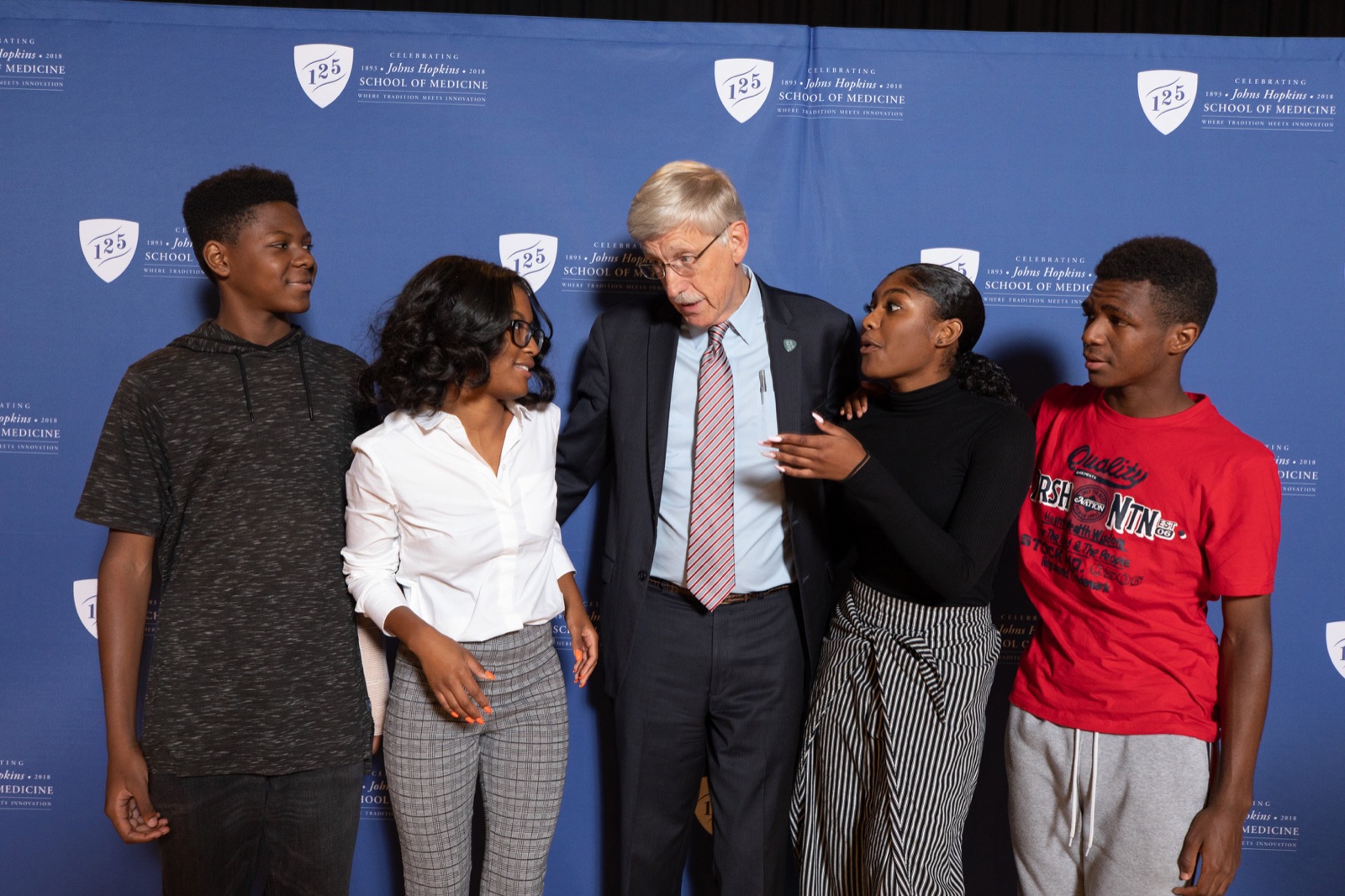
The reckoning sharpened in 2013, when a team of researchers sequenced and published the entire HeLa genome — the complete genetic code of Henrietta Lacks — without consulting her family. Because relatives share much of their DNA, publishing her genome effectively exposed private genetic information about her living descendants, who again had not been asked. After the family objected, the National Institutes of Health, under its director Francis Collins, negotiated an agreement: HeLa genome data would be placed under controlled access, and members of the Lacks family would sit on the committee deciding who could use it. It was a remarkable, if very late, acknowledgement that the family had rights in the matter at all. Then, in 2023, the family reached a settlement with a major biotechnology company that had sold HeLa products — the first time, after seven decades, that Henrietta Lacks's descendants received compensation connected to her cells.
Institutions, too, have shifted from silence to acknowledgement. Johns Hopkins, which has long maintained that it neither sold nor profited from the HeLa cells, has publicly recognised its failures in the matter, named a research building after Henrietta Lacks, and established lectures and scholarships in her honour. The wider scientific world increasingly treats her name as a standing reminder of what consent and recognition require. None of this undoes the original wrong, and some of the family have been clear that statues and building names are no substitute for the say and the share they were denied for seventy years. But the trajectory — from a woman reduced to four anonymous letters, to a named person memorialised, consulted, and at last compensated — is itself a small history of how slowly, and how incompletely, medicine has learned to see the people behind its samples.
What is established, and what it means
The facts of the Henrietta Lacks story are not in dispute. The cells were taken without her knowledge or consent; they became the immortal HeLa line; HeLa transformed biomedicine and became a commercial product; her family was not informed for over twenty years and went uncompensated for over seventy. What the story demands is not a factual investigation but a moral one — about consent, about whose bodies science is built on, and about who is remembered and who is paid.
It would be easy to flatten the story in either direction — to treat HeLa purely as a triumph and wave away the wrong, or to treat the science as tainted by its origins. Both miss the point. The honest reckoning is that the good and the wrong are bound together: the same cells that advanced medicine for everyone were taken from a woman who was given no say and a family who were given nothing, in a system that — through the ordinary workings of segregation, custom, and law — was arranged so that this could happen without anyone quite breaking a rule. That is what makes Henrietta Lacks's story a permanent fixture of bioethics. It is not the tale of a single villain. It is the tale of a whole structure that could take everything from a person and call it routine.
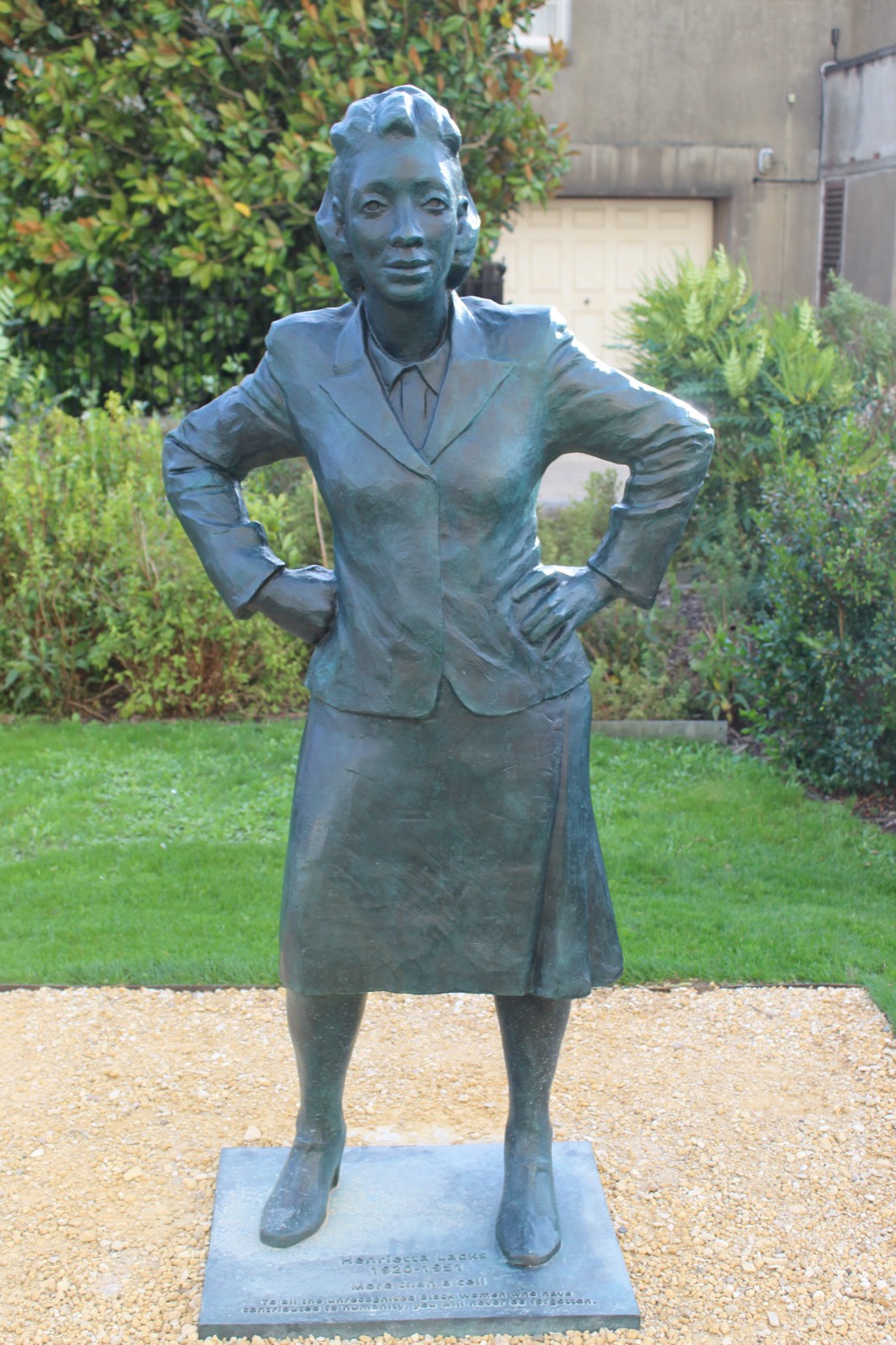
In the end, Henrietta Lacks is everywhere and was, for most of a century, nowhere — her cells in every major laboratory on earth, her name unknown even to the scientists who used them. The reckoning, when it came, could not undo what was taken or repay what was owed; it could only insist on the truth, which is that the immortal cells had a mortal source, that she was a person and not a product, and that the medicine built on her was built on something taken from her without a word. She has a statue now, and a name on the papers, and at last a family acknowledged in the matter of her own body. It is very late. It is better than the silence that came before.
Sources
- Rebecca Skloot, The Immortal Life of Henrietta Lacks (Crown, 2010) — the definitive popular account — secondary.
- Johns Hopkins Medicine, official statements and history regarding Henrietta Lacks and the HeLa cell line — primary.
- National Institutes of Health, the 2013 HeLa Genome Data Use Agreement and related statements (Francis Collins) — primary.
- Moore v. Regents of the University of California, California Supreme Court (1990) — primary.
- Reporting on the 2023 Lacks family settlement with Thermo Fisher Scientific — secondary.
- Scientific literature on the origin, characteristics, and uses of the HeLa cell line, including its role in the polio vaccine — academic.
- Histories of race and consent in American medicine, including the [[tuskegee-syphilis]] study — academic.
- George Gey's contemporary tissue-culture research records and later accounts of the HeLa line's creation — primary.
- Coverage of the HeLa genome publication controversy (2013) and the bioethics debate it prompted — secondary.
Inspired this / based on it
Rebecca Skloot
Crown. The bestselling account that restored Henrietta's name and told her family's story.
George C. Wolfe
HBO. Adaptation of Skloot's book, with Oprah Winfrey as Deborah Lacks.
Adam Curtis / BBC
Early documentary on the HeLa cells and the story behind them.
Filed under
- #henrietta-lacks
- #hela
- #johns-hopkins
- #cell-culture
- #medical-ethics
- #informed-consent
- #race-and-medicine
- #bioethics
- #1950s
- #confirmed
Click any tag for every article carrying it.
Continue reading
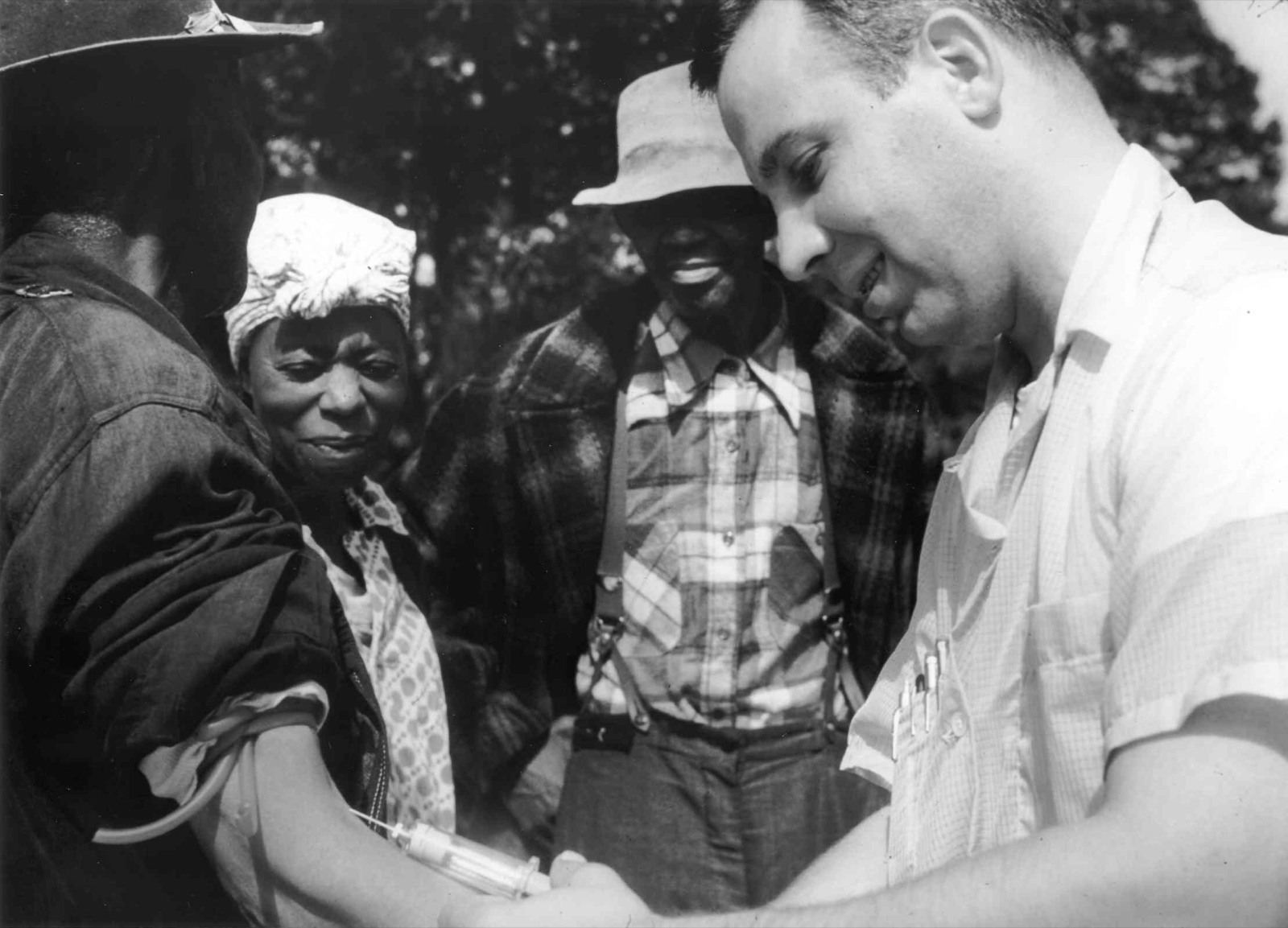
The Tuskegee Syphilis Study
In 1932, the U.S. Public Health Service began a study of 399 Black men in Macon County, Alabama, who had syphilis. They were told they were being treated. They were not. For forty years — including the twenty-five years after penicillin became standard care — the Public Health Service watched the disease take its course. A whistleblower's documents reached the Associated Press on July 25, 1972, and the study ended a few months later. President Clinton apologized on behalf of the United States government in 1997.
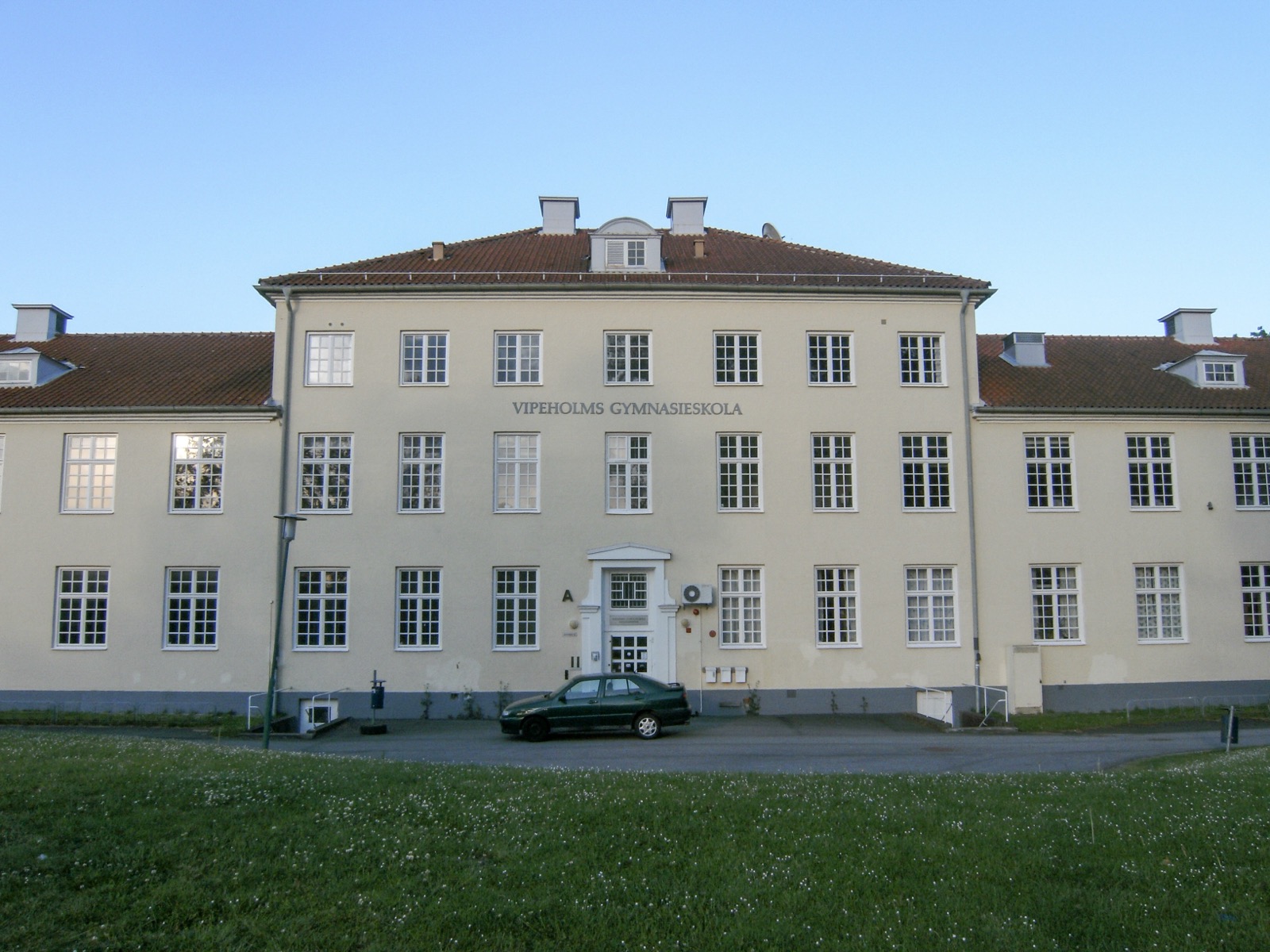
The Vipeholm Experiments and the Toffee Made to Rot Teeth
At the Vipeholm hospital outside Lund, in southern Sweden, the patients could not leave and could not consent. They were adults with severe intellectual disabilities, classified in the language of the time as 'uneducable,' housed for life in a state institution that controlled every meal they ate. And in the years after the Second World War, that total control made them, in the eyes of Sweden's medical authorities, the perfect material for an experiment. The country had one of the worst rates of tooth decay in the world, and the National Board of Health wanted to understand, definitively, what caused it. So between 1945 and the mid-1950s, researchers used the people of Vipeholm to find out — feeding different groups different diets, and, in the most notorious phase, giving some of them large quantities of a specially formulated sticky toffee, eaten between meals, that was engineered to cling to the teeth and bathe them in sugar for as long as possible. The patients' mouths were the laboratory. Many of them developed severe, irreversible cavities. The studies that resulted were a genuine scientific landmark: they established, more clearly than any work before, that it is sugar — and above all sugar eaten frequently and in sticky form — that drives tooth decay. That finding reshaped dentistry and gave Sweden its enduring tradition of lördagsgodis, sweets saved for Saturdays. But it was bought with the teeth of people who were never asked, and could not have answered. This is the story of what was done at Vipeholm, what it taught the world, and the question it leaves about the price of knowledge.
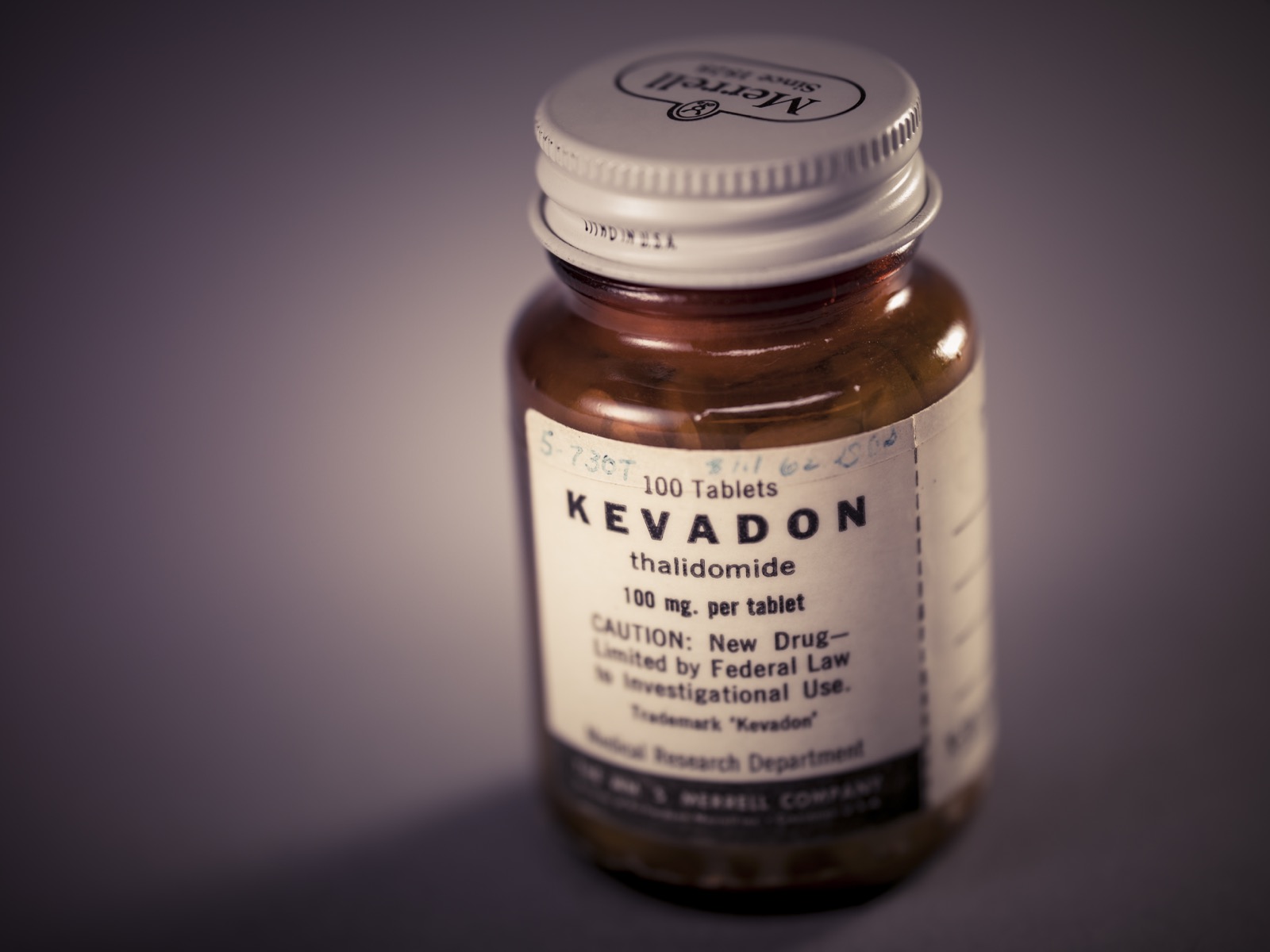
Thalidomide and the Wonder Drug That Came for the Unborn
It was sold as the safest drug imaginable. Thalidomide — marketed as Contergan in West Germany, Distaval in Britain, Neurosedyn in Sweden, and Kevadon in North America — was a sedative and sleeping pill that the German company Grünenthal advertised as so harmless it was impossible to take a fatal overdose, suitable even for children, and, crucially, safe for pregnant women suffering morning sickness. None of it had been properly tested for what it did to a developing fetus, because in the late 1950s almost no one tested for that at all. Between 1957 and 1961 the drug was sold in dozens of countries, and as it spread, something terrible began to appear in maternity wards: babies born with limbs shortened or missing entirely — hands attached at the shoulder, the condition doctors called phocomelia — along with damage to ears, eyes, hearts, and internal organs. By the time the cause was identified and the drug pulled from shelves in late 1961, roughly ten thousand children worldwide had been born with thalidomide injuries, and thousands more had died before or shortly after birth. The United States was very nearly spared entirely, because of one woman: Frances Oldham Kelsey, a new reviewer at the Food and Drug Administration who, against sustained pressure from the manufacturer, simply refused to approve it. The thalidomide disaster destroyed the comfortable assumption that a drug on the market must be safe, broke the makers' long resistance to accountability, and forced governments to rebuild the entire system by which medicines are tested and approved. This is the story of how it happened, who stopped it, and what it changed.