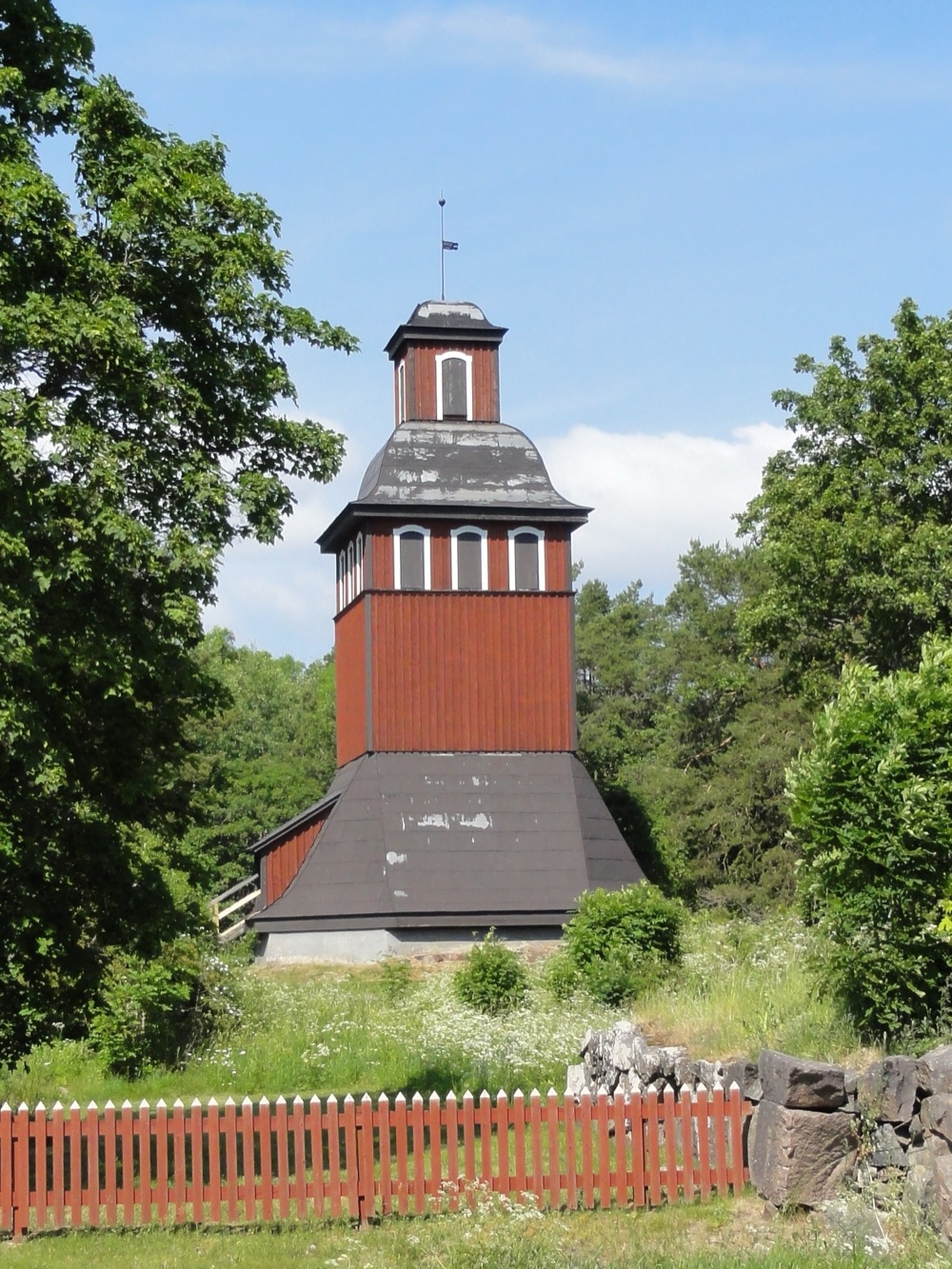
The village of Knutby in Uppland, north of Stockholm. In this quiet rural place, an insular Pentecostal congregation developed cult-like control that culminated in a manipulated murder in 2004. Wikimedia Commons / CC BY-SA 3.0.
Knutby: The Swedish Pentecostal Cult and the Nanny Made to Kill
Sweden, 2004 — In a small, insular Pentecostal congregation, a female leader was revered as the 'Bride of Christ,' and a charismatic pastor wielded near-total control. He manipulated the family's young nanny into shooting his wife dead — a murder that exposed how a closed religious community had become a machine of coercion
- Category
- Religion, Cults & Spirituality
- Published
- Length
- 3,600 words · 18 min read
- Author
- The editors
The Knutby case is a smaller and more intimate tragedy than the mass deaths of Jonestown or the Solar Temple, but it is no less revealing of how coercive religious control works, and in some ways it is more unsettling precisely because of its scale. There was no compound, no mass death, no exotic apocalypse — just a small Pentecostal congregation in a Swedish village, and a single murder. Yet that murder, and the community that produced it, laid bare with terrible clarity the machinery by which a closed religious group and a manipulative leader can take an ordinary, vulnerable person and turn her into an instrument of killing. Knutby is a case study in coercive control at close range, and its lesson is that the dynamics which end in the deaths of hundreds in a jungle can operate, just as destructively, in a single household in the ordinary countryside.
This is the story of the murder at Knutby.
The congregation
Knutby is a small village in the rural landscape of Uppland, in the county of Uppsala, and for most of its history it was utterly unremarkable — a scattering of houses, a church, a station, the quiet rhythms of the Swedish countryside. Sweden is a heavily secular country, but it retains free-church and Pentecostal congregations, and in Knutby there was one such small community, the Knutby Filadelfia, part of the broader Pentecostal (Filadelfia) tradition.

Over the 1990s and into the 2000s, this small congregation turned increasingly inward, developing the characteristics of a cult: a closed community, a heightened sense of separation from the surrounding world, and an intense concentration of spiritual and personal authority in its leaders. The decisive theological development was the emergence of the belief that one of the congregation's leaders, Åsa Waldau, was a figure of divine significance — that she was the "Bride of Christ" (Kristi Brud), destined to be wedded to Jesus at his second coming. Around this belief, and around a small circle of leaders, the congregation organized itself into an environment of extraordinary control, in which members' lives, relationships, and beliefs were shaped and dominated by the group's authority.
The transformation of a mainstream Pentecostal congregation into a controlling group did not happen overnight, and understanding how it occurred is important, because the process is a familiar one. It began, as such things often do, with intensified devotion and a heightened sense of the community's special spiritual status, which shaded gradually into separation from the outside world and suspicion of those beyond the group. Authority became increasingly concentrated and increasingly unquestionable, and the ordinary boundaries between religious guidance and personal domination eroded. Members' relationships, marriages, and decisions came under the community's influence; dissent and independent judgment were discouraged; and the leaders' claims — culminating in the extraordinary assertion of a divine "Bride of Christ" in their midst — were accepted as beyond challenge. Each step may have seemed a natural deepening of faith to those inside, which is precisely how a healthy religious community can slide, without any single obvious moment of rupture, into a coercive one.

The pastor
The "Bride of Christ" belief that stood at the center of the congregation's theology deserves a word, because it illustrates how a group's spiritual claims can become an engine of control. To hold that a living member of one's own community was a divine figure, destined to wed Christ himself, was to place her — and the inner circle around her — beyond ordinary human question, clothing the leaders' authority in the absolute garments of the sacred. In such a framework, to defy the leadership was not merely to disagree with fellow believers but to defy the divine order itself, and the psychological pressure to submit became enormous. This is the deeper function such extraordinary claims serve in coercive groups: they transform the leaders' will into the will of God, so that obedience becomes salvation and dissent becomes damnation, and the individual's capacity to resist is dissolved in reverence. The Knutby congregation had built exactly such a structure, and it was within it that the pastor Helge Fossmo operated.
The figure who would turn this closed world lethal was Helge Fossmo, a pastor in the congregation. Charismatic, intelligent, and manipulative, Fossmo wielded great influence within the Knutby Filadelfia, and his personal life was entangled with the community's power structure in ways that would prove catastrophic. His history included an earlier tragedy: his first wife had died some years before, in circumstances that had been treated as accidental but that later attracted suspicion — though that earlier death was not the basis of the case that would eventually convict him. Within the congregation's intense, controlled environment, Fossmo operated as a dominating presence, and he came to exercise a particularly profound and destructive control over one vulnerable member of the community: the young woman who worked as a nanny in his household, Sara Svensson.
The manipulation
The relationships at the heart of the Knutby tragedy were tangled and illicit. Helge Fossmo was married to Alexandra, but he was also involved with other women in the community's orbit — including Sara Svensson, the nanny, and another woman whose husband was a neighbor named Daniel Linde. These entanglements, within a community that fused the personal and the spiritual and demanded obedience to its leaders, created the volatile situation from which the murder emerged. Fossmo, it would be established, set out to have his wife killed and to strike at the husband of the other woman, and he chose as his instrument the person he had most completely under his control: Sara Svensson.
The means of manipulation was as insidious as it was effective. Fossmo worked on Svensson psychologically, exploiting her dependence and her conditioning to obey, and he used anonymous text messages, which Svensson was led to understand as carrying a divine or unquestionable authority, to direct her toward the killing. In a mind already isolated and dominated, framed within a religious world where obedience to authority was paramount and where the ordinary checks of independent judgment had been eroded, these instructions took on a coercive force that an outsider might find impossible to comprehend. Svensson was, in a real sense, both perpetrator and victim: the hand that fired the gun, and a person whose capacity to refuse had been systematically dismantled by the man who directed her.
The murder
On the morning of 10 January 2004, Sara Svensson carried out the crime she had been directed toward. She went to the Fossmo home and shot Alexandra Fossmo, killing her, and then went to a neighboring house and shot Daniel Linde, who was gravely wounded but survived. The violence, in the quiet village, was shocking, and the initial mystery of who had done it and why did not last long: Sara Svensson was identified and, when questioned, confessed to the shootings.
But the confession of the nanny was only the surface of the case. As investigators probed the circumstances — the relationships, the messages, the dynamics of the congregation — the picture that emerged was not of a lone killer but of a manipulated one, and behind her stood Helge Fossmo. The anonymous text messages were traced and their true source and purpose uncovered; the web of Fossmo's relationships and his motive to be rid of his wife and to strike at his lover's husband came into view; and it became clear that the pastor had orchestrated the murder, using Svensson as his instrument. The killing was not the eruption of one disturbed mind, but the calculated act of a manipulator who had turned another person into a weapon.
The reckoning
The Swedish justice system prosecuted both the hand and the mind behind the crime. Sara Svensson was convicted of the murder and the attempted murder, but the court found that she was suffering from a serious mental disorder, shaped by the coercion and manipulation she had endured, and she was sentenced not to prison but to forensic psychiatric care. Helge Fossmo was prosecuted as the instigator — for incitement to murder and to attempted murder — and, convicted, was sentenced to life in prison. The verdicts recognized the essential structure of the crime: that the person who fired the gun had been manipulated into doing so by the person who bore the deeper responsibility.

The case transfixed and horrified Sweden, a secular country unused to such an eruption of lethal religious coercion in its midst, and it prompted a long reckoning with what had happened in the Knutby Filadelfia. Åsa Waldau, the leader revered as the Bride of Christ, was investigated in connection with the killing but was not charged with it. But scrutiny of the congregation continued over the following years, and a fuller picture of the abuse and control within it gradually emerged. The congregation, its reputation destroyed and its inner workings exposed, eventually dissolved, and in later years further revelations and legal proceedings addressed the pattern of abuse that had characterized the community over decades.
The longer reckoning revealed that the 2004 murder had not been an isolated aberration but the most violent symptom of a deeply dysfunctional community. In the years after the killing, former members came forward with accounts of systematic psychological, spiritual, and in some cases physical and sexual abuse within the Knutby Filadelfia stretching back many years — a pattern of control and exploitation of which the murder was the extreme expression rather than an isolated event. These later disclosures, aired in documentaries and pursued in further legal proceedings, painted a picture of a community that had been coercive and harmful long before it became lethal, and they deepened Sweden's understanding of the case from a single shocking crime into a decades-long story of religious abuse. The dissolution of the congregation, when it finally came, was the end of a community that had caused harm far beyond the one murder for which it became infamous.
For a country like Sweden — secular, orderly, proud of its rationalism — Knutby was profoundly disorienting. It punctured the comfortable assumption that lethal religious fanaticism was something that happened elsewhere, in other cultures or other centuries, and forced a recognition that the dynamics of coercive control could take root in a quiet corner of the modern Swedish countryside. The case entered the national consciousness as a byword for the dark potential of closed religious communities, and it prompted a broader awareness of coercive control and of the warning signs that a faith community may be curdling into a cult. If there is any redemption in the Knutby tragedy, it lies in that awareness — in the sober recognition, purchased at the cost of a woman's life and another's freedom, that no society is immune to the machinery of coercion, and that vigilance about it is owed everywhere.
The meaning of Knutby
In the end, Knutby stands as a small-scale tragedy that illuminates a large truth. In an ordinary Swedish village, an insular Pentecostal congregation turned in on itself, elevated one leader to divine status, and concentrated in its inner circle a power over its members' minds and lives that proved, ultimately, lethal. A manipulative pastor took the most vulnerable and dominated person within his reach — the young woman who cared for his children — and, exploiting her isolation and her conditioned obedience, directed her through anonymous messages of false divine authority to murder his wife and to shoot his lover's husband. The killing that resulted was, in its structure, both a murder and the product of coercion, and the Swedish courts recognized this, sending the manipulated nanny to psychiatric care and the manipulating pastor to prison for life. Knutby did not end in a mass grave or a burning building, but it revealed the same essential machinery that drives those larger horrors, operating in the most intimate and ordinary of settings. It is a reminder that the danger of coercive control is not confined to distant compounds and exotic beliefs, but can take root in any closed community and any dominated relationship, and that its power to turn an ordinary person into an instrument of death is as real in a village household as anywhere on earth.
Inspired this / based on it
Discovery+ / Various
Swedish documentary series revisiting the murder and decades of abuse in the congregation.
Various
The case generated extensive Swedish journalism and books.
Filed under
- #knutby-2004
- #knutby-filadelfia
- #helge-fossmo
- #cult
- #sweden
- #coercive-control
- #murder
- #religious-movements
- #2000s
- #confirmed
Click any tag for every article carrying it.
Continue reading

NXIVM: The Self-Help Company That Was a Coercive Cult
From the outside, NXIVM looked like an ambitious self-improvement business. Founded in the late 1990s near Albany, New York, it sold expensive courses in 'Executive Success Programs' — personal and professional development, communication, overcoming one's limitations — and it attracted an impressive roster of members, including successful professionals, wealthy heiresses to the Seagram fortune, and well-known Hollywood actresses. At its center was Keith Raniere, whom his followers revered as a uniquely brilliant and ethical man, calling him 'Vanguard' and treating his teachings as a path to a better self and a better world. But behind the seminars and the self-help vocabulary, NXIVM was something very different: a coercive, hierarchical group built around total devotion to Raniere, in which members were financially exploited, psychologically manipulated, and bound ever more tightly to his control. And within it, Raniere built a secret inner circle even darker than the rest — a clandestine sorority called DOS, in which women were recruited under false pretenses, made to hand over blackmail 'collateral' to guarantee their obedience, subjected to extreme dieting and sexual coercion, and branded in the skin with a symbol that, unknown to them, incorporated Raniere's own initials. When survivors escaped and spoke out, and journalists exposed the branding, the whole structure collapsed. Raniere was arrested, tried, and convicted of racketeering, forced labor, and sex trafficking, and sentenced to 120 years in prison. This is the story of how a company that promised self-improvement became an instrument of exploitation, and of the women whose courage brought it down.

Jonestown: How a Dream of Justice Became a Massacre
The Peoples Temple did not begin as a death cult. It began, in the 1950s and 1960s, as a church that preached racial integration and social justice at a time when both were radical, that fed the poor and cared for the addicted and the elderly, and that drew to it thousands of idealistic people — many of them Black, many of them poor, many of them sincere seekers of a better and fairer world. At its head was Jim Jones, a charismatic preacher who could speak movingly of equality and who built real influence in California, courted by politicians and admired by progressives. But behind the movement's humane public face, Jones was constructing something else: a system of total control, sustained by manipulation, humiliation, sexual and physical abuse, financial exploitation, and a deepening, drug-fueled paranoia. As scrutiny closed in, he moved his followers to a remote agricultural settlement carved out of the Guyanese jungle — Jonestown — where, cut off from the outside world and utterly under his power, some thousand people lived in isolation and fear. When a United States congressman flew in to investigate reports of abuse, Jones had him murdered at a nearby airstrip. And that same day, 18 November 1978, he set in motion the final act he had long rehearsed: the deaths of everyone in Jonestown. More than nine hundred people died, poisoned with cyanide — many of them forced, many coerced, and more than three hundred of them children who could not consent at all. It was not, for most of the victims, a suicide. It was a massacre. This is the story of how a dream of justice became one of the worst atrocities of its kind in modern history — and of the people who died in it.

Aum Shinrikyo and the Tokyo Subway Attack
At 7:48 a.m. on Monday, March 20, 1995, five members of the Japanese new-religious-movement *Aum Shinrikyo* boarded five different trains on three converging Tokyo subway lines. Each carried two or three plastic bags wrapped in newspaper, each bag containing approximately 600 milliliters of impure liquid sarin. As the trains approached Kasumigaseki station — the station at the political heart of Tokyo, beneath the National Diet, the Supreme Court, and the major ministries — each man set down his package, pierced the bags with the sharpened tip of an umbrella, and stepped off at the next station. The released sarin evaporated through the morning commute. The first 911 call came at 8:09 a.m. By the time the trains had been cleared, hospitals across Tokyo were processing the largest mass-casualty event in Japanese postwar history: 13 dead (a 14th died of injuries 14 years later), approximately 5,800 injured, of whom approximately 1,000 required hospitalization. The attackers belonged to a cult that, in 1989, had been registered as a recognized religious organization with Japanese authorities, and by 1995 claimed approximately 40,000 members worldwide. Its founder, Shoko Asahara — a half-blind acupuncturist and yoga instructor — had ordered the attack as part of a planned millenarian apocalypse that would establish Aum theocratic rule in Japan. Asahara was executed by hanging on July 6, 2018, together with six other Aum senior figures. The attack remains the single most consequential act of chemical-weapon terrorism by a non-state actor in modern history.