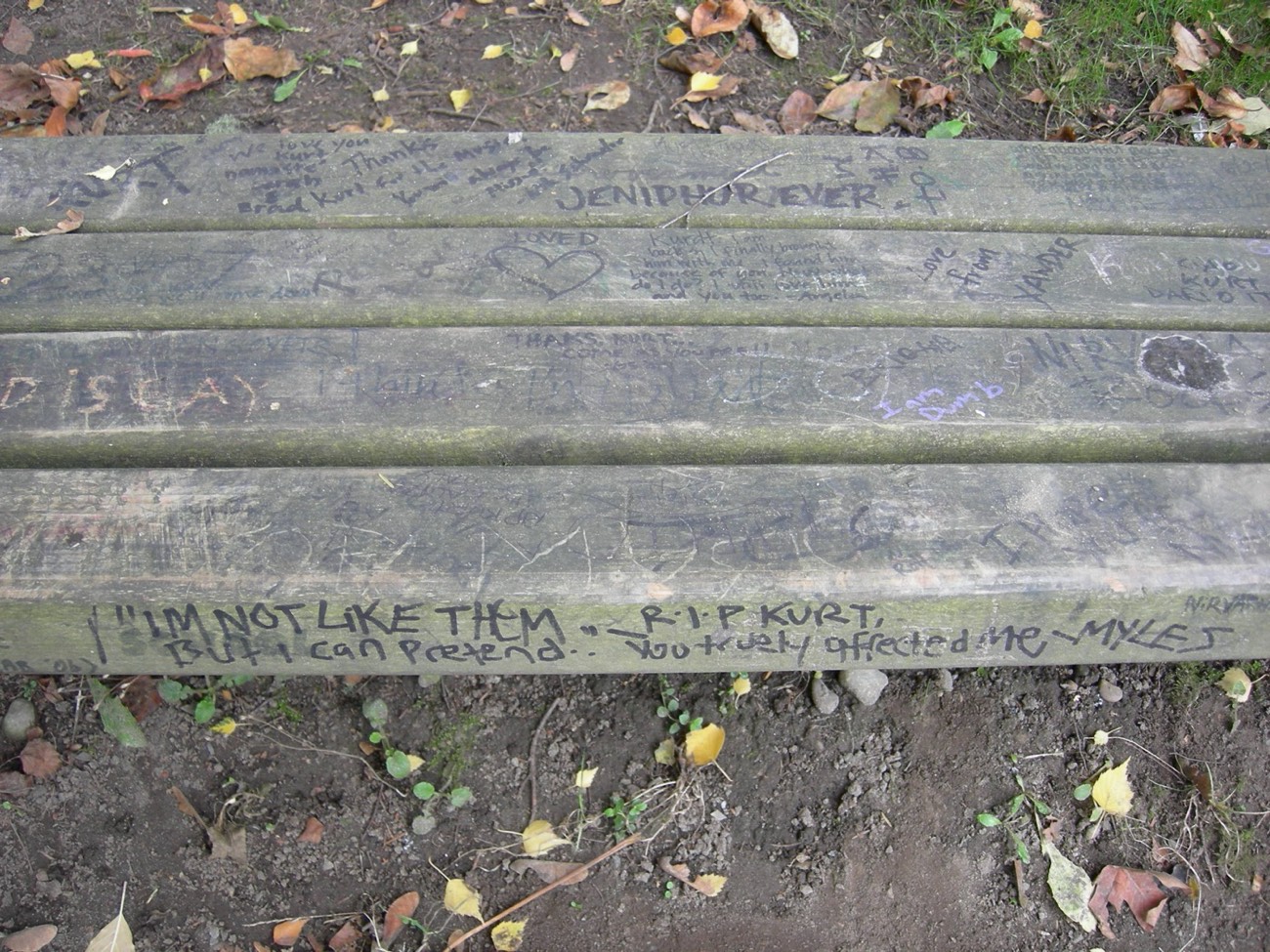
The memorial bench in Viretta Park, Seattle, near Kurt Cobain's former home, where fans have gathered to leave messages since his death in 1994. Wikimedia Commons / CC BY-SA 3.0.
The Death of Kurt Cobain: The Reluctant Icon and the Theories
Seattle, April 1994 — The Nirvana frontman who defined a generation died at twenty-seven of a self-inflicted gunshot, a death ruled a suicide and repeatedly reaffirmed by police. A minority have long alleged murder — but the evidence, and the painful reality of his struggles, point the other way
- Category
- Assassinations & Disappearances
- Published
- Length
- 3,550 words · 18 min read
- Author
- The editors
The death of Kurt Cobain is a case that demands a particular kind of care, because it sits at the meeting point of three difficult things: a real and documented suicide, a persistent conspiracy theory that denies it, and the sensitive subject of mental illness and addiction that underlies the whole tragedy. The temptation, in writing about it, runs in two dangerous directions — toward sensationalising a young man's death as a murder mystery, and toward treating suicide carelessly, as spectacle or puzzle rather than as the terrible outcome of illness it usually is. This account tries to avoid both. It takes seriously the evidence, which points clearly and consistently to suicide; it examines the murder theories honestly and explains why they have not withstood scrutiny; and it keeps at its centre what matters most and is most often lost — that Cobain was a human being in profound pain, and that his death is a tragedy to be understood with compassion, not a riddle to be solved for entertainment. The conspiracy, for all its persistence, is ultimately a way of not facing the harder and sadder truth.
This is the story of his death, told as carefully as it deserves.
The reluctant icon
To understand the shock of his death, one must understand the peculiar burden of Kurt Cobain's fame. Born in 1967 in Aberdeen, a hardscrabble logging town in Washington State, Cobain had a difficult childhood marked by his parents' divorce, instability, and a sense of alienation, and he found refuge in music. The band he formed, Nirvana, emerged from the Pacific Northwest's underground scene and, with the 1991 album Nevermind and its inescapable single "Smells Like Teen Spirit," exploded into the mainstream, toppling the polished pop of the day and making grunge a global phenomenon. Almost overnight, Cobain became the face and voice of a generation — a role he never wanted and openly resented. He was, by temperament, a sensitive, private, ironic person, deeply uncomfortable with celebrity, ambivalent about success, and troubled by the sense that his art had been co-opted and misunderstood by the very mass audience it had won.
The gap between the public Cobain — the rock god, the spokesman, the millionaire star — and the private one, a fragile and suffering young man, is central to his story. Fame magnified pressures he was ill-equipped to bear, and it came layered on top of problems that predated it: a lifelong tendency to depression, and a chronic, undiagnosed stomach ailment that caused him constant, severe pain. It was in part to dull that pain, by his own account, that he had turned to heroin, and the addiction that followed became one of the defining struggles of his final years. The image the world consumed — of angst as style, of the tortured artist as icon — obscured the reality that Cobain's torment was not a pose but a genuine and worsening medical and psychological crisis.
The struggles
An honest account of Cobain's death must dwell, with compassion, on the depth of his suffering, because it is the essential context that the conspiracy theories tend to skip. In the years before his death he battled a heroin addiction that he tried repeatedly and unsuccessfully to overcome; he was tormented by chronic physical pain from his stomach condition; and he endured a severe depression that those close to him recognised as dangerous. The strain touched every part of his life — his marriage to the musician Courtney Love, his role as a new father to their daughter, his relationship with his bandmates, and his fraught feelings about Nirvana's fame. Friends and family have described a man increasingly worn down, and there were warning signs that, in retrospect, were grave.

The clearest of those warnings came in early March 1994. While in Rome, Cobain was found unconscious after consuming a large quantity of sedatives together with alcohol, and lapsed into a coma from which he was revived only with difficulty. At the time it was described publicly as an accidental overdose, but it is now widely understood to have been, in all likelihood, a suicide attempt — a fact that bears heavily on interpreting what followed weeks later. A person who has recently made a serious attempt on their own life is at markedly elevated risk of dying by suicide, and Cobain's death in April came in the immediate shadow of the Rome episode. This is not the profile of a man unexpectedly murdered; it is, tragically, the profile of a man in acute and escalating danger from his own despair.
The final days
The last weeks of Cobain's life have the terrible momentum of a crisis reaching its end. After the Rome overdose, his family and friends, alarmed, staged an intervention, and in late March he was persuaded to enter a drug-rehabilitation facility in Los Angeles. He remained only a couple of days before leaving, climbing over a wall and making his way back to Seattle. For several days his exact whereabouts were uncertain, and his family, increasingly frightened, sought to locate him. It was during this period, the medical examiner later determined, that Cobain died, on or about 5 April, at his Seattle home. His body was discovered on 8 April by an electrician who had come to install a security system, and the news of his death spread around the world within hours, plunging his fans into grief and prompting an outpouring of public mourning.
At the scene a note was found, addressed in part to an imaginary childhood friend and to his fans, family, and wife, reflecting on his loss of joy in music and life. The note, his documented despair, the recent overdose, the toxicology, and the physical evidence together formed the basis for the suicide determination. For the medical examiner and the police, and for most who have examined the case, the conclusion was, sadly, not in serious doubt: a profoundly depressed and addicted young man, days after a near-fatal attempt and an aborted stint in rehab, had taken his own life.
The murder theories
Despite this, a persistent minority have argued that Cobain was murdered, and their claims deserve to be addressed honestly rather than merely dismissed. The theories originated largely with a private investigator whom Courtney Love hired to locate Cobain during the days he was missing, and who afterward came to believe, and to publicise, the view that Cobain had been killed — a view later amplified in books and in documentary films. The arguments assembled over the years include claims that the high level of heroin in Cobain's blood would have incapacitated him and made it impossible for him to act; that the note reads more like an announcement of retirement from music than a farewell to life; that the shotgun bore no legible usable fingerprints; and that aspects of the investigation were handled improperly. Around these arguments has grown a cloud of insinuation, sometimes directed at those closest to him.

It is important, in addressing these theories, to be fair to the living. The insinuations that have swirled around Cobain's widow and others have never been supported by evidence, and no such person has ever been charged with any crime; they are entitled to the presumption of innocence, and it would be both unjust and irresponsible to treat rumour and speculation as if they were fact. The persistence of the murder theory owes less to any evidence than to a combination of factors: the difficulty of accepting the suicide of a beloved figure, the appetite of books and films for a sensational alternative, and the genuine, understandable grief and anger of fans who cannot bear the idea that their hero chose to leave. But understandable emotion is not evidence, and the honest conclusion, however painful, is that the official finding is almost certainly correct.
What the theories miss
The deepest problem with the conspiracy theories is not merely that they are unsupported, but that they distract from what actually matters about Cobain's death, and in doing so do a disservice to him and to others who suffer as he did. By reframing his death as a murder mystery — a whodunit with villains and clues — they turn a tragedy of mental illness and addiction into entertainment, and they implicitly deny the reality of the suffering that killed him. Cobain did not die because of a plot; he died because he was gravely ill, in ways that his era, and his own circumstances, failed to treat adequately. His depression was real, his addiction was real, his physical pain was real, and his death was the culmination of all three, foreshadowed by a suicide attempt only weeks before. To insist otherwise is, in a sense, to look away from the hard truth about suicide: that it can take even the gifted, the beloved, and the outwardly successful, and that its causes are usually to be found not in conspiracies but in the treatable, and too often untreated, illness of depression.

What it means
Kurt Cobain's death was a generational trauma, and its meaning has deepened rather than faded with time. In the immediate aftermath it was mourned as the loss of a singular artist and the symbolic end of an era; in the decades since, as conversations about mental health have grown more open, it has come also to be seen as a stark example of the toll of untreated depression and addiction, even — especially — on the seemingly invincible. Cobain has taken his place, at twenty-seven, in the melancholy company of gifted musicians lost too young, and his music endures, as vital and as raw as ever. But perhaps the most valuable legacy of his death, if it can be said to have one, is the reminder it offers: that fame and talent are no shield against despair, that the pain behind the art was real, and that the honest response to such a loss is not to invent a mystery but to extend compassion and to take suffering seriously.
The scale of the mourning revealed how much he had meant. In the days after his death, thousands of fans gathered for a public vigil near the Seattle Center, and radio stations played Nirvana's music around the clock; young people who had found in Cobain's songs a voice for their own alienation grieved as if for a friend. That grief was, and is, genuine and profound, and it helps explain the tenacity of the conspiracy theories: for many, the idea that Cobain chose to leave is simply unbearable, and a murder — with a villain to blame — is, paradoxically, easier to accept than a suicide, which implicates the crueler and more diffuse enemy of mental illness. But the kindest thing that grief can do, in the end, is to face the truth rather than flee it, and to let the loss mean something. In the years since, Cobain's death has become part of a broader reckoning with the toll of depression and addiction on the young and the gifted — a reckoning that honours him far more than any conspiracy could.
In the end, the death of Kurt Cobain is not, despite the theories, a genuine mystery. The evidence, examined and re-examined by the authorities, points consistently to suicide, in the shadow of a recent near-fatal attempt and amid years of documented depression, addiction, and pain. The murder theories, for all their persistence and their emotional appeal, have never produced evidence of a crime, and they persist chiefly because the truth is so hard to bear and because speculation sells. The honest and humane account sets the conspiracy aside and holds instead to the sad reality: that a profoundly gifted and profoundly troubled young man was lost to an illness that his fame could not cure and that our culture still struggles to confront. Remembering him well means remembering that — mourning the person rather than debating a plot, and letting his loss stand as a reason to take care of the living. If you or someone you know is struggling, help is available, and no fame, success, or talent should ever have to stand between a person and the support they need.
In the end, the death of Kurt Cobain endures as a case where the responsible conclusion and the compassionate one are the same. The overwhelming evidence, the official findings, and the tragic context of his final weeks all point to suicide, and the murder theories — however loudly advanced — have never produced the proof their claims would require. To keep insisting on a conspiracy is to turn away from a harder and more important truth: that Cobain was a young man in genuine agony, lost to depression and addiction that were every bit as real and as lethal as any assailant, and that his death is a tragedy to be met with understanding rather than a mystery to be exploited. He deserves to be remembered for the extraordinary music he made and for the humanity behind it, not reduced to a conspiracy — and his loss, honestly understood, is a call to take seriously the suffering that too often hides behind even the brightest fame.
Inspired this / based on it
Brett Morgen
An authorised documentary on Cobain's life, drawing on his personal archives.
Benjamin Statler
A film advancing the murder theory via Tom Grant; its claims are not supported by the evidence.
Filed under
Click any tag for every article carrying it.
Continue reading
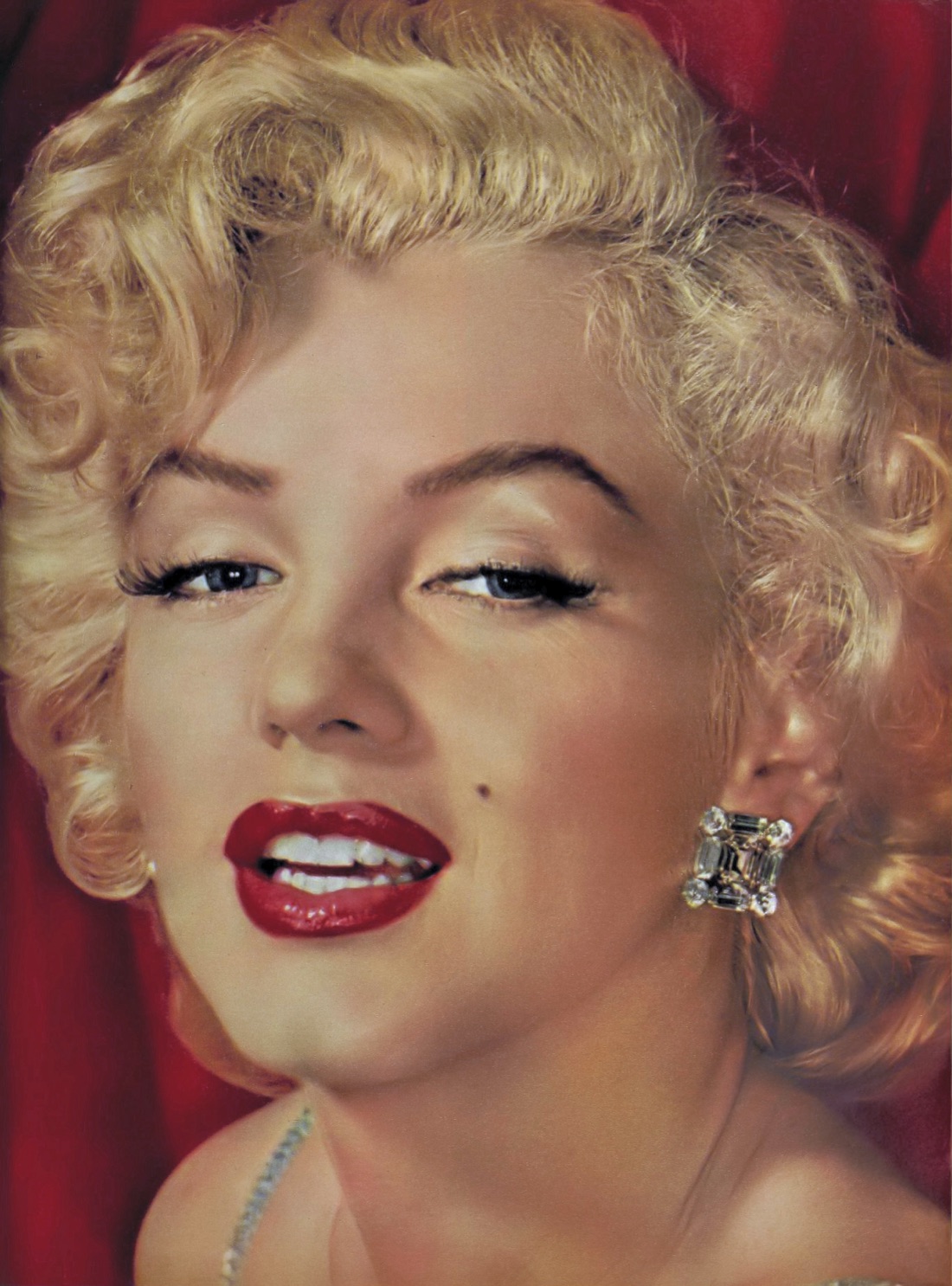
The Death of Marilyn Monroe: The Star, the Overdose, and the Theories
In the early hours of 5 August 1962, Marilyn Monroe — the most photographed and adored star of her age, an icon of Hollywood glamour recognised the world over — was found dead in the bedroom of her modest home in the Brentwood district of Los Angeles. She was thirty-six years old. The Los Angeles County coroner determined that she had died of acute barbiturate poisoning, a lethal quantity of sleeping pills in her system, and classified the death as a 'probable suicide,' consistent with her long and painful history of depression, insomnia, and dependency on the drugs that both sustained and endangered her. It should have been, and in its essentials was, the tragic end of a brilliant, fragile woman whom fame had exploited more than it had protected. But the investigation that night was careless and confused, the timeline muddled, the accounts of those present contradictory; and Monroe's rumoured connections to President John F. Kennedy and his brother, Attorney General Robert Kennedy, gave rise almost immediately to whispers, and then to an enduring industry, of conspiracy — that she had been murdered, or silenced, to protect powerful men. Sixty years on, those theories persist, unproven and unpersuasive, while the documented evidence points, as it did from the start, toward a lonelier and more ordinary tragedy. This is the story of the death of Marilyn Monroe — what is known, what is not, and why the difference matters.

The Death of Natalie Wood: Drowning Off Catalina
On the morning of 29 November 1981, the body of Natalie Wood — one of the most cherished actresses of her generation, a star since childhood — was found floating in the Pacific Ocean about a mile from her yacht, the Splendour, off the coast of Santa Catalina Island in California. She was forty-three, and she had drowned. The night before, she had been aboard the yacht with three other people: her husband, the actor Robert Wagner; her Brainstorm co-star, Christopher Walken; and the boat's captain, Dennis Davern. The Los Angeles coroner initially ruled the death an accidental drowning, theorising that she had slipped while trying to secure or board the yacht's dinghy and had been unable to climb back out of the cold water. But the account of that night was troubled from the start — there had reportedly been drinking and an argument aboard, the stories of those present shifted over the years, and Wood, it was widely known, had a lifelong fear of water. Three decades later, in 2011, the case was reopened; the cause of death was formally amended to 'drowning and other undetermined factors'; and in 2018 her husband was named a 'person of interest' — though he has always denied any wrongdoing, was never arrested or charged, and no evidence of foul play has ever been established. This is the story of the death of Natalie Wood — a genuine mystery in which the official record itself declines to say for certain what happened.

The Murder of Tupac Shakur: Twenty-Seven Years to an Arrest
On the night of 7 September 1996, Tupac Shakur — the visionary rapper, actor, and activist who was, at twenty-five, one of the most influential artists in the world — was shot in a drive-by while riding through the Las Vegas Strip in a car driven by the Death Row Records boss Marion 'Suge' Knight. The two had just left the Mike Tyson boxing match at the MGM Grand, where, earlier that evening, Tupac and his entourage had been caught on casino cameras beating a man in the lobby. As their car waited at a red light near the Strip, a white Cadillac pulled alongside and someone opened fire, hitting Tupac four times. He was rushed to hospital and fought for his life for six days before dying on 13 September 1996. His murder stunned the music world and became one of the most infamous unsolved killings in American cultural history — bound up with the bitter East Coast–West Coast rivalry that then convulsed hip-hop, and followed six months later by the strikingly similar murder of his rival, The Notorious B.I.G. For twenty-seven years, despite widespread belief about who was responsible, no one was charged. Then, in September 2023, Las Vegas police arrested a former gang leader who had publicly admitted his role, and charged him with orchestrating the killing. This is the story of the murder of Tupac Shakur — the man, the rivalry, the long silence, and the arrest that came almost three decades too late.