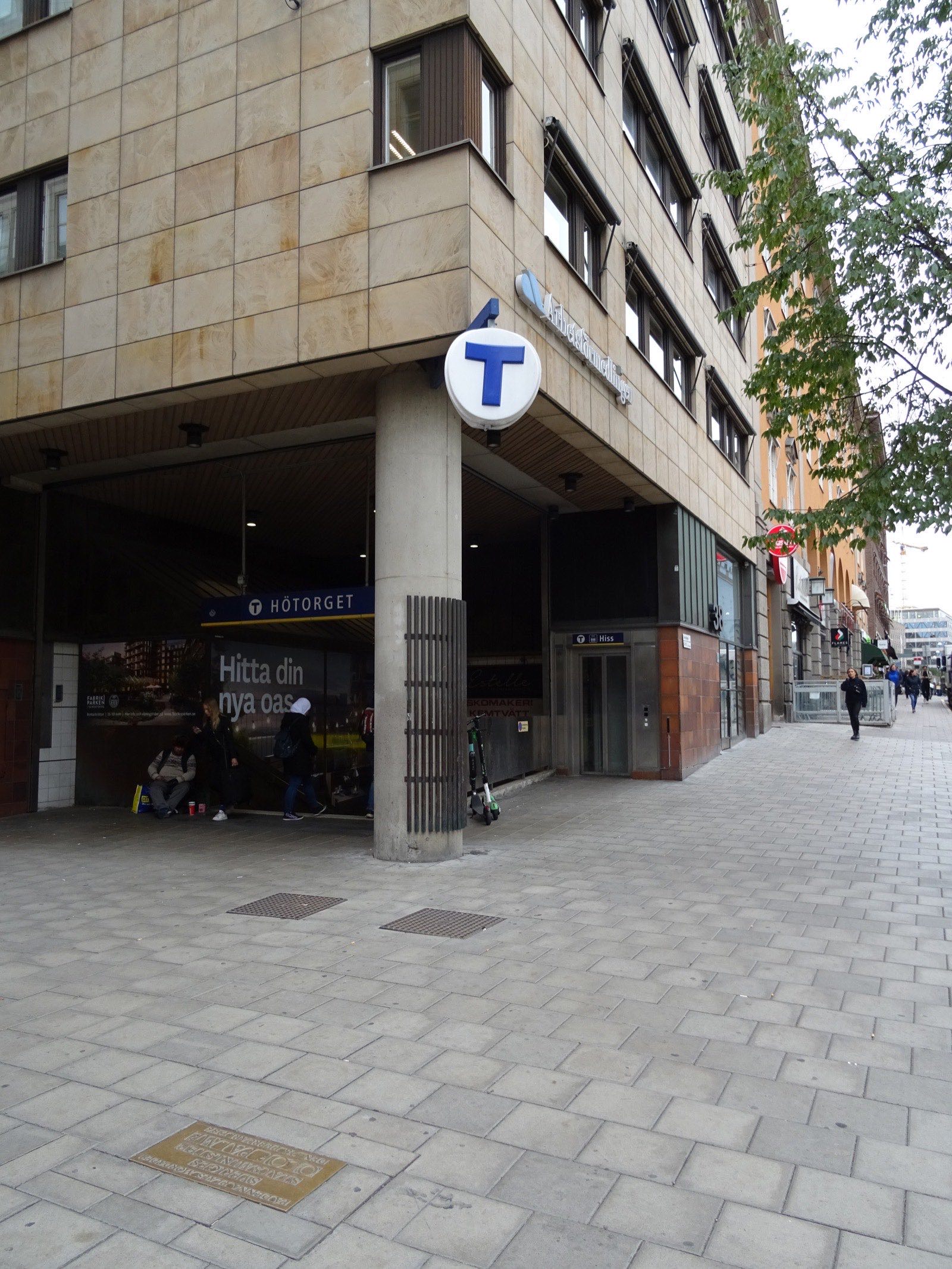
The corner of Sveavägen and Tunnelgatan in Stockholm. On a February night in 1986, the Prime Minister of Sweden was shot here. The memorial plaque set into the pavement is the only physical marker that anything happened. Wikimedia Commons, CC BY-SA 4.0.
The Olof Palme Assassination
Stockholm, February 28, 1986
- Category
- Assassinations & Disappearances
- Published
- Length
- 3,650 words · 17 min read
- Author
- The editors
The Olof Palme Assassination
Stockholm, February 28, 1986.
The walk
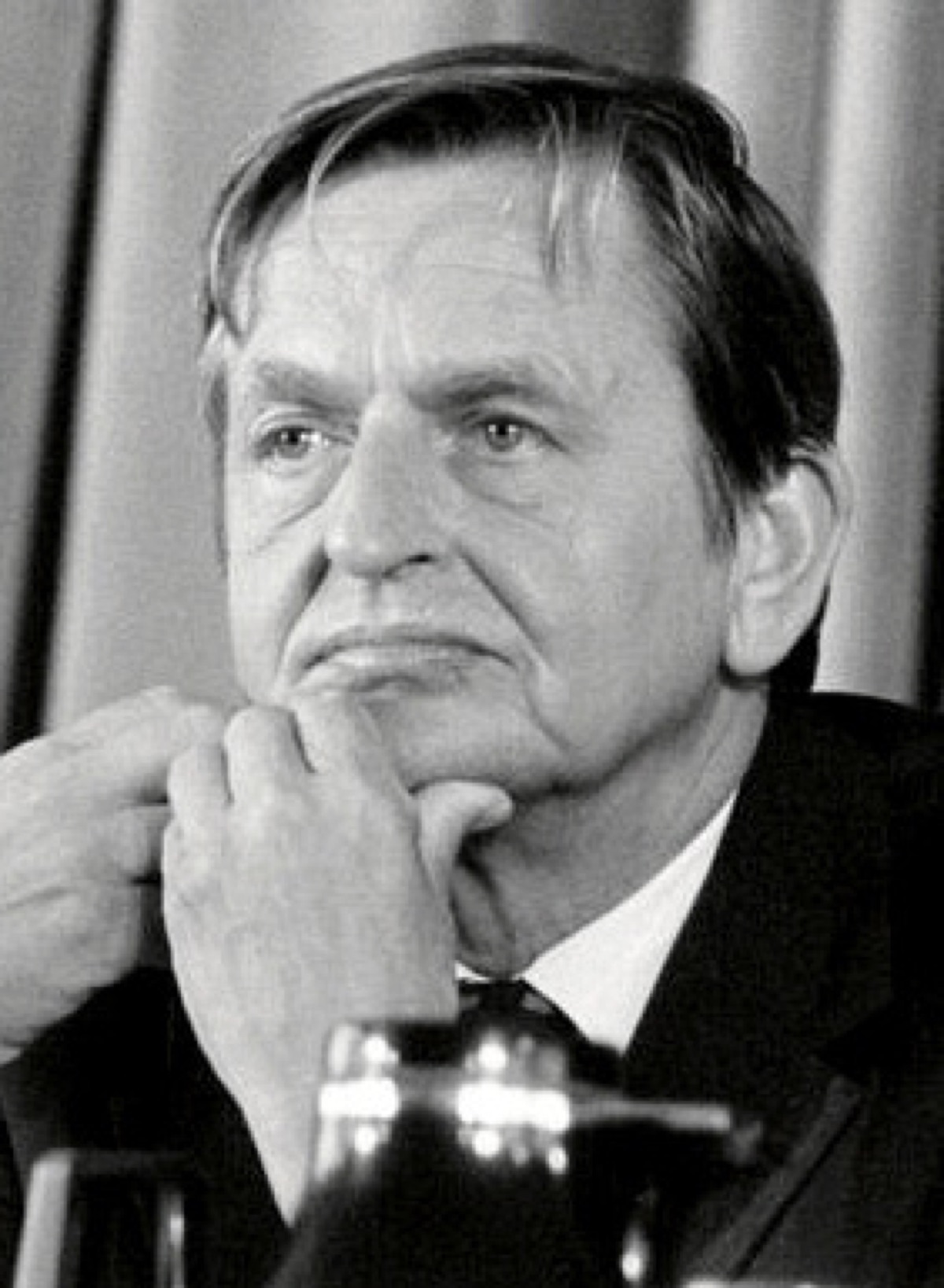
Olof and Lisbet Palme had taken the underground train to Östermalmstorg that evening. From there they had walked to the Grand Cinema on Sveavägen 45. They saw the Swedish film Bröderna Mozart — The Mozart Brothers — directed by Suzanne Osten. It was a Friday-night film about a theatre director and his troupe. It was 109 minutes long. It began at 9:00 p.m. and ended at 10:51.
The Palmes were joined at the cinema by their son Mårten, who was 27, and his girlfriend Ingrid Klockare. After the film, the four of them stood for a few minutes in front of the Grand discussing the film. Mårten and Ingrid then took the underground south toward their own apartment. Olof and Lisbet decided to walk home to the Old Town (Gamla stan), where they lived in an apartment on Västerlånggatan.
The walk was approximately 2 kilometres south down Sveavägen, with no immediate plan to take public transport. It was a cold night — approximately -1°C — but dry. The pavements had patches of slush.
Palme had been Prime Minister of Sweden continuously since October 1982 (and previously from 1969 to 1976). He was 59 years old. He walked without a security detail. He had been repeatedly briefed on threat assessments by Säpo (the Swedish security service) since the early 1970s and had repeatedly declined permanent protection. "En statsminister med livvakter är ingen statsminister," he was reported to have said — "A Prime Minister with bodyguards is no Prime Minister." His unguarded walk home from the cinema on a Friday night in February 1986 was, by Säpo standards, the kind of exposure they had been warning him about for fifteen years.
The shot
At approximately 11:21 p.m., the Palmes reached the intersection of Sveavägen and Tunnelgatan. They were walking south on the eastern side of Sveavägen. Tunnelgatan crossed from east to west — a small side street that led up a slight gradient to the Brunkeberg ridge, where a stone staircase connected to the David Bagares Gata neighborhood above.
The witnesses present at the intersection at that moment included several Stockholm residents walking nearby, several people who had just exited a McDonald's restaurant approximately 30 metres south, and a married couple in a car waiting at the traffic light on Sveavägen. Their subsequent statements, taken in the early hours of March 1, were the foundation of the police reconstruction.
A man approached the Palmes from behind. He was wearing dark clothes and what witnesses variously described as a knitted hat or a peaked cap. He fired once at point-blank range — one to one-and-a- half metres distance, according to the forensic reconstruction — into Olof Palme's back. The bullet entered between the second and third thoracic vertebrae, severed the aorta, and exited at the clavicle. Death was effectively instantaneous; Palme collapsed forward onto the pavement.
A second shot was fired. It grazed Lisbet Palme's coat — the forensic analysis later established the bullet trajectory — but did not penetrate flesh. She was effectively uninjured.
The shooter then ran east, into Tunnelgatan. Several witnesses saw him run. One witness — Karl Gunnar Bäckström, an employee of the Skandia insurance company whose office building had a side entrance on Sveavägen near the intersection — would subsequently become a central figure in the case in his own right.
The shooter was tracked by witnesses up Tunnelgatan, where it met the steep stone staircase ("Tunnelgatan-trappan") connecting to the David Bagares Gata blocks. He went up the staircase. He disappeared.
The time elapsed from shot to disappearance was approximately 40 seconds.
The first hours
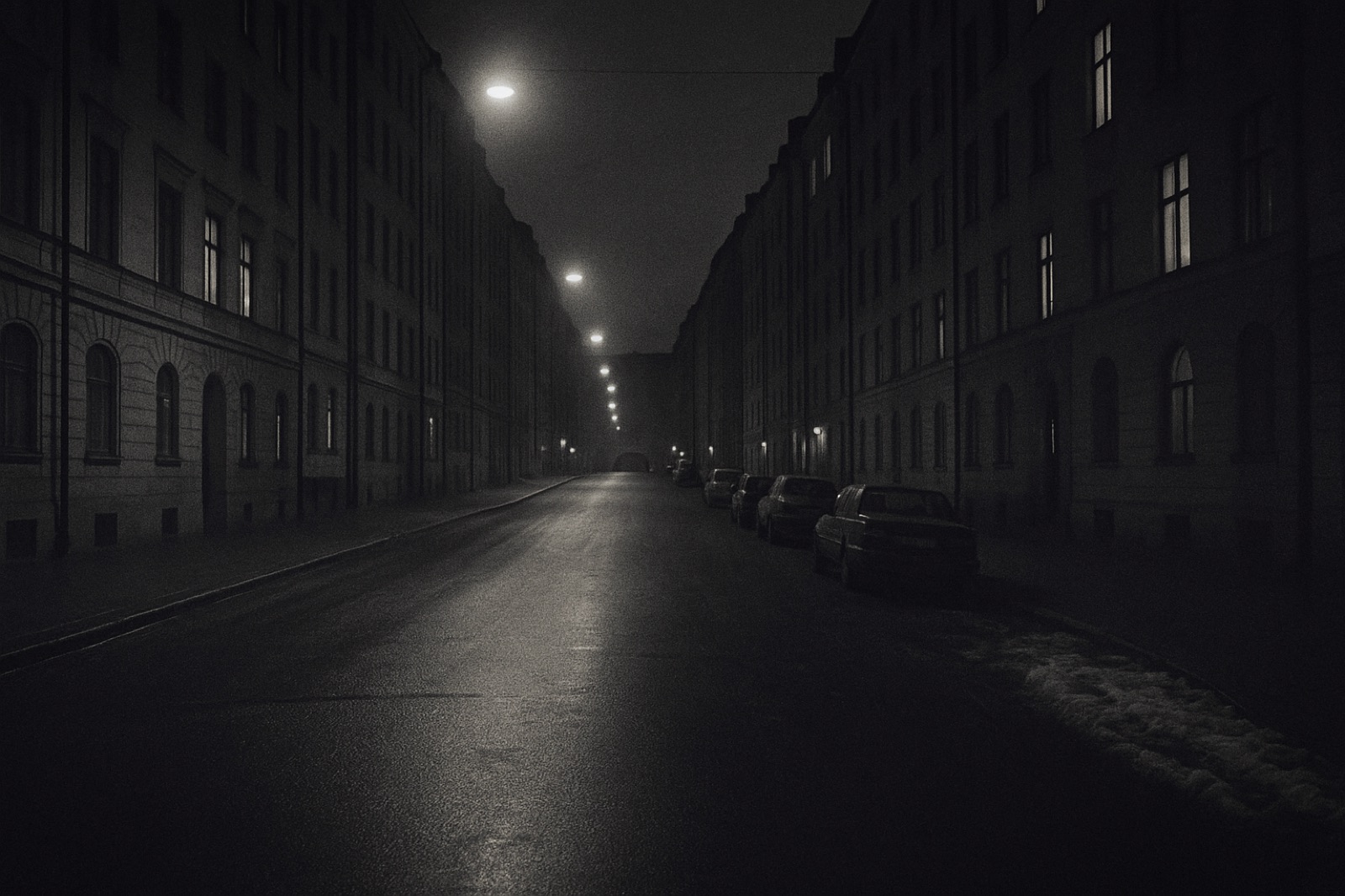
Lisbet Palme, kneeling next to her husband on Sveavägen, did not immediately recognize what had happened. A passer-by — Karl Andersson, 19 — called the emergency number from a phone booth at the McDonald's. The first police car arrived approximately 9 minutes after the shooting. The ambulance arrived approximately 12 minutes after. Palme was transported to Sabbatsberg Hospital where he was pronounced dead at 12:06 a.m.
The Stockholm Police's first hours were what the subsequent investigation reports — and a 1999 government-commissioned review — have been most critical of. The crime scene was not adequately secured. Multiple witnesses were allowed to leave without giving contact details. The pursuit-search up the Brunkeberg ridge was delayed by approximately 30 minutes while local police awaited backup. By the time a proper search of the David Bagares Gata area was initiated, the killer had been gone for nearly an hour and could have reached any of three subway stations or any of several main streets.
The bullet that grazed Lisbet Palme was not recovered. The bullet that killed Olof Palme passed entirely through his body and was found on the pavement near the scene approximately ten hours later — mid-morning Saturday, March 1 — by a passer-by. That bullet, along with a second bullet found by a different passer-by on Tunnelgatan some days later, became the only physical evidence positively connected to the crime. Both were .357 Magnum projectiles.
No weapon was recovered. The .357 Magnum revolver used to fire the fatal round has never been found.
The investigation
The Palme Murder Investigation Group (Palmegruppen) was established in the early hours of March 1, 1986 under Police Commissioner Hans Holmér. From the first weeks, the investigation pursued multiple parallel theories.
The Kurdish lead. Through 1986 and early 1987, Commissioner Holmér pursued the theory that Palme had been killed by the PKK (Kurdish Workers' Party). Sweden had refused PKK asylum applications in 1985; one PKK splinter group, the leadership had claimed, had threatened Palme. In January 1987, Holmér ordered the arrests of twenty Kurdish residents of Stockholm and held them in pre-trial detention. There was no evidence connecting any of them to the murder. They were released without charge. Holmér was removed from the investigation in March 1987.
The right-wing extremist lead. Several Swedish police officers with documented right-wing political sympathies — colloquially referred to as "the police track" (polisspåret) — were investigated in the late 1980s. The investigation produced no indictment but raised serious institutional questions about Säpo's political composition during the Cold War. The matter was re-investigated in 2017.
The South African lead. Through the 1990s, after South Africa's democratic transition, evidence emerged that the apartheid-era South African Bureau of State Security (BOSS) and the Civil Cooperation Bureau had specifically targeted Palme. Palme was a publicly prominent international supporter of the ANC, had hosted Oliver Tambo in Stockholm, and had committed Swedish government funds to the African National Congress. Eugene de Kock, the former Civil Cooperation Bureau commander, was reported in 1996 to have testified to South African investigators that he believed the Civil Cooperation Bureau had orchestrated the Palme murder. South African investigations have produced no definitive ruling.
The Iran-Iraq arms-deals lead. Palme had served as the UN Secretary-General's special mediator in the Iran-Iraq war. The Bofors arms company — Sweden's largest weapons manufacturer — was documented to have been illegally selling weapons to both sides of the conflict through complex transit arrangements. Some investigators pursued the theory that Palme's threat to the Bofors arrangement motivated the killing.
Christer Pettersson. In the absence of progress on the political-conspiracy lines, the investigation in 1988 focused on a local Stockholm alcoholic with a history of violent crime named Christer Pettersson. He was identified by Lisbet Palme in a police lineup — though the lineup procedure was subsequently criticized as suggestive. He was tried at Stockholm District Court in mid-1989 and convicted on July 27, 1989. He was acquitted on appeal at the Svea Court of Appeal on November 2, 1989 — the appeal court ruling that the identification was insufficient and that no plausible motive had been established. Pettersson died in 2004.
The Skandiamannen
On June 10, 2020, Chief Prosecutor Krister Petersson — who had taken over the investigation in 2017 — gave a press conference at the Stockholm District Court. He announced that the investigation had concluded that the most likely perpetrator was Stig Engström, a graphic designer employed by the Skandia insurance company whose Stockholm office had a side entrance on Sveavägen near the intersection.
Engström had been a witness to the immediate aftermath of the shooting — he had come out of the Skandia office a few seconds after the shots — and had been interviewed by police multiple times. He had told stories about being involved in attempted resuscitation that did not match the accounts of other witnesses. His statements over the years had been internally inconsistent. He had no criminal record. He had been the subject of journalistic investigation since 2018, when Lars Larsson's book Nationens fiende ("The Nation's Enemy") had publicly identified him as the likely shooter.
Engström had killed himself with sleeping pills in his apartment in 2000. He was 66 years old. By the time the official identification was made twenty years later, the evidence against him could not be tested in court.
The Skandiamannen conclusion is the official position of the investigation. It is not universally accepted. Some investigative journalists — most prominently Gunnar Wall, whose 2015 book Mörkläggning ("Cover-up") had argued for the police-track hypothesis — have continued to maintain that the official conclusion is the wrong one. The case file remains formally closed but the public dispute over its conclusions continues.
What the case meant for Sweden
Sweden in 1986 had been a Nordic social-democratic state for 50 years. Its self-image — accurate or otherwise — was of a society peculiarly insulated from the political violence that defined postwar Europe. The Palme killing perforated that self-image within minutes.
The structural consequences:
Security. Swedish heads of government no longer walked home unguarded. The pattern of personal security around the Prime Minister, the Speaker of the Riksdag, and the Royal Family intensified continuously from 1986 forward. The Säpo budget approximately tripled in real terms between 1985 and 1995.
Polarization. The investigation's wandering between conspiracy theories — Kurds, right-wing police, South Africans, arms dealers, Pettersson, Skandiamannen — became itself a marker of how Swedish political culture had moved from a presumption of institutional competence toward a presumption of institutional failure. The "Palme case" became a shorthand in Swedish public discourse for "a case the state cannot solve."
Lisbet Palme. Lisbet Palme, who was a developmental psychologist at Stockholm University before her husband's death and had continued in that role afterward, lived until October 2018. She gave very few interviews. She was, until her death, the only person known to have seen the shooter at close range and survived — and she had said in 1986 that she would recognize him again. Her death closed a particular evidentiary door.
The cast
Why this case is filed as "mystery"
The Palme assassination meets the criteria for our "mystery" label even though an official conclusion has been reached. The identification of Stig Engström as the likely perpetrator was made by the investigation, not by a court. It cannot be tested in court because Engström is dead. The case file has been formally closed but the underlying question — was it Engström? was it political? was it institutional? — remains a matter of active dispute among Swedish journalists, historians, and political commentators.
The mystery is not the absence of a candidate. It is the absence of resolution that a normal court process provides. Sweden, the country whose institutional self-image rested on civic competence, lost its Prime Minister on a city street and never recovered the weapon, never tried the perpetrator, and never closed the case in the conventional sense.
What we still don't know
Several questions remain materially unresolved:
The weapon. The .357 Magnum revolver used in the killing has never been recovered. Modern forensic comparison would be possible if it were found. It has not been.
The chain of motive. Whether Engström acted alone, on what specific provocation or grievance, and whether he had connections to any of the political networks the earlier investigation had explored — Kurdish, right-wing-police, South African, arms-deals — remains undetermined.
The first-hour evidence. Whether evidence at the crime scene that was lost, destroyed, or not collected in the first hours might have changed the case. The 1999 government review concluded that the first-hour failures fundamentally limited the investigation's ceiling.
The Holmér-era waste. Whether the two-year Kurdish detour cost the investigation its best chance at reconstructing the killing within the period of useful witness recall. The Palme Commission of 1999 concluded that it likely did.
Sources
Primary documents:
- Olof Palme-mordet — Beslut om nedläggning av förundersökning — Chief Prosecutor Krister Petersson, press conference and accompanying decision, June 10, 2020. Available at Åklagarmyndigheten archive.
- Granskningskommissionen — Slutbetänkande (SOU 1999:88), 1999. The government-commissioned review of the investigation's first 13 years.
- Granskningskommissionen — Granskning av polisens utredning av mordet på statsminister Olof Palme (SOU 1987:14), 1987.
- Stockholm District Court, Mål B 8-1985 vs Christer Pettersson, verdict July 27, 1989.
- Svea Court of Appeal, Mål B 191-89 vs Christer Pettersson, acquittal November 2, 1989.
- Säpo / Riksarkivet, declassified Palme-case file portions, 1986-2020.
Secondary investigative reporting: 7. Lars Larsson, Nationens fiende: Stig Engström — Skandiamannen (Norstedts, 2018). The book that publicly identified Engström before the prosecutor's announcement. 8. Gunnar Wall, Mörkläggning: Statsmakten och Palmemordet (Bokförlaget Augusti, 2015). 9. Jan Stocklassa, Stieg Larssons arkiv: Nyckeln till Palmemordet (Albert Bonniers, 2019). The Larsson investigative archive as researched after his death. 10. The New York Times, multi-correspondent coverage 1986-present. 11. Dagens Nyheter and Svenska Dagbladet, continuing coverage 1986-2020. 12. SVT, Palme — Sveriges värsta brott (2020 series, 3 episodes). 13. Christoph Andersson, Operation Norrsken: Om Stasi och Sverige under Kalla kriget (Norstedts, 2013) — useful for political context. 14. Hans Holmér, Olof Palme är skjuten! (Wahlström & Widstrand, 1988) — the case as the original commissioner described it.
Academic scholarship: 15. Henrik Berggren, Underbara dagar framför oss: En biografi över Olof Palme (Norstedts, 2010). The standard scholarly biography. 16. Kjell Östberg, I takt med tiden: Olof Palme 1927-1969 and När vinden vände: Olof Palme 1969-1986 (Leopard, 2008 and 2009). Two-volume scholarly biography. 17. Klas Åmark, Att bo granne med ondskan: Sveriges förhållande till nazismen, Nazityskland och Förintelsen (Bonnier, 2011) — for the political-cultural backdrop.
Corrections & updates
2026-05-26: First publication.
Inspired this / based on it
SVT
Three-episode public-television series; comprehensive English-subtitled treatment.
Kristina Lindström & Maud Nycander · ★ 7.7
Documentary biography. Won Guldbagge for Best Documentary.
Lars Larsson
The book that publicly identified Engström as the likely shooter two years before the prosecutor's announcement. Norstedts.
Gunnar Wall
Comprehensive critique of the official investigation. Bokförlaget Augusti.
Jan Stocklassa
The Larsson investigative archive as researched after his death. Albert Bonniers.
Henrik Berggren
The standard scholarly biography. Norstedts.
Filed under
- #palme
- #olof-palme
- #lisbet-palme
- #sweden
- #stockholm
- #sveavagen
- #stig-engstrom
- #skandiamannen
- #christer-pettersson
- #krister-petersson
- #palmegruppen
- #bofors
- #p2
- #south-africa
- #1986
- #europe
- #assassination
- #cold-war
Click any tag for every article carrying it.
Continue reading
The Snowden Disclosures
In May 2013, a 29-year-old NSA contractor named Edward Snowden boarded a flight from Honolulu to Hong Kong carrying four laptops loaded with classified documents from the world's largest signals-intelligence agency. Over the following months, *The Guardian*, *The Washington Post* and *Der Spiegel* published material from those drives that revealed the architecture of post-9/11 surveillance — PRISM, XKeyscore, Boundless Informant, MUSCULAR. Within ninety days, the global conversation about surveillance, sovereignty, and the limits of state power had shifted. Snowden has lived in Russia since August 2013.
Operation Mockingbird
Between 1948 and the mid-1970s, the Central Intelligence Agency cultivated paid and unpaid working relationships with American journalists, editors, and publishers across every major U.S. news organization. The architect was an OSS veteran named Frank Wisner. He called the network the 'Mighty Wurlitzer' — a theatre-organ metaphor for a machine that could play many instruments from a single console. The full scope was confirmed by the 1975 Church Committee, expanded upon in Carl Bernstein's 25,000-word 1977 Rolling Stone investigation, and partly declassified since. What the records have not yet given up is the operational name everyone agrees was attached to it.
Operation Gladio
From 1956 onward, NATO and the CIA helped build clandestine paramilitary networks across Western Europe — Italy, Belgium, West Germany, France, the Netherlands, Greece, Turkey, Spain, Portugal — designed to wage guerrilla war if the Red Army crossed the Iron Curtain. The Red Army never crossed. The networks did not disband. In Italy, where the operation was codenamed Gladio, the same structures became entangled with right-wing terror that killed hundreds of civilians between 1969 and 1984. The network's existence was confirmed by the Italian Prime Minister, in Parliament, on October 24, 1990.