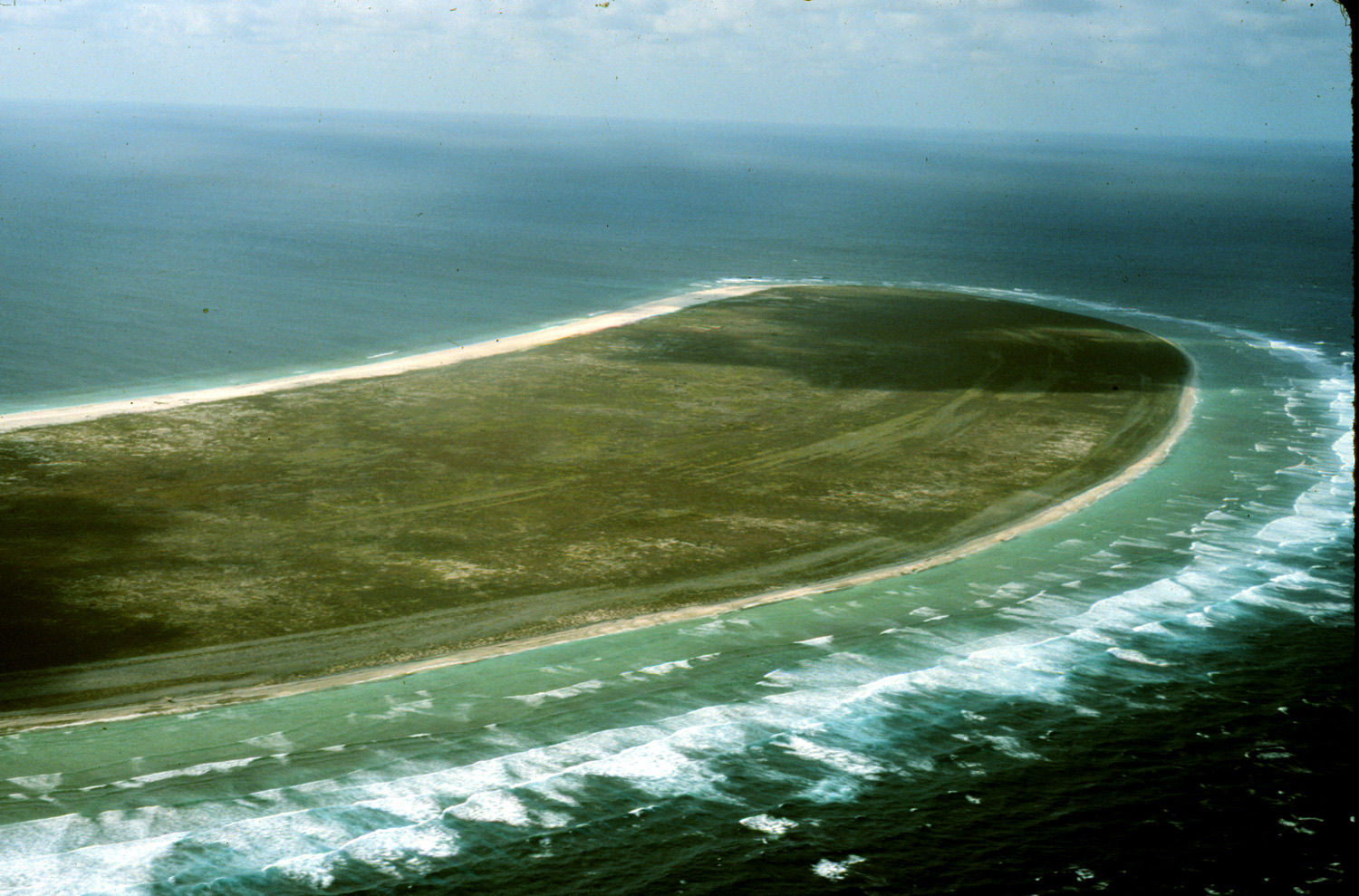
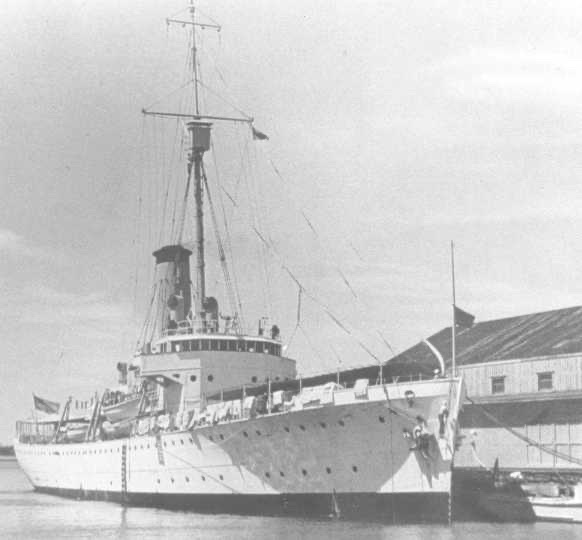
Howland Island, the central-Pacific speck — about a mile and a half long and twenty feet high — that Amelia Earhart was trying to reach on July 2, 1937. Finding it after more than 2,500 miles of open ocean was the central problem of the flight; the photograph shows why. A landing strip had been graded here especially for her arrival. U.S. Fish and Wildlife Service — public domain (Wikimedia Commons).
Amelia Earhart and the Speck in the Pacific
Pacific Ocean, 1937 — the most famous aviator of her age vanished on the hardest leg of a flight around the world, aiming for an island so small she never found it. Nearly ninety years and three rival theories later, neither her plane nor her body has been confirmed
- Category
- Assassinations & Disappearances
- Published
- Length
- 4,320 words · 17 min read
- Author
- The editors
Amelia Earhart and the Speck in the Pacific
Pacific Ocean, 1937 — the most famous aviator of her age vanished on the hardest leg of a flight around the world, aiming for an island so small she never found it. Nearly ninety years and three rival theories later, neither her plane nor her body has been confirmed.
The aviator and the flight
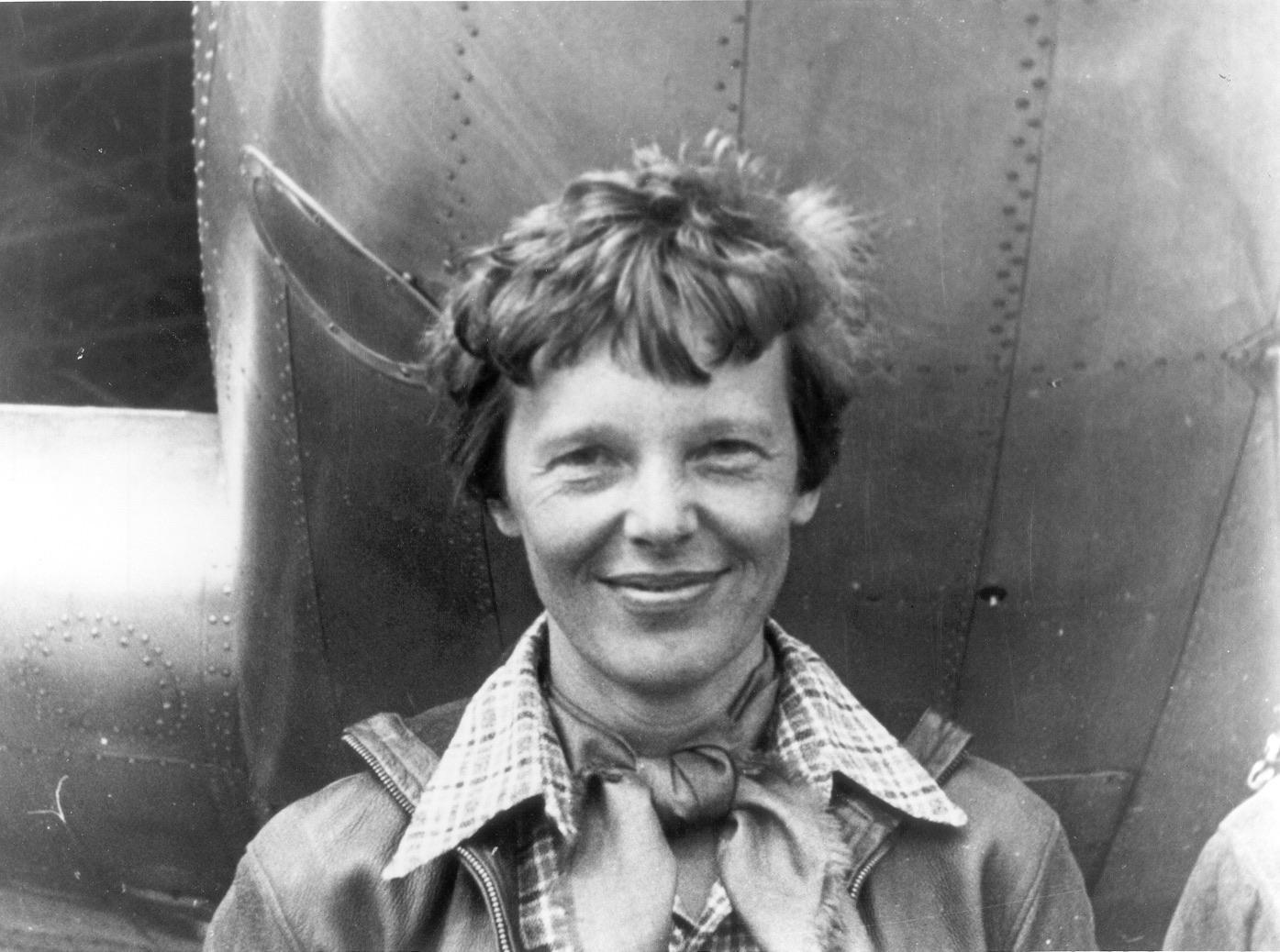
By 1937 Amelia Earhart was not merely a pilot but a phenomenon. She had been the first woman to cross the Atlantic by air in 1928 (as a passenger) and then, in 1932, the first to fly it solo; she had flown solo from Hawaii to California in 1935, a stretch of open Pacific that had killed others; she was a best-selling author, a magazine editor, a friend of the Roosevelts, and a public symbol of what women could do. What she wanted next was the biggest prize left: to be the first person to fly around the world at its widest point, along the equator, a journey of some twenty-nine thousand miles.
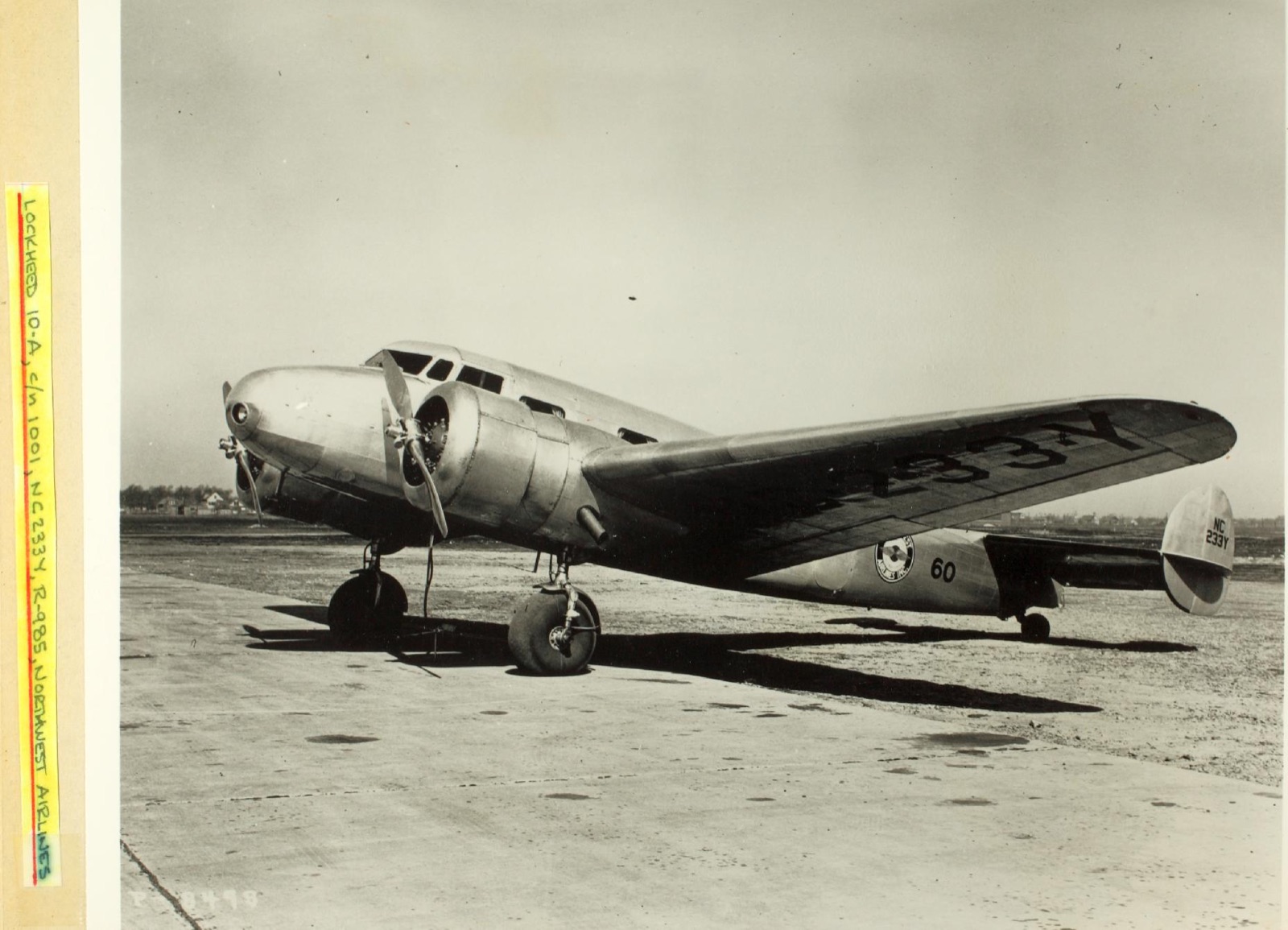
For the attempt she had a machine built for distance: a Lockheed Model 10-E Electra, a sleek twin-engined all-metal monoplane, modified with extra fuel tanks in the cabin to extend its range far beyond the airliner it was based on. Her navigator was Fred Noonan, a former Pan American Airways man and one of the most experienced aerial navigators alive, a specialist in the celestial navigation — fixing position by sun and stars — on which any ocean crossing then depended. A first attempt in March 1937, flying westward, ended when the Electra ground-looped and was badly damaged on takeoff at Honolulu. The aircraft was shipped back and rebuilt, and in June Earhart set out again, this time eastward, from Miami.
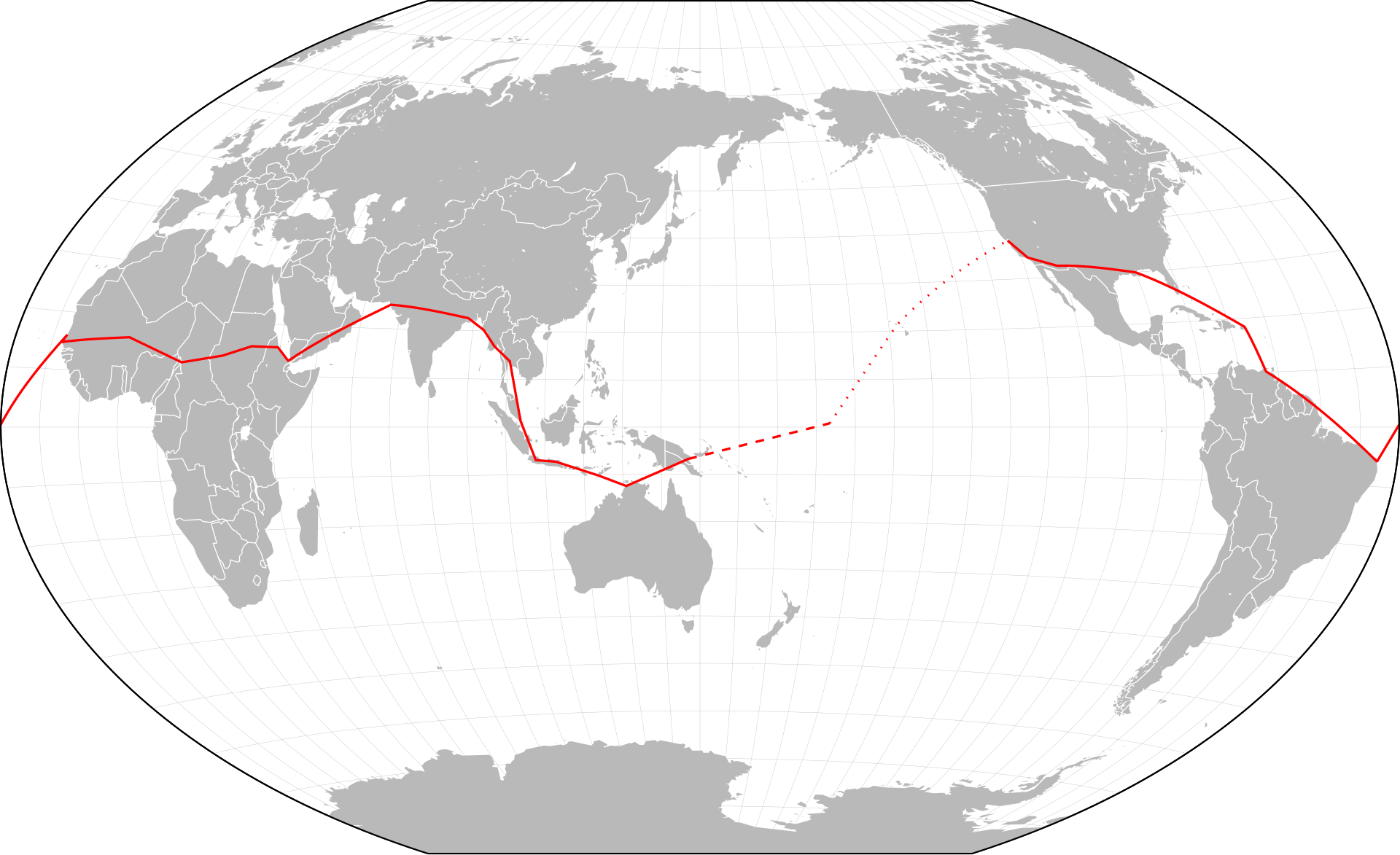
The eastbound flight went well. Across the Caribbean and South America, over the South Atlantic to Africa, across the breadth of Africa and southern Asia, through Southeast Asia and down to Australia and New Guinea, Earhart and Noonan covered some twenty-two thousand miles in a series of long hops. By the end of June they had reached Lae, on the northern coast of New Guinea, with about seven thousand miles to go — almost all of it over the Pacific, and the worst of it first.
The hardest leg
From Lae the route ran to Howland Island, and Howland was the problem the whole flight had been building toward.
It is hard to overstate how small a target Howland is. A flat ribbon of coral and sand about a mile and a half long and half a mile wide, nowhere more than twenty feet above the sea, it sits alone in the central Pacific more than 2,500 miles from Lae. To reach it, Earhart and Noonan would fly through a night and into a morning over open ocean, navigating by dead reckoning and the stars, and then have to pick out a low green sliver against the glare of the sea — a sliver that, from a few miles off and a few degrees of error, simply would not be there. A landing strip had been graded on Howland specifically for Earhart's arrival, and the United States Coast Guard cutter Itasca had been stationed just offshore to act as a radio beacon: she would home in on its signals, and it would lay down a plume of smoke she could see from a distance.
The margin for error was unforgiving. After a night over the ocean, Noonan's celestial fixes might place the aircraft within a few miles of where it actually was — superb navigation by the standards of 1937, and still potentially fatal here, because a few miles of uncertainty around a target a mile and a half long means the island can sit just beyond the horizon, invisible, while the fuel that would let you hunt for it drains away. Everything had to align: the navigation, the fuel, the weather, and above all the radio link that was meant to turn 'somewhere near Howland' into 'on Howland.' The first three more or less held. The fourth did not.
The plan depended entirely on radio, and radio was where it broke down. The coordination between Earhart and the Itasca was a tangle of mismatched frequencies, schedules, and equipment. Through the final hours the ship heard Earhart's transmissions, some of them strong, but she gave no sign of hearing the ship's replies, and the direction-finding that was supposed to let her steer toward the Itasca never functioned as intended. She was, in effect, talking into the dark — broadcasting her growing difficulty to people who could hear her clearly and could do nothing to reach her.
The reasons for the radio failure have been argued over ever since, and they compound one another. Earhart and the Itasca had never properly reconciled which frequencies each would use for voice and for direction-finding, and the schedules they tried to keep drifted out of step. She transmitted on frequencies the ship could hear but appears to have been unable, or unequipped, to take a bearing on the ship's signals in return; a trailing wire antenna that might have helped had been left behind earlier in the trip, and her own facility with the radio equipment was limited. The result was a one-way conversation at the worst imaginable moment — a pilot telling a ship a few miles away that she was lost and nearly out of fuel, while the ship's every effort to steer her in landed on a set that could not receive it.
"We must be on you but cannot see you"
The last hours survive in the Itasca's radio log, and they are hard to read without a sense of dread.
As the morning of July 2 wore on, Earhart's transmissions came in at intervals, and they tracked a rising anxiety. She called for bearings; she reported her position only vaguely; she said she was low on fuel. At about 7:42 a.m. local time came the line that has echoed ever since: 'We must be on you but cannot see you… gas is running low.' The Itasca, hearing her at strong signal strength, poured black smoke into the sky and transmitted in every way it could, but nothing it sent seemed to reach her. She was close — close enough to be heard loudly — and yet she could not find the island, and the island could not turn her in.
Her last transmission understood by the Itasca came at about 8:43 a.m. In it she gave a line of position — 'We are on the line 157 337' — and said she was running on that line, north and south. The numbers describe a navigational sun line, a line at right angles to the rising sun that Noonan would have drawn through Howland's known position: the standard technique when you have reached the right longitude but cannot be sure whether you are north or south of your target was to fly up and down that line until the island appeared. After that message, there was nothing. The Itasca waited, called, and then, as the hours passed with no further word, began to search.
What followed was the largest air and sea search the United States had ever mounted. The Navy threw in a battleship and an aircraft carrier; ships and aircraft combed roughly a quarter of a million square miles of ocean over about two weeks, at great expense. They found no aircraft, no wreckage, no oil slick, no raft, no bodies — nothing. On July 19 the search was called off. Amelia Earhart and Fred Noonan had vanished as completely as if the sky had closed over them, and on January 5, 1939, they were declared legally dead.
That so enormous an effort — mounted within hours, sustained for two weeks, the most expensive search for a single aircraft the country had ever made — produced not one confirmed trace is itself among the central facts of the case. The nation followed it on the front pages; Earhart's husband, the publisher George Putnam, pressed for every resource and, for years afterward, chased every rumour of her fate. And at the end of it there was nothing to bury and nothing to explain — only a quarter of a million square miles of unhelpful ocean and a silence that has never been filled. It is that founding emptiness, a search so large finding a trace so small, that both the orthodox theory and all its rivals have been trying to account for ever since.
Crash-and-sink
The simplest explanation is also the one most experts have always favoured, and it is bleak in its plainness: that the Electra, unable to find Howland, flew on along that sun line until its fuel was exhausted, ditched in the ocean somewhere near the island, and sank.
The case for it is the absence of any other. Earhart's own last words describe a plane low on fuel, at the right longitude, unable to see its target — exactly the situation from which a ditching follows. The waters around Howland are deep, thousands of metres down; an aircraft going into them would be gone beyond any 1937 hope of recovery, and very nearly beyond a modern one. No distress, no sighting, no debris is what one would expect from a plane that hit the sea far from any witness and went down. To its adherents — and they include much of the official and historical mainstream — crash-and-sink needs no exotic evidence precisely because it is what almost always happened to aircraft lost over open ocean. The mystery, in this reading, is not what happened but only where the wreck lies.
What the theory lacks, after nearly ninety years, is the wreck itself. Deep-sea expeditions have searched the sea floor around Howland with sonar and submersibles and have not, to date, produced a confirmed piece of the Electra. That absence does not disprove crash-and-sink — the search area is vast and brutally deep — but it has left just enough room for the alternatives.
The search has, in truth, never stopped. From the 2000s onward, deep-water expeditions swept the sea floor for miles around Howland with side-scan sonar and autonomous vehicles, in water more than five thousand metres deep, and came up empty. In early 2024 a company called Deep Sea Vision announced a sonar image of a plane-shaped object on the seabed roughly a hundred miles from the island, and for a few weeks it seemed the Electra might finally have been found; closer study suggested the shape was most likely a natural rock formation. The pattern recurs like clockwork — a tantalising anomaly, a surge of headlines, an inconclusive result. The deep ocean around Howland is precisely the kind of place that can hide an aircraft indefinitely, and so far it has.
The castaways of Nikumaroro
The most substantial alternative sends the Electra not into the sea but onto another island.
The line Earhart said she was running — 157 and 337 degrees — points, extended to the south-east, toward a string of islands in the Phoenix group, the nearest substantial one being Gardner Island, now called Nikumaroro, an uninhabited coral atoll about 350 nautical miles from Howland. The hypothesis, pursued for decades by the International Group for Historic Aircraft Recovery (TIGHAR) under Ric Gillespie, is that Earhart and Noonan, failing to find Howland, turned down the line, reached Nikumaroro, and landed the Electra on its flat reef at low tide — from where, over the following days, they sent the radio distress calls that were in fact reported at the time, before the rising tides carried the aircraft off the reef and they died as castaways.
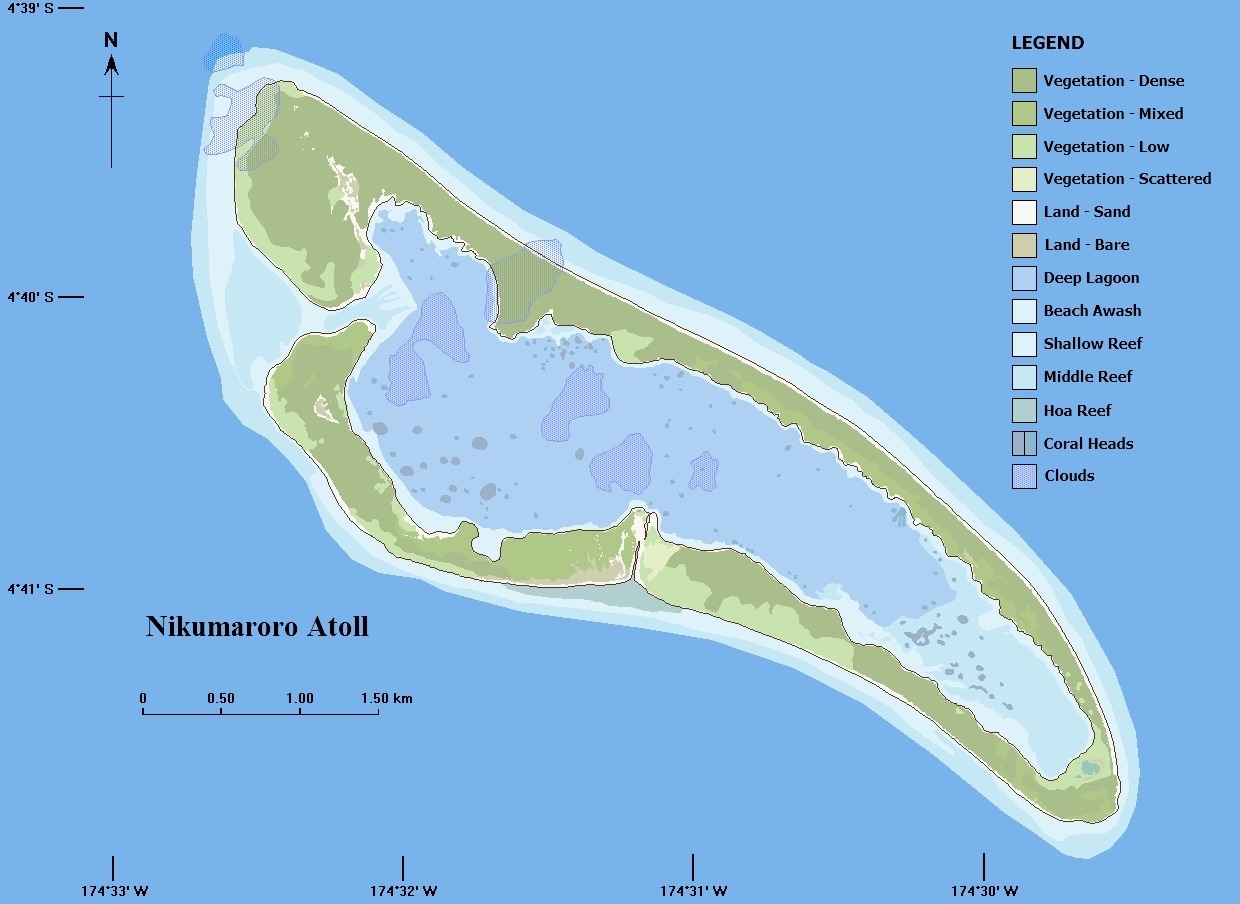
The Nikumaroro case rests on an accumulation of circumstantial strands rather than a single proof. There were, in the days after the disappearance, numerous reported radio distress signals — some dismissed as hoaxes, but others, including bearings taken by distant stations, crossing plausibly near the Phoenix group, and of a kind that could only have come from a transmitter on land, not a plane in the sea. In 1940 a British colonial officer found a partial human skeleton on Nikumaroro, together with a woman's shoe and a sextant box; the bones were examined in Fiji and pronounced those of a man, then lost — but in 1998 and again in 2018 the anthropologist Richard Jantz re-analysed the original measurements with modern methods and argued they matched Earhart's estimated dimensions more closely than they matched almost anyone else. TIGHAR's expeditions to the island have recovered a scatter of suggestive objects: a sheet of aircraft aluminium, the remains of a woman's compact, a jar consistent with a 1930s freckle cream, zipper and shoe parts, and the traces of campfires with the bones of birds, fish, and turtles — the diet of someone surviving on a desert island.
Two further strands are often cited. In the days after the loss, a teenage girl in Florida named Betty Klenck said she listened to a shortwave receiver and copied into a notebook fragments of a woman's distressed transmissions, including what she took to be references to Noonan and to injury — a record that, if genuine, fits a stranded-on-land scenario far better than a sinking. And a photograph taken at Nikumaroro in late 1937, months after the disappearance, shows an object protruding from the reef edge that some analysts argue is consistent with the landing gear of a Lockheed Electra — the so-called Bevington Object. Neither is decisive; both are the kind of suggestive, contestable trace that the Nikumaroro theory steadily accumulates without ever quite converting into proof.
None of it, however, has closed the case either. Sceptics note that Nikumaroro had been visited and inhabited at various times, that some of the artifacts have innocent explanations, that the aluminium sheet has been disputed as a match for the Electra, and that the lost bones cannot now be tested directly. The Nikumaroro hypothesis is the strongest of the alternatives to crash-and-sink and the one supported by the most evidence; it is also, after thirty years of dedicated searching, still short of proof.
The capture theory, and the photograph
A third explanation has always had more popular traction than scholarly support: that Earhart and Noonan strayed north, came down in the Japanese-mandated Marshall Islands, were captured by the Japanese military, and died — of illness or execution — in custody on Saipan.
The theory draws on post-war testimony from Marshallese and Saipanese witnesses who recalled an American woman flier in Japanese hands, and it has been kept alive by books, documentaries, and the broader suspicion, in the shadow of the coming Pacific war, that Earhart's flight might have had an intelligence purpose. Its most prominent modern airing came in 2017, when a History Channel documentary unveiled a photograph from the U.S. National Archives said to show Earhart and Noonan on a dock in the Marshalls after their capture. Within days the claim collapsed: a Japanese researcher found the very same photograph published in a 1935 Japanese travelogue — two years before Earhart disappeared — which meant it could not possibly show anything connected to her 1937 loss. The episode is a useful caution. The capture theory is not impossible, but it rests on contested memory and discredited evidence, and the single piece of documentation that briefly seemed to clinch it turned out to predate the disappearance entirely. Most historians do not accept it.
The intelligence speculation is what has always given the capture theory its pull. The Pacific in 1937 was sliding toward war, the Japanese-mandated islands were closed and secretive, and the notion that the United States might have used a celebrated civilian flight to glimpse them is not absurd on its face. But plausibility is not evidence. No documentation of any such mission has surfaced in the archives; the witness accounts are late, second-hand, and inconsistent; and the course to Howland led away from the Japanese islands, not toward them. The theory endures less on proof than on a very human refusal — the sense that a figure so famous could not simply have run out of fuel and fallen into the sea, and that something more deliberate must lie behind so complete a vanishing.
What the question still is
The Earhart disappearance has the peculiar durability of a mystery that is, at bottom, not very mysterious — and that is precisely why it will not rest.
The likeliest explanation has been the same since 1937: a small aircraft, navigating to the limit of what was possible, failed to find a tiny island, ran out of fuel, and went into a deep ocean that kept it. That account fits the radio log, the fuel state, the geography, and the total absence of debris; it requires nothing that did not routinely happen to lost aircraft of the era. Its only weakness is the one that keeps the case open: the sea has never given back the proof. And into that gap the alternatives flow — the castaway island with its scatter of maybe-artifacts and its re-measured bones, the captured spy with her debunked photograph, the survivor living quietly under another name. Each offers what crash-and-sink withholds: a story, a place, a body, an answer.
What sustains the legend is the collision of an enormous public figure with a vanishingly small physical trace. Earhart was one of the most photographed people in the world; she disappeared into one of its emptiest places, and left behind a few minutes of anxious radio and nothing else certain. Modern tools keep promising to close the distance — deep-sea sonar that finds a plane-shaped shadow near Howland, forensic re-analysis of decades-old measurements, DNA techniques waiting for a bone to test — and each promise revives the hope that this time the ocean will be made to answer. So far it has not. The most honest verdict is that Amelia Earhart almost certainly died on July 2, 1937, or within a few days of it, somewhere in the central Pacific, either in the water near the island she could not find or on the shore of one she reached by mistake — and that which of those it was remains, after nearly ninety years, genuinely unknown.
Sources
Primary
- The radio log of the USCGC Itasca, July 2, 1937, recording Earhart's final transmissions.
- U.S. Navy and Coast Guard records of the 1937 search.
- The 1940 discovery report and the 1941 (Hoodless) examination of the Nikumaroro bones, and Richard Jantz's later re-analyses (1998, 2018).
- TIGHAR expedition reports and artifact analyses from Nikumaroro.
- Contemporary press coverage of the flight, the disappearance, and the search, 1937.
Secondary
- Reporting and retrospectives in The New York Times, the BBC, National Geographic, Smithsonian, and the Washington Post on the disappearance and the competing theories.
- Coverage of the 2017 History Channel photograph claim and its prompt debunking.
- Accounts of the modern deep-sea searches near Howland (Nauticos; the 2024 Deep Sea Vision sonar claim).
Academic / reference
- Richard Jantz, analyses of the Nikumaroro skeletal measurements (peer-reviewed, 2018).
- Aviation-history and navigation references on the Lockheed Electra, celestial navigation, and the difficulty of the Lae-to-Howland leg.
Inspired this / based on it
Mira Nair
Fox Searchlight. Biographical film with Hilary Swank as Earhart, covering her career and the final flight.
History Channel
Advanced the Japanese-capture theory around a National Archives photo that was debunked within days as a 1935 image.
Ric Gillespie
Naval Institute Press. The book-length case for the Nikumaroro castaway hypothesis by TIGHAR's director.
Amelia Earhart
Brewer, Warren & Putnam. Earhart's own memoir of her flying career, written five years before the final flight.
Filed under
- #amelia-earhart
- #fred-noonan
- #howland-island
- #nikumaroro
- #lockheed-electra
- #pacific
- #tighar
- #disappearance
- #aviation
- #unsolved
- #1930s
- #mystery
Click any tag for every article carrying it.
Continue reading
D.B. Cooper and the Only Hijacking That Was Never Solved
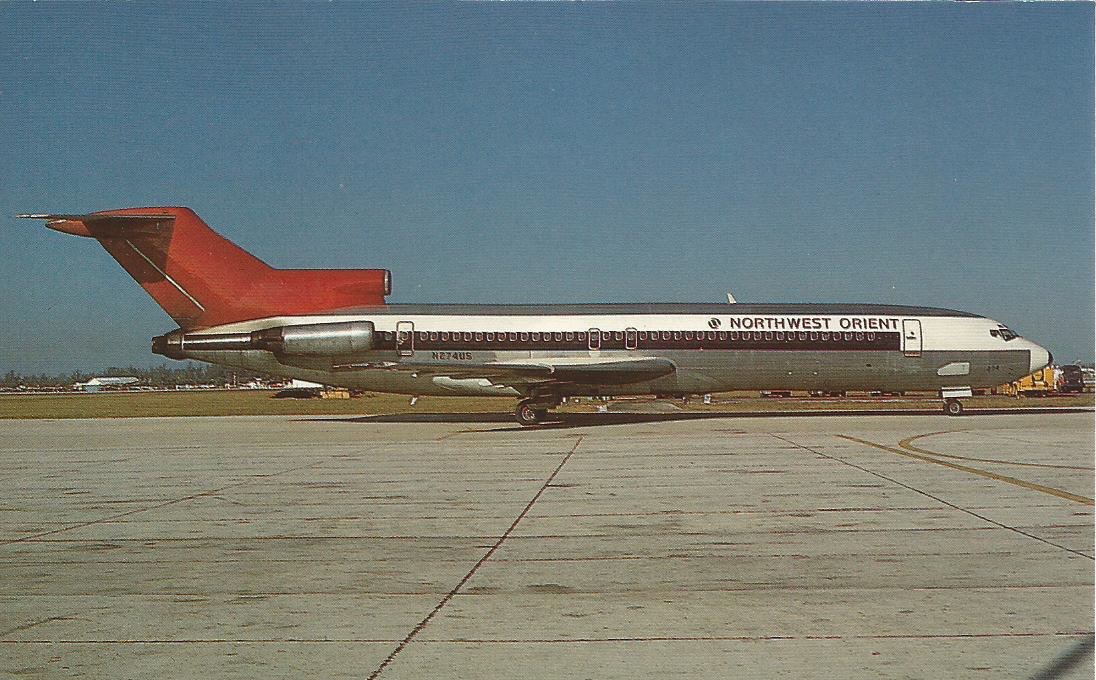
On the afternoon of Wednesday, November 24, 1971, the day before Thanksgiving, a man in a dark suit and a clip-on tie boarded Northwest Orient Airlines Flight 305, a Boeing 727 making the short hop from Portland, Oregon, to Seattle. He had bought his ticket with cash under the name Dan Cooper. Once airborne he handed a flight attendant a note saying he had a bomb, opened a briefcase to show her a tangle of wires and red cylinders, and dictated his terms: two hundred thousand dollars in twenty-dollar bills and four parachutes, to be waiting when the plane landed at Seattle-Tacoma. The airline paid. On the ground Cooper released the thirty-six passengers, kept four crew, had the jet refuelled, and ordered it back into the air toward Mexico City — flying low and slow, landing gear down, with the rear airstair lowered. Somewhere over the dark, rain-soaked forests of southwestern Washington, at around a quarter past eight in the evening, he stepped off the end of those stairs into the night with the money strapped to his body, and vanished. No body was ever found. No parachute was ever found. Of the ten thousand marked bills, exactly two hundred and ninety ever turned up — a packet of rotting twenties dug out of a riverbank by a child nine years later. The FBI worked the case for forty-five years, ran down more than a thousand suspects, and in 2016 quietly closed it without an answer. The skyjacking of Flight 305 remains the only unsolved act of air piracy in the history of American aviation, and 'D.B. Cooper' — a name born from a reporter's error — became the rarest kind of American legend: a criminal almost everyone half-hopes got away. This article reconstructs what actually happened that night, what the single scrap of physical evidence does and does not tell us, and why a fifty-year-old robbery has never let go of the public imagination.
MH370
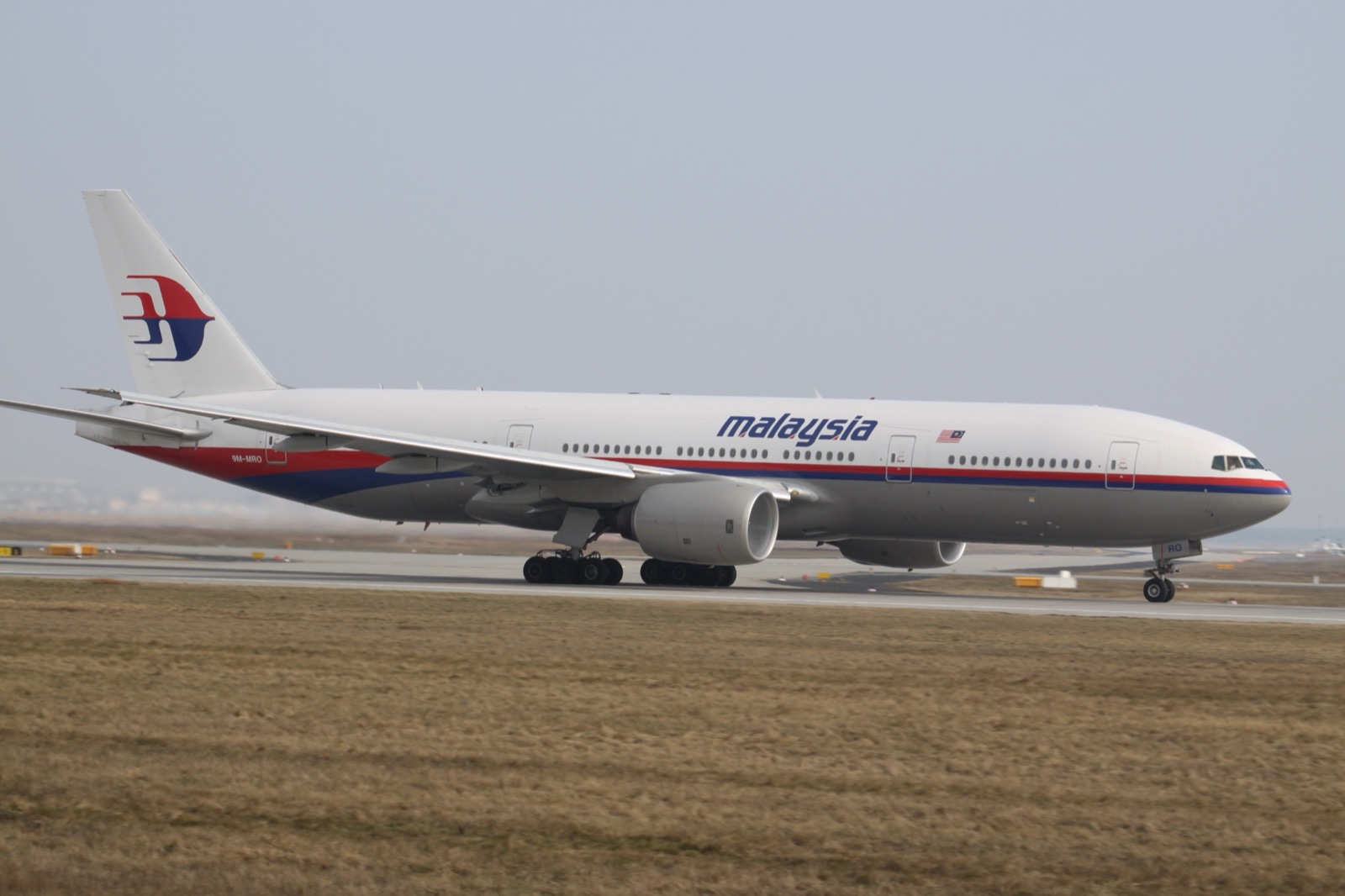
On March 8, 2014 at 12:41 a.m. Malaysia time, Malaysia Airlines flight 370 — a Boeing 777-200ER registered 9M-MRO — left Kuala Lumpur for Beijing with 239 people on board. Thirty-eight minutes later, the aircraft's transponder went dark over the South China Sea. Military primary radar then tracked an unidentified return making a hard left turn back across the Malay Peninsula, threading the gap between Malaysian and Thai air defense, before heading up the Strait of Malacca. The aircraft's satellite communications terminal made handshakes with Inmarsat's 3-F1 satellite for seven more hours. The final handshake, at 8:19 a.m., placed the aircraft along an arc somewhere in the southern Indian Ocean roughly 1,600 km west-southwest of Perth, Australia. Three years of surface and seabed search across 120,000 square kilometres found nothing. Thirty-three confirmed pieces of debris, beginning with a flaperon that washed ashore on Réunion in July 2015, are the only physical remains. The 2018 Malaysian Annex 13 report concluded that the aircraft was deliberately diverted but could not say by whom or why.
Dyatlov Pass
On the afternoon of February 1, 1959, a group of nine experienced Soviet ski-tourists — eight men and one woman, all between 20 and 38 years old, all members or alumni of the Ural Polytechnical Institute in Sverdlovsk (now Yekaterinburg) — pitched a four-pole canvas tent on the eastern slope of an undistinguished 1,079-meter mountain in the northern Urals named, in the Mansi language, Kholat Syakhl — 'Dead Mountain.' The group was led by 23-year-old Igor Dyatlov, a fifth-year radio-engineering student. The party had skied approximately 280 kilometers from the closest railway terminus over the prior nine days. Their planned summit, the following day, was the higher Otorten peak ten kilometers north. None of them reached it. When a search party located the abandoned tent on February 26, it had been cut open from the inside. Most of the group's clothing and equipment was still inside. The first three bodies — including Dyatlov — were found later that day, scattered along the slope below the tent, dressed only in underwear or light layers, none in proper outer clothing, none in their boots. Two further bodies were found nearer the tent over the following weeks. The final four bodies — including the only female member, Lyudmila Dubinina — were not located until May 4, 1959, in a snow-covered ravine approximately 1.5 kilometers downslope. Three of those four had massive internal trauma — equivalent in the words of the autopsy report to high-speed automobile-collision injuries — without corresponding external wounds. Two had missing soft tissue: Dubinina lacked her tongue and eyes. Some of the recovered clothing tested positive for elevated beta-particle radiation. The Soviet criminal investigation concluded in May 1959 that the deaths were caused by 'a compelling natural force which the hikers were unable to overcome.' The Russian Procurator-General's Office reopened the case in 2019 and concluded in July 2020 that the cause was a slab avalanche followed by hypothermia and disorientation. A 2021 computational study published in *Communications Earth & Environment* by Alpine snow scientists at EPFL Lausanne provided a quantitative mechanical model supporting the slab-avalanche conclusion. The case is closed in Russia. It is, in international public discussion, the most-debated cold-weather forensic mystery of the 20th century.