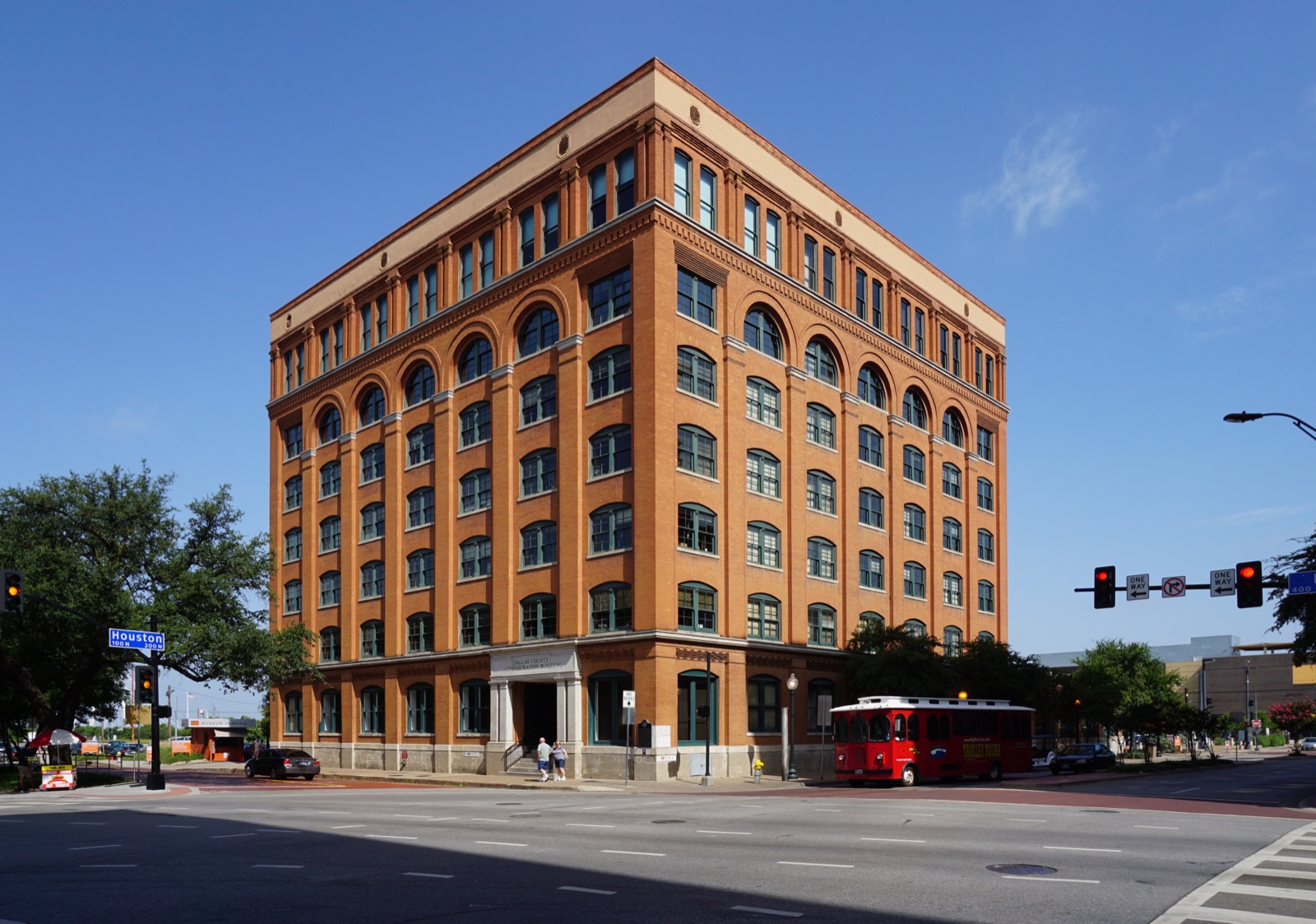
The Texas School Book Depository, Dallas. Lee Harvey Oswald worked here from October 16, 1963 forward. The Warren Commission concluded that he fired the shots that killed Kennedy from the sixth-floor southeast corner window. The building is now the Sixth Floor Museum. Wikimedia Commons, CC BY-SA 4.0.
The JFK Assassination
Dallas, November 22, 1963
- Category
- Assassinations & Disappearances
- Published
- Length
- 3,700 words · 17 min read
- Author
- The editors
The JFK Assassination
Dallas, November 22, 1963.
The President
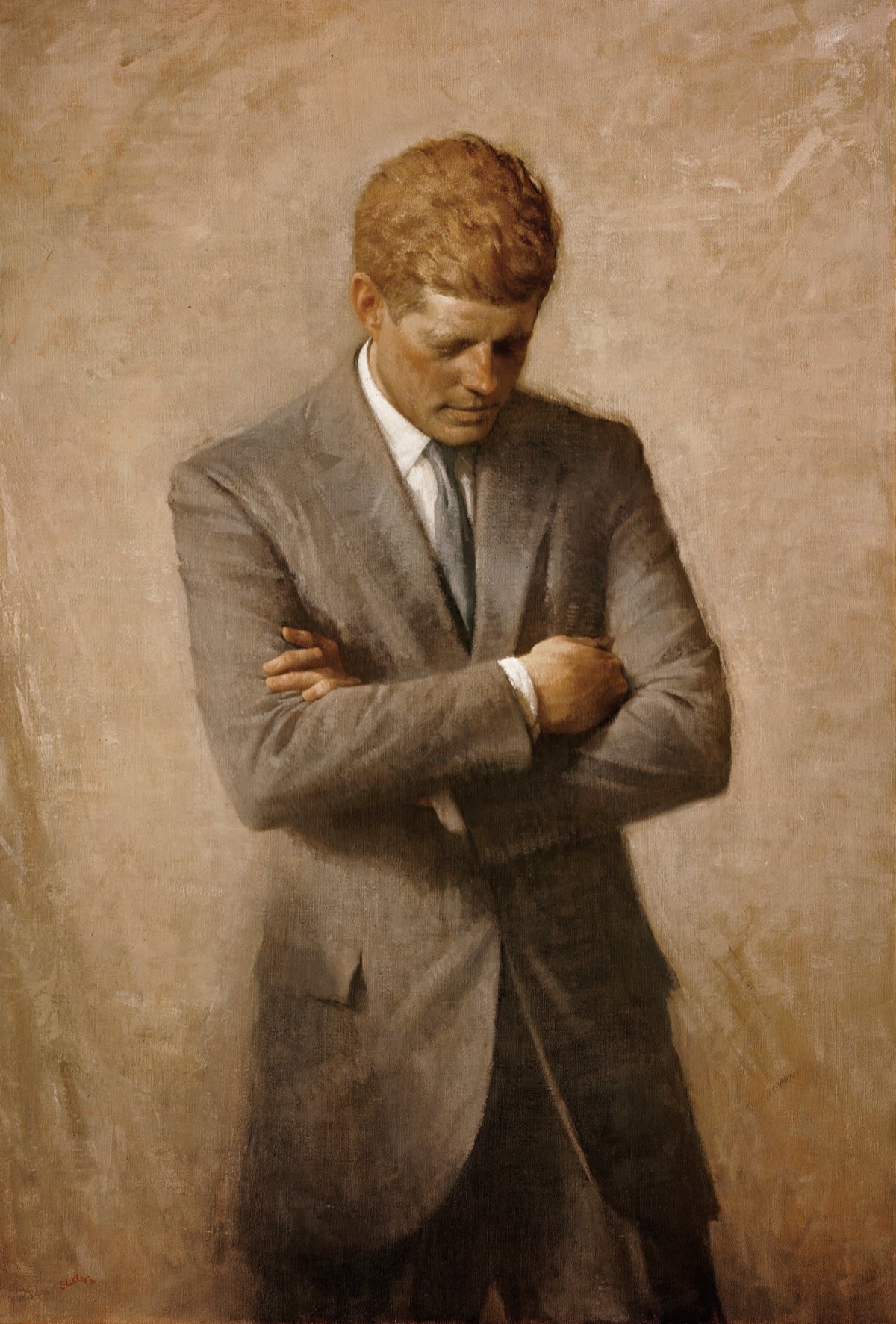
John F. Kennedy had been President of the United States for two years and ten months at the time of his death. His first term had been substantively defined by:
- The April 1961 Bay of Pigs invasion failure — a CIA-organized Cuban-exile operation that Kennedy had inherited from the Eisenhower administration and that failed within 72 hours of initiation. The failure shaped Kennedy's subsequent relationship with the CIA.
- The October 1962 Cuban Missile Crisis — the thirteen-day confrontation with the Soviet Union over Soviet missiles in Cuba. The crisis was substantially resolved through back-channel diplomacy between Kennedy and Soviet Premier Nikita Khrushchev.
- The civil rights legislative agenda — the Kennedy administration submitted the Civil Rights Act of 1963 to Congress in June 1963. The bill was still in committee at the time of the assassination.
- The Vietnam War — Kennedy had escalated U.S. advisory presence in South Vietnam from approximately 800 to approximately 16,000 personnel. The question of whether he intended further escalation or planned withdrawal has been subsequently disputed.
The Texas trip in November 1963 was a political trip — intended to mediate the factional dispute between Texas Senator Ralph Yarborough (liberal Democrat) and Governor John Connally (conservative Democrat, Lyndon Johnson's political protégé). The political stakes were the unified Texas Democratic Party support Kennedy would need in the 1964 presidential election.
The trip itinerary: San Antonio (November 21 morning), Houston (November 21 afternoon), Fort Worth (November 21 evening), Dallas (November 22 morning), Austin (November 22 afternoon), the LBJ Ranch (November 22 evening). The Dallas leg included the motorcade from Love Field to a luncheon at the Dallas Trade Mart.
The motorcade route — Main Street to Houston Street to Elm Street through Dealey Plaza, then onto the Stemmons Freeway — had been published in the Dallas Times Herald on November 19, 1963 and the Dallas Morning News on the morning of November 22. The detailed route was, by Secret Service standard practice, public information for crowd-control purposes.
What happened in Dealey Plaza
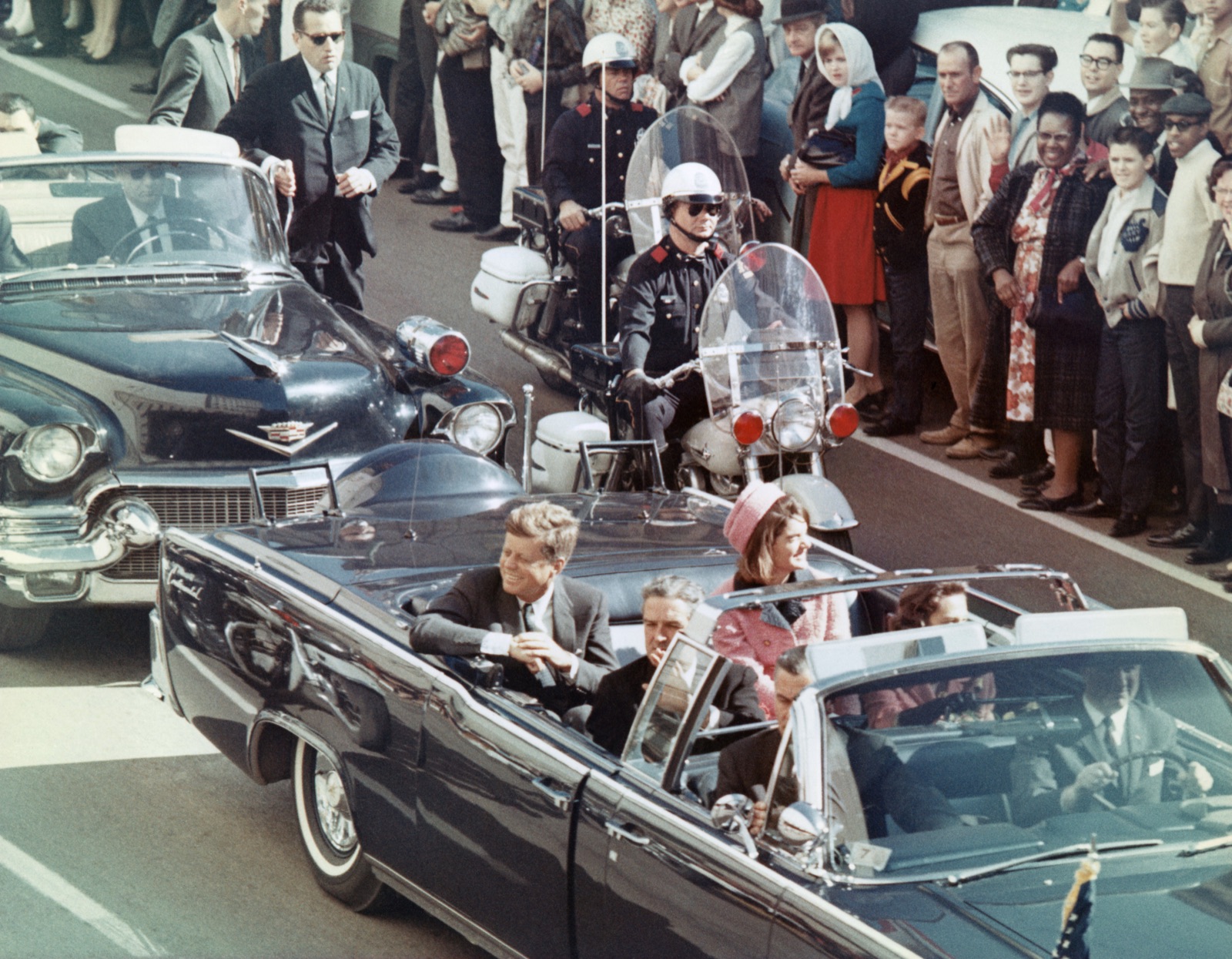
The motorcade approached Dealey Plaza from the north on Houston Street and turned left (west) onto Elm Street at the Texas School Book Depository at 12:29:55 p.m. The Lincoln presidential limousine was traveling at approximately 11 miles per hour to allow waving and photography.
The shots — three, by the substantial consensus of acoustic and ballistic evidence — were fired between approximately 12:30:14 and 12:30:21 p.m. The Warren Commission timeline:
Shot 1 (~12:30:14) — A shot that missed; the precise miss-target has been debated but the Warren Commission concluded it struck a nearby curb. The bullet was not recovered.
Shot 2 (~12:30:17) — A shot that struck Kennedy in the upper back / lower neck, exited his throat, then struck Governor Connally in the back, exited his chest, struck his wrist, and embedded in his thigh. The Warren Commission's "single bullet theory" was the central explanation. The bullet was recovered in substantially intact condition on Connally's stretcher at Parkland Hospital — the so-called "magic bullet" of conspiracy-theory literature.
Shot 3 (~12:30:21) — A shot that struck Kennedy in the right rear of the head. The fatal shot. The bullet fragmented; the fragments were recovered.
The shots came from above and behind. Multiple witnesses, photographers, and the Zapruder film support this. The Warren Commission concluded the shots were fired from the sixth-floor southeast corner window of the Texas School Book Depository, on the basis of:
- The Mannlicher-Carcano 6.5mm bolt-action rifle (serial C2766) found on the sixth floor, identified as Oswald's, with three spent cartridges and one unfired round.
- Oswald's documented presence at the Depository as an employee.
- Eyewitness identification of a man at the window matching Oswald's description.
- Oswald's palm-print on the rifle stock.
The motorcade accelerated. Secret Service Agent Clint Hill jumped onto the rear of the limousine and pushed Mrs. Kennedy back into the seat from her panic-driven climbing toward the rear. The limousine reached Parkland Memorial Hospital, approximately 4 miles away, at 12:35 p.m. Kennedy was unresponsive on arrival; resuscitation continued for approximately 22 minutes; he was pronounced dead at 1:00 p.m. Texas time. The death certificate specifies cause of death as a gunshot wound to the head.
Lyndon Johnson was sworn in as the 36th President of the United States at 2:38 p.m. CST aboard Air Force One at Dallas Love Field before the aircraft departed for Washington. The oath was administered by U.S. District Judge Sarah Hughes — the only U.S. federal judge in Dallas at that hour. Mrs. Kennedy stood beside Johnson during the swearing-in, still wearing the blood- stained pink suit she had been wearing during the shooting.
Oswald
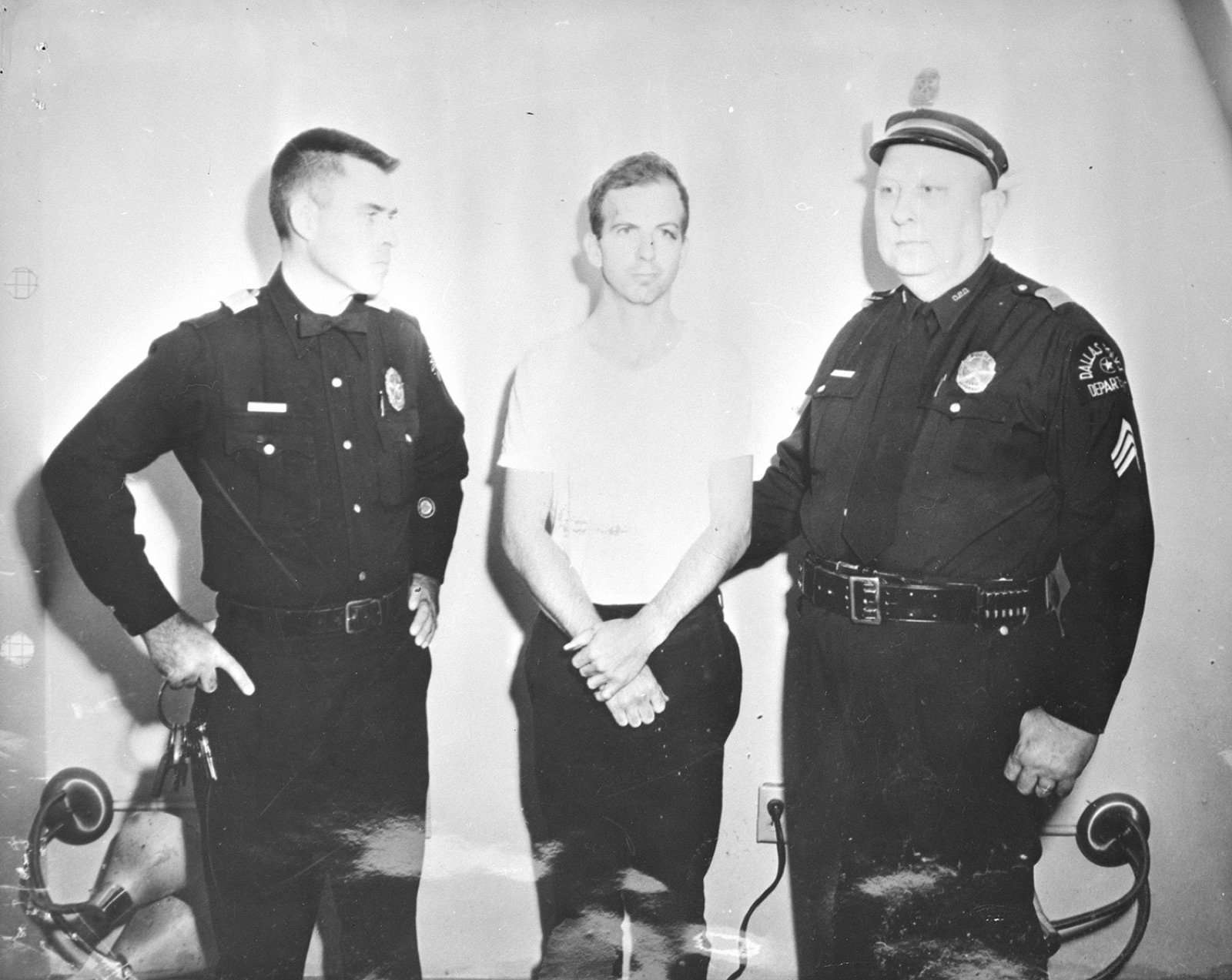
Lee Harvey Oswald had been born in New Orleans on October 18, 1939, two months after the death of his father. He was raised by his mother Marguerite — a poor, periodically working single mother — in a series of New Orleans, Dallas, and New York residences. He joined the U.S. Marine Corps on October 24, 1956, the day after his 17th birthday. He served as a radar operator at the U.S. Marine Corps Air Station Atsugi (Japan) and Marine Corps Air Station El Toro (California) before receiving a hardship discharge to care for his mother in September 1959.
Three weeks after his discharge, Oswald sailed to the Soviet Union. He attempted to renounce his U.S. citizenship at the American Embassy in Moscow on October 31, 1959. The renunciation was not completed (procedural delays at the embassy); Soviet authorities ultimately granted him permission to remain in the USSR as a non- citizen worker. He was assigned to a radio factory in Minsk where he worked as a metal-worker for two and a half years. In April 1961 he married Marina Prusakova, a 19-year-old Russian pharmacist.
In June 1962, Oswald, Marina, and their infant daughter June returned to the United States. They settled in Fort Worth, then Dallas. Oswald worked a series of unskilled jobs — at Jaggars- Chiles-Stovall (a Dallas printing company), then Reily Coffee Company in New Orleans (May-July 1963).
The New Orleans period — May to October 1963 — included substantial activity that the Warren Commission and subsequent investigators have studied in detail. Oswald established the Fair Play for Cuba Committee Chapter (a single-member chapter, in operational terms). He was arrested August 9, 1963 for disturbing the peace during a leafleting confrontation with an anti-Castro Cuban exile. He appeared on local New Orleans radio (WDSU) on August 21, 1963 in a debate on Cuba.
In late September 1963, Oswald traveled to Mexico City by bus. He visited the Cuban and Soviet embassies between September 27 and October 2, 1963, attempting to obtain travel documents that would allow him to enter Cuba and from there proceed to the Soviet Union. Both embassies declined his applications. He returned to Dallas.
The Mexico City visit is the operational episode most extensively addressed by the post-1992 declassifications. The CIA's Mexico City station — which had under-cover audio surveillance of both the Cuban and Soviet embassy compounds — recorded Oswald's visits. The CIA also took photographs of visitors to the embassies during the period. The recordings and photographs have substantial gaps and inconsistencies that have been the subject of declassification-archive investigation since 1992.
By late October 1963 Oswald had returned to Dallas. He took a job at the Texas School Book Depository on October 16, 1963, through a referral from a neighbor. He rented a room at a boarding house in the Oak Cliff district of Dallas. He visited his wife Marina and their two daughters (the second daughter Audrey had been born October 20, 1963) on weekends at the home where they were staying with Ruth Paine — a Quaker friend who provided Marina housing.
The rifle found on the sixth floor of the Depository — a 6.5mm Mannlicher-Carcano bolt-action, serial number C2766 — had been ordered by Oswald in March 1963 from a Chicago mail-order firm using the alias "A.J. Hidell." The same alias appeared on a fake Selective Service card in Oswald's wallet at the time of his arrest.
What Ruby did
At 1:50 p.m. on November 22, 1963 — approximately one hour and fifteen minutes after the assassination — Oswald was arrested at the Texas Theatre, a movie theater in the Oak Cliff district of Dallas approximately 5 miles south of Dealey Plaza. He had been identified to police as the man who had killed Dallas Police Officer J.D. Tippit at approximately 1:15 p.m. on East Tenth Street, approximately 1 mile from the Texas Theatre.
Oswald was charged on Friday evening with two counts of murder: Tippit and Kennedy. He was held at Dallas Police Department headquarters through Friday night and Saturday. He was interrogated intermittently by Dallas Police Captain Will Fritz and federal agents. The interrogation sessions were not recorded — the Dallas police did not have recording equipment in the interrogation room. Detective Fritz's contemporaneous handwritten notes were the only contemporaneous record; they were transcribed by an investigator the following week.
Oswald's interrogation responses included:
- He denied killing Kennedy.
- He denied killing Tippit.
- He acknowledged being in the Depository building during the shooting but characterized his presence as an ordinary workday.
- He requested representation by John Abt, a New York attorney associated with the American Communist Party. Abt was unavailable.
- He characterized himself, in a press-conference brief exchange on November 22 evening, as "a patsy."
On Sunday morning, November 24, 1963, the Dallas Police arranged to transfer Oswald from police headquarters to the Dallas County Jail. The transfer was to be conducted through the basement parking garage at police headquarters. The basement transfer was not, by standard police-practice criteria, well-secured — approximately 70 journalists and photographers had gained access to the basement with credentials.
At 11:21 a.m., as Oswald was led out for the transfer, Jack Ruby — a 52-year-old Dallas nightclub owner who had walked into the basement using his known relationships with Dallas Police — stepped forward and shot Oswald once with a .38 caliber Colt Cobra. The shooting was televised live by NBC and recorded by photographers from multiple outlets. Oswald died at Parkland Hospital at 1:07 p.m.
Ruby was arrested at the scene. He was tried for Oswald's murder in Dallas in February-March 1964, convicted on March 14, and sentenced to death. The conviction was overturned on appeal in October 1966 on technical grounds; he was awaiting retrial when he died of lung cancer at Parkland Hospital on January 3, 1967.
Ruby's documented background included:
- Long-running connections to Chicago organized crime through his childhood neighborhood and family.
- Documented relationships with Dallas Police personnel from his nightclub operations.
- A pattern of psychiatric episodes including documented paranoia and depression in the years before 1963.
The Warren Commission concluded that Ruby had acted alone, motivated by emotional response to the Kennedy killing and a desire to "spare Mrs. Kennedy a trial." Ruby himself, during his trial and in post-conviction interviews, gave varying explanations of his motive.
The Warren Commission
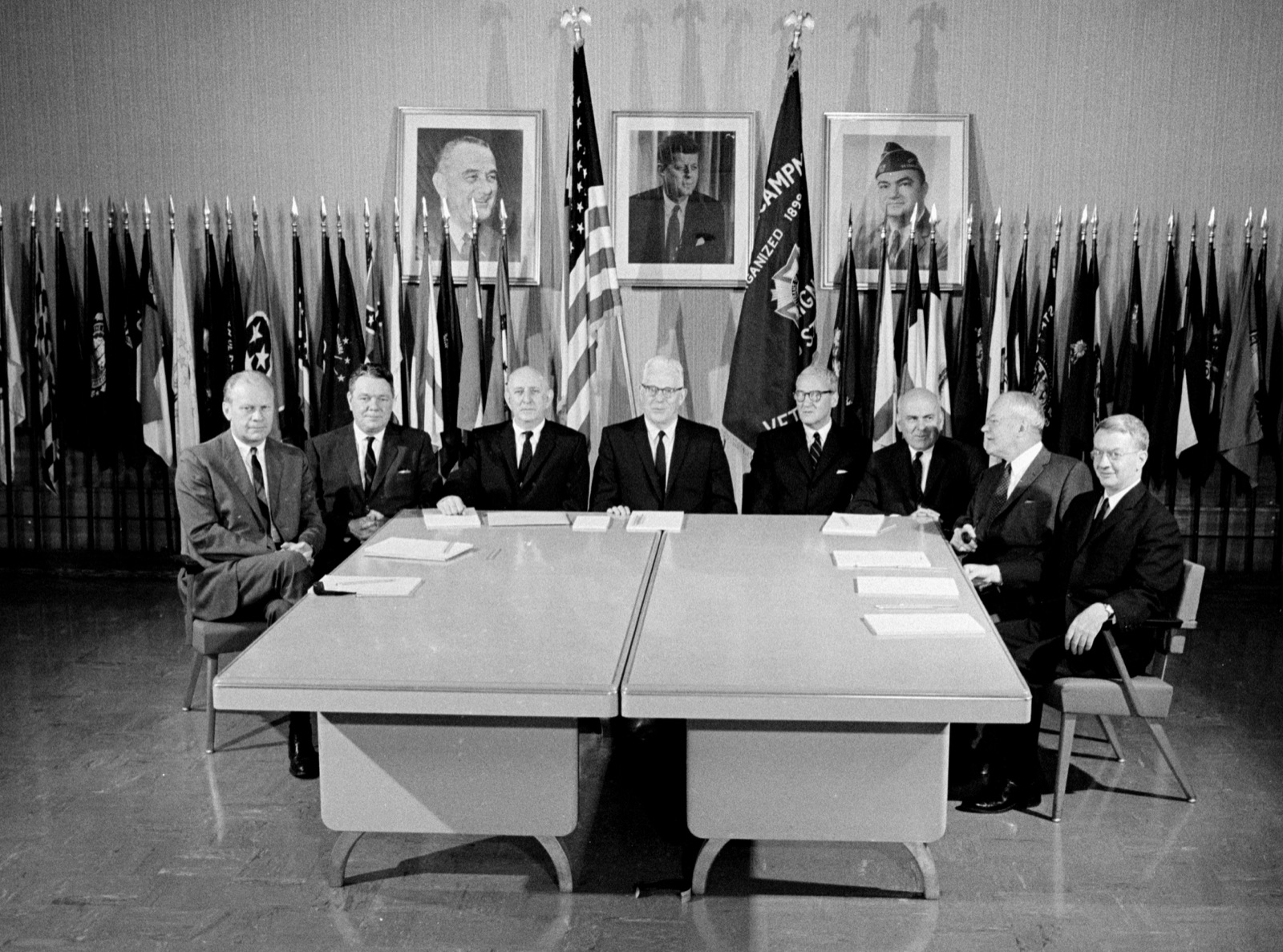
President Lyndon Johnson appointed the Commission on November 29, 1963, seven days after the assassination. Johnson's stated reason for creating the Commission was to forestall multiple state and federal investigations that would have produced contradictory conclusions. The Chief Justice initially declined; Johnson personally pressed him into acceptance with the argument that the alternative was political destabilization.
The Commission worked for ten months. It heard testimony from 552 witnesses, took 25,000 FBI investigative interviews and 1,500 Secret Service interviews, and reviewed 17 volumes of hearings testimony. Its 888-page final report was delivered to President Johnson on September 24, 1964 and published five days later.
The Commission's central findings:
- The shots that killed President Kennedy were fired from the sixth-floor southeast corner window of the Texas School Book Depository.
- Lee Harvey Oswald fired all three shots.
- There was no credible evidence of a conspiracy — either foreign or domestic — to assassinate the President.
- Jack Ruby acted alone in killing Oswald.
The Commission report was, in its immediate reception, broadly accepted. Doubts began to accumulate within months of publication:
- The "single bullet" theory — the Commission's conclusion that one bullet had struck both Kennedy and Connally — was challenged by trajectory and ballistic analysts. The challenges centered on the timing in the Zapruder film between Kennedy's observable injury reaction and Connally's.
- Witnesses on the grassy knoll — the area on the north side of Elm Street west of the Depository — had reported smoke and sound consistent with a shot from there. The Commission had weighed and rejected the grassy-knoll testimony.
- Specific CIA-Mossad-Cuba connections in Oswald's pre-assassination history had not been comprehensively addressed.
By 1965, dissenting books — particularly Mark Lane's Rush to Judgment — were in widespread circulation. By 1976, a Senate Select Committee on Intelligence (the Church Committee) documenting CIA assassination programs against Castro and others had renewed Congressional attention.
The HSCA
The U.S. House Select Committee on Assassinations operated from 1976 to 1979 under Chairman Louis Stokes (D-OH). It investigated both the Kennedy assassination and the Martin Luther King Jr. assassination. Its September 1979 final report on Kennedy reached substantially different conclusions than the Warren Commission:
- Oswald assassinated Kennedy.
- There were probably two gunmen, not one. The basis for this conclusion was acoustic analysis of a Dallas Police Department dictabelt recording from a motorcycle radio that allegedly captured a fourth gunshot.
- The assassination was probably the result of a conspiracy. The Committee identified no specific conspirators with high confidence but characterized the most likely candidates as organized-crime figures, anti-Castro Cuban exiles, or independent right-wing operatives.
- The investigations by the FBI and the Warren Commission had been incompetent.
The HSCA's acoustic-evidence conclusion was the principal foundation of its "conspiracy probable" finding. The acoustic analysis was conducted by Bolt Beranek and Newman (BBN), a respected scientific firm. The conclusion that a fourth shot had been recorded was, however, subsequently challenged. In 1982, a National Academy of Sciences review (Ramsey panel) concluded that the dictabelt recording had been mistimed — that the alleged fourth shot occurred at a moment when the motorcade was not yet at Dealey Plaza, making it operationally impossible to be related to the assassination. The acoustic "fourth shot" was, by the most authoritative subsequent review, a recording artifact.
The HSCA's "conspiracy probable" conclusion was, in its specific acoustic basis, substantially discredited. Its broader characterization of the case — that the Warren Commission had been inadequate and that the case had not been comprehensively investigated — has held up better.
The declassifications
The JFK Records Act of 1992 — passed in response to the public controversy generated by Oliver Stone's 1991 film JFK — required that all federal records related to the case be released within 25 years (i.e., by October 26, 2017) unless specifically exempted by the President on national-security grounds.
The 2017 deadline produced major declassifications:
- October 26, 2017 — Approximately 2,800 documents released.
- November 9, 2017 — Approximately 600 additional documents.
- April 26, 2018 — Approximately 19,000 additional pages.
- December 15, 2022 — Approximately 13,000 documents (under Biden administration extension).
- June 27, 2023 — Final tranche under the 1992 Act.
- March 18, 2025 — Trump second-administration release of approximately 80,000 pages, characterized as the final declassification.
The declassifications have, taken together, established:
- Extensive CIA surveillance of Oswald in Mexico City in September-October 1963. The CIA's pre-assassination knowledge of Oswald was substantially greater than the Warren Commission had been told.
- The CIA's "Mongoose" operations against Castro, including multiple assassination plots, were substantially active at the time of the Kennedy assassination. The Warren Commission was not informed of these operations.
- The FBI's pre-assassination knowledge of Oswald included a November 1963 visit by FBI Agent James Hosty to Marina Oswald, and a written threat by Oswald (the so-called "Hosty note") that FBI Agent Hosty subsequently destroyed.
The declassifications have not produced:
- Documentary evidence of a second shooter.
- Documentary evidence of a U.S. government operational role in the assassination.
- Documentary evidence of a Cuban, Soviet, or organized-crime operational role in the assassination.
The case file, in this sense, has been substantially opened — but the opening has confirmed the Warren Commission's central conclusion (Oswald acted) while reframing what the U.S. government knew about Oswald in advance.
What Garrison did
In 1966, New Orleans District Attorney Jim Garrison — operating on the basis of the New Orleans portion of Oswald's pre- assassination activities — began investigating a possible local conspiracy. Garrison concluded by 1967 that a group of anti-Castro Cuban exiles and right-wing New Orleans figures had organized the assassination.
Garrison prosecuted Clay Shaw, a prominent New Orleans businessman, for conspiracy to assassinate the President. The trial ran from January 21 to March 1, 1969. The jury deliberated for 54 minutes and acquitted Shaw. The trial was the only criminal trial of an alleged Kennedy conspirator that has been conducted.
Garrison subsequently wrote On the Trail of the Assassins (1988), which was the principal source for Oliver Stone's JFK (1991). The Stone film generated the public political pressure that produced the 1992 JFK Records Act.
What we still don't know
Oswald's motive. Without a trial, his specific motivation has been inferred from his pre-assassination activities. The inference has not been settled.
The Mexico City period. Some declassified material remains redacted. The full operational picture of Oswald's September-October 1963 movements has substantial documentary gaps.
The Ruby connection. Whether Ruby's killing of Oswald was spontaneous (Warren Commission position) or organized (the conspiracy-theory hypothesis) has not been definitively settled.
The classified residual. Some material remains classified under national-security and personal-privacy provisions. The exact volume is disputed.
Why this case is filed as "mystery"
The JFK case meets the criteria for our "mystery" label notwithstanding the substantial Warren Commission and post-1992 documentary record. The factual base — that Oswald shot Kennedy from the Depository — is supported by ballistic, eyewitness, and documentary evidence to the standard of any reasonable historical conclusion. The disputed elements — that there was no conspiracy beyond Oswald's individual action, that the Warren Commission's investigation was adequate, that the subsequent declassifications have closed the case — remain genuinely contested in U.S. public opinion (which has consistently shown 60-70% believing in a conspiracy across 60 years of polling) and partially contested in scholarly literature.
The case is, in this sense, the foundational American conspiracy mystery — not because the basic facts are disputed but because the framing of those facts (Oswald alone vs. Oswald-as-tool- of-larger-operation) has never been definitively settled in a way that has resolved public doubt. The case file remains open in the practical sense — both in the sense that some material remains classified and in the sense that the underlying political question (who killed Kennedy, in the broadest sense) remains, in U.S. political culture, unresolved.
The cast
Sources
Primary documents:
- Report of the President's Commission on the Assassination of President Kennedy (Warren Commission), September 24, 1964. 888 pages.
- Report of the Select Committee on Assassinations of the U.S. House of Representatives (HSCA), September 1979. 686 pages.
- JFK Records Act declassifications, October 2017-March 2025. National Archives JFK Assassination Records Collection.
- Final Report of the Assassination Records Review Board, September 1998. Documentary review of 1992 Act implementation.
- Zapruder film and Bell & Howell single-frame analyses. National Archives.
- Texas Court of Inquiry Report (Texas Attorney General Waggoner Carr), 1964.
- Bolt Beranek and Newman acoustic analyses, 1978-79; National Academy of Sciences Ramsey panel review, 1982.
Secondary investigative reporting: 8. Vincent Bugliosi, Reclaiming History: The Assassination of President John F. Kennedy (W.W. Norton, 2007). 1,632 pages. The most comprehensive Warren Commission defense. 9. Gerald Posner, Case Closed: Lee Harvey Oswald and the Assassination of JFK (Random House, 1993). 10. Anthony Summers, Not in Your Lifetime: The Definitive Book on the JFK Assassination (Marlowe, 1989; revised 2013). The most-cited conspiracy-aligned scholarly treatment. 11. Mark Lane, Rush to Judgment (Holt, Rinehart and Winston, 1966). The first comprehensive Warren Commission critique. 12. James W. Douglass, JFK and the Unspeakable: Why He Died and Why It Matters (Orbis Books, 2008). 13. Jim Garrison, On the Trail of the Assassins (Sheridan Square Press, 1988). 14. PBS Frontline, "Who Was Lee Harvey Oswald?" (2013). 15. Oliver Stone, JFK (1991), and JFK: Destiny Betrayed (2021). 16. The New York Times, The Washington Post, multi-decade Kennedy coverage 1963-present.
Academic / specialist scholarship: 17. James K. Galbraith and Heather A. Purcell, "Did the U.S. Military Plan a Nuclear First Strike for 1963?" — American Prospect, 1994. Context on Kennedy-military tensions. 18. Robert Dallek, An Unfinished Life: John F. Kennedy 1917-1963 (Little, Brown, 2003). The standard contemporary biography. 19. David Talbot, Brothers: The Hidden History of the Kennedy Years (Simon & Schuster, 2007). 20. Larry Sabato, The Kennedy Half-Century (Bloomsbury, 2013). Charting public-opinion shifts.
Corrections & updates
2026-05-29: First publication.
Inspired this / based on it
Oliver Stone · ★ 8
Three-and-a-half-hour dramatization of Jim Garrison's investigation. Kevin Costner. Catalyzed the 1992 JFK Records Act.
Oliver Stone · ★ 7.4
Stone's four-part documentary follow-up to *JFK*; based on the 2017 declassifications.
Vincent Bugliosi
W.W. Norton. 1,632 pages. The most comprehensive Warren Commission defense.
Gerald Posner
Random House. The most-cited contemporary Warren Commission defense.
Anthony Summers
Marlowe; revised 2013. The most-cited conspiracy-aligned scholarly treatment.
James W. Douglass
Orbis Books. Religious/moral framing.
Filed under
- #jfk
- #john-f-kennedy
- #lee-harvey-oswald
- #jack-ruby
- #dallas
- #dealey-plaza
- #warren-commission
- #hsca
- #house-select-committee
- #jim-garrison
- #earl-warren
- #1963
- #north-america
- #usa
- #declassified
- #cia
Click any tag for every article carrying it.
Continue reading
MK-Ultra
Between 1953 and 1973, the Central Intelligence Agency ran one of the most ambitious — and least restrained — human-experimentation programs in American history. The goal was mind control. The subjects rarely knew they were subjects. By the time the public found out, most of the records had been burned.
Operation Northwoods
In March 1962, the Joint Chiefs of Staff put a document on Robert McNamara's desk. It proposed a series of false-flag attacks against the United States — sunk ships, civilian terror campaigns in Miami and Washington, a faked civilian airliner shoot-down — to manufacture public support for invading Cuba. Every member of the Joint Chiefs signed it. Kennedy rejected it within days. The document stayed buried for thirty-five years.
Operation Mockingbird
Between 1948 and the mid-1970s, the Central Intelligence Agency cultivated paid and unpaid working relationships with American journalists, editors, and publishers across every major U.S. news organization. The architect was an OSS veteran named Frank Wisner. He called the network the 'Mighty Wurlitzer' — a theatre-organ metaphor for a machine that could play many instruments from a single console. The full scope was confirmed by the 1975 Church Committee, expanded upon in Carl Bernstein's 25,000-word 1977 Rolling Stone investigation, and partly declassified since. What the records have not yet given up is the operational name everyone agrees was attached to it.