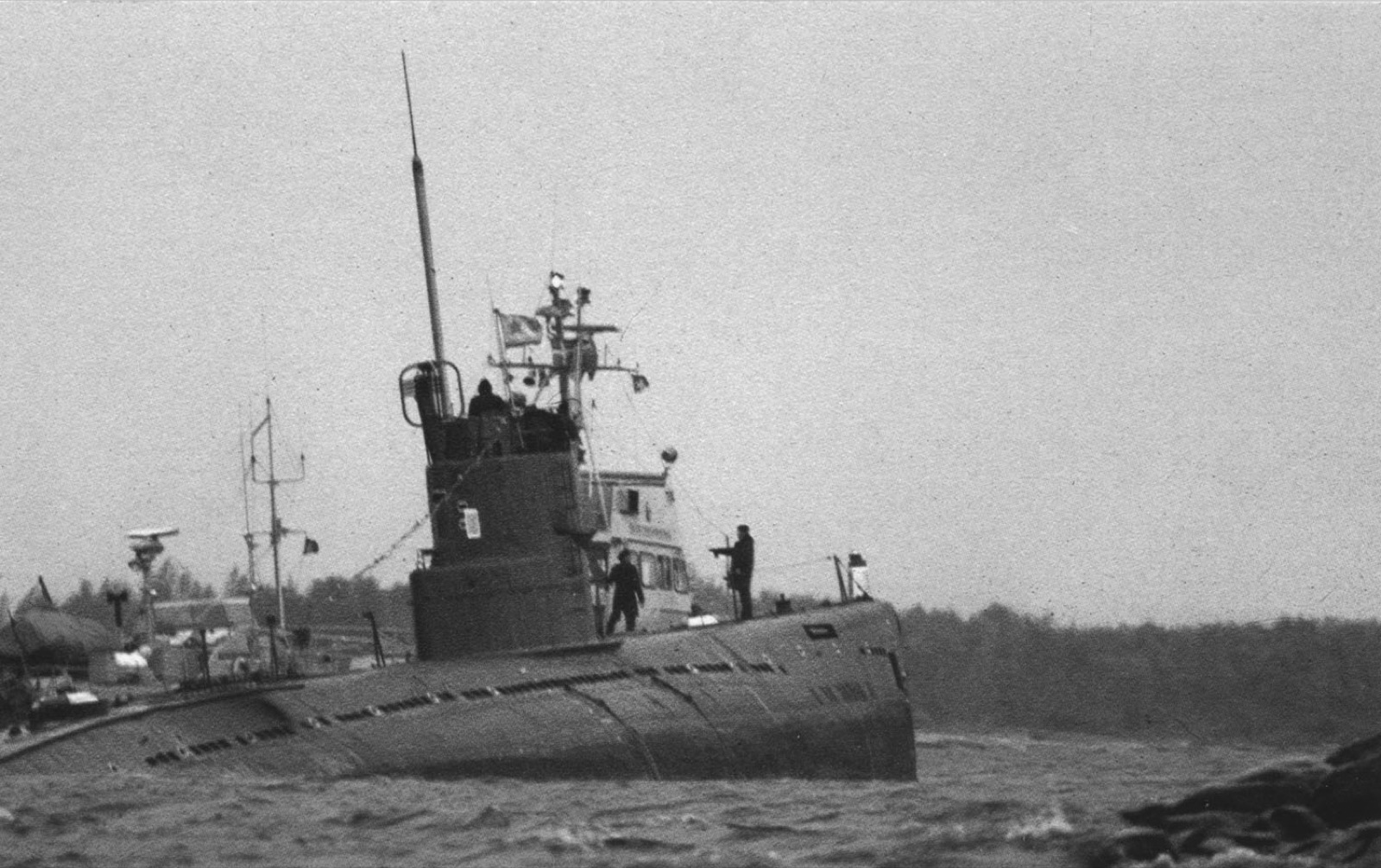
The Soviet submarine U 137 aground on the rocks of Gåsefjärden, inside a restricted Swedish military zone near the Karlskrona naval base, in October 1981 — the incident the Swedish press dubbed 'Whiskey on the Rocks.' Unlike the submarine hunts that followed, this intrusion was undeniable: the vessel sat stranded in plain view for days. Wikimedia Commons / Jan Collsiöö, CC0.
The Swedish Submarine Incidents and the Phantoms in the Archipelago
Sweden, the 1980s — a Soviet submarine ran aground beside a top-secret naval base, and for years afterward the Swedish navy hunted foreign submarines through its archipelagos with depth charges, never catching one. Decades later, the question of whose submarines they were — if any — remains open
- Category
- Cold War Files
- Published
- Length
- 4,120 words · 19 min read
- Author
- The editors
The Swedish submarine affair is really two stories wearing one name. The first is the tale of U 137, which is not a mystery at all: a Soviet submarine ran aground in Swedish waters in 1981, and everyone could see it. The second is the long, strange saga of the submarine hunts that followed — years of pursuit, alarm, and accusation in which Sweden became convinced its waters were full of hostile intruders, and never caught one. The first story is a fact. The second is a genuine mystery, and possibly a collective delusion, and the hard work of this article is to keep them apart: to honour what is certain and to be honest about what, after four decades, is still unknown.
This is the story of the submarine on the rocks, and the phantoms that followed it.
A neutral country and its waters
To understand the panic, you have to understand Sweden's Cold War position. Sweden was neutral, formally outside both NATO and the Warsaw Pact, but it sat in a strategically vital corner of the world: its long Baltic coastline faced the Soviet bloc directly, and the waters between Sweden, the Soviet Union, and NATO's northern flank were among the most militarily sensitive on earth. A neutral Sweden's job, in its own strategic conception, was to defend its territory and waters credibly enough that neither superpower would find it worth violating — and the Swedish navy took the integrity of its territorial waters with deadly seriousness. Foreign submarines creeping into Swedish archipelagos were not just a nuisance; they were a challenge to the entire logic of armed neutrality.
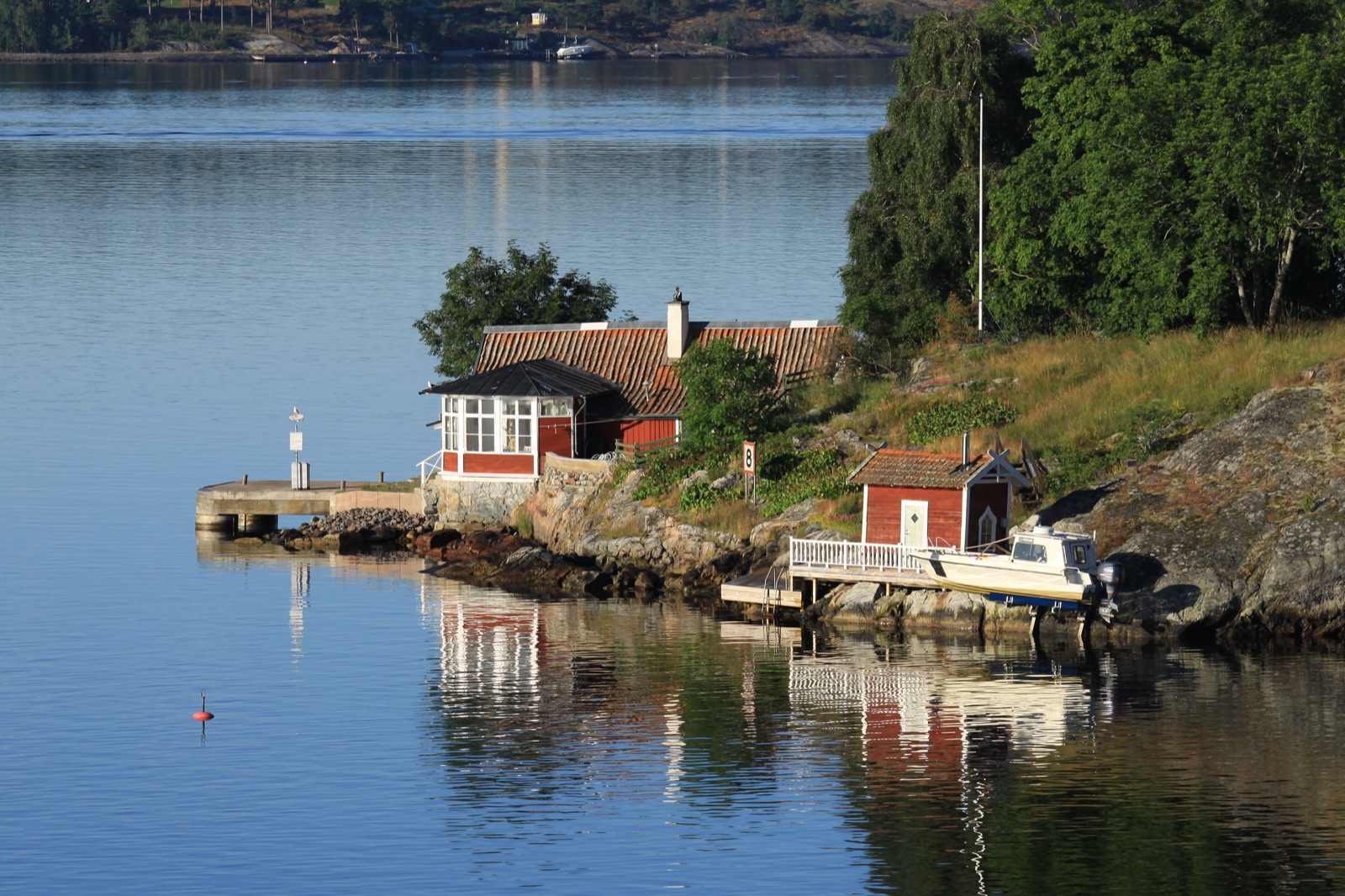
The Baltic itself made the problem peculiar. It is shallow, cold, and acoustically treacherous — full of varying salinity layers, temperature boundaries, and biological noise that play havoc with sonar. Sound behaves strangely there; echoes deceive; and the archipelagos add a maze of rock and channel in which, in principle, a small submarine might hide. These were ideal conditions for genuine intrusion to be hard to detect — and equally ideal for false alarms, in which natural phenomena could be mistaken for the deliberate movements of an enemy. Both things were true at once, and telling them apart would prove nearly impossible.
Whiskey on the Rocks
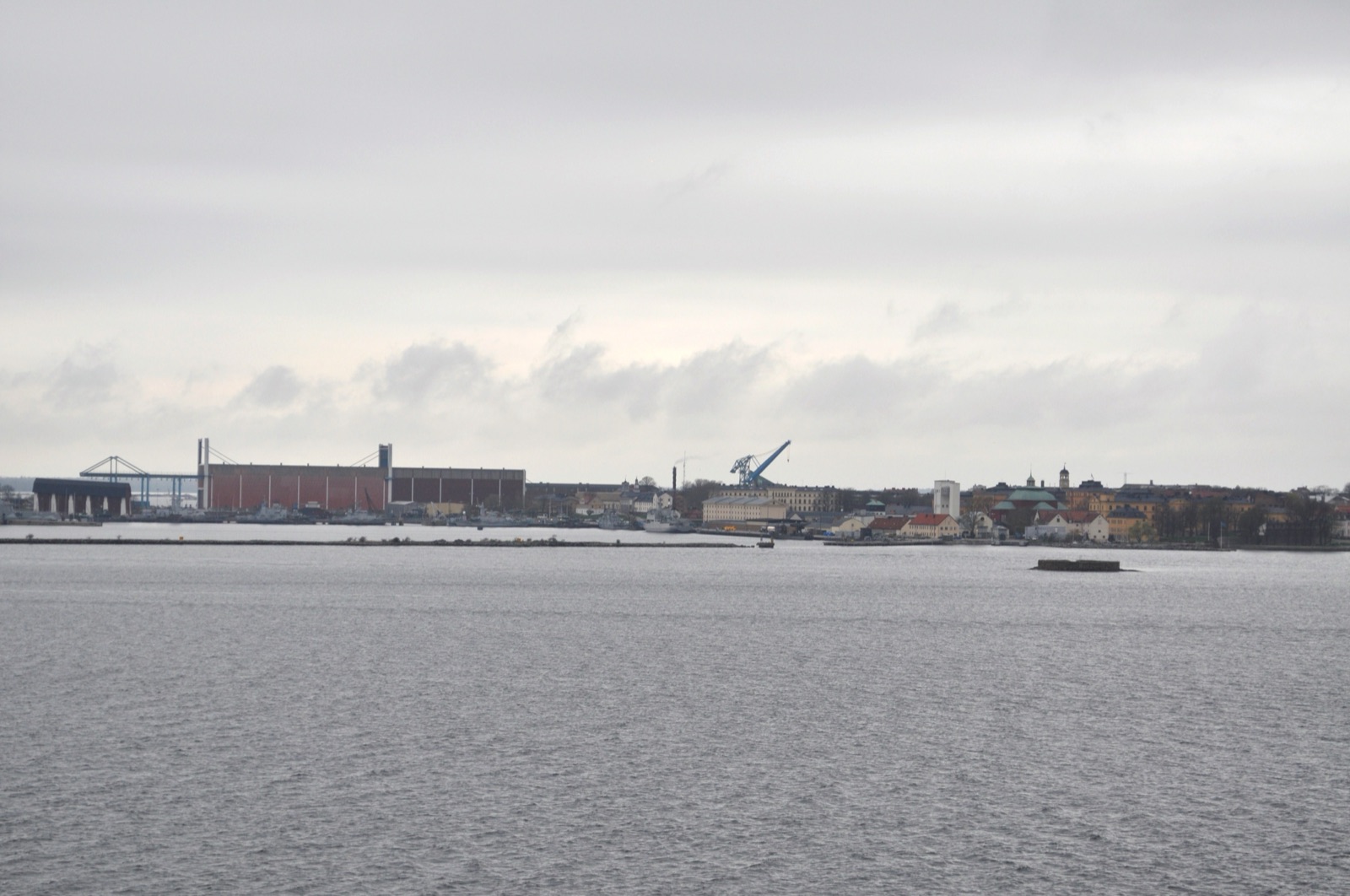
Then came the night that made it all concrete. On 27 October 1981, U 137 ran aground at Gåsefjärden, inside the restricted waters around Karlskrona — the home of Sweden's southern naval command. There was no ambiguity: a Soviet submarine was physically stuck on Swedish rocks, far inside a military exclusion zone where it had no conceivable innocent reason to be. The Soviets claimed navigational error — that faulty equipment had led the boat astray — an explanation few in Sweden believed given how deep into sensitive waters it had strayed.
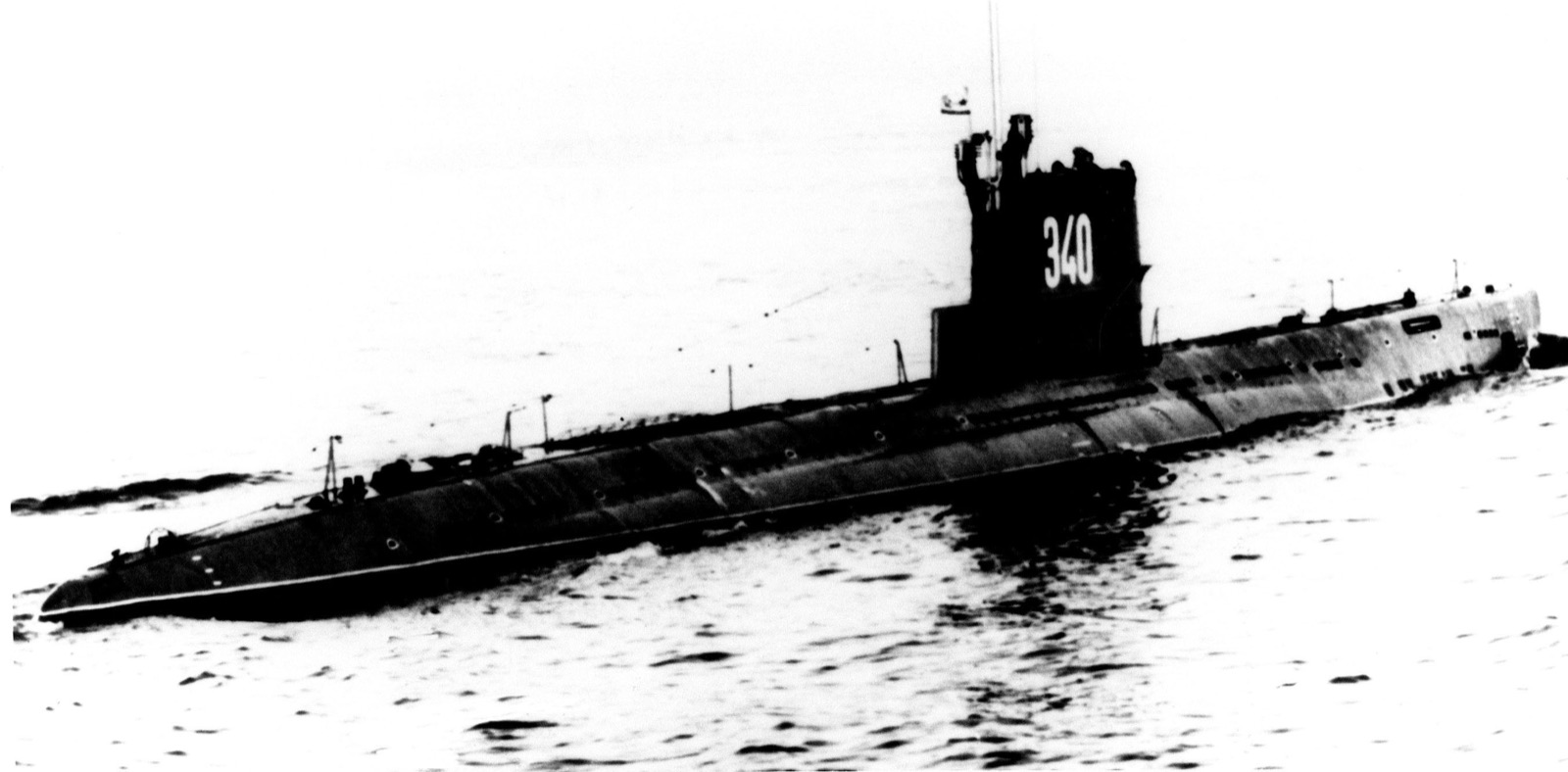
The incident became a tense diplomatic crisis. The Swedish military held the submarine and questioned its commander; most alarmingly, Swedish measurements indicated the likely presence of nuclear weapons aboard — uranium-238, consistent with nuclear torpedoes — which made a foreign nuclear-armed vessel stranded in Swedish waters an extraordinary provocation. After more than a week of standoff, interrogation, and negotiation, Sweden released U 137 and let it be towed back to sea, having extracted what information and protest it could.
The detail of the suspected nuclear weapons deserves emphasis, because it transformed the incident from an embarrassing navigational blunder into something graver. Swedish technicians, measuring radiation from the hull, concluded that the submarine very probably carried nuclear warheads — almost certainly nuclear-tipped torpedoes. This meant that a nuclear-armed Soviet vessel had run aground inside the territorial waters of a neutral, non-nuclear nation, beside one of its most important naval bases. For Sweden, it was confirmation of its worst assumptions about how little its neutrality was respected by the superpowers; for the Soviet Union, it was a propaganda disaster that exposed both the intrusion and the nuclear cargo it would have preferred to keep invisible. The episode thus carried a weight far beyond a single stranded boat, and it seared into the Swedish military and public mind a conviction that would prove almost impossible to dislodge: that the threat beneath the water was real, Soviet, and nuclear. The affair was a humiliation for the Soviet Union and a vindication, in Swedish eyes, of the navy's deepest fears: the intruders were real, they were Soviet, and they were here. That conclusion, drawn from one undeniable case, would shape how Sweden interpreted everything that came after — and that is where certainty ends and the mystery begins.
Hårsfjärden, 1982
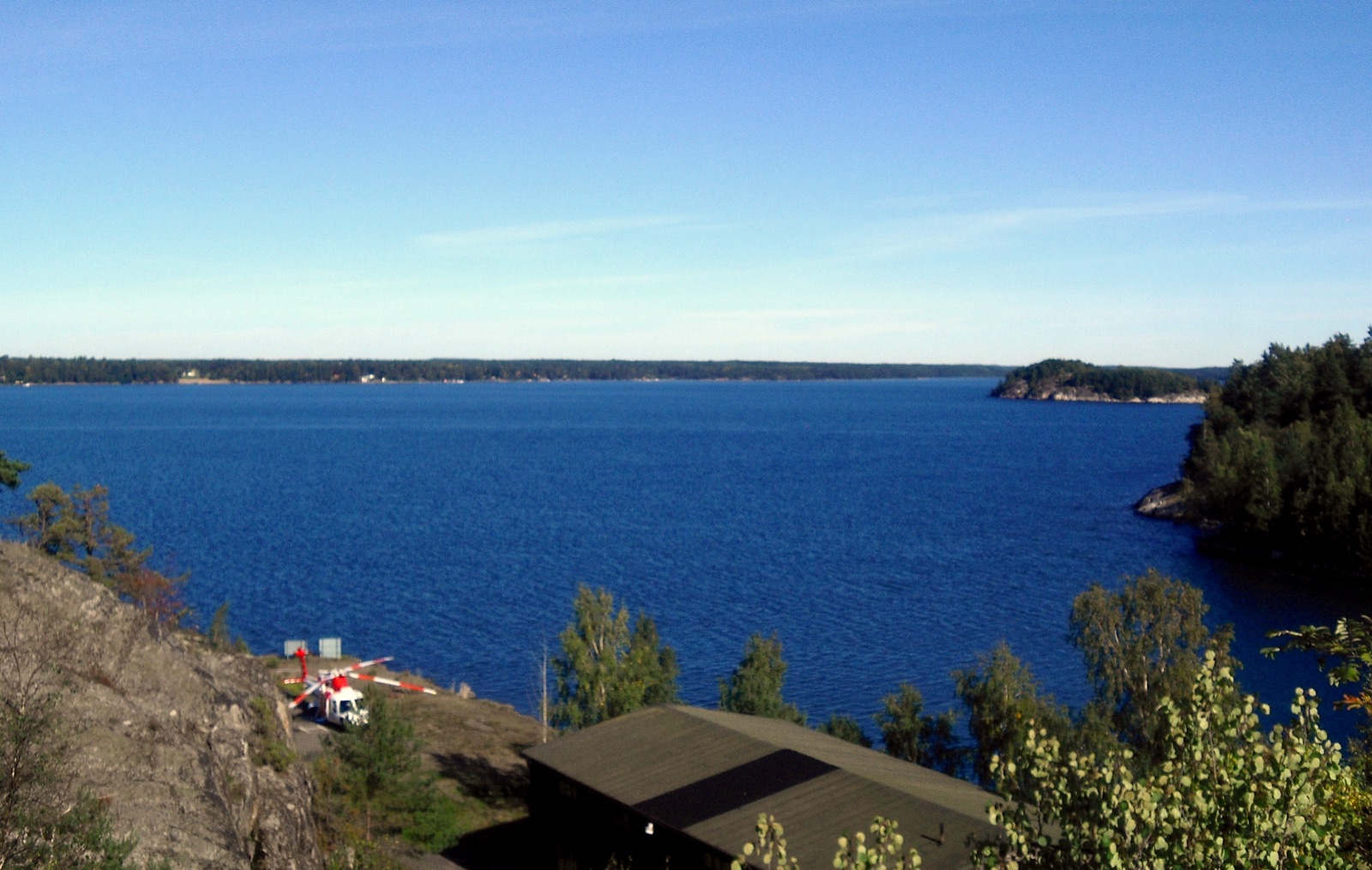
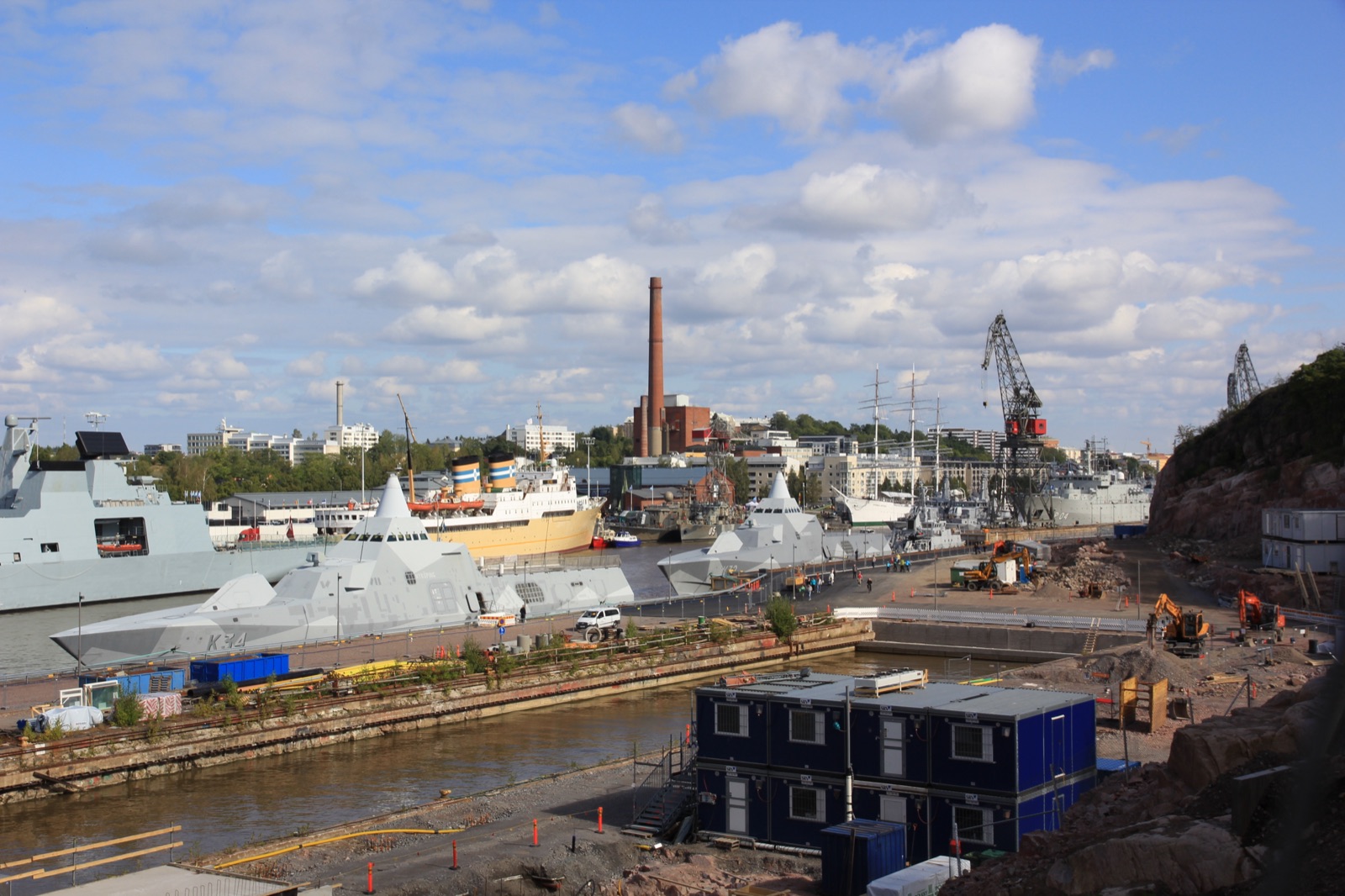
The defining episode of the disputed phase came a year later. In the autumn of 1982, the Swedish navy detected what it believed were foreign submarines in Hårsfjärden, a bay near the Muskö naval base south of Stockholm — one of the most sensitive locations in the country. What followed was a major, weeks-long submarine hunt: the navy sealed off the area, deployed ships and helicopters, and dropped depth charges and mines in an effort to force the intruder or intruders to the surface. The nation watched, transfixed, as its military waged war on an unseen enemy in its own coastal waters.
The Hårsfjärden hunt ended as nearly all of them would: without a submarine. Nothing was forced up, nothing was captured, no hull was photographed. What the navy had instead were traces and indications — sonar contacts, observed disturbances, and what investigators interpreted as bottom tracks on the seabed left by submarine-like objects. In the aftermath, a government commission examined the incident and concluded, with confidence, that the intrusions were real and that the most likely culprit was the Soviet Union. Prime Minister Olof Palme delivered a formal protest to Moscow. The official Swedish position had hardened into certainty: Soviet submarines were violating Swedish waters, repeatedly and deliberately.
The hunt becomes an obsession
Through the rest of the 1980s, the submarine intrusions became a recurring national drama. Reports of sightings and sonar contacts came in regularly; the navy mounted hunt after hunt; the public, primed by U 137 and Hårsfjärden, was ready to believe that the archipelagos were infested with hostile boats. Submarine-spotting became almost a civic activity, with members of the public reporting periscopes and disturbances. The threat shaped defence policy and public opinion, fed anti-Soviet feeling, and kept the navy in a state of high alert. The intruder was everywhere — and nowhere, because despite the scale and frequency of the hunts, the pattern never changed: no submarine was ever definitively caught.
The cost of this was not only material but psychological and political. The submarine threat justified defence budgets, reshaped naval doctrine, and poisoned Swedish-Soviet relations at a delicate moment; it became a fixture of national life, a recurring emergency that the public learned to expect each autumn. It also created a powerful institutional momentum: the navy had staked its credibility on the reality of the intrusions, the government had formally accused a superpower, and the public had been mobilised to watch the water — and all of that investment made it progressively harder for anyone in authority to entertain the possibility that the threat might be smaller, or stranger, than advertised. To doubt the submarines was, in effect, to accuse the navy of chasing ghosts and the government of crying wolf to a foreign power. The structure of the situation rewarded continued belief and punished skepticism, which is exactly the condition under which a collective misperception, if that is partly what it was, can sustain itself for years.
The evidence wars
Because no submarine was ever caught, everything turned on the interpretation of indirect evidence — and that evidence became the subject of a long, bitter, and still-unresolved scientific and political dispute. Three kinds of evidence were central, and each was contested.
There were the seabed tracks — marks on the bottom of bays that the navy interpreted as the trails of crawling mini-submarines, but which skeptics argued could have natural or ambiguous explanations. There were the visual sightings, which ranged from credible to plainly mistaken and which the conditions of the archipelago made notoriously unreliable. And, most famously, there were the sounds: underwater acoustic recordings that the military presented as the characteristic noises of foreign submarines. Years later, in one of the affair's most deflating turns, analysis indicated that some of these supposedly damning "typical submarine sounds" were nothing of the kind — they were the sounds of marine life, including, by some accounts, mink swimming and herring releasing gas bubbles. The revelation that a superpower confrontation had, in part, been built on the noises of fish and small aquatic mammals became an emblem of how badly the evidence had been read.
This is not to say that every contact was a fish or that no foreign submarine ever entered Swedish waters — U 137 proves that at least one certainly did, and intrusions by someone may well have occurred. But it established that a significant portion of the evidence on which the national alarm rested was weak, ambiguous, or simply wrong, and that the confident official conclusion of repeated Soviet incursion had been built on foundations far shakier than the public had been told.
Whose submarines?
If submarines were intruding, the question of whose they were became, in time, even more destabilising than whether they existed. The official Swedish position throughout the 1980s was unambiguous: the intruders were Soviet. This fit the strategic logic, the Cold War mood, and the undeniable precedent of U 137, and it served domestic politics, hardening Swedish opinion against the Eastern bloc.
But from the 1990s onward, as the Cold War ended and archives and memoirs began to open, a more uncomfortable possibility gained ground. Some analysts, and eventually some Swedish and Western officials, suggested that at least a portion of the submarine activity in Swedish waters during the 1980s might have been Western — NATO submarines, possibly British or American, testing Swedish defences, gauging the navy's reactions, or operating for reasons of their own, perhaps even with a tacit understanding that Sweden would blame the Soviets. The evidence for this remains partial and contested, and it does not mean all the activity was Western; the picture may be mixed, with genuine Soviet activity, possible Western activity, and outright false alarms all tangled together. But the very fact that serious people came to doubt the official "it was the Soviets" certainty marked how far the case had come from the confident days of the 1980s. A reappraisal running into the 2010s and 2020s, drawing on declassified material and new analysis, kept the question open rather than closing it.
The most provocative version of the Western thesis, advanced most prominently by the researcher Ola Tunander, holds that NATO submarines deliberately violated Swedish waters to test and influence Swedish policy — even that there was a tacit understanding in which the West probed Sweden's defences while Sweden's leadership blamed the Soviets, hardening Swedish opinion against the East to NATO's benefit. This is a strong and contested claim, and many Swedish officials and analysts reject it, maintaining that the principal intruder, where there was one, was Soviet. It has not been proven, and it should not be presented as established fact. But it could be raised at all, by serious people citing documents and testimony, is itself significant: it shows that the confident Cold War narrative had fractured badly enough that even the basic question of which superpower, if either, was violating Swedish waters could no longer be answered with assurance. Whether the truth is mostly Soviet, partly Western, or mostly phantom, the one thing now clear is that the simple official story of the 1980s was too simple.
What is established, and what is not
The Swedish submarine affair demands the careful separation of its two halves, and the honest conclusion is genuinely split.
What is established beyond any doubt: that the Soviet submarine U 137 ran aground in restricted Swedish waters near Karlskrona in October 1981; that it had no legitimate reason to be there; that it likely carried nuclear weapons; and that this was a real, undeniable violation of Swedish territory by the Soviet navy. On this, there is no mystery. At least one foreign submarine certainly did intrude into Swedish waters in the Cold War, because it got stuck and was photographed.
What is contested or unresolved: almost everything about the wider pattern of submarine intrusions through the 1980s. Whether the many hunts were chasing real submarines or phantoms; how much of the evidence was sound and how much was mink, herring, and misreading; whether the intruders, where real, were Soviet, Western, or both; and why, in years of determined effort, not one was ever caught — these questions have never been definitively answered. The official 1980s certainty that Sweden faced a sustained Soviet submarine campaign has not survived intact; nor has it been replaced by any new certainty. The truth, four decades on, is that Sweden knows one submarine was there, suspects others, and cannot prove who they were or, in many cases, whether they existed at all.
It is worth adding that the affair did not end cleanly even as the Cold War did. Reports of suspected submarine activity in Swedish waters recurred sporadically in later decades — including a noted incident in the Stockholm archipelago in 2014 that briefly revived the whole drama, complete with a naval search and, once again, no captured submarine. The pattern outlived the Soviet Union itself: an alarm, a hunt, an inconclusive end. Whether this reflects genuine continuing intrusion by some power, or the durability of a national sensitivity first seared in by U 137, is yet another version of the same unanswerable question. Sweden's unease about the dark water off its coasts — the sense that something hostile may be moving down there, just out of reach of proof — has never fully resolved, and the submarine affair of the 1980s is the reason why.
In the end, the Swedish submarine incidents remain suspended between fact and phantom. One submarine, beyond dispute, sat on the rocks at Gåsefjärden for the cameras of the world. The rest — the years of hunts, the depth charges in the bays, the confident accusations, the periscopes in the archipelago — dissolve, on close inspection, into a fog of ambiguous traces, disputed sounds, political certainty, and the occasional swimming mink. Sweden spent a decade convinced its waters were full of enemies and never caught one, and four decades later still cannot say for certain how many were truly there, or whose they were. It is among the purest examples in this archive of a threat that was real enough to be terrifying and elusive enough to be unprovable — a Cold War ghost story in which the one ghost everyone could see was the only one anyone could ever be sure of.
Sources
- Swedish government submarine-defence commissions and their reports on the intrusions (1980s, and later reappraisals) — primary.
- Swedish Armed Forces / navy records on the U 137 grounding and the Hårsfjärden operation — primary.
- Contemporary reporting on the U 137 ("Whiskey on the Rocks") incident, October 1981 — primary/secondary.
- Ola Tunander, The Secret War Against Sweden: US and British Submarine Deception in the 1980s (2004) — secondary/academic (the Western-intrusion thesis).
- Analyses re-attributing recorded "submarine sounds" to marine life (mink, herring) — academic.
- Later Swedish official statements and declassifications revisiting the submarine question (2000s–2020s) — primary.
- Memoirs and accounts from Swedish naval officers and officials involved in the hunts — primary/secondary.
- Scholarship on Cold War naval intelligence, Baltic acoustics, and threat perception — academic.
Inspired this / based on it
Ola Tunander
Frank Cass. The contested thesis that NATO, not only the USSR, was behind the intrusions.
SVT
Swedish television re-examinations of the 1980s submarine incidents and the disputed evidence.
Filed under
Click any tag for every article carrying it.
Continue reading

The Olof Palme Assassination
At 11:21 p.m. on Friday, February 28, 1986, the Prime Minister of Sweden, Olof Palme, was shot in the back at point-blank range on Sveavägen, Stockholm, while walking home from a cinema with his wife Lisbet. Lisbet Palme was grazed by a second shot. Olof Palme was 59 years old. He had been the Prime Minister of Sweden from 1969 to 1976 and again from 1982. He had no bodyguards that night. The killer ran east up Tunnelgatan and disappeared. He has never been positively identified. Sweden's Palme Commission and its successor police investigation ran for 34 years. On June 10, 2020, Chief Prosecutor Krister Petersson publicly named the most likely perpetrator — a Swedish graphic designer named Stig Engström, the so-called "Skandiamannen" — and simultaneously closed the case because Engström had died in 2000 and could not be tried. The 40-year-old investigation produced 22 binders of investigative material, dozens of failed theories, one wrongful conviction, and no court ruling. It is the largest unsolved political assassination in modern European history.
Operation Gladio
From 1956 onward, NATO and the CIA helped build clandestine paramilitary networks across Western Europe — Italy, Belgium, West Germany, France, the Netherlands, Greece, Turkey, Spain, Portugal — designed to wage guerrilla war if the Red Army crossed the Iron Curtain. The Red Army never crossed. The networks did not disband. In Italy, where the operation was codenamed Gladio, the same structures became entangled with right-wing terror that killed hundreds of civilians between 1969 and 1984. The network's existence was confirmed by the Italian Prime Minister, in Parliament, on October 24, 1990.

The Sinking of MS Estonia and the Wreck Sweden Would Not Raise
Shortly after one o'clock in the morning on 28 September 1994, the passenger ferry MS Estonia was midway across the Baltic Sea, sailing from Tallinn to Stockholm through a strong autumn gale, when the great clamshell visor at her bow — the hinged structure that lifted to let cars drive on and off — wrenched free of its locks under the pounding of the waves. As it fell away it dragged open the ramp behind it, and the sea poured onto the car deck. A ship like the Estonia could not survive water loose on that long, open deck: it sloshed to one side, the ferry took on a heavy list, and within minutes she was rolling over. From the first violent heel to the moment she vanished beneath the surface, perhaps fifty minutes passed — barely time for those near the upper decks to scramble out into the freezing water, and no time at all for the hundreds asleep in cabins below. Of the 989 people aboard, 852 died. It was the deadliest peacetime shipwreck in European waters of the twentieth century, and a wound that has never fully closed in Sweden, Estonia, and Finland, the three nations that lost the most. An official investigation concluded in 1997 that the visor's failure had doomed the ship. But what turned a catastrophe into an enduring controversy was what came after: Sweden's decision not to raise the bodies or the wreck, to leave the dead in the hull and seal it as a grave; the persistent theories of explosions and secret military cargo; and, in 2020, documentary footage of a large hole in the hull that forced the case to be reopened. This article sets out what happened that night, what is firmly established, and what remains genuinely contested.