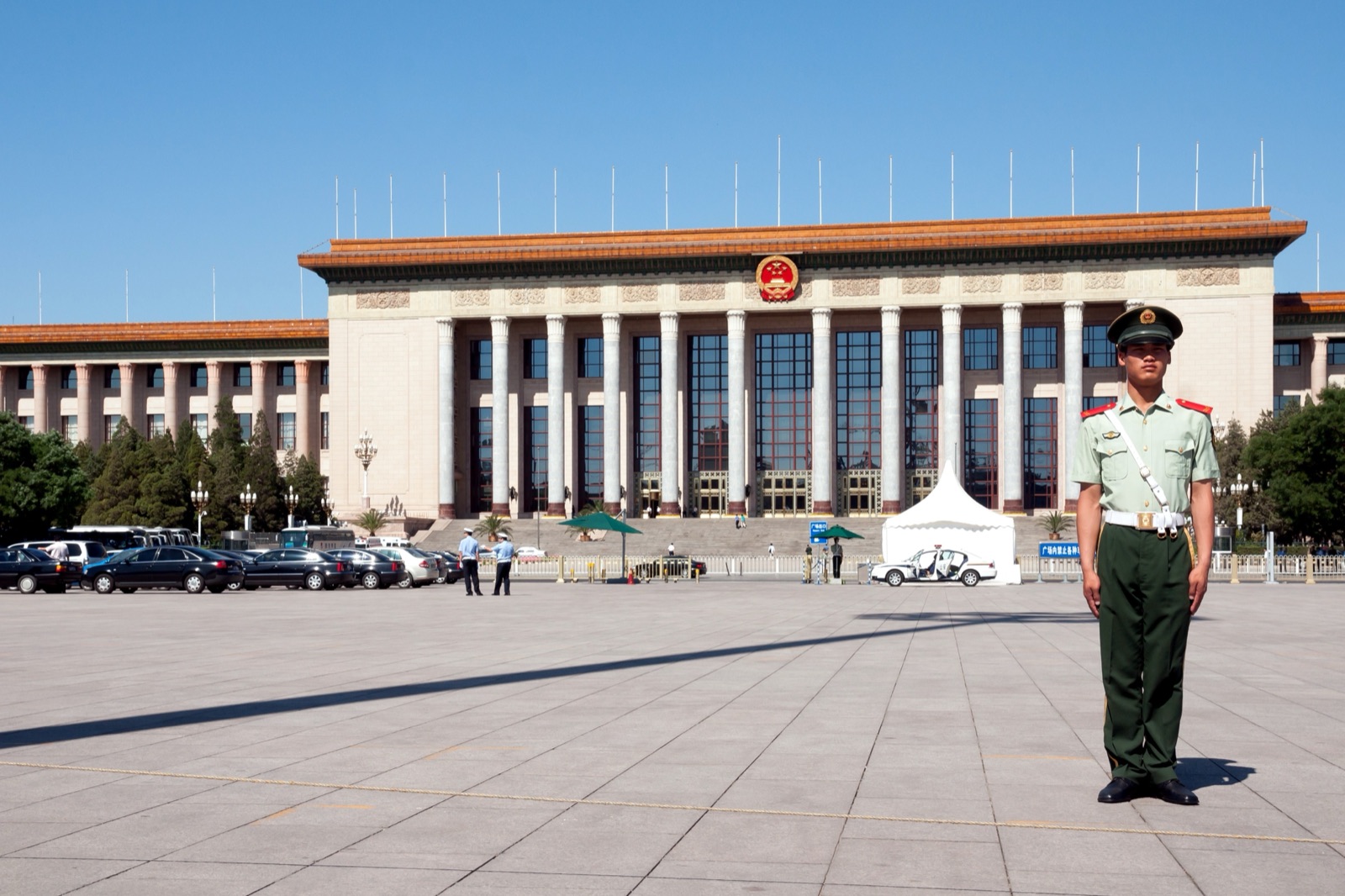
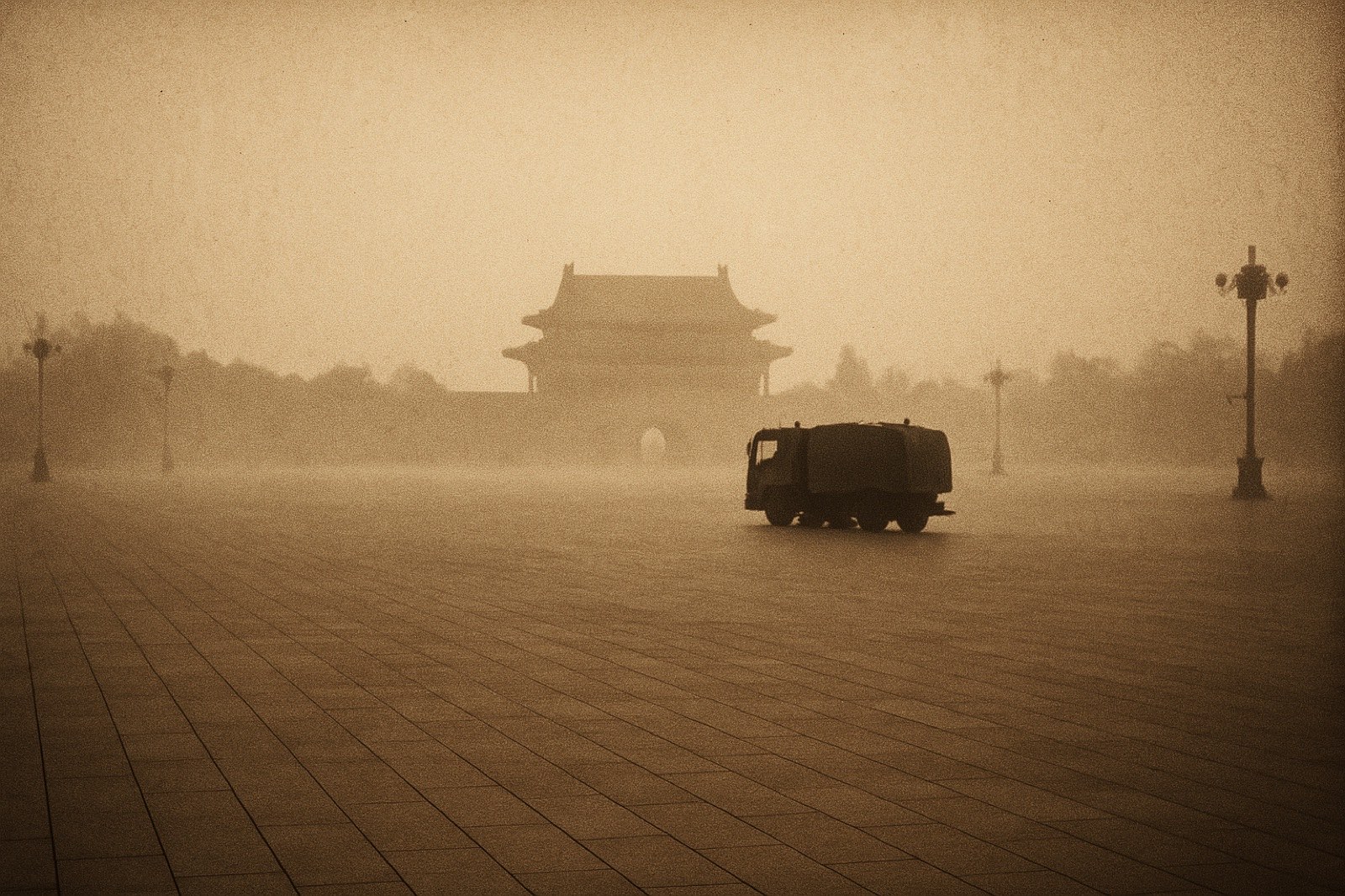
Tiananmen Square, Beijing. The plaza extends approximately 880 meters north-south and 500 meters east-west — the largest urban public square in the world. The Forbidden City lies to the north, the Mausoleum of Mao Zedong to the south. Wikimedia Commons, CC BY-SA 3.0.
Tiananmen Square 1989
The protest, the night of June 3-4, and forty years of erasure
- Category
- State & Intelligence Operations
- Published
- Length
- 3,700 words · 17 min read
- Author
- The editors
Tiananmen Square 1989
The protest, the night of June 3-4, and forty years of erasure.
What started it
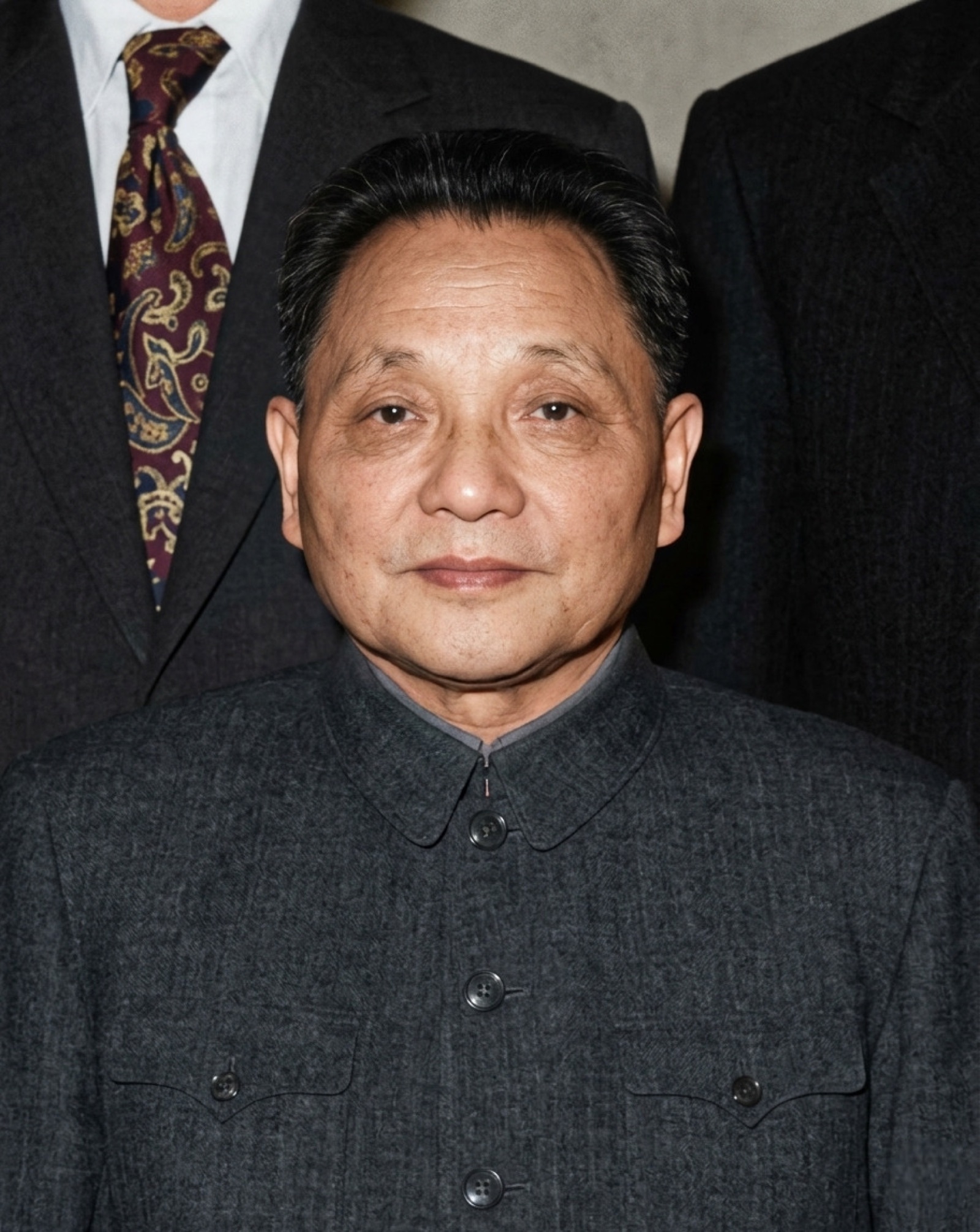
Hu Yaobang had been General Secretary of the Chinese Communist Party from September 1982 to January 1987. He was, by the internal Party assessment of subsequent reformists, the most politically liberal of the senior Party leaders. His tenure was associated with rehabilitation of Cultural Revolution victims, relaxed media controls, and limited tolerance of intellectual dissent.
Hu had been forced from the General Secretary position in January 1987 by Deng Xiaoping in a factional dispute over student protests in late 1986. He retained a Politburo seat and was, at the time of his April 1989 death, in a politically ambiguous status — neither restored nor formally disgraced.
When Hu died of a heart attack on April 15, 1989, the Beijing university student community organized memorial gatherings. The first gatherings on April 16-18 were small (approximately 1,000-5,000 students). The mass attendance came on April 22, the day of Hu's official state funeral — when approximately 100,000 students gathered on Tiananmen Square demanding to be addressed by Premier Li Peng. Li did not appear.
From April 22 forward, the gatherings escalated in size and in political demand. On April 26, the People's Daily — the official Party newspaper — ran an editorial characterizing the protests as "a planned conspiracy to undermine the Communist Party." The editorial was understood by the protesters as a hardline declaration. It had been personally drafted at Deng Xiaoping's instruction.
The April 26 editorial radicalized the movement. Within days the protests had spread from Beijing to Shanghai, Wuhan, Chengdu, and approximately 80 other Chinese cities. On May 4, the 70th anniversary of the original 1919 Tiananmen movement against Japanese imperial demands, approximately 300,000 protesters gathered on Tiananmen Square in Beijing.
What the movement wanted
The movement was, in its early phase, programmatically modest. The student demands articulated on April 27 and refined through early May were:
- Reassessment of Hu Yaobang's status — formal rehabilitation.
- Reassessment of the April 26 People's Daily editorial — withdrawal of the "planned conspiracy" characterization.
- Publication of Party officials' incomes and family financial holdings (an early anti-corruption demand).
- Press freedom — specifically, freedom for Chinese domestic media to report on the protests.
- Increased education spending.
- Dialogue with the Party leadership.
The movement's leadership — primarily a Beijing Students' Autonomous Federation under figures including Wuer Kaixi (a 21-year-old Uighur graduate student), Wang Dan (a 20-year-old Peking University history student), and Chai Ling (a 23-year-old psychology graduate student) — was internally divided about strategy. Some advocated negotiating with the moderate Party faction (Zhao Ziyang). Others advocated extending the protests until the hardline majority capitulated.
By mid-May, the Beijing Workers' Autonomous Federation had also formed — representing factory workers organizing outside the official Party-controlled trade unions. The workers' federation articulated more economic demands (wage stability, anti- corruption enforcement against managers) than the students' political demands. The combination of student-intellectual protests and worker organizing was, in Party-leadership assessment, the genuinely threatening combination — the same combination that had brought down the Polish United Workers' Party through Solidarity nine years earlier.
The hunger strike — beginning May 13 on Tiananmen Square — was the strategic decision that extended the movement past the moderate-Party-faction's ability to manage it. Approximately 3,000 students refused food. The hunger strike was timed to coincide with Mikhail Gorbachev's May 15-18 Beijing visit (the first Sino-Soviet summit in 30 years), which would bring hundreds of international journalists to Beijing. The Chinese government had to receive Gorbachev — including the formal welcome ceremony at the Great Hall of the People, which faces Tiananmen Square — while the square was occupied by hunger strikers.
The international press attention was operationally devastating to the Chinese leadership's preferred narrative.
The split
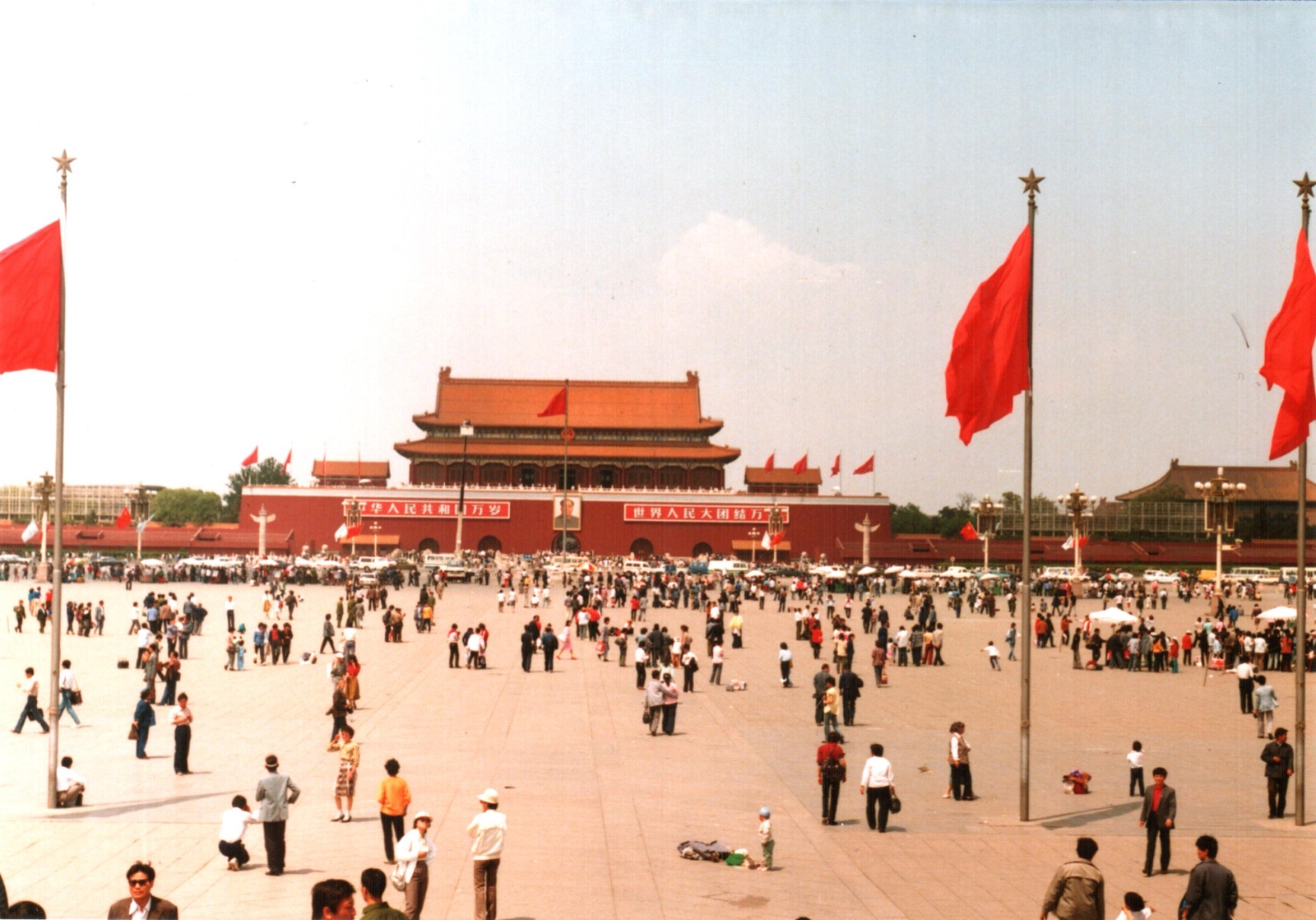
Within the Communist Party Politburo Standing Committee, the period from approximately May 13 to May 19 was a sustained factional confrontation. The principals:
The reformist faction — General Secretary Zhao Ziyang (1919-2005), Politburo Standing Committee member Hu Qili. Their position: the movement could be managed through dialogue with moderate student leaders, partial concessions on press freedom, and rehabilitation of Hu Yaobang.
The hardline faction — Premier Li Peng (1928-2019), President Yang Shangkun (1907-1998), Vice President Wang Zhen (1908-1993). Their position: the movement was a counter- revolutionary plot that had to be suppressed by force; allowing the dialogue position to prevail would create a precedent of backing down to street pressure.
Deng Xiaoping (1904-1997), the paramount leader. Deng held no Politburo membership but had retained the chairmanship of the Central Military Commission. His decision was determinative.
On May 17, Deng convened an enlarged Standing Committee meeting at his home. Zhao argued for the dialogue approach. The hardline faction argued for martial law. Deng sided with the hardline faction.
On May 19, in his final public appearance, Zhao Ziyang visited the hunger-striking students on Tiananmen Square. He characterized himself as having "come too late" and apologized for the political situation. He did not, in that visit, signal the imminent martial law declaration. His public statement was:
Martial law was declared by Premier Li Peng at 10 a.m. on May 20. Zhao was placed under house arrest later that day. He would remain in the same Beijing courtyard residence until his death in January 2005.
The clearing
The Beijing operational plan for clearing Tiananmen Square was developed between May 20 and June 3 under the supervision of Yang Shangkun and his half-brother Yang Baibing (PLA General Political Department director). The 27th Army from Shijiazhuang (approximately 300 km southwest of Beijing) and the 38th Army from Baoding (approximately 150 km southwest) were selected as the principal clearing forces. The 27th Army's commander, Major General Yang Jianhua, was Yang Shangkun's nephew.
Why these specific units: the Beijing Military Region's local 38th Army had been initially deployed for the May 20 martial law enforcement and had encountered substantial passive resistance from Beijing residents who blocked the roads. The 38th Army's commander, Major General Xu Qinxian, had been removed from command and arrested for "command failure" on May 25; his replacement Yan Tongmao was operationally aligned with the hardline faction. The 27th Army was drawn from outside Beijing for ideological reliability — its soldiers had limited contact with Beijing residents and were considered less likely to refuse orders.
The clearing operation, on the night of June 3-4, 1989:
~10:00 p.m. June 3 — 27th and 38th Army units begin advancing on Chang'an Avenue from the west. Beijing residents block the intersections with buses and barricades.
~10:30 p.m. — First armored vehicle incidents at the Muxidi intersection, approximately 6 km west of Tiananmen Square. Eyewitness accounts and journalists' reports describe gunfire into crowds at Muxidi. Casualties are documented from this intersection through to Tiananmen Square through the night.
~12:00 midnight — Lead 27th Army units reach the western edge of Tiananmen Square. Most protesters on the square itself are unaware of the violence at the western intersections.
~1:00 a.m. June 4 — The student leadership on the square votes to evacuate. The decision is contested by some — the Beijing Workers' Autonomous Federation members had been preparing to remain. The "Voice of the Students" broadcast from the square's central makeshift radio announces the evacuation.
~4:00 a.m. — The square's lights are extinguished. The remaining students and workers evacuate through the southern exit — the only exit that the PLA permits to remain open for peaceful withdrawal.
~6:00 a.m. — Tiananmen Square is fully under PLA control. The Goddess of Democracy statue — the 10-meter foam-and-paper- mache statue students had erected on May 30 facing the Mausoleum of Mao — is bulldozed.
The death toll occurred substantially outside Tiananmen Square itself. Most of the documented fatalities were at the Muxidi, Liubukou, and other western intersections of Chang'an Avenue between approximately 10 p.m. and 4 a.m. The "Tiananmen Massacre" — as the events have been called in the Western press since 1989 — is, in geographic precision, the Chang'an Avenue clearing rather than a clearing of the square itself.
What the numbers actually show
The death toll question has been one of the most consequential arguments about the case across the subsequent decades.
Official Chinese figures (Beijing Mayor Chen Xitong's June 30, 1989 report to the National People's Congress): 200 civilians and soldiers, with implicit characterization of approximately equal numbers on each side.
Chinese Red Cross initial figures (June 4, 1989): 2,600 dead. This figure was retracted by the Red Cross within hours under government pressure.
Western intelligence estimates (June-July 1989): U.S. State Department initial estimate: 700-2,800. CIA range: 800-3,200. The estimates were based on hospital interviews, embassy observations, and limited eyewitness reporting.
Alan Donald cable (June 5, 1989, declassified October 2017): Cited a Chinese State Council source giving 10,454 dead. The cable's accompanying analysis suggested the figure included casualties beyond Beijing — possibly across multiple Chinese cities — and emphasized that the source could not be independently verified.
Recent academic estimates (2015-2024): The most-cited recent academic figures — particularly those by Andrew Nathan, Perry Link, and Louisa Lim — place the Beijing-specific death toll at approximately 800-1,500, with substantial uncertainty bounds. Nation-wide figures (including the suppression of secondary protests in Shanghai, Chengdu, and other cities) push the total higher.
The order-of-magnitude disagreement remains genuine. The lower figures rely on hospital records that the Chinese government controls; the higher figures rely on aggregated extrapolation from partial sources. The actual figure is, in the operational sense, unknown — and unlikely to be definitively established until and unless the Chinese state opens its archives.
The man on Chang'an Avenue
The morning of June 5, 1989 — the day after the clearing — a column of PLA armored vehicles was crossing Chang'an Avenue heading east, away from Tiananmen Square. An unidentified man in a white shirt carrying two shopping bags stepped into the roadway in front of the lead vehicle. He did not move.
The vehicle stopped. The man and the lead vehicle's commander exchanged words from approximately three meters apart. The vehicle attempted to drive around the man; he repositioned himself. The man climbed onto the lead vehicle, knocked on the hatch, and appeared to address whoever was inside.
The encounter lasted approximately three minutes. The man then descended from the vehicle. Two bystanders — possibly civilian witnesses, possibly plain-clothes security — pulled the man off the avenue. The armored column then proceeded.
The encounter was photographed from the balconies of the Beijing Hotel, approximately 800 meters east on Chang'an Avenue, by:
- Jeff Widener (Associated Press) — the most-circulated image, taken with a 800mm lens.
- Stuart Franklin (Magnum) — a similar angle.
- Charlie Cole (Newsweek) — a different angle, won World Press Photo 1989.
- Arthur Tsang Hin Wah (Reuters) — a fourth angle.
All four photographers were at the Beijing Hotel because foreign journalists had been ordered confined to the hotel during the clearing operations. The Tank Man encounter was, in operational terms, the first photographable event after the foreign press had been allowed back onto the avenue.
The man's identity has never been publicly established. Various candidates have been proposed:
- Wang Weilin — a 19-year-old student named in some early Western press reports. Chinese government has neither confirmed nor denied. No subsequent independent confirmation.
- Anonymous Beijing worker — the hypothesis advanced by Charlie Cole's subsequent reporting.
- No known surviving identification — the position of most later researchers.
What happened to the man after the encounter is also unknown. The two bystanders who pulled him off the avenue may have been saving him from arrest or may themselves have been arresting him. He has not, by any subsequent identified appearance, been located.
The Tank Man image was, in the immediate post-1989 international news cycle, the dominant visual representation of the case. Time magazine named the photograph one of the 100 most influential images of all time. The Chinese state has, since 1989, systematically blocked the image from Chinese internet infrastructure; access to the photograph remains contested inside China.
What the state did after
The Chinese state's response to the post-June 4 period had three operational components.
1. Arrests and trials. Approximately 1,600 people were tried for participation in the protests according to official figures; human rights organizations have estimated the figure substantially higher. Approximately 30 people were executed for specific protest-period acts — most commonly attacks on PLA soldiers, vehicle-burning, and incitement charges. Many more were sentenced to long prison terms.
2. Internal Party purge. Zhao Ziyang's faction was substantially purged from senior positions across 1989-1991. Approximately 17,000 Party members were expelled or punished for protest-period actions. Premier Li Peng remained in power until his retirement in 1998. President Yang Shangkun was politically rehabilitated within the leadership.
3. Information control. The Chinese state has, since 1989, maintained one of the world's most sustained information- suppression operations specifically on the June 4 events. The date itself ("June 4," "Liu Si" in Chinese) is blocked on Chinese internet platforms. Related terms (Tank Man, Tiananmen, the year 1989, "May 35th" — a workaround) are blocked or filtered. Searches for related Chinese-language content return zero results on Baidu and other Chinese search engines on the date and its anniversaries.
What Hong Kong did
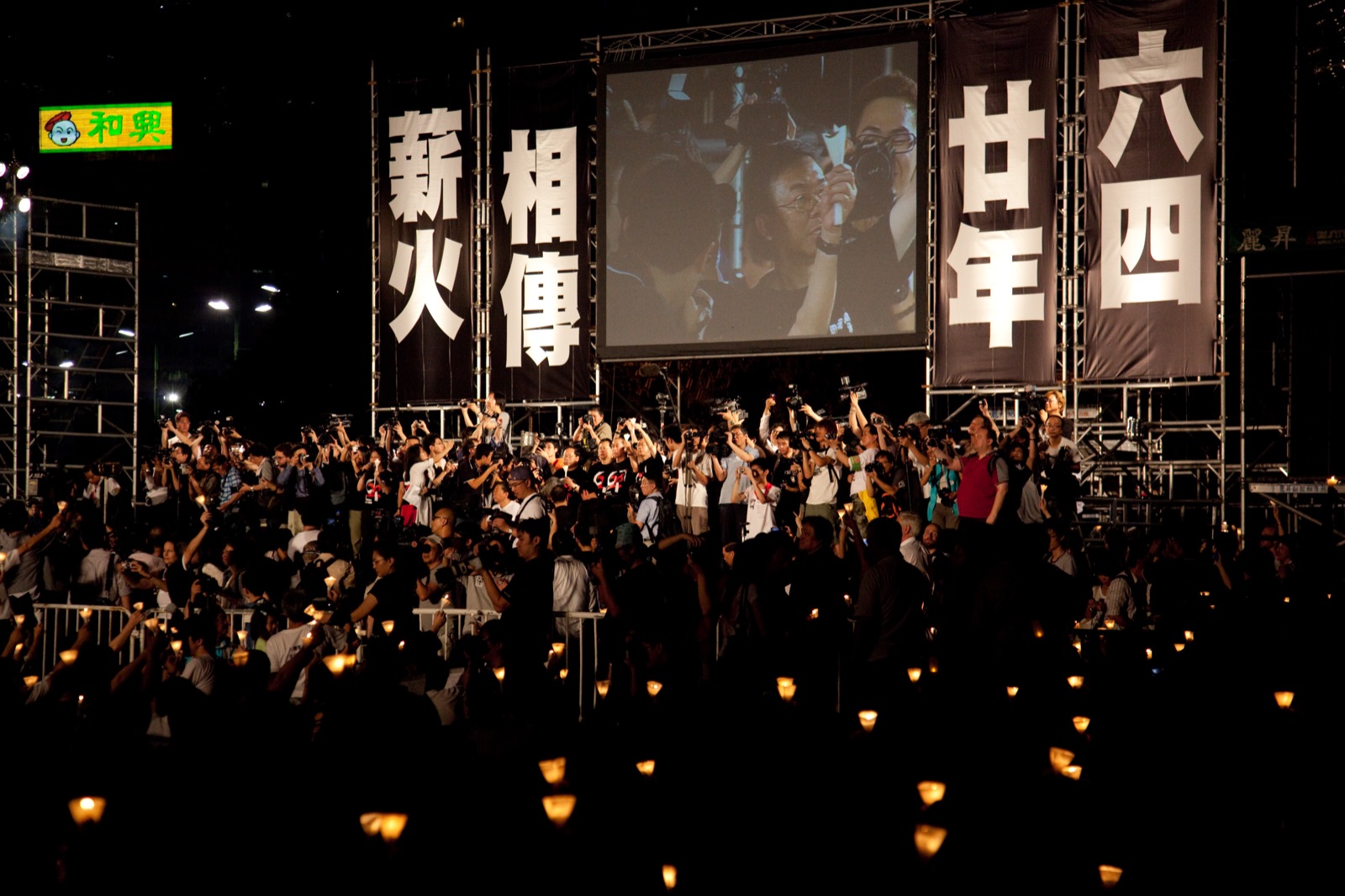
The Hong Kong June 4 Tiananmen Massacre Victims Memorial vigil at Victoria Park began in 1990 and continued annually through 2019 — 30 years. At peak attendance (the 25th anniversary in 2014, the 30th anniversary in 2019), the vigil drew approximately 180,000 people. The vigil was organized by the Hong Kong Alliance in Support of Patriotic Democratic Movements of China, founded 1989.
The vigil was, until 2020, the only sustained public commemoration of the Tiananmen events on Chinese territory — permitted under the "one country, two systems" framework that governed Hong Kong from the 1997 British handover through 2020.
In 2020, after the imposition of Hong Kong's National Security Law by the Chinese central government, the vigil was banned on COVID-19 public-health grounds for 2020 and 2021. On September 25, 2021, the Hong Kong Alliance announced its own dissolution under pressure from the national security investigation. Its president Lee Cheuk-yan was sentenced to seven years' imprisonment in November 2024 under sedition and foreign-collusion charges. The Pillar of Shame statue at the University of Hong Kong — Jens Galschiøt's 1997 sculpture commemorating the Tiananmen victims — was removed by university authorities in December 2021.
The 35th anniversary of the events (June 4, 2024) was marked by candlelight gatherings at the U.S. Consulate in Hong Kong by small groups, with several arrests. The mainland Chinese commemoration continues to be effectively impossible.
The cast
Why this case is filed as "confirmed"
The Tiananmen Square events are extensively documented in non- Chinese archives. The foreign press coverage of June 1989 is the most comprehensive contemporaneous record of any 20th- century Chinese political event. The Alan Donald cable (October 2017 declassification), the Tiananmen Papers (contested but substantially corroborated by multiple academic reviewers), the Zhao Ziyang memoir (published posthumously 2009), and Louisa Lim's The People's Republic of Amnesia (2014) collectively constitute a documentary base that meets any reasonable standard of historical confirmation.
What is sometimes still misunderstood — particularly by audiences familiar with the Tank Man image but not with the broader case — is the systematicness of the post-1989 information operation. The events of June 1989 are not, in any practical sense, part of the official Chinese historical record. They are absent from domestic textbooks, blocked from internet platforms, and removed from the historical-memorial landscape of modern China. The absence is itself a feature of the case: a state actor demonstrating that it can sustain a memory-control operation across thirty-six years.
What we still don't know
The exact death toll. The 200-10,454 range remains the honest reflection of source disagreement.
Tank Man's identity. Various candidates have been proposed; none confirmed.
The Politburo decision-making record. Some 1989 records remain classified in Chinese archives; The Tiananmen Papers have been substantially corroborated but their full authenticity has been disputed.
The post-1989 dissident archive. Many of the 1,600+ documented post-protest prisoners remain incompletely identified; their subsequent fates partially unknown.
Sources
Primary documents:
- Alan Donald cable to the British Foreign Office, June 5, 1989. Declassified October 2017. UK National Archives.
- Beijing Mayor Chen Xitong Report on the Quelling of the Counter-Revolutionary Rebellion. June 30, 1989. Chinese state document.
- The Tiananmen Papers (Andrew Nathan and Perry Link, eds., PublicAffairs 2001). Documents claimed to be Politburo records 1989.
- Zhao Ziyang, Prisoner of the State: The Secret Journal of Premier Zhao Ziyang (Simon & Schuster, 2009). Posthumous publication of secretly-recorded audio.
- U.S. State Department, declassified cables on Beijing, May-June 1989.
- UNHCR / Operation Yellowbird records — Hong Kong escape network for protest participants.
Secondary investigative reporting: 7. Louisa Lim, The People's Republic of Amnesia: Tiananmen Revisited (Oxford UP, 2014). The most-cited recent treatment. 8. Andrew Nathan, China's Crisis (Columbia UP, 1990). The contemporaneous scholarly account. 9. Long Bow Group, The Gate of Heavenly Peace (1995). The principal documentary film treatment. 10. Tiananmen Square in Berlin: A Memorial — multi-decade Hong Kong Alliance archive. 11. Liu Xiaobo, Charter 08 and related essays. Liu was the 1989-period dissident who later won the 2010 Nobel Peace Prize while in Chinese prison. 12. James Mann, About Face: A History of America's Curious Relationship with China (Knopf, 1999).
Academic / specialist scholarship: 13. Robin Munro and Andrew J. Nathan, "Tiananmen: How Wrong We Were" — Foreign Affairs, 1991. 14. Ian Buruma, Bad Elements: Chinese Rebels from Los Angeles to Beijing (Random House, 2001). 15. Wu Renhua, June Fourth: The True Story (Hong Kong, 2014). Chinese-language scholarly treatment based on participant testimony. 16. Frank Dikötter, China after Mao: The Rise of a Superpower (Bloomsbury, 2022).
Corrections & updates
2026-05-28: First publication.
Inspired this / based on it
Long Bow Group / Carma Hinton · ★ 8
3-hour documentary using extensive contemporaneous footage and post-1989 participant interviews. The most-cited single film treatment.
Louisa Lim
The most-cited recent treatment. Oxford UP. NPR China correspondent's investigation.
Andrew J. Nathan & Perry Link (eds.)
PublicAffairs. Documents claimed to be Politburo records from 1989.
Zhao Ziyang (posthumous)
Simon & Schuster. The deposed General Secretary's posthumous memoir.
PBS Frontline / Antony Thomas · ★ 8
Documentary investigation of the unidentified man's encounter on Chang'an Avenue.
Andrew J. Nathan
Columbia UP. The contemporaneous scholarly account.
Filed under
- #tiananmen
- #tiananmen-square
- #june-fourth
- #deng-xiaoping
- #zhao-ziyang
- #hu-yaobang
- #tank-man
- #tankman
- #chang-an-avenue
- #alan-donald
- #1989
- #china
- #asia
- #pla
- #censorship
- #declassified
Click any tag for every article carrying it.
Continue reading
The Olof Palme Assassination
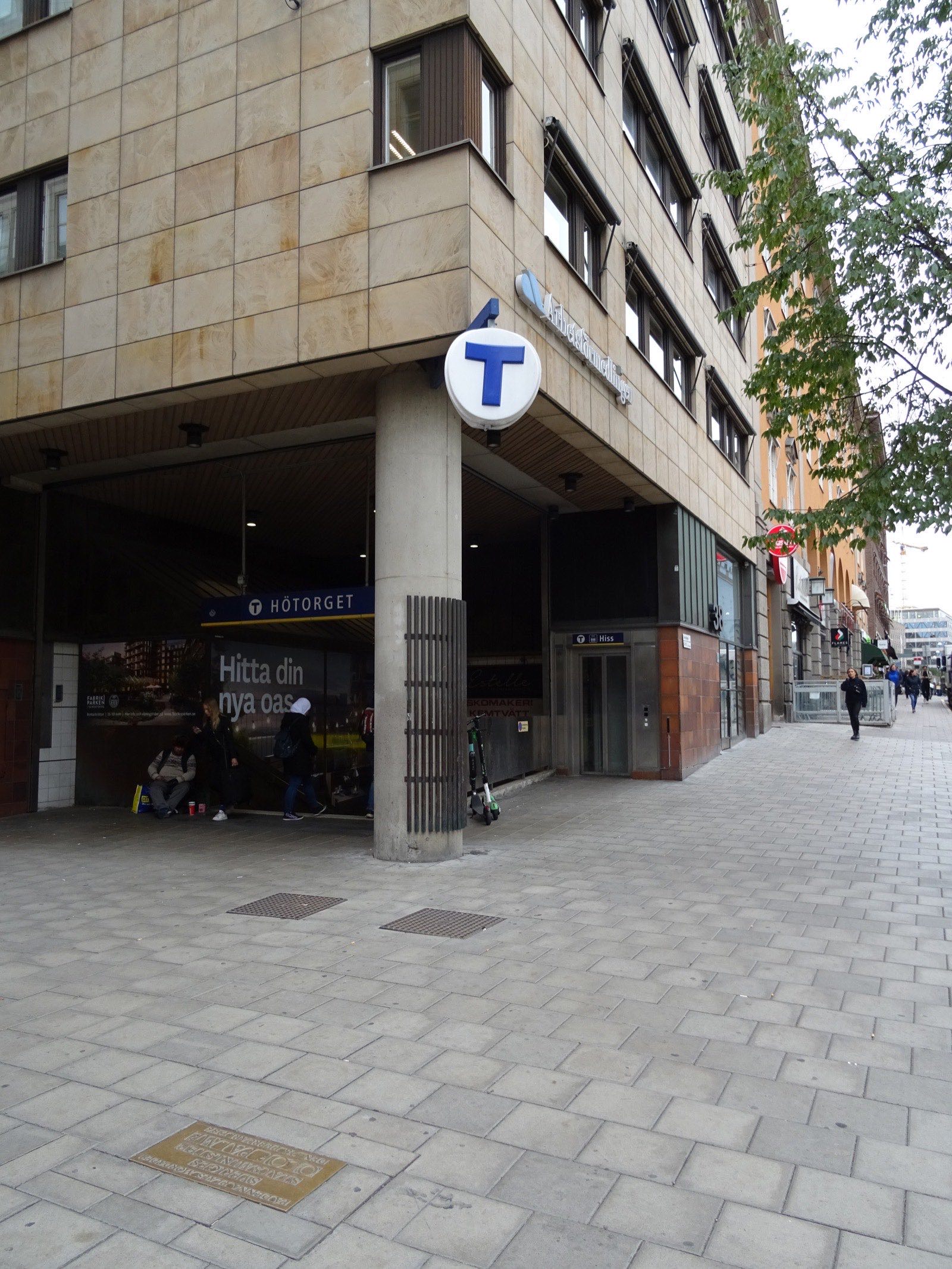
At 11:21 p.m. on Friday, February 28, 1986, the Prime Minister of Sweden, Olof Palme, was shot in the back at point-blank range on Sveavägen, Stockholm, while walking home from a cinema with his wife Lisbet. Lisbet Palme was grazed by a second shot. Olof Palme was 59 years old. He had been the Prime Minister of Sweden from 1969 to 1976 and again from 1982. He had no bodyguards that night. The killer ran east up Tunnelgatan and disappeared. He has never been positively identified. Sweden's Palme Commission and its successor police investigation ran for 34 years. On June 10, 2020, Chief Prosecutor Krister Petersson publicly named the most likely perpetrator — a Swedish graphic designer named Stig Engström, the so-called "Skandiamannen" — and simultaneously closed the case because Engström had died in 2000 and could not be tried. The 40-year-old investigation produced 22 binders of investigative material, dozens of failed theories, one wrongful conviction, and no court ruling. It is the largest unsolved political assassination in modern European history.
Operation Mockingbird
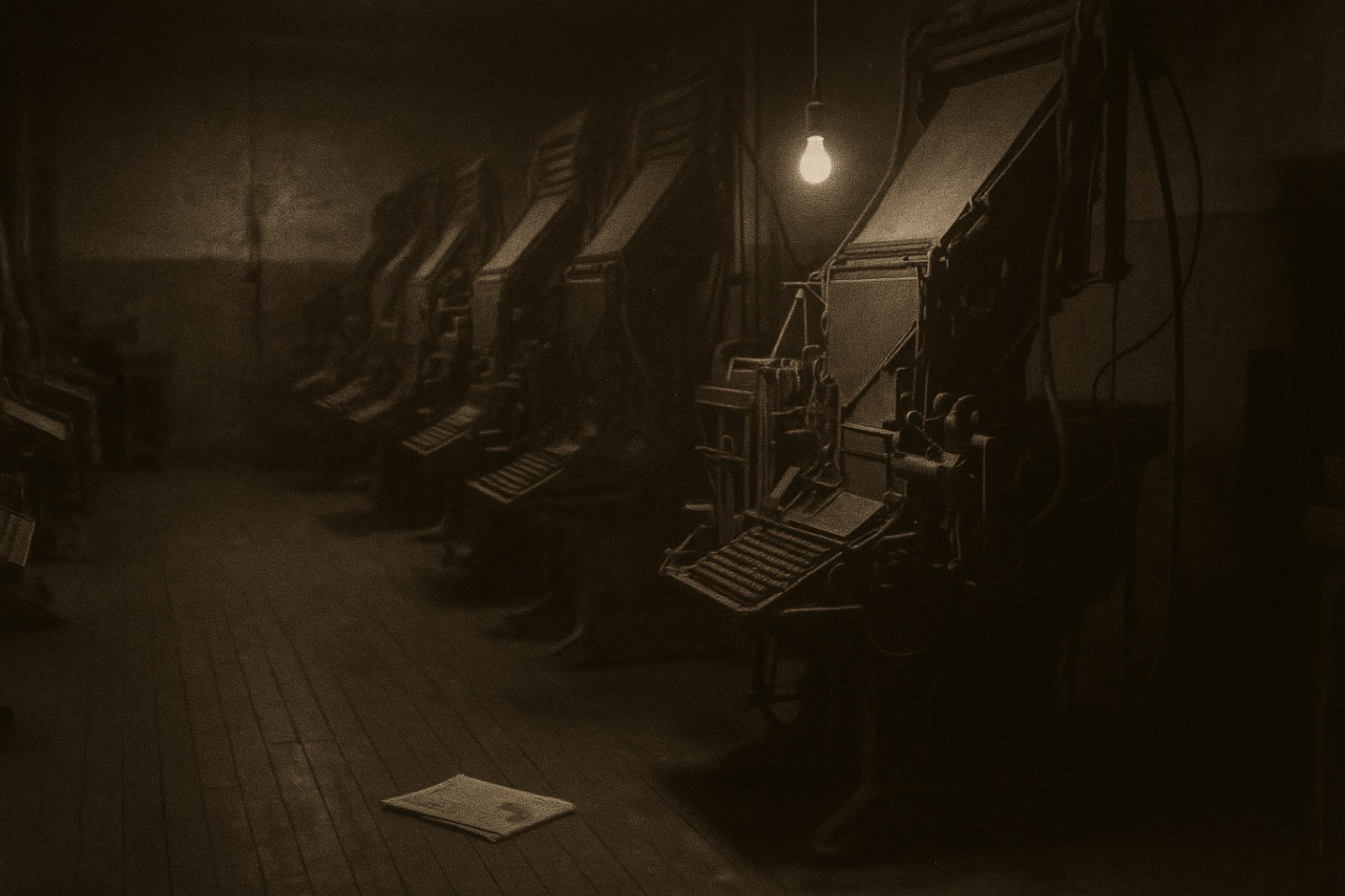
Between 1948 and the mid-1970s, the Central Intelligence Agency cultivated paid and unpaid working relationships with American journalists, editors, and publishers across every major U.S. news organization. The architect was an OSS veteran named Frank Wisner. He called the network the 'Mighty Wurlitzer' — a theatre-organ metaphor for a machine that could play many instruments from a single console. The full scope was confirmed by the 1975 Church Committee, expanded upon in Carl Bernstein's 25,000-word 1977 Rolling Stone investigation, and partly declassified since. What the records have not yet given up is the operational name everyone agrees was attached to it.
Iran 1953 — Operation Ajax
In the summer of 1953, the CIA was six years old. It had never overthrown a government. By August 19 of that year, working with British MI6, it had — and the country it had overthrown was Iran, the prime minister was Mohammad Mosaddegh, and the cause was, almost entirely, oil. The operation was codenamed Ajax. It was authorized by President Eisenhower against the recommendation of his Secretary of State, executed on the ground by a 36-year-old grandson of Theodore Roosevelt, and very nearly failed. The CIA officially acknowledged its role only in August 2013.