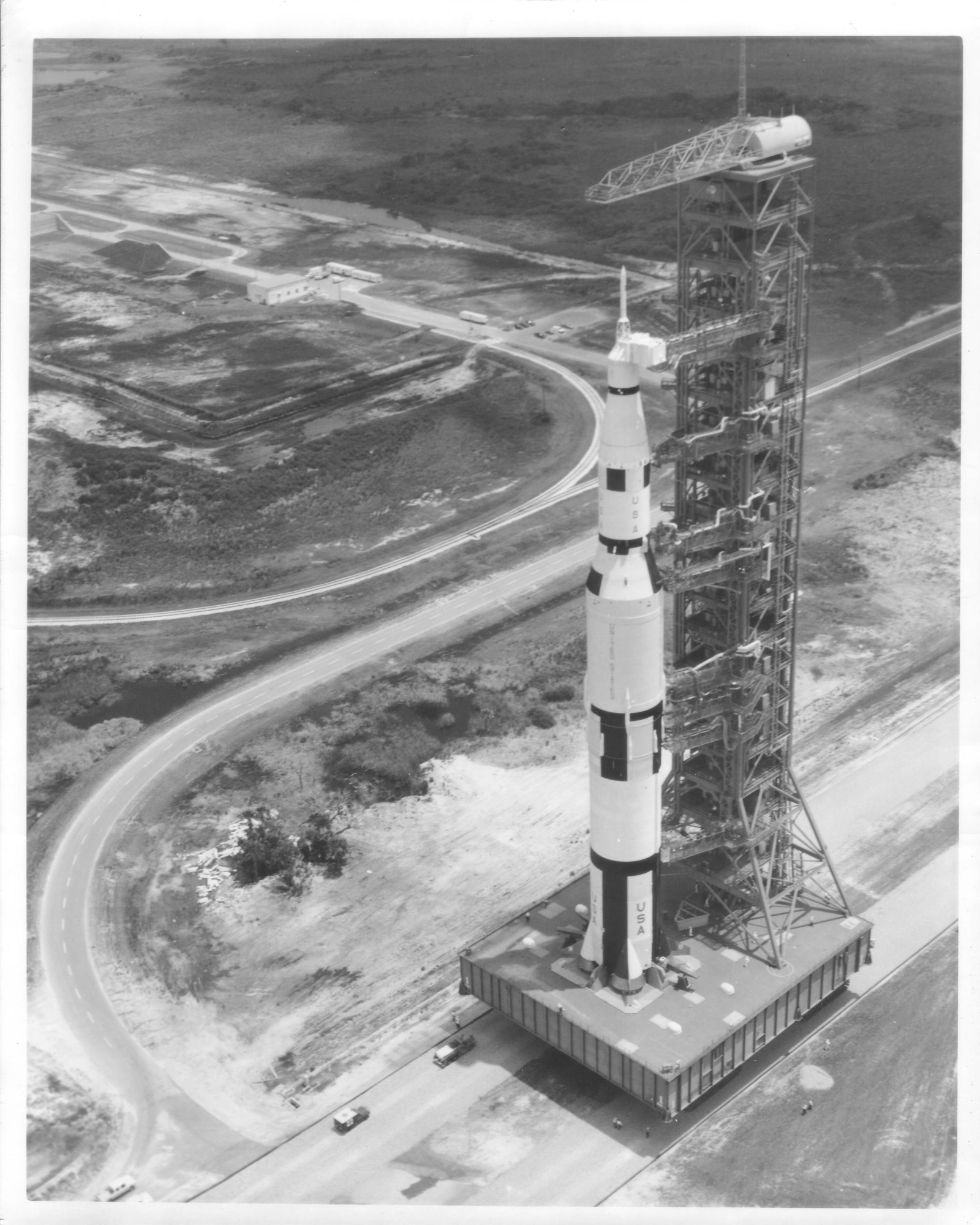
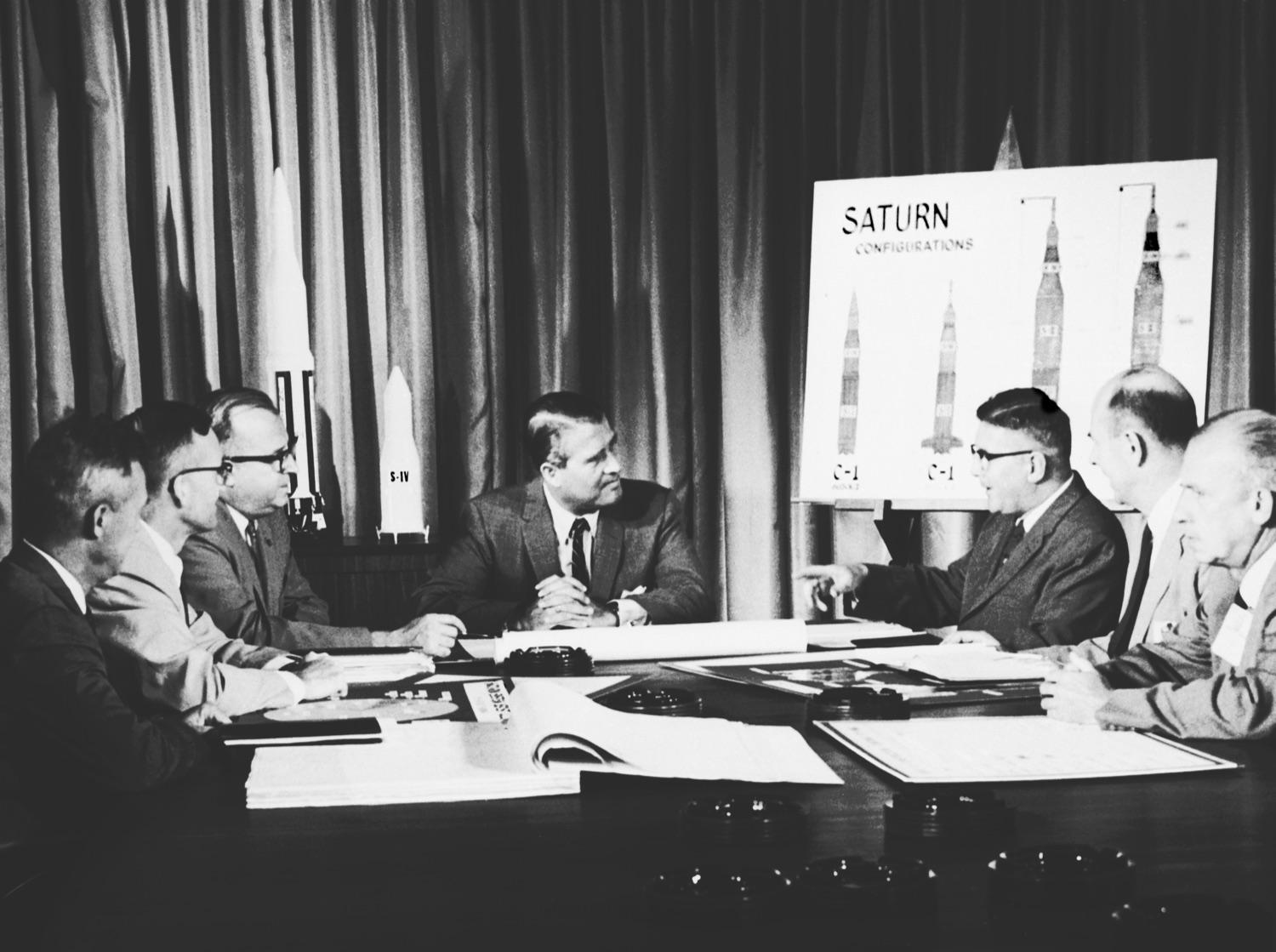
Saturn 500F rollout, Cape Kennedy, May 1966. Wernher von Braun and Kurt Debus attended — both had been V-2 engineers at Peenemünde twenty-five years earlier. NASA photograph, public domain.
Operation Paperclip
How the V-2 became the Saturn V
- Category
- State & Intelligence Operations
- Published
- Length
- 3,800 words · 18 min read
- Author
- The editors
Operation Paperclip
How the V-2 became the Saturn V.
The race for the rockets
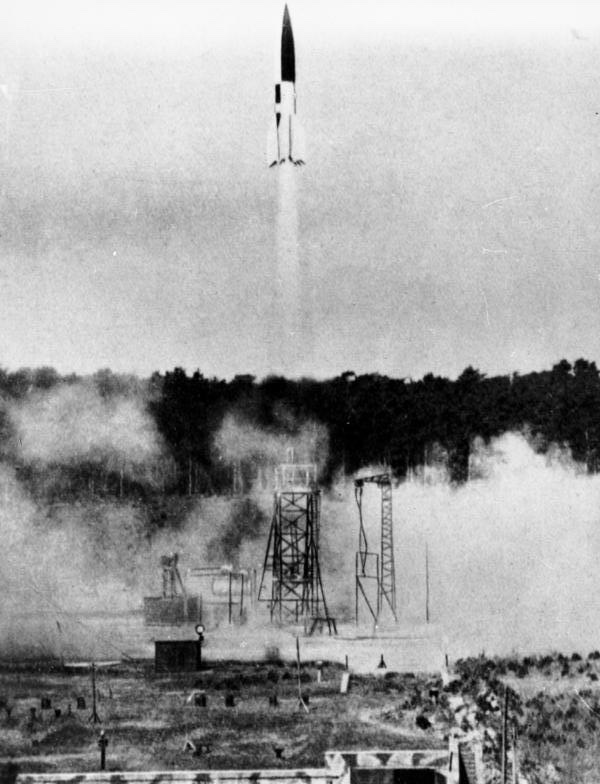
By the spring of 1945, the V-2 ballistic missile was the most advanced large rocket on Earth. Designed under Wernher von Braun at the Wehrmacht's rocket facility at Peenemünde on the Baltic coast, it was the first guided ballistic missile to deliver a one-ton warhead across continental distances. More than 3,000 had been launched against London, Antwerp, Liège, and other Allied cities in the war's final eight months. They killed approximately 9,000 civilians.
They had been built by slaves.
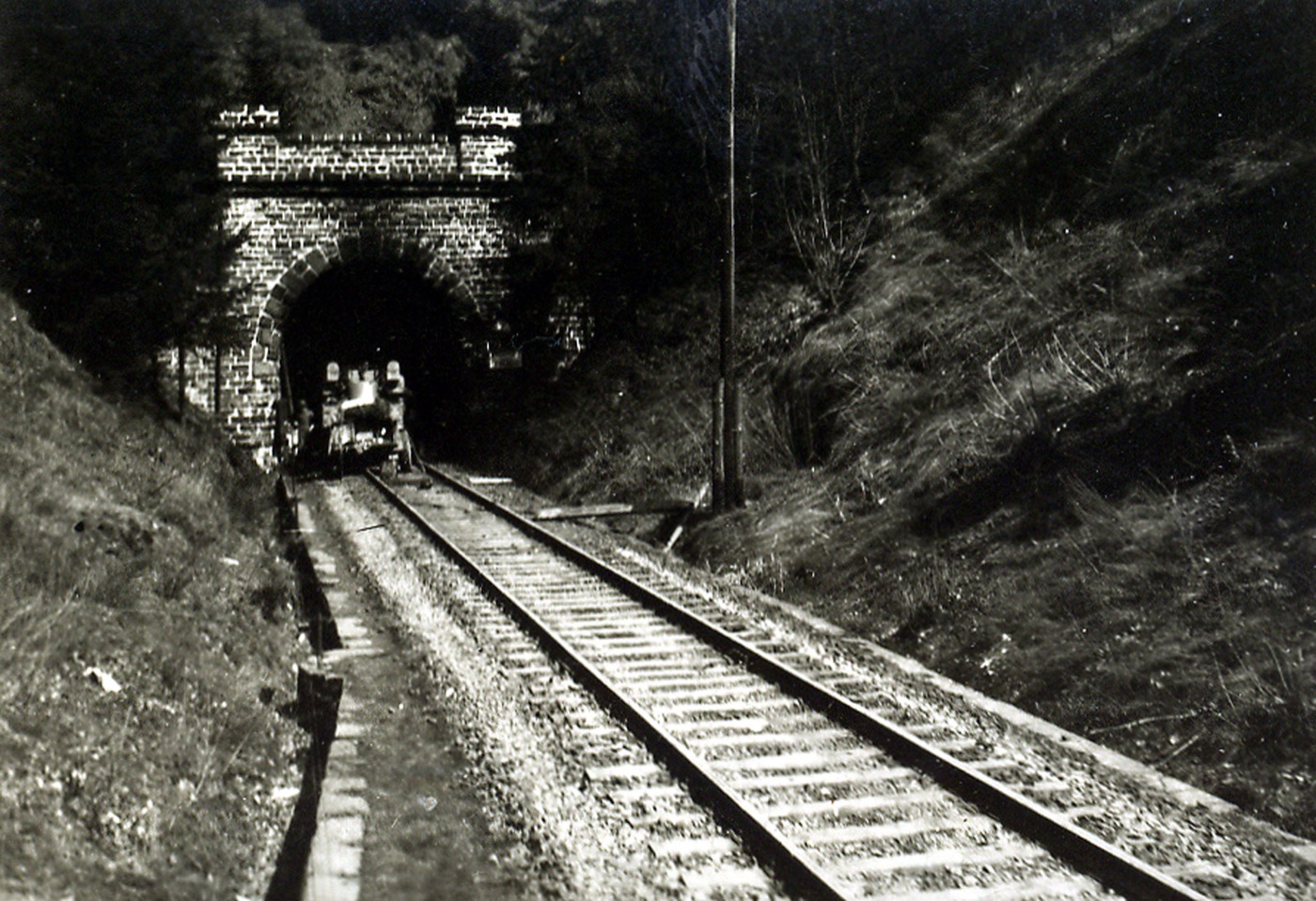
By 1945 the V-2 production line had been moved underground — to the Mittelwerk, a converted gypsum-mine tunnel complex in the Harz mountains near the city of Nordhausen. Mittelwerk was supplied with labour from the adjacent Mittelbau-Dora concentration camp. At any given time, the workforce was 12,000 to 15,000 prisoners drawn from across the Nazi camp system. By the time the U.S. Army reached Mittelwerk on April 11, 1945, an estimated 60,000 prisoners had been cycled through the facility, of whom approximately 20,000 had died: of starvation, of beatings, of typhus, of summary execution for "sabotage" (which often meant nothing more than the appearance of slackness).
That was substantially more than the V-2 had killed in flight.
The American intelligence officers who entered Mittelwerk in April 1945 understood two things very quickly. The first was that the V-2 was a technological achievement of strategic importance for the next war — which, with the Soviet Union now controlling half of Europe, many of them believed was coming. The second was that the V-2's engineers, including the most senior figures of the German rocket program, were within American reach.
The Soviet army was 110 kilometres east of Mittelwerk and closing.
Operation Overcast
The U.S. Army Ordnance Corps moved fast. Between May and August 1945, in an operation initially called Overcast, Army intelligence teams swept central Germany and Austria, identifying, interviewing, and selectively transporting German scientists they wished to extract before the Soviets could get to them.
Wernher von Braun surrendered to the U.S. 44th Infantry Division at Reutte, in Austrian Tyrol, on May 2, 1945. He had walked his brother and a small core of his Peenemünde leadership team across Bavaria, southward, in deliberate flight from the Soviet zone. According to the contemporaneous American intelligence report, von Braun introduced himself with the line: "We knew we'd been captured by the Americans because of the kindness."
He was thirty-three years old.
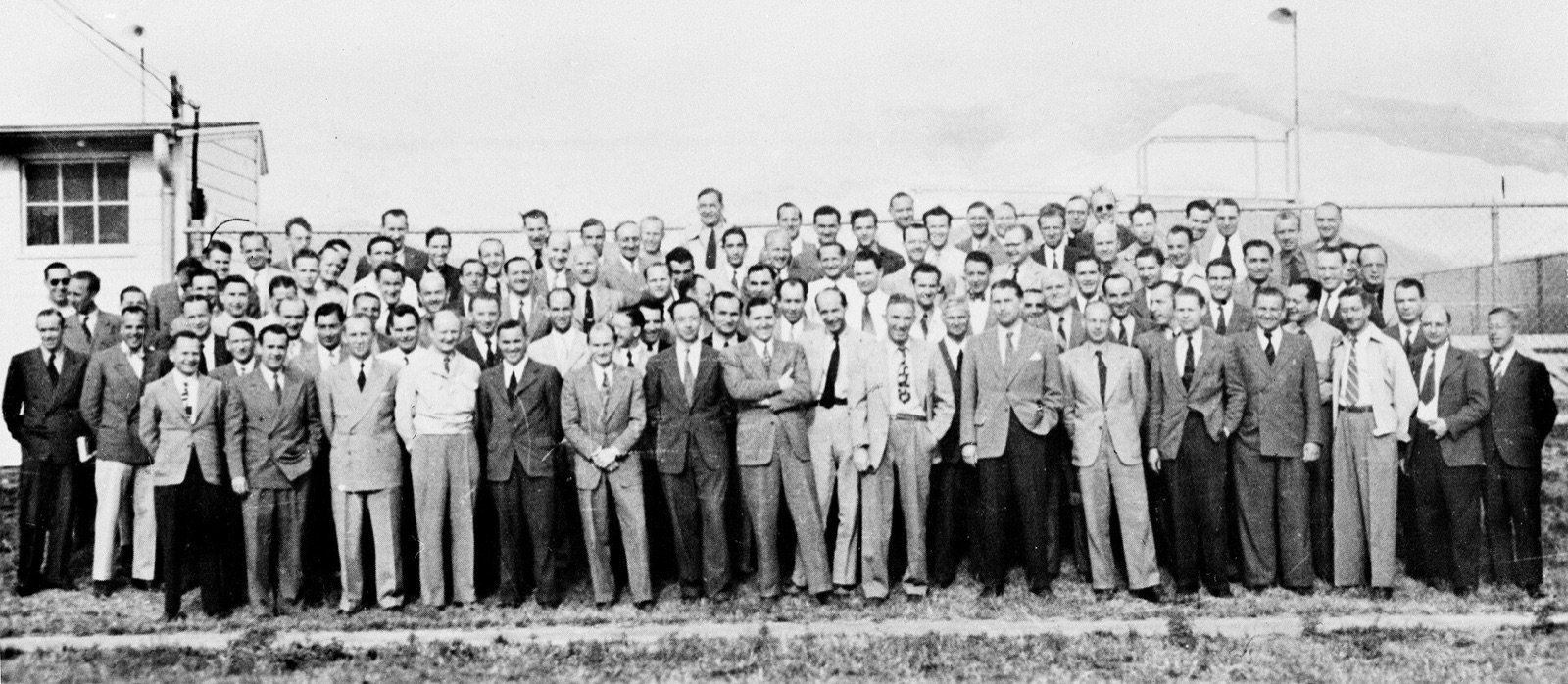
By August 1945, von Braun and 117 of his Peenemünde colleagues were under American military custody at Garmisch-Partenkirchen, awaiting transport. Their wives and children were detained in nearby villages. By September, the first group — von Braun himself, his brother Magnus, Walter Dornberger (the program's military director), and six others — was on a U.S. military aircraft to Fort Strong on Long Island, then onward to Fort Bliss, Texas, just outside El Paso.
The Army's plan was to use the imported engineers to reverse-engineer captured V-2s at White Sands Proving Ground in New Mexico. Within eighteen months the United States had its own V-2 launch program at White Sands, conducted by the same team that had built the originals.
The paperclip
In November 1945, the program was rechristened. The Joint Intelligence Objectives Agency (JIOA), a sub-committee of the Joint Chiefs of Staff, formally took over administration from the Army Ordnance Corps. Officers in JIOA's records section began attaching small paperclips to the personnel files of German specialists they wished to recruit to the United States — a discreet marker for the files of men whose political histories required additional handling before State Department clearance could be obtained.
The handling, when it occurred, was substantial.
The JIOA's standard procedure, documented by historian Linda Hunt in her 1991 book Secret Agenda and corroborated by Annie Jacobsen's 2014 Operation Paperclip, involved:
- Rewriting personnel summaries to omit Nazi Party membership.
- Reclassifying SS membership as "necessary for professional advancement" rather than ideological commitment.
- Substituting bland phrases ("not believed to be an active Nazi") for the more concrete language that had appeared in the original Army Counter-Intelligence Corps interviews.
- For the most problematic cases — those with documented connections to slave labour or to the medical experiments of the camps — the preferred handling was either to omit the information entirely or to characterize the subject as "indispensable."
In September 1946 President Truman, after months of internal debate between the State Department (largely opposed) and the War Department (strongly in favour), signed a secret directive formally approving Paperclip and authorizing the import of 1,000 German specialists under "temporary, limited military custody." That number eventually expanded, through various extensions, to more than 1,600.
The American public was not informed until 1950, when the New York Times reported on the program in a single page-twelve article. The slave-labour aspect of the V-2 production was not publicly known to American readers until the 1980s.
The first scandal that wasn't
The first public dissent came almost immediately. In December 1946, twenty-four prominent American scientists — including Albert Einstein — signed a public letter to President Truman protesting the "importation into this country, with the aid of the federal government, of a number of Nazi scientists."
The letter named no specific individuals. It did not allege specific crimes. It argued, as a matter of principle, that the United States should not be recruiting men whose professional achievements had been made in service to the Reich.
The letter was published. It generated a brief news cycle. It changed nothing.
The structural problem with Einstein's letter was that the Cold War had begun. The Soviet Union had detonated its first atomic bomb in August 1949. The Communist victory in China came in October. The Korean War began in June 1950. In the political environment those events created, the question of where America's rocket engineers had spent the war was no longer a question that the political system was prepared to ask out loud.
Von Braun, meanwhile, was making his name. He became a U.S. citizen in 1955. He published the influential Collier's magazine series on space exploration (1952–1954). He worked with Walt Disney on three Disneyland television specials (1955) that taught a generation of American children that space flight was an inevitable American destiny. The Soviet launch of Sputnik in October 1957 made his Army Ballistic Missile Agency at Huntsville — and the team of former Peenemünde engineers under his direction — suddenly the most politically important industrial unit in the United States.
In 1960, with the creation of NASA, the Huntsville team and its rocket-development infrastructure became NASA's Marshall Space Flight Center. Von Braun was named director. He held the post until 1970.
Arthur Rudolph and the limit of forgetting
Rudolph's case is what the system looks like when it does, eventually, break down.
Arthur Rudolph had been the production manager of the Mittelwerk V-2 line — directly responsible, in the operational sense, for the conditions under which 20,000 Dora-Mittelbau prisoners had died. In the Paperclip file delivered to the State Department in 1945, his role was characterized as that of an "industrial engineer" with no particular comments. He came to the United States. He worked at Fort Bliss, then at Redstone Arsenal, then at NASA Marshall. He served as the project manager for the Saturn V's first-stage F-1 engine — the rocket motor that lifted every Apollo mission off the ground.
By the late 1970s, the Office of Special Investigations within the U.S. Department of Justice, established by Congress in 1979 to identify and denaturalize Nazi war criminals living in the United States, had begun examining Paperclip recruits. Rudolph's name came up in 1982. The OSI confronted him with internal Mittelwerk documentation he had himself signed.
Rather than contest a denaturalization hearing, Rudolph signed an agreement in May 1984 in which the U.S. government agreed not to prosecute him in exchange for his renunciation of U.S. citizenship and voluntary departure from the country. He returned to Germany, where he died in 1996 at age 89.
The Rudolph case was the highest-profile Paperclip retroactive prosecution. It was also the only one of significance. The vast majority of the 1,600 Paperclip imports were never formally investigated by any U.S. body. By the time the institutional capacity to do so came into existence (with OSI in 1979), most were dead, retired, or politically untouchable.
What von Braun knew, and when
The von Braun question — what did he personally know about Mittelwerk's conditions, and when did he know it — has been the most contested factual element of the program for forty years.
The documentary record, as established by Michael Neufeld (Smithsonian Air & Space Museum), Annie Jacobsen, and Linda Hunt, is no longer seriously ambiguous. Von Braun:
- Was an SS member at the rank of Sturmbannführer (Major) by 1943.
- Visited Mittelwerk at least nine times between 1943 and 1945.
- Wrote a memo on August 15, 1944, in which he described having personally selected prisoners from Buchenwald for transfer to Dora-Mittelbau, on the basis of skill requirements he had identified.
- Chaired a staff meeting on August 25, 1944, that recommended expanded use of prisoner labour in V-2 production.
- Was, by his own later acknowledgement, present at Dora when prisoners were being hanged for sabotage.
What is contested is the moral interpretation of these facts. Von Braun himself, in interviews from the 1960s and 1970s, characterized his SS rank as a professional formality and his Mittelwerk visits as limited to "rocket engineering." His defenders — most notably his authorized biographer Erik Bergaust (1976) — argued that von Braun faced a choice between cooperation and arrest, and that within the operational constraints of late-war Germany he did the minimum necessary to keep his program operating.
His critics — Tom Lehrer's 1965 song "Wernher von Braun" being the most-quoted example — characterize this as moral cowardice asynchronously rebranded as patriotism. ("'Once the rockets are up, who cares where they come down? That's not my department,' says Wernher von Braun.")
The Tom Lehrer position has, on the whole, become the consensus position of professional historians. The American institutional position has continued to be a softer version of the von Braun defenders' position: that the scientific value justified the import, that any individual's specific responsibility was difficult to establish in 1945, and that the program's documented post-war contributions to American science outweighed the moral cost.
That is the position the United States has held for eighty years. It is also the position that, in the words of historian Michael Neufeld, "contains everything that is wrong with the American postwar moral imagination."
What proponents and critics still argue
The factual record of Operation Paperclip is closed. The interpretive questions remain.
The "necessity" argument. The Cold War created an environment in which the United States could either acquire Germany's rocket expertise or watch the Soviet Union acquire it. By that frame, the question is not whether to bring von Braun, but whether to bring von Braun or accept the Soviet Union getting him. That counterfactual is unfalsifiable. What is established is that the Soviet program (with substantially less of the Peenemünde leadership) did still reach Sputnik first in 1957 — suggesting that the marginal advantage American Paperclip recruits provided over what the Soviets achieved without them is smaller than the program's defenders argued.
The "individual responsibility" argument. Many of the 1,600 had been Wehrmacht engineers or low-level scientific personnel whose individual contribution to Nazi war crimes was minimal. To assess the program by reference to its most morally compromised participants (von Braun, Rudolph, Strughold) is to caricature the broader cohort. This is partly fair. It does not, however, address the question of why JIOA's systematic file-cleaning was thought necessary at all if the bulk of recruits had nothing to hide.
The "long shadow" argument. Some critics have argued that the moral compromises of Paperclip set institutional precedents that manifested later in MK-Ultra, in the Operation Sunshine plutonium experiments on humans, and in other domestic abuses of the early Cold War period. The empirical link is hard to draw cleanly, but the cultural link — that the U.S. government got comfortable, in 1945–1959, with the idea that scientific value justified investigatory exemption — is harder to dismiss.
How we read the evidence
Operation Paperclip is the foundational case for thinking about how the postwar American national security state organized its priorities. It established, at very high official levels, the principle that the ends of strategic competition justified means of moral falsification — that JIOA officers could and would falsify personnel records in service of recruitment, and that no internal mechanism existed to overrule them. That principle, once established, did not remain confined to the recruitment of German scientists. It propagated through the CIA's covert operations program (MK-Ultra, Operations Mongoose and Northwoods), through FBI domestic intelligence (COINTELPRO), and through Iran-Contra in the 1980s.
Paperclip is therefore not, in the strictly journalistic sense, the biggest of the Cold War conspiracies we have written about. It is the first of them, and the one that established the institutional playbook the others would refer back to.
What the Saturn V represents, by that reading, is not a triumph of the postwar American scientific imagination. It is an artefact of the deal the United States made in 1945, and a reminder that the rocket that put Neil Armstrong on the Moon was built — in significant part — by men whose professional debt had not been settled.
Key figures
Further reading
Books:
- Annie Jacobsen, Operation Paperclip: The Secret Intelligence Program that Brought Nazi Scientists to America (Little, Brown, 2014).
- Linda Hunt, Secret Agenda: The United States Government, Nazi Scientists, and Project Paperclip, 1945-1990 (St. Martin's Press, 1991).
- Michael J. Neufeld, Von Braun: Dreamer of Space, Engineer of War (Knopf, 2007).
- Michael J. Neufeld, The Rocket and the Reich: Peenemünde and the Coming of the Ballistic Missile Era (Free Press, 1995).
- Tom Bower, The Paperclip Conspiracy: The Battle for the Spoils and Secrets of Nazi Germany (Michael Joseph, 1987).
Films and documentaries:
- Chasing the Moon (2019, dir. Robert Stone). PBS American Experience; covers Paperclip background.
- The Devil and Wernher von Braun (2019, dir. Pierre-Henri Gibert). French documentary.
- Dr. Strangelove (1964, dir. Stanley Kubrick). The title character is widely understood as von Braun satire.
Primary archives:
- National Archives — JIOA files
- Smithsonian Air and Space Museum — Von Braun Papers
- Marshall Space Flight Center History — NASA
Sources
Primary sources
- Joint Intelligence Objectives Agency. Paperclip personnel files, 1945–1959. Declassified through OSI investigations and FOIA litigation.
- U.S. Army Counter Intelligence Corps. Interrogation reports of German scientists, 1945–1947.
- President Truman. Secret directive of September 3, 1946 authorizing expanded Paperclip recruitment.
- Office of Special Investigations. Rudolph denaturalization file, 1982–1984.
Secondary sources
- Jacobsen, A. (2014). Operation Paperclip. Little, Brown.
- Hunt, L. (1991). Secret Agenda. St. Martin's Press.
- Neufeld, M. J. (2007). Von Braun: Dreamer of Space, Engineer of War. Knopf.
- Neufeld, M. J. (1995). The Rocket and the Reich. Free Press.
- Bower, T. (1987). The Paperclip Conspiracy. Michael Joseph.
- Bergaust, E. (1976). Wernher von Braun: The Authoritative and Definitive Biographical Profile. National Space Institute.
- The New York Times, December 1946 — Einstein letter coverage.
- PBS American Experience. "Wernher von Braun and the Nazis." 2019.
- Slate, August 2023. "The Nazis in the Space Program." Eric Berger.
Academic sources
- Lasby, C. G. (1971). Project Paperclip: German Scientists and the Cold War. Atheneum.
- Mick, C. (2008). "Engineering the Reich: V-2 Production at Mittelwerk and the Question of Engineering Ethics." Engineering Studies, 1(2), 99-122.
Corrections & updates
(None yet.)
Inspired this / based on it
Annie Jacobsen
The definitive popular history
Linda Hunt
The first investigative book to use declassified files
J. Lee Thompson · ★ 6.1
Hagiographic von Braun biopic released while he was alive. Curt Jürgens as von Braun.
Stanley Kubrick · ★ 8.4
The title character is widely understood as von Braun satire — Peter Sellers in his most political performance
Pierre-Henri Gibert
French documentary; the Paperclip past, NASA cover-up
Robert Stone
PBS American Experience; episode 1 covers Paperclip background
Filed under
- #operation-paperclip
- #von-braun
- #nasa
- #v-2
- #saturn-v
- #mittelwerk
- #dora
- #ss
- #jioa
- #huntsville
- #1940s
- #1950s
- #usa
- #germany
- #declassified
Click any tag for every article carrying it.
Continue reading
MK-Ultra
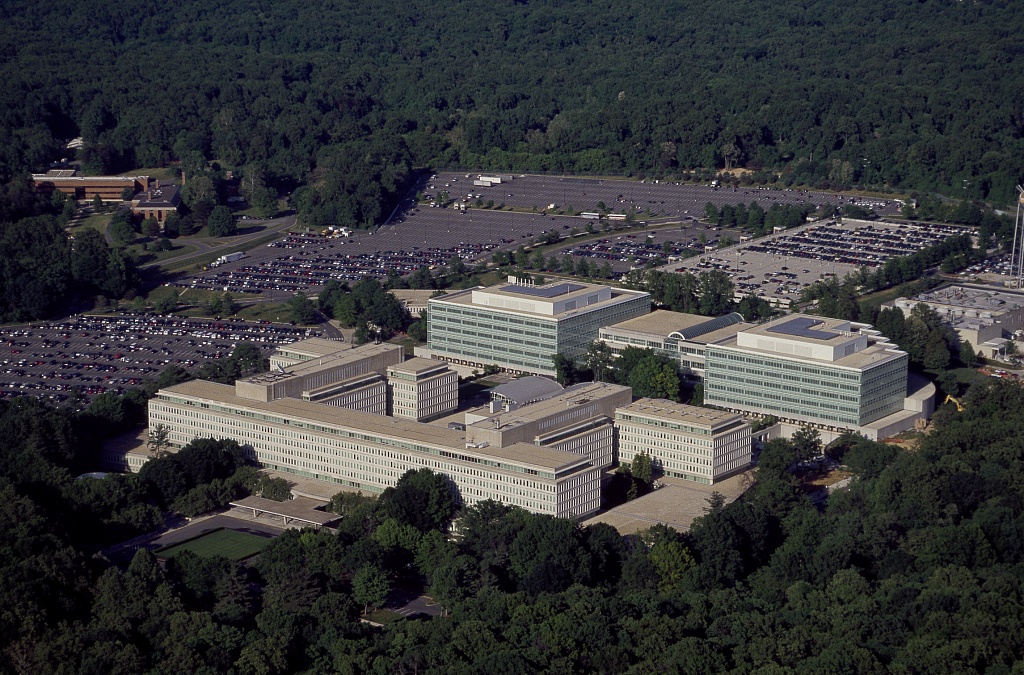
Between 1953 and 1973, the Central Intelligence Agency ran one of the most ambitious — and least restrained — human-experimentation programs in American history. The goal was mind control. The subjects rarely knew they were subjects. By the time the public found out, most of the records had been burned.

Operation Northwoods
In March 1962, the Joint Chiefs of Staff put a document on Robert McNamara's desk. It proposed a series of false-flag attacks against the United States — sunk ships, civilian terror campaigns in Miami and Washington, a faked civilian airliner shoot-down — to manufacture public support for invading Cuba. Every member of the Joint Chiefs signed it. Kennedy rejected it within days. The document stayed buried for thirty-five years.
COINTELPRO
Between 1956 and 1971, the Federal Bureau of Investigation ran a counter-intelligence program against Americans. Not foreign agents — Americans. The targets were Martin Luther King Jr., Malcolm X, the Black Panther Party, the American Indian Movement, the Students for a Democratic Society, the Communist Party, the Ku Klux Klan, and dozens of others. The methods included blackmail, forged letters, planted informants, and — in at least one documented case — collaboration in a killing. The program stayed secret until eight people walked into an FBI office in Pennsylvania on the night of a heavyweight title fight.